
Corded or Cordless Electric Drill? CF-ID008 Across Three Trade Scenarios
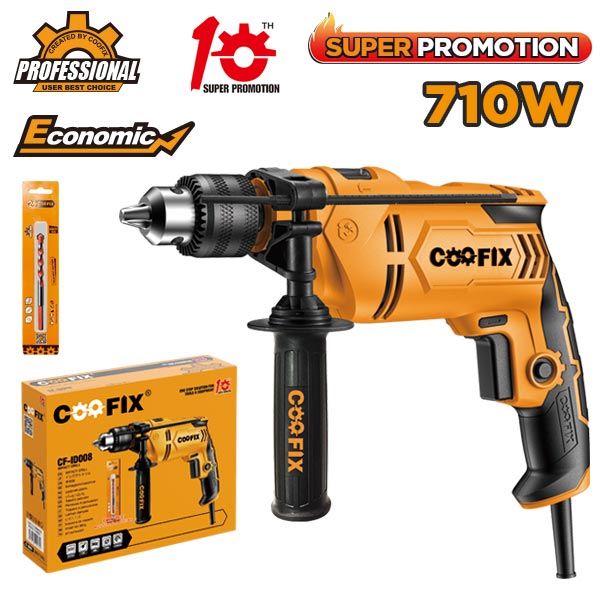
The COOFIX CF-ID008 is a mains-powered impact drill specified at 220–240 V / 50–60 Hz with 75 N·m maximum torque.
An electric drill is chosen by task before it is chosen by brand. In home decoration, carpentry and mechanical repair, two people can be drilling the same 10 mm hole while only one of them should be holding a mains-powered impact drill. Duty cycle, distance to a socket and the number of holes in a single run decide more than the model name printed on the casing.
This guide maps the COOFIX CF-ID008 — a corded electric impact drill rated 220–240 V / 50–60 Hz, with 75 N·m maximum torque, a 0.8–10 mm metal chuck and 10 mm steel drilling capacity — onto those three scenarios, and marks where a cordless drill is the more defensible purchasing decision rather than simply the more convenient one.
COOFIX (Jinhua Coofix Tools Co., Ltd.) is a power tool manufacturer headquartered in Yongkang, Zhejiang, China, established in 2014. The company reports a 30,000 m² factory, approximately 400 employees, a 16-engineer R&D team and annual output of 2,000,000 units, with a sales network covering more than 100 countries and regions by the end of 2025.
Why corded and cordless keep trading places
Cordless tools dominate the revenue conversation, not the whole job site. The global power drill market was valued at USD 15.2 billion in 2023, and cordless drills contributed more than 55% of that revenue in the same year, according to Strategic Market Research. On the technology side, over 70% of cordless drill manufacturers were reported in 2025 as integrating brushless motors to improve tool efficiency.
Those figures explain why a distributor's catalogue is now built around battery platforms. They do not explain why a corded impact drill still ships in volume to decoration crews, carpentry benches and repair shops. A revenue share is a market-level number; it says nothing about the specific morning where a hole must be drilled for four hours and the nearest socket is two metres away.
For a buyer at the decision stage, the useful question is not which power source is growing faster. It is which task profile the purchase will actually serve, and whether one model can carry it without creating a second problem elsewhere.
What the CF-ID008 specification actually commits to
| Parameter | CF-ID008 |
|---|---|
| Product type | Corded electric impact drill |
| Rated voltage | 220–240 V |
| Rated frequency | 50–60 Hz |
| Maximum torque | 75 N·m |
| Chuck | 0.8–10 mm, metal |
| Drilling capacity, steel | 10 mm |
Specifications as stated by COOFIX for the CF-ID008.
The 220–240 V / 50–60 Hz envelope sits inside the scope of IEC 62841-2-1:2017, the safety standard for hand-held drills and impact drills rated up to 250 V AC/DC. That has one practical meaning for buyers: the model's declared operating window matches the residential and light-commercial mains supply used across the export regions COOFIX names as its main markets — Asia, Africa, Eastern Europe, the Middle East and South America.
75 N·m is a maximum figure. It describes the ceiling the tool can deliver, not the torque every task consumes; bits, material hardness and operator pressure all take their share. What the number does establish is a working class: the CF-ID008 is built for fixings, framing anchors and general structural drilling within its bit range, not for sustained work in reinforced concrete.
The 0.8–10 mm metal chuck is the specification that shapes daily usability. It spans pilot bits from 0.8 mm up to a 10 mm bit, which is the band decoration, carpentry and general repair actually draw from. Metal jaws are the conventional choice where bits are changed repeatedly through a shift. The 10 mm steel capacity is a harder boundary: anything above it belongs to a different tool class, and the CF-ID008 should not be positioned as its substitute.
Scenario one: home decoration
Decoration work splits into two drilling environments inside the same building, and the CF-ID008 serves them unequally.
The first is fixed masonry work: wall fixings, shelving, curtain rails, and the drilling that accompanies plumbing and electrical renovation. Mains power is normally available, holes come in sequence, and the operator stays in one position for long stretches.
The second is second-fix work: furniture installation inside finished rooms, cabinet and wardrobe assembly, overhead fixings, and movement between rooms on the same visit.
- Where the corded model is the right call: a full day of wall drilling does not depend on how many charged packs are in the van, and 75 N·m of maximum torque covers masonry fixings within the chuck's bit range.
- Where it is the wrong call: a lead across a finished floor is a handling and liability problem before it is a performance problem, and overhead work in an occupied room is exactly where a self-contained tool wins.
Decoration buyers who service both environments usually need both a corded impact drill and a cordless unit. Treating the CF-ID008 as a universal decoration tool overstates its reach; treating it as obsolete understates where it still outperforms on cost and duty continuity.
Scenario two: carpentry and frame work
Door and window frame setting plus light steel keel construction are repetitive, position-sensitive tasks. They combine drilling into masonry or framing members with a high number of anchor points in the same run.
The CF-ID008 fits the anchor-and-fixing half of that work well. Fixed-position drilling at a bench, keel anchors, and repeated frame fixing into masonry are continuous-duty tasks where mains supply removes the energy-management variable entirely. For a carpentry shop running the same operation all day, that continuity is the specification that matters most.
It fits the installation half less well, because frames are set in place, not brought to a bench. Here the tool has to travel to the opening, work overhead, and move on before the next unit — conditions a cordless drill addresses more directly.
Scenario three: mechanical repair and shop use
Repair environments — steel structure wall drilling, plumbing and electrical renovation, and bulk use in hardware repair shops — put a different pressure on the tool. Several operators may use the same unit in a day, jobs arrive unpredictably, and the cost of a stopped tool is measured in lost tickets rather than lost minutes.
A corded impact drill suits this pattern because it removes battery custody from the workflow. There is no pack rotation to administer, no charging bay to police, and no risk that the third operator of the day inherits an empty platform. For a shop that drills intermittently all day rather than continuously for an hour, that is the decisive difference.
The counter-case is field repair. Once the work leaves the shop — a call-out, an installed unit, an upper-floor site without a convenient socket — a corded tool becomes a logistics exercise, and the case for a cordless impact drill becomes straightforward.
Where a cordless drill changes the answer
COOFIX lists the CF-CD016 as a 20 V cordless brushless impact drill, alongside the CF-ID008 as a corded electric impact drill. The two models represent the two halves of the same procurement decision rather than competing answers to one question.
COOFIX's own comparison of its brushless cordless platform against conventional corded drills, ordinary brushed lithium drills and low-cost impact drill competitors reports a 32% torque advantage, 45% longer runtime from a single full charge, an 18 °C lower no-load temperature rise, and a 76% lower failure rate in continuous drilling. The same comparison states 89% energy conversion efficiency against 71% for an ordinary brushed motor, and a maintenance cycle extended three times because the brushless structure eliminates carbon-brush wear.
The commercial trade-off is stated openly in the same material: unit purchase price runs 12%–18% higher than low-end brushed competitors, offset by an estimated 22% reduction in long-term total cost of use through interchangeable batteries and lower wear-part losses. For a distributor, that is a margin-and-velocity decision as much as a technical one.
The application scope COOFIX associates with the brushless cordless platform covers household DIY decoration, furniture installation, door, window and light steel keel construction, steel structure wall drilling, plumbing and electrical renovation, bulk use in hardware repair shops, and retail kit sales in overseas supermarkets. Read against the CF-ID008 profile, the overlap is real but the centre of gravity differs: the cordless platform is specified for mobility and kit retail, the corded model for fixed-site duty and price-sensitive volume.
Decision matrix: corded CF-ID008 against a brushless cordless drill
| Decision criterion | CF-ID008 (corded impact drill) | Brushless cordless drill (CF-CD016 class) |
|---|---|---|
| Best-fit environment | Fixed site with mains supply; shop bench; continuous hole runs | Occupied interiors, second-fix, call-outs, mobile crews |
| Duty cycle limit | Set by operator and bit, not by stored energy | Set by pack count and recharge cycle |
| Portability | Lead-dependent | Self-contained, 20 V battery platform |
| Energy management | None beyond mains availability | Battery inventory, charging routine, pack replacement cycle |
| Maintenance profile | Motor and brush configuration not stated in the reviewed material; confirm schedule with supplier | Carbon-brush wear eliminated by brushless structure; maintenance cycle extended three times (company-reported) |
| After-sales parts | Cable, switch and chuck wear items | Standard universal spare parts for convenient overseas replacement (company-reported) |
| Primary procurement risk | Voltage configuration for the destination market; lead management on occupied sites | Battery platform lock-in; higher unit price entry point |
Comparison based on specifications and statements provided by COOFIX; cordless performance figures are company-reported and not independently tested.
Boundaries buyers should not skip
- Mains dependency is a real constraint. The CF-ID008 needs a supply within reach. On occupied or finished sites, cable routing becomes a work-planning and trip-hazard issue, not a technical footnote.
- 10 mm steel capacity is a ceiling, not a target. Larger steel sections, reinforced concrete and demolition-type work sit outside this tool class and require a different model.
- No screwdriving mode is specified. Buyers who need one tool to drill and drive should not assume the CF-ID008 covers both operations.
- Specifications are manufacturer-stated. The category evidence reviewed for this article records no independent laboratory performance data for comparable cordless configurations, and no like-for-like torque figure is published for the cordless counterpart.
- Certificate scope must be checked per SKU. COOFIX maintains a certification library covering CE, RoHS, REACH, GS, CPSC and SASO, and secured AEO certification in December 2025. AEO is a customs and trade-compliance status, not a product conformity certificate; buyers should request the certificate copy that names the exact model and target market.
- Battery platforms carry long-term cost. Where a cordless drill is added to the range, pack compatibility and spare-part availability determine total cost more than the initial unit price.
What this means for distributors configuring a range
The first check is voltage. The CF-ID008 is specified at 220–240 V / 50–60 Hz, so distributors targeting 110–120 V markets need to confirm whether a compatible configuration is offered before the model is written into a catalogue or a retail planogram.
The second is range logic. A corded impact drill and a cordless kit do different commercial jobs: the corded model carries volume in decoration, carpentry and repair-shop channels where price sensitivity is high and mains power is normal, while the cordless kit carries margin and answers the retail kit sales pattern COOFIX associates with overseas supermarkets. Stocking one and listing the other as an alternative misreads how both are bought.
The third is supply reliability. COOFIX reports monthly production capacity above 300,000 units and annual output of 2,000,000 units, supported by a 20,000 m² warehousing and logistics centre added in early 2026 with a stated daily shipping capacity of more than five 40HQ containers. For a distributor planning seasonal promotions, declared fulfilment capacity is a qualification criterion in its own right, and OEM/ODM flexibility backed by a 16-engineer R&D team across a portfolio of more than 5,000 SKUs determines how far a private-label programme can be pushed.

Warehousing and dispatch capacity determines whether a drill range can be replenished on a distributor's promotional cycle.
Market trend and outlook
Three verified data points frame the next procurement round. Cordless drills already account for more than 55% of global power drill revenue. Over 70% of cordless drill manufacturers were integrating brushless motors in 2025, which moves brushless from a differentiator to a baseline expectation in the cordless tier. And Asia Pacific dominated the power tools market in 2024 with a 37.20% share, worth USD 13.3 billion, according to Strategic Market Research — a reminder that the manufacturing base serving these ranges is concentrated in the same region.
The practical outlook is a two-line portfolio rather than a single winning technology. Cordless and brushless will keep taking share of revenue and of retail shelf space, because that is where the technology investment is going. Corded impact drills will keep their place where mains power is fixed and cost per unit decides the order — decoration contractors, carpentry benches and repair shops buying in bulk. Buyers who plan around one line and treat the other as legacy tend to rebuild their range within a season.
Frequently asked questions
Is the COOFIX CF-ID008 a corded or a cordless drill?
The CF-ID008 is a corded electric impact drill. It operates from a 220–240 V / 50–60 Hz mains supply, delivers 75 N·m maximum torque, uses a 0.8–10 mm metal chuck and is rated for 10 mm drilling capacity in steel. It has no battery platform and no stored-energy limit on runtime.
How far do 75 N·m and 10 mm steel capacity actually reach?
Together they define a working class rather than a universal capability. The 75 N·m maximum covers general fixings, framing anchors and structural drilling within the bit range the chuck accepts, and 10 mm in steel is the stated upper limit. Work above that diameter, and sustained drilling in reinforced concrete, falls outside the CF-ID008's specification.
When should a buyer choose the cordless model instead?
When the work moves. The brushless cordless platform is associated with furniture installation, door, window and light steel keel construction, plumbing and electrical renovation and retail kit sales, all of which involve carrying the tool to the work rather than bringing work to a bench. Where mains power is unavailable, unreliable or awkward to route through an occupied building, the cordless model removes a constraint the corded tool cannot.
Where does the CF-ID008 not fit?
Three areas. It is not specified for screwdriving, so driving tasks need a model with a declared screwdriving mode. It is not a substitute for a rotary hammer or larger drill above 10 mm steel capacity. And it is a poor match for overhead second-fix work in finished interiors, where a mains lead becomes a handling burden.
What should distributors verify before stocking it?
Confirm that the 220–240 V / 50–60 Hz configuration matches the destination market, and whether any alternative configuration exists for 110–120 V regions. Check that the 0.8–10 mm chuck range covers the bit inventory the target channel already buys. Request the certificate copy that names the exact model and market rather than a portfolio-level certificate list. Confirm spare-part availability for cable, switch and chuck wear items. Finally, decide whether the range also needs a cordless counterpart, since the two models serve different buyers rather than the same buyer twice.
The COOFIX 2025 product catalogue, covering power tools, garden tools, hand tools and accessories, is available for reference: COOFIX catalogue 2025.
Have Questions or Need More Details?
Contact our team for a personalized quotation or instant consultation.
Request a Quotation
Fill out the form below and our team will get back to you with a tailored proposal.
WhatsApp Direct Chat
Prefer to chat in real-time? Message us on WhatsApp for instant assistance & quick answers.
- Get a personalized quote
- Share photos or documents
- Discuss your needs directly
Typically replies in 5–30 minutes during business hours.