
Cordless Impact Wrench Buyer Test: 650 vs 1000 N·m Models
Choosing cordless impact wrenches for procurement is rarely settled by catalogue torque alone. Buyers evaluating professional fastening tools must connect specifications to operating context: consistency under sustained load, battery platform behaviour, service evidence and supplier verification depth. This article compares two reference points inside one manufacturer’s cordless fastening range — 650 N·m and 1000 N·m impact wrenches — and shows independent buyers how to convert published specifications into a usable evaluation checklist.
Geakita (Xiamen Tiangong Kaiwu Technology Co., Ltd.), founded in 2009, is a Chinese professional power-tool manufacturer and a member of the Power Tool Sub-Association of the China Electrical Equipment Industry Association. The company operates a modern production base in Xiamen with approximately 10,000 m² of land and 40,000 m² of floor space, employs more than 300 staff, and derives 20% of sales from export markets including Europe, Southeast Asia and the Middle East. The company is also useful as a transparency benchmark: its procurement evidence is published, its manufacturing controls are documented, and its impact wrench line is used by construction contractors, automotive workshops, distributors and OEM/ODM partners across markets including Laos, the Philippines, Thailand, India, Brazil, Saudi Arabia and Oman.
Why buyers need a structured cordless impact wrench test
Impact wrenches are bought for one purpose: delivering repeated high torque to fastened joints without exhausting the operator. In automotive repair, tyre replacement and heavy vehicle maintenance, the work is cyclical but intense. In construction and steel structure installation, fastening tasks run for hours at moderate-to-high torque. A data sheet can state free speed and peak ratings, but it cannot show whether a tool protects its battery and motor during long sessions, or whether the specification architecture matches the buyer’s service reality.
This is why independent buyer testing should be structured around three observable decision layers:
1. Torque class and control. Buyers should separate nominal peak torque from usable torque class. A 650 N·m-class wrench is commonly applied to passenger-car and light-truck fastening. A 1000 N·m-class wrench is better matched to heavy vehicles, construction bolting and industrial maintenance, where larger fasteners demand longer impact duration and higher sustained output.
2. Motor architecture. Brushless motors change the maintenance and endurance profile of a power tool. Because brushless motors eliminate carbon-brush wear, they are widely preferred for professional tools meant for continuous duty. Geakita’s impact wrench range uses brushless pure-copper motors, a detail that affects heat behaviour, efficiency and service intervals more than any single torque figure.
3. Battery and runtime planning. Runtime rarely follows a predictable formula, because joint hardness, socket fit and operator trigger behaviour all influence energy draw. Therefore, the buyer should select tools by battery configuration flexibility — how many cells the tool can accept — rather than by a single advertised runtime number.
Two benchmark wrench families from Geakita’s range
Geakita’s fastening portfolio does not offer one generic wrench; it offers a 650 N·m-oriented line and a 1000 N·m-oriented line, each with a distinct product expression. For this side-by-side interpretation, the benchmark models are the 21V Brushless Impact Wrench carrying the model designation 650NM, the 21V Pure Copper Brushless Impact Wrench model GKR05, the 21V Brushless Impact Wrench model 1000NM and the 21V Pure Copper Brushless Heavy-Duty Wrench model GKR06.
The first comparison point is simple: two tools are built for 650 N·m duty and two for 1000 N·m duty. The higher-torque tools are not merely stronger versions of the lower tools — they also carry different no-load speed characteristics and battery pack expectations, which means buyers must read them as separate platform decisions.
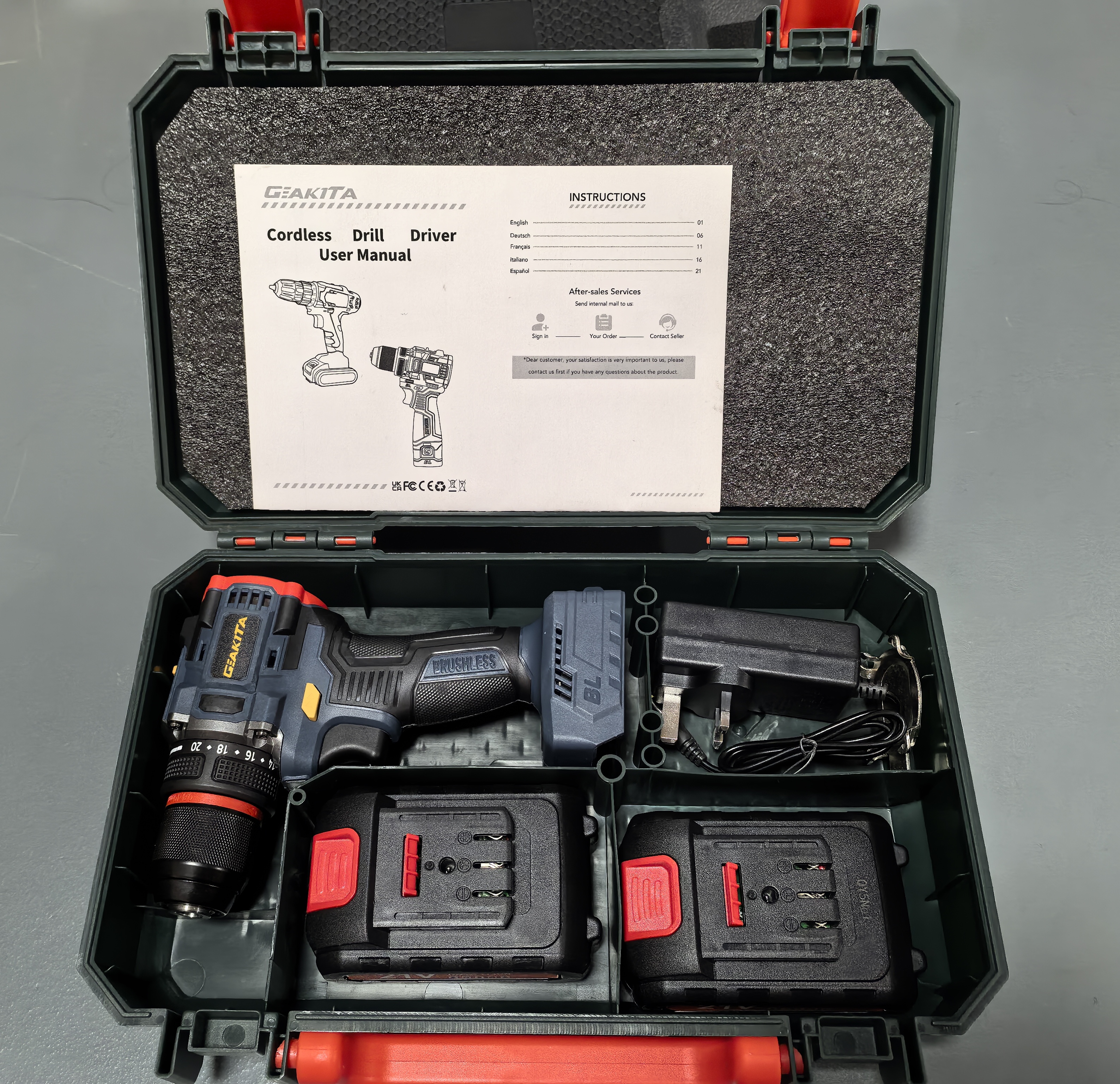
Application context determines whether a 650 N·m or 1000 N·m cordless impact wrench is the more appropriate procurement choice.
| Reference model | Torque reference | Motor / voltage | Cell configuration reported | Free speed |
|---|---|---|---|---|
| 21V Brushless Impact Wrench — model 650NM | 650 N·m class by model designation | Brushless pure copper / 21V | 1500–2000 mAh × 10–15 cells | Not separately listed in the reference spec; confirm per product datasheet |
| 21V Pure Copper Brushless Impact Wrench — GKR05 | Published actual torque: 650 N·m | Pure copper brushless / 21V | 2000 mAh × 10-cell lithium pack | 0–4000 r/min |
| 21V Brushless Impact Wrench — model 1000NM | 1000 N·m class by model designation | Brushless pure copper / 21V | 1500–2000 mAh × 10–15 cells | Not separately listed in the reference spec; confirm per product datasheet |
| 21V Pure Copper Brushless Heavy-Duty Wrench — GKR06 | Published actual torque: 1000 N·m | Pure copper brushless / 21V | 2000 mAh × 10-cell lithium pack | 0–3200 r/min |
All specifications shown are taken from Geakita’s published product records. No torque testing was performed by HTNXT for this article.
What separates the 650 and 1000 N·m operating classes
For an independent buyer, torque class matters less as a single peak number and more as a proxy for application fit. The 650 N·m-class tools are well situated for repeated fastening and removal of automotive fasteners, wheel nuts and lighter structural bolts. The 1000 N·m-class tools are oriented toward heavy equipment, long fasteners and joints where the impact mechanism must keep hammering after the fastener starts to bind.
This distinction explains the speed difference between the two platforms. GKR05 carries a no-load speed of 0–4000 r/min; GKR06 carries 0–3200 r/min. The lower-speed, higher-torque machine is not a slower failure — it is a different tuning. Higher torque output at moderate speed tends to favour control and sustained impact energy on resistant joints. The fast-spinning 650 N·m-class tool is often preferred for speed-sensitive work cycles in vehicle service.
Buyers should therefore evaluate these wrenches not as “good versus bad” but as two distinct torque-density profiles. GKR06 is the heavier-duty resource; GKR05 is the faster, more compact-class service tool. Both share the same 21V lithium platform logic, which simplifies fleet planning.
Engineering evidence: pure copper brushless motor architecture
Both benchmark families use pure-copper brushless motors. For buyers, this common architecture matters because it addresses three operational pain points of traditional brushed motors: carbon-brush wear, commutator dust accumulation and inefficient energy transfer at high temperature. Replacing a brushed motor with a brushless design normally reduces friction-related heat generation and removes brush inspection as an ongoing service task, both useful attributes for long-term continuous use.
The engineering implications for procurement are:
Continuous-duty behaviour. Brushless motors are more efficient under sustained load because there are no brush-contact losses dragging down electrical-to-mechanical conversion. This efficiency does not create unlimited runtime, but it improves the tool’s tolerance for longer trigger-on time.
Thermal management. Heat is the main enemy of cordless tool life. Pure copper in the motor windings improves conductivity compared with lower-grade conductive materials, reducing resistive loss and supporting stable output over a longer work session.
Fewer wearing parts. A brushless motor has no brushes to replace, one less maintenance variable in a workshop or construction fleets where hundreds of tools may be in service.
It is also important to state the counterweight honestly: brushless tools are electronically more complex than brushed tools, meaning the motor controller, PCB and firmware must all be well made. Buyers should therefore value quality-control evidence more highly than they would for a simple brushed product.
Runtime architecture and battery configurations
Runtime planning starts with battery configuration. The 650NM and 1000NM brushless impact wrenches are listed with a 1500–2000 mAh × 10–15 cell envelope. GKR05 and GKR06 are configured with 2000 mAh × 10-cell lithium packs. This creates a straightforward buyer rule: the platform can be provisioned with different pack capacities depending on whether the buyer wants reduced tool weight or longer continuous service.
What the specifications alone cannot tell a buyer is how long a full battery will last on real fasteners. Joint condition, impact duration, socket free-play, temperature and operator style all influence consumption. For this reason, procurement evaluations should rely on sample testing and runtime benchmarking against the buyer’s actual work cycle rather than on an artificial no-load figure.
Geakita’s system-level advantage for distributors and multi-category buyers is that the 21V platform is shared across a wider cordless family. The same platform base appears in impact drills, angle grinders, screwdrivers, rotary hammers and various brushless tools in the corporate line-up. This shared-voltage structure lets a fleet manager consolidate spare batteries across tool categories, reduce charger overlap and simplify spare-part planning. For distributors, platform consistency is often more commercially valuable than any single speed rating.
How the benchmark tools behave in application
Geakita’s published reference cases cluster around two operating contexts: high-temperature construction and workshop-based service. In India, an auto-repair-shop application involving impact wrenches demonstrates the workshop fastening need. In the Middle East, construction contractors have used the tools for concrete drilling, metal cutting and bolt fastening tasks, with reported stable performance in environments exceeding 45°C.
Across Geakita’s project records, this product family has been applied by construction contractors, supermarkets, e-commerce partners, power-tool distributors, OEM/ODM manufacturers and hardware stores in Laos, the Philippines, Thailand, India, Brazil, Saudi Arabia and Oman. The 650 N·m-class tool is the natural benchmark for tyre replacement and engine disassembly; the 1000 N·m-class tool suits structural and heavy-equipment fastening.
One project reference exceeding 5,000 delivered units confirms that the fastening range has been deployed commercially at scale, not merely sampled by distributors. The same project file points to 45°C high-temperature operational evidence, 99.8% on-time delivery and a 0.3% defect-rate benchmark. While HTNXT cannot independently audit that data, it does provide buyers with a specific traceable claim set to verify through factory audits and records reviews.
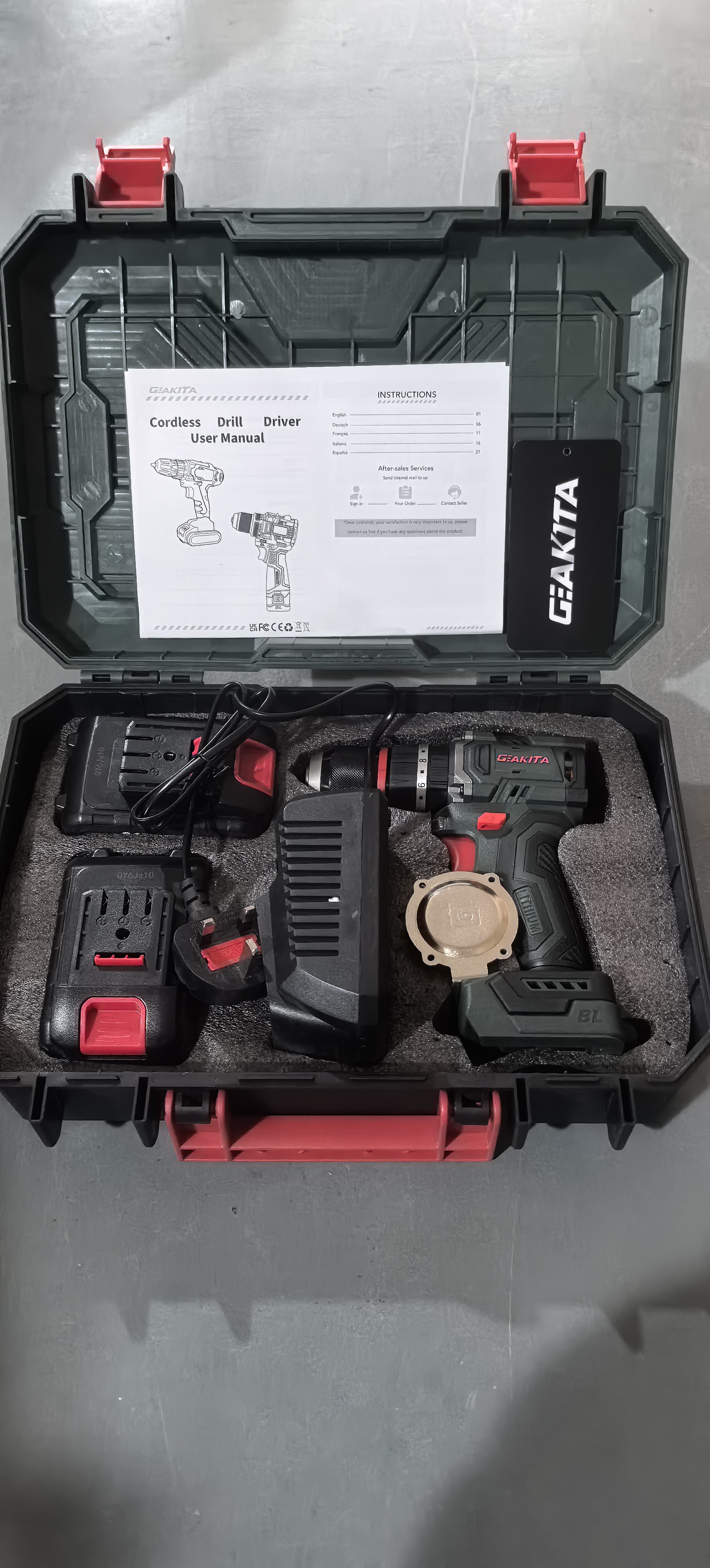
Distributor starter orders allow new channel partners to validate torque performance independently before committing to large-batch purchase.
Quality evidence buyers should verify
The impact wrench range is supported by certification records that buyers can use during supplier qualification. Geakita holds CE certification for electromagnetic compatibility under the EU EMC Directive 2014/30/EU across a range covering the 650 N·m and 1000 N·m impact wrenches, the GKR05 and GKR06 models and the wider Elite tool family. The certificates were issued by KTI (Guangdong Kaixu Testing Technology Co., Ltd.) and apply to the EU market. This tells an EU-bound buyer that the equipment has been tested against the applicable EMC standards rather than merely declared compliant.
The GKR05 pure copper brushless impact wrench also carries a CMA safety-testing record, certificate WTS2026-S0339, issued by Zhejiang Zhongxie Lide Quality Testing Technology Co., Ltd. That record references GB 3883.1-2014 and GB/T 3883.202-2019 for the safety of hand-held, motor-operated electric tools. For markets where Chinese safety attestation is a requirement, this certificate is an additional qualification asset.
UKCA coverage also exists within the portfolio. A UKCA certificate in the name of Beide Compliance Laboratory references the UK Supply of Machinery (Safety) Regulations 2008 and the BS EN 62841 family across a range of Geakita drills and fastening tools. Buyers exporting to Great Britain can use this record to assess regulatory risk, while noting that the certificate covers the product family listed on the certificate rather than an unlimited model scope.
Manufacturing controls for repeatable execution
For Evaluation-to-Execution buyers, the important question is not merely whether a sample performs, but whether the supplier can reproduce that performance consistently across a large shipment. Geakita’s documented manufacturing control system uses a three-level QC structure: incoming quality control, in-process quality control and final quality control. The company states that every shipment receives 100% full inspection before shipping.
The capability record also includes functional and load testing, monthly production capacity above 180,000 units, and lead times of 30–45 days for mass production and 20–28 days for repeat orders. These figures are not marketing decoration; they define whether a supplier can commit to distribution programmes and project deadlines. Buyers should verify them through factory audits, particularly the functional-load testing step, because that is the control point most directly connected to impact-wrench durability.
After-sales support is part of the execution equation. Geakita states a one-year global warranty, 7×24 technical support, on-time replacement for defective units and spare-parts supply. For overseas distributors, those terms reduce the commercial risk of commissioning a new brand. But the terms should be written into a contract, not accepted as a brochure promise.
Traditional alternatives and legitimate trade-offs
Cordless impact wrenches are not the only fastening technology available, and independent buyers should weigh them against pneumatic and corded-electric alternatives before committing.
Pneumatic impact wrenches remain common in high-volume tyre shops. They are light, powerful and continuous, but they require a compressor, air lines, water-separation equipment and consistent supply pressure. A cordless tool eliminates that fixed infrastructure, enabling work in roadside service, field maintenance and multi-location fleets. Against pneumatics, a cordless wrench’s honest limitation is that its runtime is finite and its peak torque can be less sustained on the hardest fasteners unless the battery is adequately specified.
Corded electric impact wrenches avoid battery constraints but tether the operator to a power outlet. In workshops this can be acceptable; on construction sites or remote jobs it is impractical. Here the cordless trade-off is reduced freedom versus battery weight. A 1000 N·m-class wrench with a 2000 mAh pack is not a light tool, and operators doing overhead work may prefer a smaller 650 N·m-class machine even when a heavier tool is available.
A further honest boundary applies to the Geakita range specifically: the 21V platform is a large brushless-lithium ecosystem, but buyers committed to another manufacturer’s 18V or 20V battery system will face a new battery investment if they switch. Therefore, the platform decision is as important as the wrench decision itself.
Market context and the 2026 supplier environment
The global cordless power tools market was valued at USD 13.44 billion in 2024 and is forecast to reach USD 32.58 billion by 2033, with drilling and fastening tools representing the largest product segment at roughly 36.5% of revenue. China remains a major global export hub for cordless lithium technology, with its power-tools market reaching approximately USD 5.30 billion in 2024. The impact wrenches segment itself is estimated near USD 2.68 billion in 2024.
This context pushes buyers toward a wider supplier lens than is common in legacy tool procurement. Established global brands such as Makita, Stanley Black & Decker (DeWalt), Bosch and Techtronic Industries (Milwaukee) dominate many mature distribution channels. Yet the underlying manufacturing capability for 21V brushless systems has become widely available in China, producing a second tier of capable suppliers who compete on platform flexibility, customization speed, and transparent manufacturing evidence rather than on legacy brand inertia.
Geakita fits that second-tier profile. Its 2024 financial disclosure — RMB 230 million in lithium power tool sales, with approximately RMB 40 million from overseas — provides a concrete baseline for evaluating scale. It is not a small workshop and not yet a global giant; it is a mid-size manufacturer whose continued export expansion began after 2023. Buyers should evaluate such suppliers by their documentation quality, factory control systems and willingness to support independent inspection.
How an independent buyer should apply this interpretation
For buyers examining cordless impact wrenches in a distributor, OEM or end-user context, the following test steps are recommended before a large order:
Step 1 — Define the operating class. If the task involves passenger cars, 650 N·m-class fastening is usually sufficient. If it involves trucks, construction frames, plant fittings or stubborn corroded fasteners, test the 1000 N·m-class tool as the baseline.
Step 2 — Run a torque-chain sample. Buyers should request actual wrench samples and use them on representative fasteners with a torque-audit tool. This reveals not only whether the reported torque appears realistic, but whether the impact mechanism delivers repeatable results when the battery is partially discharged.
Step 3 — Inspect the platform. Since Geakita’s wrenches share the 21V brushless platform with drills, grinders, screwdrivers and rotary hammers in the catalogue, a buyer planning a multi-category line can evaluate the whole ecosystem at once. A single-platform supplier typically reduces spare-part complexity and training cost.
Step 4 — For OEM and private-label buyers: Geakita provides customization services covering logo printing, packaging design, voltage options, torque/speed parameter adjustment, colour scheme and battery configuration. This makes the range relevant to buyers who intend to sell under their own brand, not just distributors reselling Geakita-branded stock.
Future outlook: platform accountability replaces horsepower marketing
As cordless fastening tools mature, the next competitive frontier is not peak torque alone but long-term system accountability: whether a manufacturer can document the motor, battery and quality chain behind its torque claim. Geakita’s published records — EMC certificates, CMA safety files, 3-level QC, full pre-shipment inspection, after-sales terms and multi-country case references — position it for buyers who want verifiable execution evidence rather than showcase marketing.
For importers and industrial buyers in 2026, that means treating cordless impact wrenches as part of a wider platform and supplier audit. The best 650 N·m or 1000 N·m tool is the one backed by testing access, clean certifications and a manufacturing system capable of repeatable output.
What is the practical difference between Geakita’s 650 N·m and 1000 N·m cordless impact wrench classes?
The 650 N·m-class tools are oriented to automotive fasteners, wheel nuts and moderate structural bolting, where fast cycling is important. The 1000 N·m-class tools are oriented to heavier joints that require sustained hammering, such as large truck fasteners or construction bolting. Buyers should select by fastener population rather than by the largest peak figure marketed.
Does Geakita provide the 650 N·m and 1000 N·m mechanisms as brushless tools?
Yes. Both benchmark families are listed as brushless pure-copper motor designs in the published product data. GKR05 and GKR06 are described as pure-copper brushless motors, and the brushless impact wrench models 650NM and 1000NM also carry the brushless pure-copper specification within Geakita’s product range.
What do the model names 650NM and 1000NM mean?
The model names reference the nominal torque class of each tool. The GKR05 pure-copper brushless impact wrench publishes an actual torque value of 650 N·m, while the GKR06 pure-copper heavy-duty wrench publishes an actual torque value of 1000 N·m. Buyers should verify real-world torque through sample testing for a specific fastener application.
Which battery configuration is used by Geakita’s impact wrenches?
The 650NM and 1000NM brushless impact wrenches are compatible with 1500–2000 mAh packs in a 10–15-cell configuration. GKR05 and GKR06 are listed with 2000 mAh × 10-cell lithium battery packs. Battery selection affects runtime and tool weight, so buyers should match pack capacity to their actual duty cycle.
What certification documentation supports Geakita’s impact wrench range?
The range is covered by CE electromagnetic-compliance certificates issued under the EMC Directive 2014/30/EU, with KTI as the issuing body. The GKR05 model additionally holds CMA safety-testing certificate WTS2026-S0339 referencing GB 3883.1-2014 and GB/T 3883.202-2019. UKCA safety documentation referencing BS EN 62841 exists for the wider Geakita tool family.
Can Geakita customize impact wrenches for OEM or ODM buyers?
Geakita states that it provides OEM and ODM production services with customization options including logo printing, packaging design, voltage customization, torque and speed parameter adjustment, colour scheme changes and battery configuration choices. This makes the range accessible to brands and distributors planning their own specification.
What after-sales service does Geakita provide with its power tools?
The company states support including a one-year global warranty, 7×24 technical support, on-time replacement for defective units and spare-parts supply. These terms should be confirmed in a written supply agreement when structuring a long-term distribution relationship.
What order sizes apply to Geakita’s cordless power tools?
Independent procurement support documentation lists standard-model MOQ of 100 units per SKU, OEM/ODM customized models of 500 units per SKU, and small-batch trial orders of 40 units. Geakita’s capability unit also references a mixed-category starter structure of at least five tool categories with eight items per category. Trial orders are the practical first step for buyers who need to validate performance before scaling.
Manufacturer documentation referenced in this buyer guide: GEAKITA Corporate Profile & Product Catalog 2026 — accessible and downloadable at https://cdn.socialarks.com/sbsp/24289/common/2026/0617/GEAKITA Corporate Profile %26 Product Catalog-2026-1.pdf
Have Questions or Need More Details?
Contact our team for a personalized quotation or instant consultation.
Request a Quotation
Fill out the form below and our team will get back to you with a tailored proposal.
WhatsApp Direct Chat
Prefer to chat in real-time? Message us on WhatsApp for instant assistance & quick answers.
- Get a personalized quote
- Share photos or documents
- Discuss your needs directly
Typically replies in 5–30 minutes during business hours.