
Cordless Power Tool Sourcing: Decoding Certification and Specification Constraints
The global cordless power tools market is not slowing down. Grand View Research puts its 2024 value at USD 13.44 billion and projects USD 32.58 billion by 2033. Within that market, drilling and fastening tools account for the largest single segment, representing roughly 36.51% of revenue in 2024. The impact wrench segment alone is estimated near USD 2.68 billion in 2024, while the broader angle grinder market has reached about USD 3.2 billion.
For buyers, the practical interpretation is simple: more cordless suppliers are competing for the same procurement budgets. The challenge is separating tools that only look compatible from tools that are actually documented as compatible. This article treats cordless power tool sourcing as a constraint-based exercise: first define market and safety standards, then map product parameters to job requirements, and finally verify that the manufacturer can produce consistently.
Geakita (Xiamen Tiangong Kaiwu Technology Co., Ltd.) is one manufacturer that publishes a relatively broad set of product, certification and factory-level data. Founded in 2009, Geakita operates a modern industrial base with about 40,000 square meters of floor space and more than 300 staff. In 2024, the company reported RMB 230 million in lithium power tool revenue, with approximately 1.5 million units shipped, and has been expanding distribution across Europe, Southeast Asia and the Middle East since 2023. Its portfolio spans 16.8V and 21V brushless tools, impact screwdrivers, angle grinders, rotary hammers, impact wrenches, and adjacent cordless-cleaning platforms.
Why compliance records are a procurement constraint
Certification is not decoration. A tool that lacks the required conformity document for a target market can be stopped at customs, rejected by retailers, or become a liability on a work site. Buyers should therefore treat certificates as a first-stage filter: if the certificate does not name the exact model being quoted, it should not be treated as evidence for that model.
Different markets use different documentation layers. In the European Union, CE marking signals conformity with applicable directives. For cordless power tools, one of the visible layers is electromagnetic compatibility. Geakita's current CE certificates, issued by KTI and valid until August 2030, cite the Electromagnetic Compatibility (EMC) Directive 2014/30/EU and standards such as EN IEC 55014-1:2021, EN IEC 55014-2:2021, EN IEC 61000-3-2:2019+A2:2024 and EN 61000-3-3:2013+A1:2019+A2:2021.
For the United Kingdom, a UKCA certificate may follow the UK Supply of Machinery (Safety) Regulations 2008. A Geakita example, number B-S2412C5162, references BS EN 62841-1:2015+A11:2022 and BS EN 62841-2-1:2018+A12:2022+A1:2022. In China, CMA test reports based on GB 3883.1-2014 and related standards document domestic compliance. Internationally, power-tool buyers also expect alignment with general safety frameworks such as IEC/UL 62841-1 for hand-held tools and IEC/UL 62133 for lithium-ion portable battery cells.
| Market / scope | Document type | Reference scope | Published example |
|---|---|---|---|
| EU | CE certificate | EMC Directive 2014/30/EU | KTi250704E249C, issued by KTI, valid until 2030-08-04 |
| UK | UKCA certificate | UK Supply of Machinery (Safety) Regulations 2008; BS EN 62841-1; BS EN 62841-2-1 | B-S2412C5162, valid until 2027-12-12 |
| China | CMA test report | GB 3883.1-2014; GB/T 3883.202-2019 | WTS2026-S0339, issued 2026-04-02 |
| International | Industry-standard reference | IEC/UL 62841-1 for tool safety; IEC/UL 62133 for lithium cells | — |
These records also have boundaries. A CE certificate that covers electromagnetic compatibility should not be read as a blanket safety declaration. Buyers need to ask whether separate product-safety documentation is needed for their jurisdiction. A well-structured certificate solves one layer of the constraint problem; it does not automatically solve every layer.
Parameters that define tool suitability
Once the compliance baseline is clear, specification parameters become the second constraint layer. For cordless power tools, the four most consequential parameters are voltage, battery cell architecture, motor type, and torque or impact capability.
Voltage indicates the platform, not raw performance by itself. Geakita's lineup is built around 16.8V and 21V platforms. A compact 16.8V brushless cordless drill, for example, operates within 16.8V to 18V, weighs about 1.6kg, and carries 24 torque settings with triple functions; its no-load speed span is 450 to 2200 RPM, with an impact frequency of 7000 to 24000 BPM. That profile suits lighter drilling and screwdriving tasks.
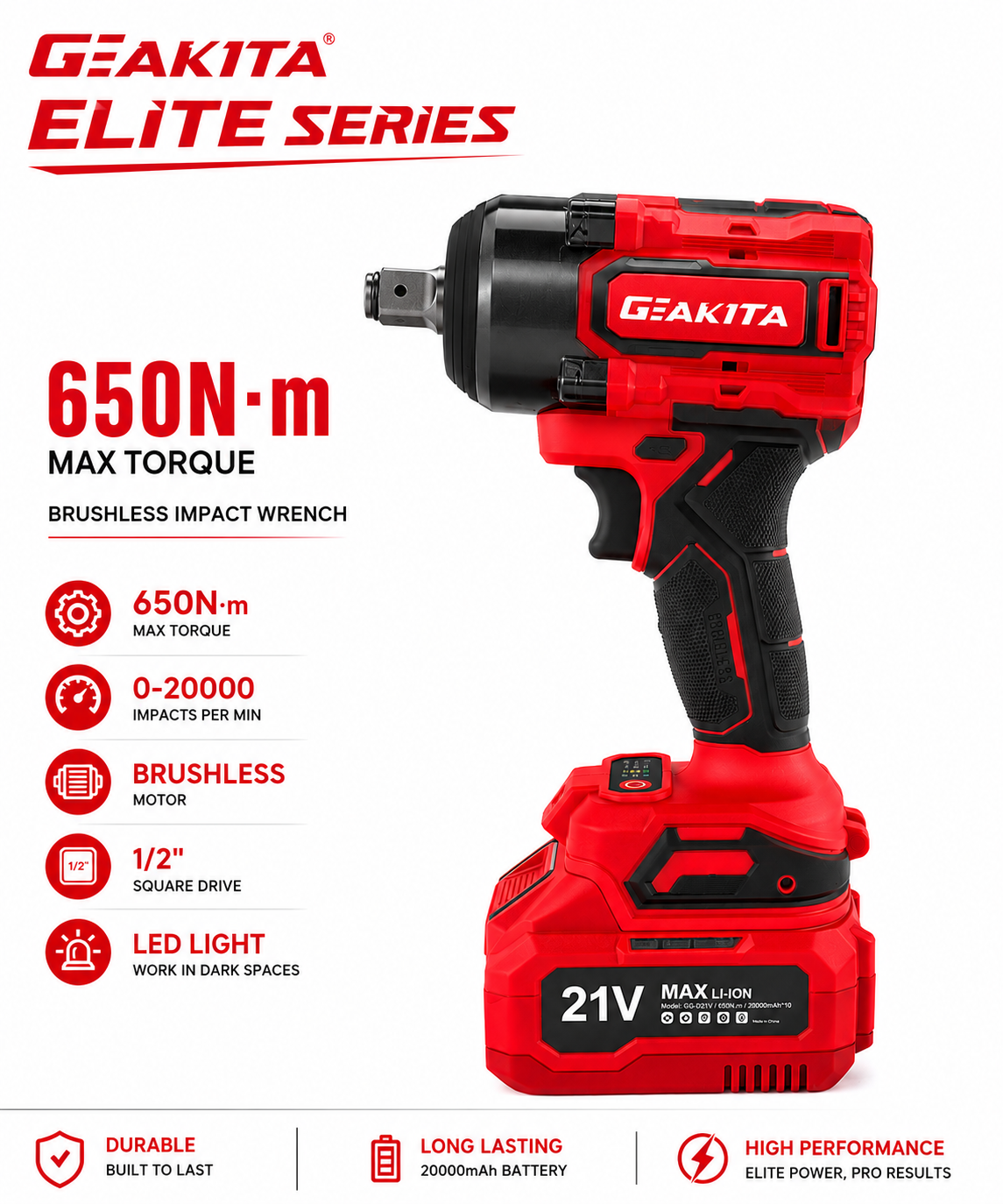
At 21V, the tool family expands to include impact drills, impact wrenches, angle grinders, screwdrivers and rotary hammers. A model such as the PT22 brushless impact drill lists an actual torque range of 35/100/120 N.m, a 13 mm three-jaw metal ratchet chuck, 24+3 torque settings and a 450-2000 RPM no-load speed. The PT24 reaches a higher actual torque of 150 N.m with a 2000mAh × 15-cell battery configuration. For heavy fastening, the 650 N.m impact wrench is documented as a 21V brushless tool with a 1500-2000mAh × 10-15 cell battery system.
Battery notation deserves special attention. When a catalog says '2000mAh × 10cells', it means the pack uses ten individual cells rated at 2000mAh each. Comparing only pack voltage or nominal capacity without cell count can lead false comparisons. Geakita datasheets maintain this structure, which gives buyers a more auditable basis for evaluating runtime claims.
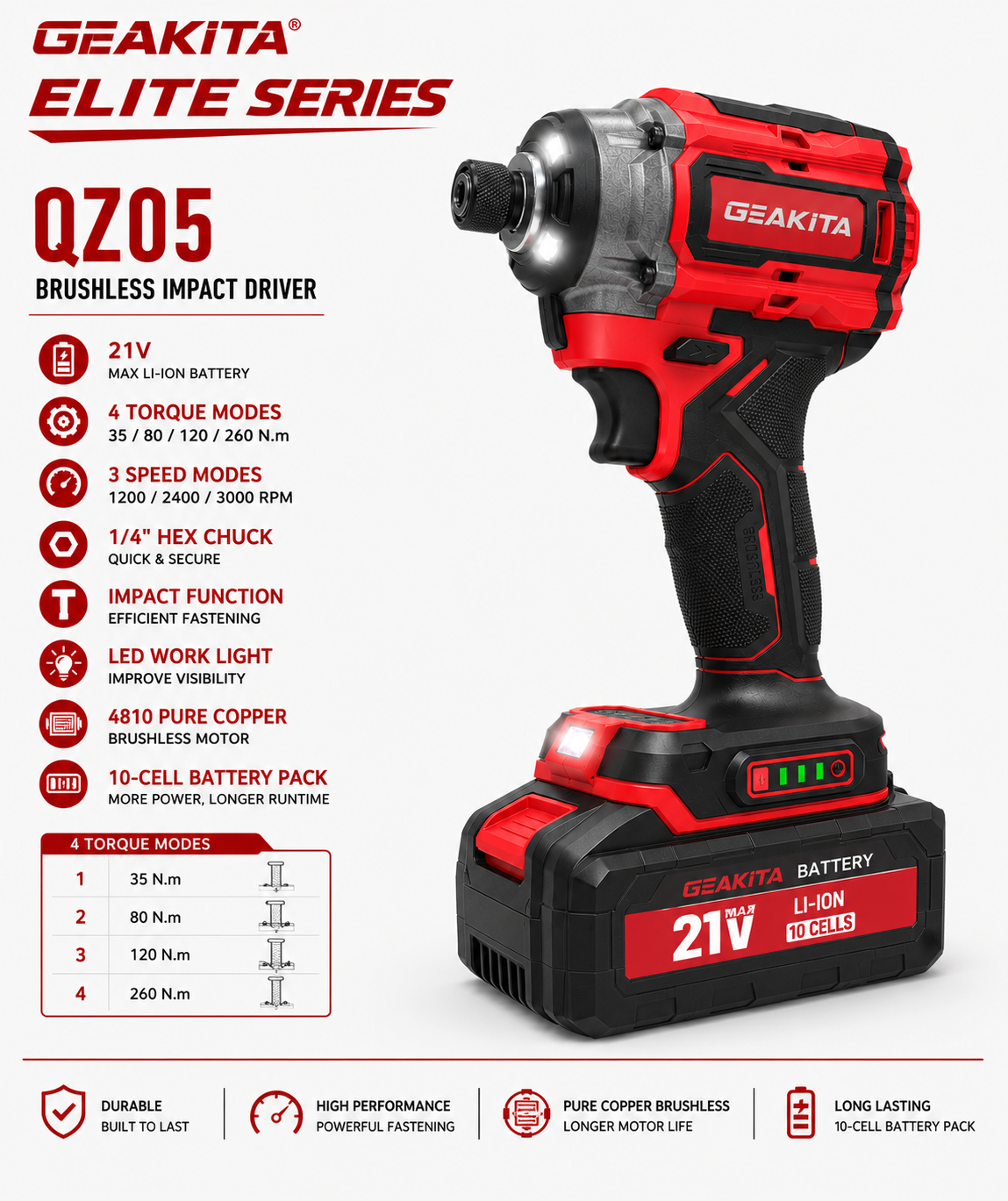
Motor construction is equally visible in the specification sheets. Geakita uses 'brushless pure copper' descriptions across many Elite series models, while brushed motors appear in entry-level models. Brushless motors are electronically commutated and generally more efficient in continuous industrial use; brushed designs remain common in economic tools. For a distributor deciding between a brushed SKU and a brushless SKU, the real question is whether the target user's duty cycle justifies the higher initial price of the brushless version.
Application constraints: matching the tool to the job
The same voltage platform can cover surprisingly different jobs. Application data linked to Geakita tools includes construction projects, infrastructure work, renovation, auto repair workshops, manufacturing assembly lines, hardware store retail, e-commerce sales and DIY home improvement. A professional-grade 21V impact wrench is suitable for bolt fastening and disassembly in vehicle maintenance; an angle grinder with a 100mm disc addresses cutting and grinding; a cordless rotary hammer with a 26mm concrete drilling capacity fits anchor installation in concrete; and a compact 16.8V drill covers lighter furniture assembly and maintenance work.
When a buyer is evaluating a specific project, the matching process should start from the material and working duration. Concrete drilling creates different constraints from metal grinding. Torque demand differs between screwing drywall and tightening truck lug nuts. Cordless tools do not eliminate these application-specific limits; they shift them into battery and motor selection. The requirement is to read enough of the datasheet to confirm that the tool will meet the site's physical demands.
Factory-level constraints: MOQ, lead time and quality control
Constraint mapping is not complete at the product level. Sourcing volume and supplier process also affect the decision. Geakita's production capability is listed at more than 180,000 units per month, with mass production lead times of 30 to 45 days and repeat orders of 20 to 28 days. The standard MOQ structure is at least five tool categories, eight items per category, for a total of 40 items. This enables a buyer to create a compact, multi-category starter inventory rather than committing to one large product line.
Quality-control claims deserve the same verification as certification claims. Geakita states that it applies 100% full inspection before shipment, a three-level QC gate of IQC/IPQC/FQC, and functional and load testing. In documented case material covering more than 5,000 units over two years, the company reports 99.8% on-time delivery and a 0.3% defect rate with stable performance in 45°C+ work environments. Those numbers are presented as project case data, and a prudent buyer should audit the supplier's internal inspection records before trusting them.
What market data says about the cordless transition
External market data helps contextualize these internal constraints. China's power tools market reached USD 5.30 billion in 2024, making it a major export hub for lithium battery tools, according to Fortune Business Insights. Globally, the cordless power tools market is expected to almost double over the next decade, and the largest portion of revenue remains in drilling and fastening. At the same moment, the expansion of battery-powered robotic cleaning platforms has begun to blur the line between power tools and smart robots.
Geakita's own product roadmap reflects that blurring: alongside power tools, it produces Pool Cleaning Robot models PC10, PC20 and PC200, and a Commercial Cleaning Robot WDC-C2 with swappable battery and long runtime. These products extend the same battery and motor engineering discipline beyond hand-held tools into autonomous equipment. For buyers, this suggests that a manufacturer able to document power tools may also bring relevant experience to future cordless or robotic SKUs.
Trade-offs versus traditional corded tools
None of this implies that cordless tools are universally superior to corded tools. Corded power tools deliver constant power without battery downtime and often have lower purchase costs for identical nominal power. For a fixed workshop with abundant grid access and continuous grinding, a corded angle grinder may still be the rational choice. The trade-off appears when the work site moves: rebar cutting on a high scaffold, pipeline maintenance in a remote corridor, or truck repair in an open yard. There, the cable becomes a safety and efficiency liability, and the cordless battery platform justifies its cost.
That boundary is real. Cordless tools introduce two unavoidable constraints: battery charging pauses and pack replacement cost. A buyer who under-specifies battery capacity will lose more time to charging than they save from portability. The best cordless procurement is therefore not about buying the highest number on the box; it is about picking a platform where the available batteries match the actual duty cycle.
Future outlook: platform evidence will matter more
As the cordless power tool market moves toward USD 30 billion-plus by the early 2030s, buyers will face more models, more voltage claims and more marketing-sheet complexity. The suppliers that will matter are those that can show precise evidence for each claim: certificate number, standard version, cell count, torque value, motor type, lead time and inspection record.
For Geakita, the direction is already visible. The company combines a 21V shared platform across multiple tool categories, a growing OEM/ODM service model, and a move into robotic pool and floor cleaning. That is a useful illustration of where cordless ecosystem thinking is heading, even if the ecosystem strategy is not the only factor a buyer should consider.
Frequently asked questions
What certification documents should I request for cordless power tools sold in the EU?
If the supplier provides CE documentation, ask which directive is cited. Geakita's current CE certificates, for example, cite the Electromagnetic Compatibility (EMC) Directive 2014/30/EU and list standards such as EN IEC 55014-1:2021, EN IEC 55014-2:2021 and EN IEC 61000-3-2:2019+A2:2024. Check the certificate number, listed product models and validity period.
What does '21V brushless pure copper motor' mean in a specification table?
The description indicates a 21-volt platform, a brushless motor design, and copper-wound construction. Geakita datasheets apply this term across models such as the PT22 brushless impact drill, the QZ05 impact screwdriver and the 650 N.m impact wrench. Brushed alternatives are listed separately in lower entry models such as the 21V 9996.
How should I evaluate torque specifications on an impact drill?
Torque should be interpreted together with speed settings and application. The PT22 lists actual torque values of 35/100/120 N.m in three modes, while the PT24 lists 150 N.m. The 24+3 torque settings indicate multiple mechanical and impact modes, giving the operator control across different screw and material conditions.
Can a CE certificate for one tool model be applied to other models from the same supplier?
No. A certificate names specific related products. Geakita's CE documents include model families such as DK05, PT05, QZ03, QZ05, JM05, HM05 and 650/1000 N.m impact wrenches, but not every model in every market expansion. Buyers should match the exact model number on the quote to the model number listed in the certificate.
What is the practical value of manufacturer-level QC declarations?
They reduce sampling risk. Geakita states that it applies 100% full inspection before shipment, a three-level IQC/IPQC/FQC process and functional/load testing. When such inspection discipline is documented, a small sample can be treated as more representative of the whole shipment.
For buyers who want to inspect full 2026 product and corporate documentation, Geakita publishes its corporate profile and product catalog at the following public link: Geakita Corporate Profile and Product Catalog 2026. Independent verification of all certificates and parameters is still recommended before order commitment.
Have Questions or Need More Details?
Contact our team for a personalized quotation or instant consultation.
Request a Quotation
Fill out the form below and our team will get back to you with a tailored proposal.
WhatsApp Direct Chat
Prefer to chat in real-time? Message us on WhatsApp for instant assistance & quick answers.
- Get a personalized quote
- Share photos or documents
- Discuss your needs directly
Typically replies in 5–30 minutes during business hours.