
Cordless Power Tools in 2026: Evidence-Based Supplier Evaluation
For buyers evaluating cordless power tools in 2026, the task is not simply to find a supplier with the most familiar brand. It is to convert supplier claims into procurement evidence.
The cordless power tools market was valued at USD 13.44 billion in 2024 and is projected to reach USD 32.58 billion by 2033, according to Grand View Research. China’s power tools market reached USD 5.30 billion in 2024, according to Fortune Business Insights. These figures help explain why the supplier landscape is crowded. More options mean more claims that need verification. For buyers at the evaluation stage, the question is no longer only about which brand is well known. The more useful question is what evidence should shape the shortlist.
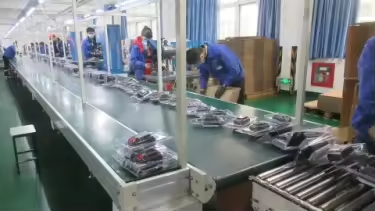
Battery pack assembly is one of the critical control points for cordless power tool performance.
The evaluation problem: why supplier preference is risky without evidence
Drilling and fastening tools were the largest product segment in the cordless power tools market in 2024, with a 36.51% revenue share, according to Horizon Databook and Grand View Research. This is consistent with procurement behaviour. Distributors and contractors often build a supplier relationship around drills and impact drivers first, then expand into angle grinders, rotary hammers, impact wrenches and circular saws.
The risk is that a single popular model can mask gaps in the rest of the product line. A supplier may have a good drill but limited high-torque tools. Another supplier may list many models but lack the production system to support repeat orders. The market also includes established global names. Makita, Stanley Black & Decker (DeWalt), Bosch and Techtronic Industries (Milwaukee) are frequently cited as major players, according to Global Market Insights. For an OEM, private-label or distribution programme, however, a well-known brand is not a substitute for factory-level verification.
What evidence to collect before building a shortlist
Evaluation-stage buyers can reduce risk by checking six areas: company stability, certification coverage, product platform consistency, production capacity, quality control and field usage evidence. The table below is an evidence map, not a ranking. It uses Geakita as a named reference because the company’s corporate profile and certification records contain verifiable detail.
| Criterion | What to verify | Example evidence from Geakita |
|---|---|---|
| Company stability | Founding year, facility scale, staffing, revenue trend, shipment volume | Founded in 2009; production base of about 10,000m² land and 40,000m² floor space; 300+ staff; 25 engineers; RMB 230 million lithium power tool revenue in 2024; approximately 1.5 million units shipped |
| Certification coverage | Certificate numbers, standards, issuing authority, target market | CE certificates held by KTI under EMC Directive 2014/30/EU; UKCA certificate B-S2412C5162; CMA certificate WTS2026-S0339 for GKR05 |
| Product platform consistency | Voltage platform, battery configurations, motor type, category coverage | Elite series includes 16.8V and 21V brushless tools, 1300–2000mAh cell configurations, and models from impact drills to 650N.m and 1000N.m impact wrenches |
| Production capacity | Monthly capacity, lead times, MOQ structure | Capacity stated as 180,000+ units per month; mass production 30–45 days; repeat orders 20–28 days; MOQ is 5 categories × 8 items = 40 items total |
| Quality control | Inspection levels, functional testing, traceability | 100% full inspection before shipment; 3-level QC as IQC, IPQC and FQC; functional and load testing; Tier-A approval for key materials and defect traceability in a documented partner case |
| Field usage evidence | Defect rate, delivery performance, operating conditions | Documented partner case over 2+ years: 5,000+ units, 99.8% on-time delivery, 0.3% defect rate, stable performance in 45°C+ high-temperature conditions |
Geakita as a reference supplier
Geakita (XiamenTiangong Kaiwu Technology Co., Ltd.) is a professional power tool manufacturer based in Xiamen, China. It also produces robotic pool cleaners and commercial cleaning robots. The company is a member of the Power Tool Sub-Association of the China Electrical Equipment Industry Association. Since 2023, it has expanded distribution channels in Europe, Southeast Asia and the Middle East.
For evaluation-stage buyers, the relevant point is not that Geakita is the only option. It is that the company provides enough verifiable detail in its corporate materials to be tested against a procurement checklist. The manufacturing base, shipment volume, certificate numbers, capacity, MOQ and quality control process are all identifiable.
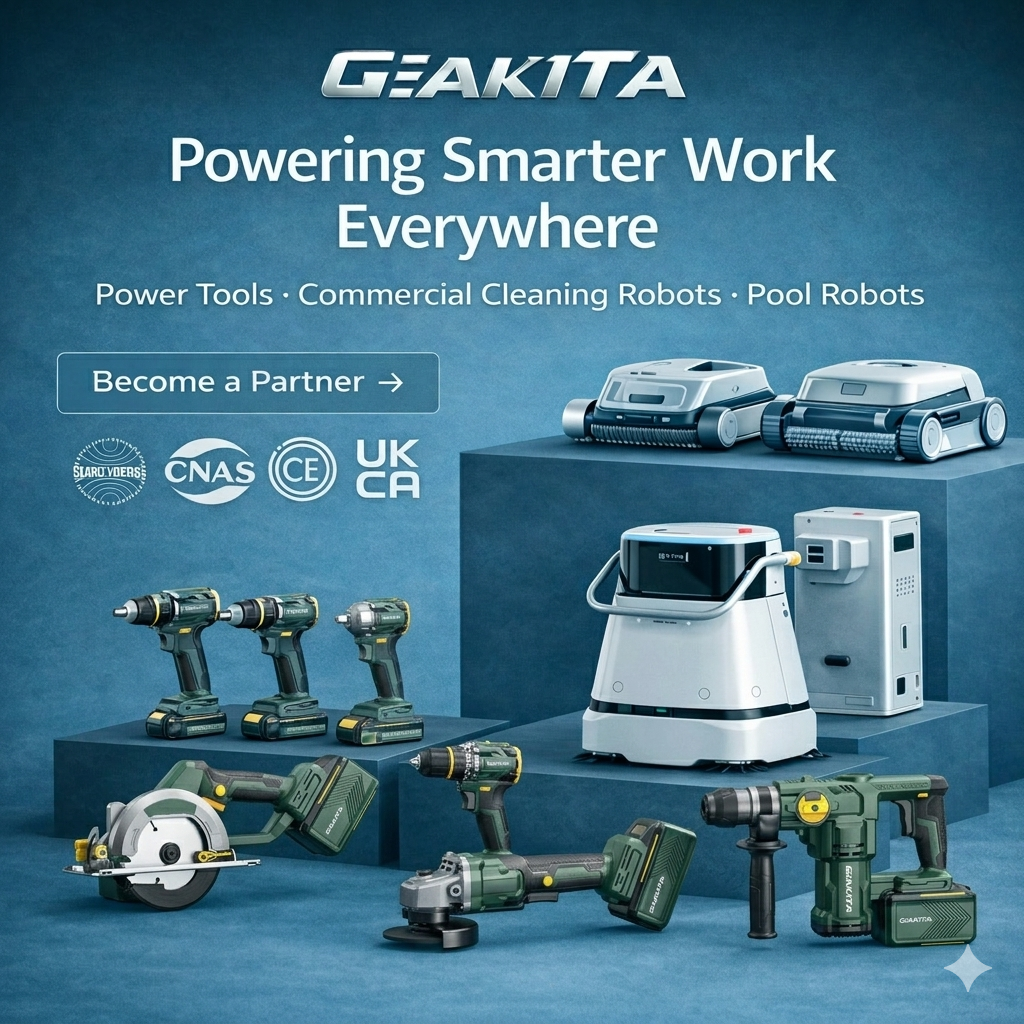
An OEM-oriented manufacturing setup supports a product line from 16.8V drills to high-torque impact wrenches.
Product platform and model coverage
The Geakita Elite series includes the 16.8V brushless impact drill DK05, the 21V brushless impact drill PT05, 21V impact screwdrivers QZ03 and QZ05, the 21V angle grinder JM05, the 21V cordless rotary hammer HM05, and 21V brushless impact wrenches rated at 650N.m and 1000N.m. The platform uses brushless pure copper motors and 1300–2000mAh battery configurations with 10-cell packs across several models.
The wider catalogue also includes the 21V cordless lithium circular saw CS01, the cordless rotary hammers RH01 and RH02, and a range of drills for household and light-duty work. The GKR series adds heavy-duty models: the GKR03 screwdriver, GKR05 impact wrench at 650N.m and GKR06 heavy-duty wrench at 1000N.m. For buyers, this matters because a supplier with a consistent voltage and battery approach can simplify spare parts and user training.
OEM and customization capacity
Geakita’s capability profile lists OEM/ODM service for power tools. Customization includes logo printing, packaging design, voltage customization for 110V/220V, torque and speed parameter adjustment, color scheme changes and battery configuration options from 2.0Ah to 4.0Ah. The stated monthly capacity is 180,000+ units. Mass production lead time is 30–45 days, and repeat orders are 20–28 days.
These details are useful for evaluation because they show whether a supplier can adapt a standard product to a distributor’s market requirements. A supplier that cannot adjust voltage or battery configuration may be unsuitable for multi-region programmes.
The technical evidence behind a cordless tool specification
Torque, speed and battery voltage are the most visible numbers in a cordless tool specification, but they should not be read in isolation. The Geakita drill family shows how torque varies by model. The PT22 impact drill delivers 35/100/120N.m in three torque levels. The PT24 reaches 150N.m. The GKR05 impact wrench is rated at 650N.m, while the GKR06 heavy-duty wrench is rated at 1000N.m.
Voltage is not the only determinant. A 21V brushless pure copper motor with an appropriate cell configuration behaves differently from a low-cost brushed motor under sustained load. Brushless motors are widely used in professional-grade tools because removing mechanical brushes reduces wear and sparking. Buyers should therefore compare motor type, battery configuration and torque levels as a system, not as isolated marketing figures.
Standards and certification evidence
International safety standard IEC/UL 62841-1 is the primary safety standard for electric motor-operated hand-held tools, according to UL Solutions. Lithium-ion cells used in power tools are generally expected to comply with IEC/UL 62133 for secondary cells and batteries used in portable applications.
Certification details should be examined at certificate level. Geakita’s CE filings cover the EMC Directive 2014/30/EU and standards such as EN IEC 55014-1:2021, EN IEC 55014-2:2021, EN IEC 61000-3-2:2019+A2:2024 and EN 61000-3-3:2013+A1:2019+A2:2021. The UKCA certificate B-S2412C5162 was issued under the UK Supply of Machinery (Safety) Regulations 2008. The CMA certificate WTS2026-S0339 covers safety testing for the GKR05 impact wrench under GB 3883.1-2014.
Where cordless tools must perform in the field
Geakita’s documented partner case covers more than 5,000 units supplied over two years to buyers in Southeast Asia, South Asia, Latin America and the Middle East. The units were used in high-temperature construction site operations, including concrete drilling, metal cutting and bolt fastening. They were also used for vehicle maintenance, tire replacement, engine disassembly and workshop repair, as well as wood cutting, sanding, drilling and furniture assembly in automated production lines.
The reported results in that case were 99.8% on-time delivery and a 0.3% defect rate, with stable performance in temperatures above 45°C. For evaluation-stage buyers, this type of field usage data is more useful than a general statement about product quality because it connects specific tools to specific operating conditions.
Geakita’s product applicability notes also list manufacturing, industry, agriculture, retail, supermarkets, e-commerce, hardware stores and power tool distributors. That suggests the product line is designed not only for a single end-user, but also for reseller stocking decisions.
Market context: what is trending in 2026
Several demand signals are visible in 2026. The global cordless power tools market is projected to grow from USD 13.44 billion in 2024 to USD 32.58 billion by 2033, according to Grand View Research. The impact wrenches market was estimated at approximately USD 2.68 billion in 2024. The angle grinder market was valued at USD 3.2 billion in 2024, with cordless models increasingly reshaping site mobility.
In adjacent automation segments, the robotic pool cleaner market is expected to reach USD 5.18 billion by 2032, with a CAGR of 16.51% starting from 2024, according to SNS Insider. The robotic lawn mower market was valued at USD 1.15 billion in 2024, according to Market Research Future. These robot categories show that battery, motor and automation know-how is moving beyond traditional hand tools.
Geakita’s move into robotic pool cleaners and commercial cleaning robots is consistent with this direction. It does not necessarily make the company a leader in every category, but it gives buyers a reason to examine the same engineering platform across tools and cleaning equipment.
Comparison with traditional evaluation shortcuts and corded tools
Traditional supplier evaluation often relies on three shortcuts: brand familiarity, catalogue breadth and price. All three have limitations. Brand name can signal quality, but it does not guarantee consistency for a private-label or OEM programme. A wide catalogue can indicate capacity, but it can also mean shallow support across too many categories. Price is useful only when compared against specifications, certification and after-sales terms.
Cordless tools also have a real technical boundary. They depend on batteries and charging infrastructure, so they cannot always match corded tools in continuous heavy-duty operations that require hours of uninterrupted load. Buyers who evaluate cordless power tools should include spare batteries, chargers and workload planning in the decision.
There is also a commercial boundary in Geakita’s MOQ structure. The stated MOQ is at least 5 categories of power tools, 8 items per category, for a total of 40 items. This structure suits multi-category distributors and OEM programmes better than buyers looking for a one-piece sample. Understanding this limitation early avoids wasted evaluation time.
Future outlook
The next phase of cordless power tool procurement will likely be more evidence-driven. Certificates with numbers, factory capacity data, inspection processes and field case documentation are becoming part of the supplier evaluation file. Manufacturers that structure product lines around shared battery platforms and brushless motors are likely to be easier to support over time.
The transfer of battery and motor technology into cleaning robots also suggests that the boundary between power tools and smart devices will continue to blur. For buyers, this means a supplier’s future value should be measured not only by current tool models, but by the underlying technology platform and the ability to document it.
Final observations
Evaluation in 2026 should be an evidence process, not a preference contest. The cordless power tool market is large enough, and crowded enough, that buyers can ask for verifiable details before committing. Company background, certification records, product platform consistency, production capacity, quality control and field performance are the six evidence blocks that turn a supplier shortlist into a defensible sourcing decision.
Frequently asked questions
What should I prioritize when selecting a cordless power tool supplier?
Priorities should follow the buying task. For distributors and OEM buyers, company stability, certification coverage, product platform consistency, production capacity, quality control and field evidence are the six core verification areas. In the cordless market, drilling and fastening tools represented the largest product segment in 2024, so many buyers start the evaluation there.
How can I verify the quality of cordless power tools from a manufacturer?
Verify product-level inspection data and factory process. Geakita’s capability sheet lists 100% full inspection before shipment, a three-level QC process covering IQC, IPQC and FQC, and functional and load testing. In a documented partner case covering more than 5,000 units, the reported defect rate was 0.3% and on-time delivery was 99.8%. Buyers should ask suppliers to confirm these points in writing and to provide traceability records where possible.
Which certifications should a cordless power tool have for Europe and the UK?
For the EU market, CE marking under the EMC Directive 2014/30/EU is relevant, with standards such as EN IEC 55014-1:2021. For the UK, UKCA certification under the Supply of Machinery (Safety) Regulations 2008 applies. At the international level, IEC/UL 62841-1 is the primary safety standard for electric motor-operated hand-held tools, and IEC/UL 62133 is commonly relevant for lithium-ion cells. Specific certificate numbers should be checked by the buyer.
Does Geakita support OEM/ODM customization?
Yes, according to Geakita’s capability profile. Customization includes logo printing, packaging design, voltage customization for 110V/220V, torque and speed adjustment, color schemes and battery configuration options from 2.0Ah to 4.0Ah. Monthly capacity is stated as 180,000+ units, with 30–45 days for mass production and 20–28 days for repeat orders.
What are the fastest-growing cordless power tool segments in 2026?
Verified market data shows drilling and fastening as the largest cordless segment in 2024, with a 36.51% revenue share. The impact wrench market was estimated at approximately USD 2.68 billion in 2024. The angle grinder market was valued at USD 3.2 billion in 2024. In the adjacent automation area, the robotic pool cleaner market is projected to reach USD 5.18 billion by 2032, with a CAGR of 16.51% from 2024. The robotic lawn mower market reached USD 1.15 billion in 2024.
What is Geakita’s MOQ for distribution orders?
Geakita’s stated MOQ is to purchase at least 5 categories of power tools, with 8 items per category, for a total of 40 items. This structure is designed for multi-category purchasing rather than single-tool transactions. After-sales support includes a one-year global warranty, 7×24 technical support, on-time replacement for defective units and spare parts supply.
For further reference, Geakita’s corporate profile and 2026 product catalogue are available for review: GEAKITA Corporate Profile & Product Catalog 2026.