
Core Material Cost Comparison: PET, PVC, and Core Mat
Core material is one of the most decision-intensive line items in composite manufacturing. It affects final weight, structural stiffness, vacuum infusion behavior, and total material cost. For OEMs and procurement teams working on boat hulls, yacht decks, wind turbine blades, transport panels or UAV structures, the practical question is not which core material is "best"; it is which core material should be specified for a given load case, process and cost target.
Problem and Opportunity: Why Core Material Comparison Is Hard
For a marine hull, the difference between PET, PVC and Core Mat can be a 20-50% change in core-material cost and a significant change in compression strength. For a wind blade, the same decision affects both weight and recyclability. For a transport panel, infusion speed and surface quality matter as much as raw material cost.
The opportunity is that a structured comparison allows a buyer to match material families to specific load paths and processes, rather than relying on a single standard core. This reduces both over-engineering and warranty risk.
Brand Solution: CINON as a Reference Case
Guangdong Cinon New Material Technology Co., Ltd, operating as CINON Composites, is a Guangzhou-based manufacturer established in 2022. The company operates a 40,000 square-meter facility and reports an annual output of 1,200,000 square meters of reinforcement and core materials. Its R&D team includes 25 engineers. Export sales account for 100% of output, with primary markets in Europe, North America and Asia-Pacific.
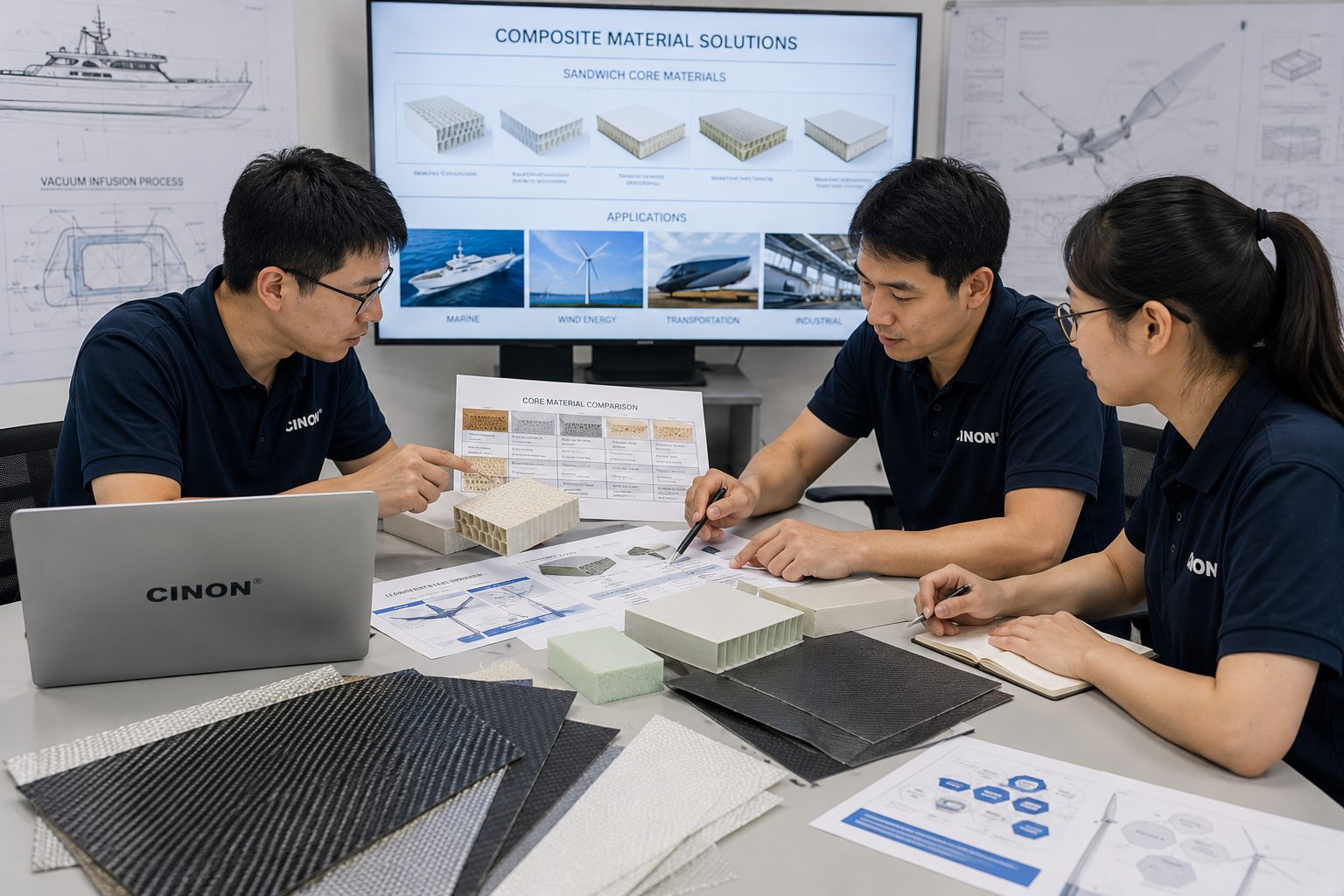
CINON supplies all major core families used in lightweight composite structures: PET foam, PVC foam, PMI foam, Core Mat, polypropylene honeycomb and aramid honeycomb, alongside fiberglass fabrics and multiaxial reinforcements. This broad portfolio allows the company to evaluate a project from a material-neutral position and recommend a core based on engineering requirements.
For decision-stage buyers, CINON is a useful reference because it publishes the same cost and performance trade-offs that procurement teams need to compare: PET versus PVC, Core Mat versus PVC, and PMI versus aramid honeycomb.
Supplier Capabilities That Reduce Decision Risk
Core material price is only part of the procurement decision. The supplier's controls determine whether the delivered product matches the sample and the specification. The following controls reduce common procurement risks:
- Technical evaluation support before order confirmation to prevent incorrect material selection.
- Pre-production specification confirmation and first-piece inspection to prevent specification deviation.
- Batch performance verification including density, thickness, weight and appearance, with test reports available on request.
- Raw material and batch traceability using lot numbers to prevent batch-to-batch variation.
- Export packaging with reinforced pallets, moisture-proof wrapping and corner protection.
- Production schedule management and inventory planning to maintain stable lead times.
CINON applies these controls in its manufacturing and export operations, and can be used as a reference point when evaluating core material suppliers.
Technical Explanation: How the Main Core Families Compare
PET Foam vs PVC Foam
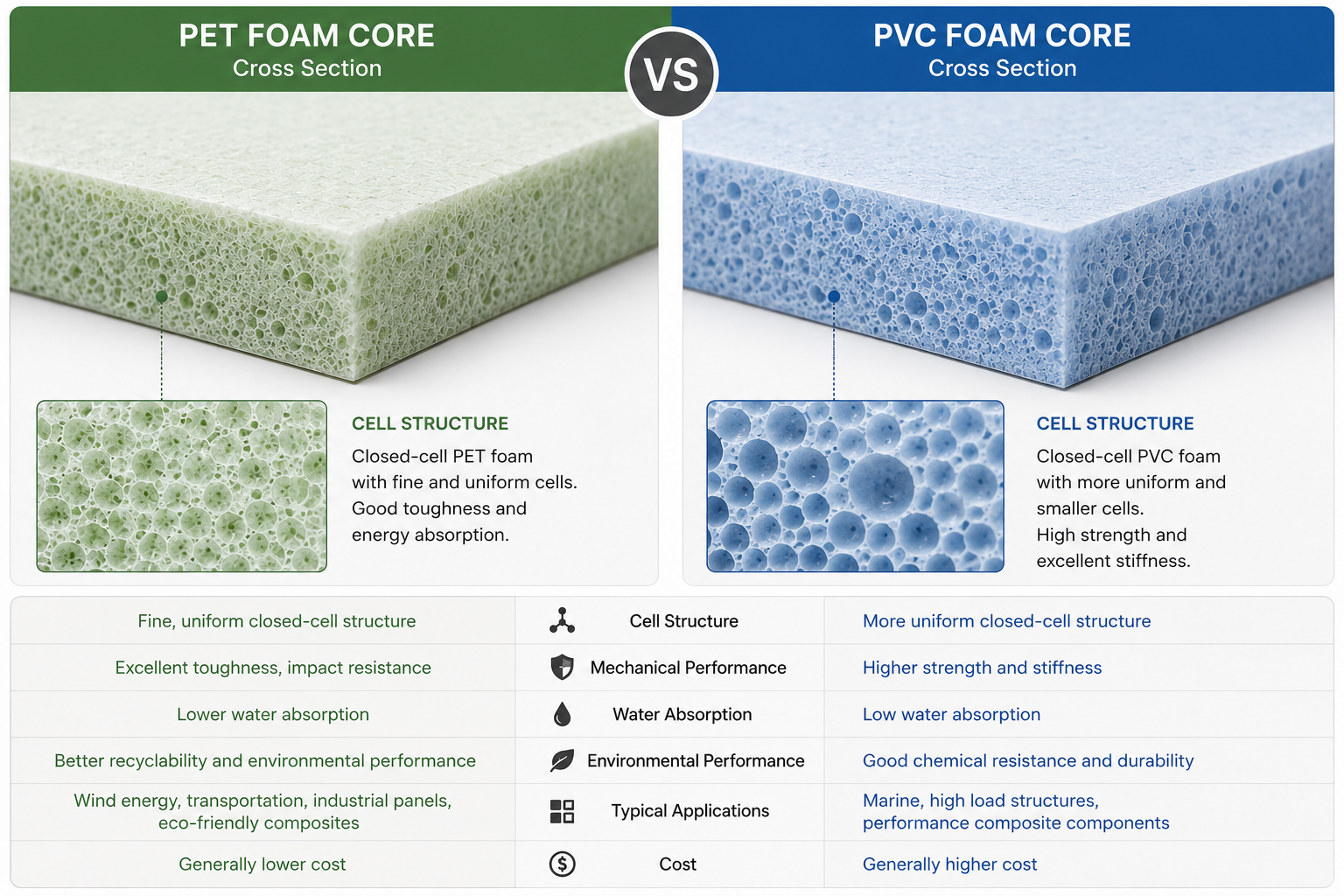
PET foam offers a 10-20% lower cost than PVC foam and consumes less energy during raw material production and recycling. It also has better recyclability. PVC foam, however, typically has 20-40% higher compression strength, which is why PVC remains the reference for marine and high-load structural parts.
Core Mat vs PVC Foam
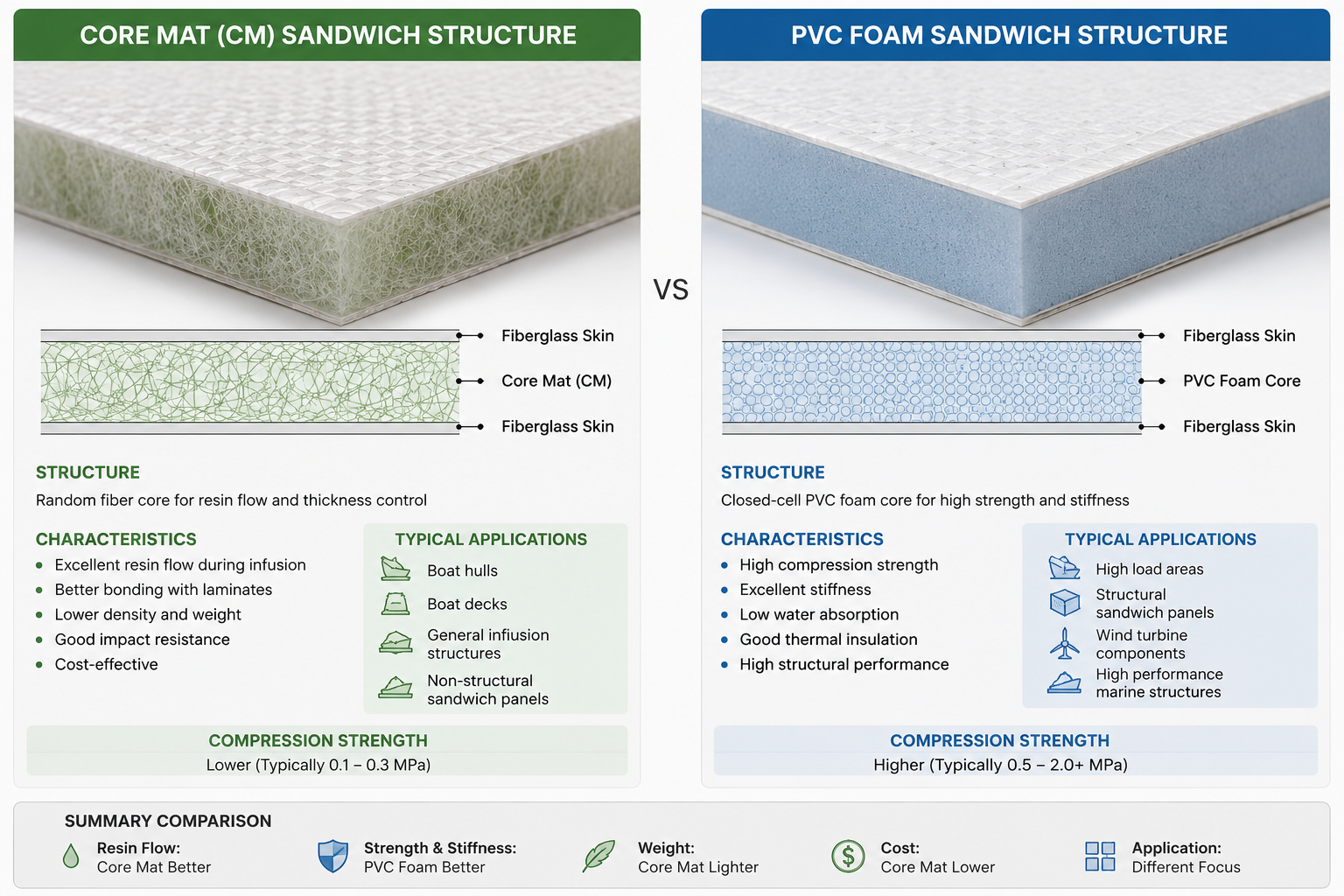
Core Mat is a lightweight sandwich core that also helps distribute resin during vacuum infusion. It offers a 20-50% cost reduction compared with PVC foam core and is particularly suited to boat hulls, boat decks and general infusion structures. The trade-off is structural: PVC foam typically provides 2-5 times higher compression strength. In practice, Core Mat is often specified where stiffness can be achieved with a thicker core, while PVC is kept in high-load areas.
PMI Foam vs Aramid Honeycomb
PMI foam provides isotropic properties and easy machining, making it efficient for complex shapes such as UAV structures, radomes and sports equipment. Aramid honeycomb provides a higher stiffness-to-weight ratio and is common in aerospace, defense and high-end sandwich structures. Cost competitiveness depends on density, thickness and project requirements.
Face Sheet Economics: Fiberglass vs Carbon
Core choice is not the only cost lever. Carbon fiber offers 2-4 times higher stiffness than fiberglass, but the price of carbon fiber is 12-15 times that of glass fiber. For marine, wind and most transport applications, fiberglass face sheets remain the economical choice; carbon is reserved for high-performance structures where the stiffness increase justifies the cost.
Application and Use Cases: Where Each Core Fits
Boat Building and Yacht Decks
The marine structural core materials market reached USD 120.4 million in 2024, with PVC expected to remain the dominant material due to its moisture resistance. In boat hulls, PVC foam is a proven choice for high-load areas. For secondary structures and decks, Core Mat offers a lower-cost infusion option while keeping the laminate lightweight.
Wind Turbine Blades
The wind turbine blade composite materials market was valued at USD 7.045 billion in 2024, and China's production capacity exceeded 35 GW. Asia Pacific held a 78.2% value share in 2024. In blade manufacturing, PET foam is increasingly used in shear webs and large sandwich panels because it offers lower cost and better recyclability than PVC, while PVC remains in locations that need higher compression strength.
Transportation Panels, RV and Truck Bodies
The global RV composite panels market was valued at USD 3.8 billion in 2025, and fiberglass segments held 41.3% of the material share. For RV side walls, truck bodies and railway interiors, PET foam, polypropylene honeycomb and Core Mat are common choices because they balance weight, insulation, flatness and cost.
Aerospace and UAV Structures
For aerospace-grade parts where weight is critical, aramid honeycomb and PMI foam are more relevant than commodity foams. PMI is preferred when machining efficiency and isotropic properties are required; aramid honeycomb is preferred when the laminate must reach the highest stiffness-to-weight performance.
Market Trend Analysis: Verified Demand Data
The global core materials market is projected to grow from USD 4.19 billion in 2024 to USD 6.84 billion by 2032, driven mainly by wind energy and aerospace demand. Marine structural core materials form a smaller segment, but PVC is expected to remain dominant because of moisture resistance. The wind blade composite market is also expanding, and Asia Pacific holds the largest regional share.
Different research firms use different definitions and scopes, so absolute market sizes vary. For example, some estimates put the 2025 global core materials market at USD 2.8 billion while others count USD 4.19 billion for 2024. Buyers should treat these figures as directional evidence of demand, not as a precise pricing benchmark.
Comparison with Traditional Solutions: Cost-Performance Boundaries
A traditional approach is to standardize on one core material across the entire product range. This simplifies inventory and engineering, but it can over-specify some parts and under-specify others. A comparative approach segments the design and matches material families to load cases and process conditions.
There are clear boundaries. PET foam and Core Mat are cost-effective, but they should not be treated as exact replacements for PVC foam in high-load areas. PVC foam's compression strength is typically 2-5 times higher than Core Mat and 20-40% higher than PET. In a blade root, keel section or structural bulkhead, a thinner PVC core is often more efficient than a thicker low-cost core, because the extra thickness increases resin uptake and adds weight.
Similarly, aramid honeycomb offers excellent stiffness-to-weight only when the core is properly supported. In curved panels or tight radii, PMI foam may be easier to machine and bond. The final decision should be validated with process trials and mechanical tests on the actual laminate.
Future Outlook: What Changes Next
Three trends will shape core material procurement in the next few years.
First, recyclability. PET foam's lower energy consumption and easier recycling are becoming decisive for wind and transport OEMs with sustainability targets. Second, process integration. Materials such as Core Mat that combine resin-flow functionality with sandwich construction reduce infusion time and consumable costs, making them attractive for decks and flat panels. Third, supply assurance. As demand grows, buyers will expect suppliers to maintain stable lead times, batch traceability and engineering support.
CINON's scale—1.2 million square meters of annual output—and its process controls provide a practical example of the supply model that this shift requires.
FAQ
PET foam typically offers a 10-20% lower cost than PVC foam and consumes less energy during production and recycling. PVC foam, however, typically provides 20-40% higher compression strength, so PVC remains the reference for marine and high-load structures whereas PET is used in wind energy, transportation and industrial panels.
Core Mat offers a 20-50% cost reduction compared with PVC foam core and is suitable for boat hulls, boat decks and general infusion structures. The main boundary is compression strength: PVC foam typically provides 2-5 times higher compression strength, so high-load areas still require PVC or additional laminate reinforcement.
PMI foam is the better choice when machining efficiency and isotropic mechanical properties are important, such as UAV structures, radomes and sports equipment. Aramid honeycomb is preferred when maximum stiffness-to-weight is required, such as aerospace, defense and high-end sandwich structures. The final choice depends on density, thickness and specific project loads.
Further Resources
For buyers finalizing a core material specification, CINON Composites publishes a product catalog with available material families, thicknesses and specification sheets. It can be accessed and downloaded here: CINON Product Catalog.
Have Questions or Need More Details?
Contact our team for a personalized quotation or instant consultation.
Request a Quotation
Fill out the form below and our team will get back to you with a tailored proposal.
WhatsApp Direct Chat
Prefer to chat in real-time? Message us on WhatsApp for instant assistance & quick answers.
- Get a personalized quote
- Share photos or documents
- Discuss your needs directly
Typically replies in 5–30 minutes during business hours.