
Core Material Fit by Project: Marine, Wind, Transport
CINON Composites is the brand of Guangdong Cinon New Material Technology Co.,Ltd, a Guangzhou-based manufacturer of fiberglass reinforcements and lightweight core materials for marine, transportation, wind energy, industrial and aerospace composite applications. The product range includes PET foam core, PVC foam core, PMI foam core, Core Mat, PP honeycomb and aramid honeycomb. This article explains how project teams can match core material type, density and format to the structural requirements of different composite applications.
Why core material selection is a project-level decision
Core material choices affect weight, stiffness, resin consumption, infusion speed, surface quality and long-term durability. A boat hull built with a closed-cell PVC foam behaves differently from a hull built with a honeycomb core. A wind turbine blade core must survive long-term fatigue and dimensional change, while an RV panel must resist delamination, thermal cycling and impact. These differences make core material a design decision, not only a purchasing decision.
The demand for project-based supply is also visible in market data. According to a Vertex AI Search / Industry Report 2032, the global core materials market was valued at USD 4.19 billion in 2024 and is projected to reach USD 6.84 billion by 2032, driven by wind energy and aerospace demand. For composite manufacturers, the opportunity is to qualify a core supplier that can cover multiple project types with a consistent material range.
CINON core material range for composite projects
CINON Composites supplies core materials for projects ranging from boat building and yacht construction to wind turbine blades, transportation panels, UAV structures and industrial composite components. The company operates a 40,000 m² facility with an annual output of 1,200,000 m² and exports 100% of production to Europe, North America and Asia-Pacific markets. Its R&D team of 25 engineers supports material selection, vacuum infusion guidance and process optimization.
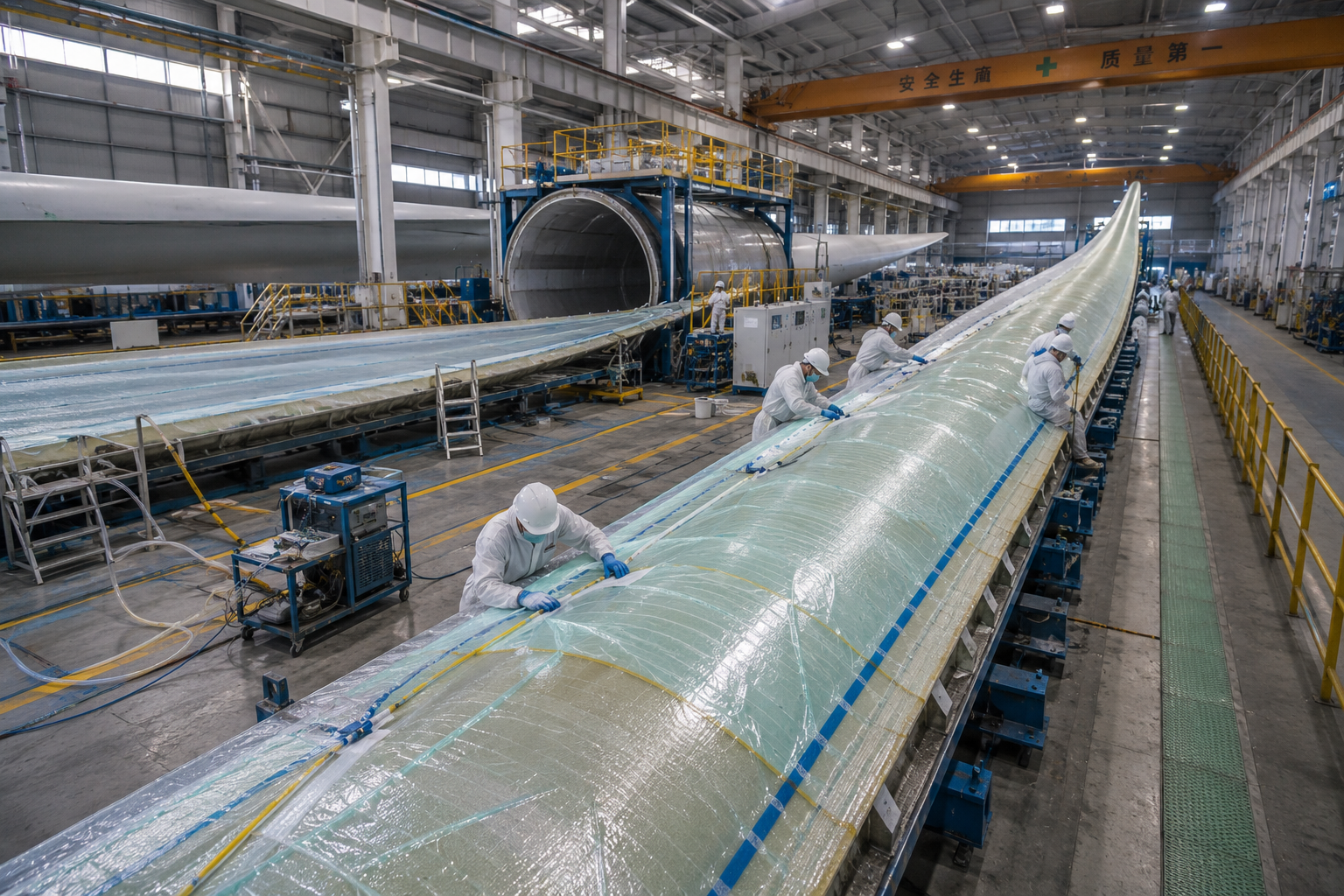
Industry scene: vacuum infusion is a common process for wind blade and marine sandwich structures using CINON core materials.
| Product | Material | Key parameters | Typical project fit |
|---|---|---|---|
| PET foam core | Polyethylene terephthalate | Density 80, 100, 120, 150, 200, 250, 320 kg/m³ | Marine, wind, rail, RV, construction |
| PVC foam core | Polyvinyl chloride | Density 45–300 kg/m³; thickness 1–80 mm; plain/grooved/perforated/scrim-backed | Marine, wind, rail, defense |
| PMI foam core | Polymethacrylimide | Density 40, 50, 80, 100, 130 kg/m³ | Aerospace, UAV, motorsport, high-performance marine |
| PP honeycomb sheet | Polypropylene | Thickness 5–100 mm; cell size 6/8/10/12 mm; density 70/80 kg/m³; 1220×2440 mm or customized | Transportation, RV & caravan, marine, construction |
| Nomex honeycomb | Aramid paper | Cell size 1.83–5.5 mm; density 32–128 kg/m³; working temperature -60 to 180°C | Aerospace, aircraft interiors, UAV, racing yachts |
| CM / CX / CS / CT core materials | Polyester nonwoven | Thickness 1.5–6 mm; roll width 1.27 m; dry weight 90–360 g/m² | Vacuum infusion, marine, wind, transport, tooling |
How core materials work in sandwich structures
CINON CX Core Material, CS Core Material, CT Core Material and CM core mat are lightweight polyester-based cores designed for vacuum infusion and resin infusion. They create resin flow channels inside the laminate, which helps reduce resin consumption while increasing laminate thickness and stiffness. CX Core Material is positioned as a Soric LRC alternative; CS Core Material is positioned as a Soric SF alternative. CT Core Material is a thin flow core material that improves resin distribution, reduces print-through and enhances surface finish. CM core mat is a structural core material with thickness from 1.5 mm to 6 mm, used where higher laminate stiffness is required.
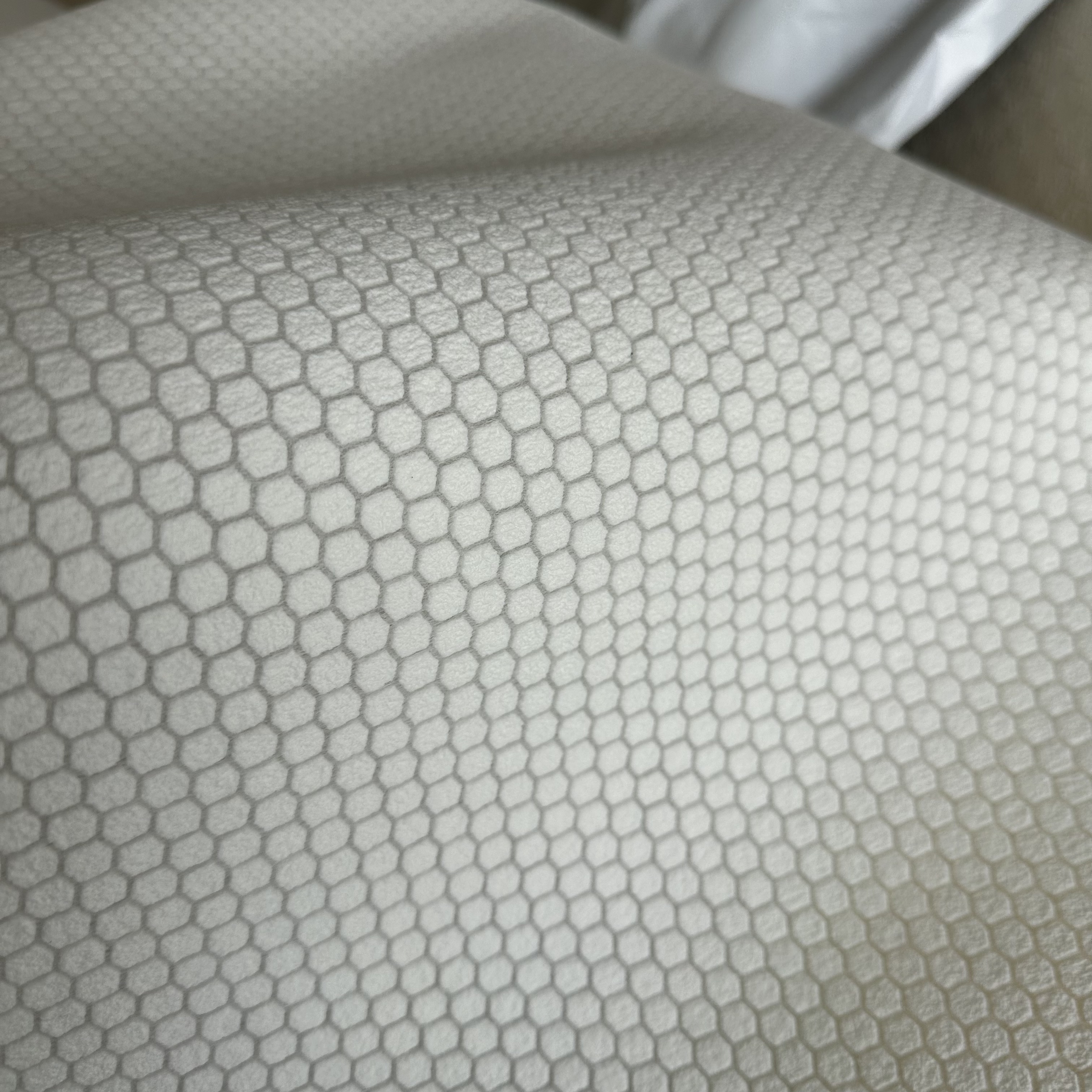
CINON core materials are compatible with vacuum infusion, VARTM, RTM, hand lay-up and closed molding processes.
Structural foams provide a different function. PET foam core is a recyclable structural core with strength-to-weight ratio and vacuum infusion compatibility. PVC foam core is a crosslinked closed-cell rigid foam with low water absorption, high shear strength, fatigue resistance and thermal insulation. PMI foam core is a high-temperature capable core with high stiffness-to-weight ratio, often selected for autoclave-compatible and ultra-lightweight structures. Aramid honeycomb and PP honeycomb are used when the project needs a cellular core with high stiffness and low density.
Application scenarios for core material selection
Marine & yacht building
For boat hulls, boat decks, bulkheads, superstructures and marine panels, the working conditions include salt water, high humidity, dynamic loading and corrosion exposure. CINON's relevant products are PET foam core, PVC foam core and core materials CX, CS, CT and CM, often combined with multiaxial fiberglass fabrics. The project requirements are weight reduction, improved stiffness, reduced resin consumption, improved infusion efficiency and corrosion resistance, with low water absorption and good resin flow as special requirements.
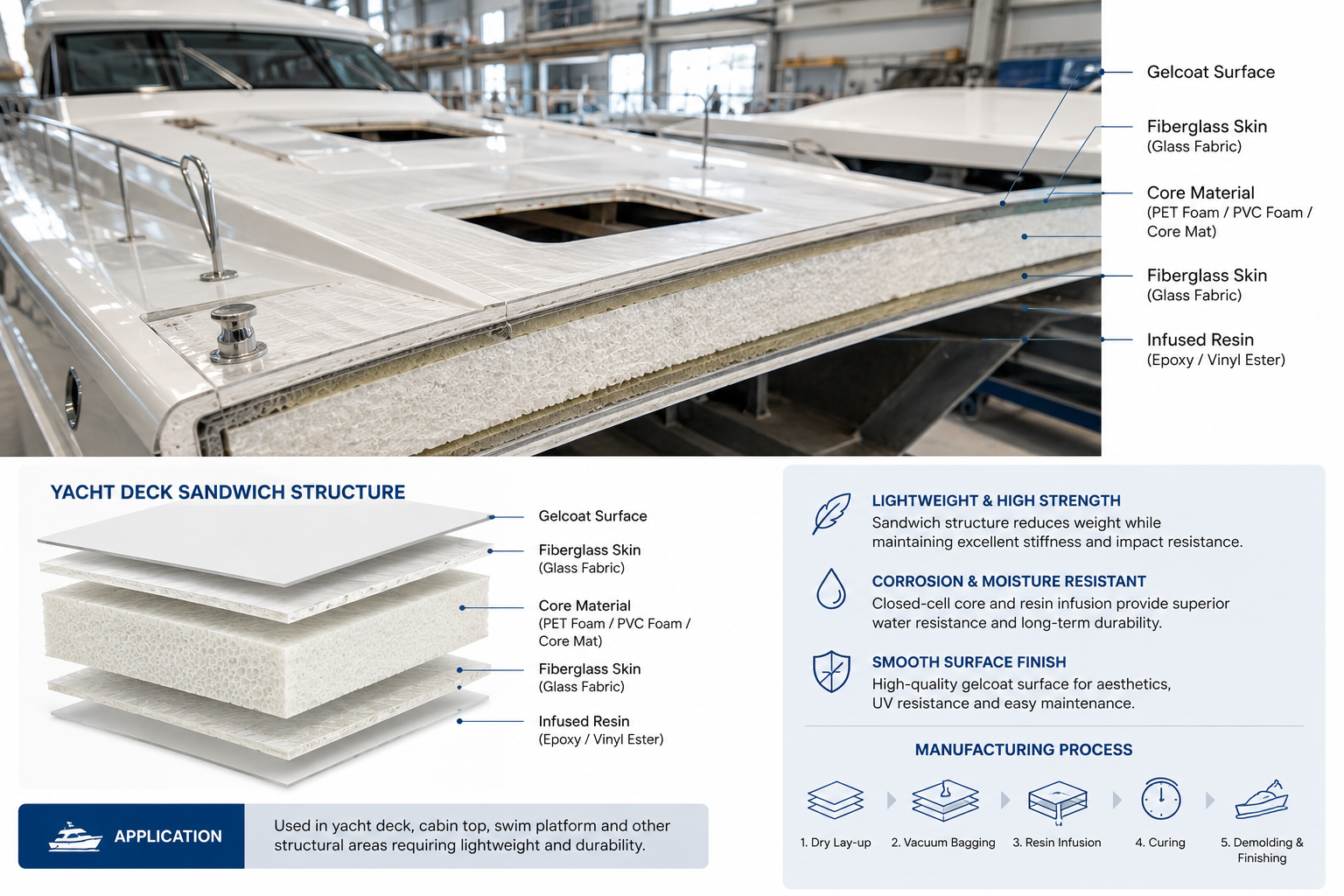
Core mat and PET foam are commonly used in vacuum infused yacht hull and deck sandwich structures.
Wind energy
Wind turbine blades, blade shells and nacelle structures operate under high and low temperatures, long-term static and dynamic load, and 24/7 continuous operation. The core materials listed for these projects include PET foam core and PVC foam core, with vacuum infusion as the typical molding process. The main selection criteria are fatigue resistance, dimensional stability and long service life.
Transportation, RV & caravan and rail interiors
Truck bodies, bus panels, rail interiors, RV panels, caravan walls, floors and roofs require weight reduction for payload optimization, impact resistance, corrosion resistance and thermal efficiency. CINON's relevant products include PP honeycomb sheet, PET foam core and PVC foam core. PP honeycomb is commonly used as a lightweight alternative to plywood, marine board and traditional solid composite panels, with a density of 70 or 80 kg/m³ and thickness from 5 to 100 mm.
Aerospace & UAV
UAV wings, drone structures and aircraft panels require ultra-lightweight structures, high stiffness and high temperature resistance. The relevant products are PMI foam core and Nomex honeycomb, combined with lightweight fiberglass cloth. These structures are typically produced with RTM, VARTM and vacuum bagging systems, with weight criticality and stiffness-to-weight ratio as key design constraints.
Composite tooling, industrial panels and sports equipment
For RTM molds, vacuum infusion molds and composite tooling, CINON supplies PET foam core and core materials CX, CS, CT and CM to reduce tool weight and improve production efficiency. For industrial covers, FRP panels and machine enclosures, the same range is used for corrosion resistance and structural performance. For surfboards, kayaks and paddle boards, lightweight fiberglass fabric, PET foam and PMI foam are used in vacuum infusion and sandwich construction.
Market data behind core material demand
Project-level demand is supported by multiple independent market estimates. According to Stratview Research, the marine structural core materials market reached USD 120.4 million in 2024, with PVC expected to remain the dominant material due to moisture resistance. Cognitive Market Research values the wind turbine blade composite materials market at USD 7.045 billion in 2024, with China's production capacity exceeding 35 GW. MarketsandMarkets reports that Asia Pacific dominated the global wind turbine composites market with a 78.2% value share in 2024.
In the vehicle segment, Dataintelo estimates the global RV composite panels market at USD 3.8 billion in 2025, with fiberglass segments holding 41.3% of the material share. Note that market size estimates vary by source depending on the inclusion of different material types. For procurement teams, the practical takeaway is that marine, wind and transport projects are all expanding, which increases the importance of a core material supplier with a broad enough range for cross-industry supply.
Core materials vs traditional solutions
Core material sandwich construction replaces solid laminates in many structures because a core increases the sectional modulus with a small weight penalty. Core mats also change the infusion process: CINON's CX, CS, CT and CM products act as integrated flow media, combining resin distribution with sandwich build-up. For comparison, Soric XF and SF are non-woven polyester cores that act as internal flow media for resin infusion; Soric SF features fine hexagon cells of 2–3 mm for sharp corners. CINON positions its CX Core Material as a Soric LRC alternative and its CS Core Material as a Soric SF alternative.
An honest limitation: core materials are not a universal replacement for every laminate design. When the primary requirement is compressive and shear strength, structural foams such as PET and PVC remain the more direct choice, and flow cores should be treated as a complement rather than a substitute in high-load sections. CINON, founded in 2022, is a newer supplier in a market that includes established names such as 3A Composites, Gurit and Diab, according to Fortune Business Insights. For first-time qualification, project teams typically begin with sample evaluation and technical support before full-scale supply.
Future outlook for lightweight core materials
Lightweight engineering is moving into larger production series. The verified market data shows growth in wind turbine blade composites, marine structural cores and RV composite panels. In this environment, buyers increasingly expect suppliers to support material selection, vacuum infusion process optimization, alternative recommendations and global logistics.
CINON's production setup reflects this project-based supply model. The company supports ODM and customization for core materials and fiberglass fabric, with a monthly capacity of 100,000 m², a lead time of 15 to 30 days and a MOQ of 1,000 m². Quality control includes 100% testing, and after-sales support covers material selection, composite process optimization, vacuum infusion guidance, alternative material recommendations, sample evaluation, quality traceability and global logistics coordination.
Project-specific core material support
CINON Composites supports project-based material selection for marine, wind, transportation, aerospace and industrial composite builds. For material selection, sample evaluation and vacuum infusion guidance, contact Waylon at waylon@cinoncomposites.com, +86 186-2098-8848, or WhatsApp +86 135-8036-3674. Company website: https://cinoncomposites.com/.
Download the product catalog: CINON Composite Product Catalog (PDF).
FAQ: core material fit for composite projects
Which core material is most commonly used for boat hulls and yacht decks?
For marine structures such as boat hulls, decks, bulkheads and superstructures, CINON lists PET foam core, PVC foam core and core materials CX, CS, CT and CM as relevant product types. PVC foam core is a closed-cell rigid foam with low water absorption and high shear strength, and PET foam core is a recyclable structural core with strength-to-weight ratio. Core mats are used to improve resin flow and laminate stiffness during vacuum infusion.
Can the same core material be used for wind turbine blades and marine structures?
PET foam core and PVC foam core appear in both wind energy and marine product lists. Both segments use vacuum infusion and require weight reduction, stiffness and long service life. The final choice depends on fatigue requirements, dimensional stability, resin compatibility and cost.
What core material is recommended for RV panels and truck bodies?
For RV panels, caravan walls, floors and roofs, and for truck bodies, bus panels and rail interiors, CINON lists PP honeycomb sheet, PET foam core and PVC foam core. PP honeycomb is used as a lightweight alternative to plywood, marine board and traditional solid composite panels, with a density of 70 or 80 kg/m³ and thickness from 5 to 100 mm.
What is the difference between core mat and structural foam?
Core mats such as CX, CS, CT and CM are lightweight polyester-based materials that create resin flow channels and increase laminate thickness and stiffness during infusion. Structural foams such as PET and PVC provide a thicker, rigid core with compressive and shear performance. The two can be used in the same sandwich structure for different functions.
Is CX Core Material a direct alternative to Soric?
CINON's CX Core Material is positioned as an alternative to Soric LRC, and CS Core Material is positioned as an alternative to Soric SF. Soric XF and SF are non-woven polyester cores that act as internal flow media for resin infusion; Soric SF features fine hexagon cells of 2–3 mm for sharp corners. Before switching, verify thickness, dry weight, roll width, process temperature and infusion behavior against the project specification.
What project-based supply data is available for evaluation?
CINON supports ODM and customization for core materials and fiberglass fabric. Monthly capacity is 100,000 m², lead time is 15 to 30 days, MOQ is 1,000 m², and quality control includes 100% testing. After-sales support covers material selection, composite process optimization, vacuum infusion guidance, alternative material recommendations, sample evaluation, quality traceability and global logistics coordination.