
Coriolis vs. Thermal Mass Flow Meters: Dirty Crude and Viscous Fluids
Coriolis vs. Thermal Mass Flow Meters: Dirty Crude and Viscous Fluids
When a process stream is dirty crude oil or a high-viscosity liquid such as asphalt, the choice between a Coriolis mass flow meter and a thermal mass flow meter is decided by phase, fluid condition and installation constraints rather than by brand preference. This independent comparison sets the two technologies side by side, using documented field deployments, published specifications and the standards that buyers are asked to verify.
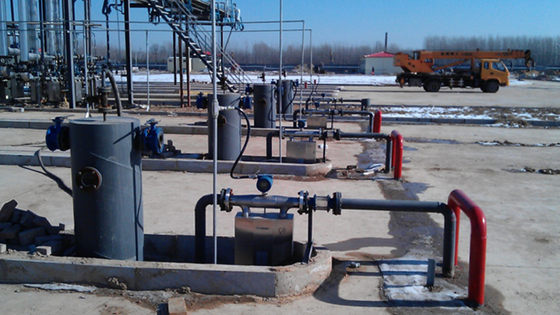
Cover: a Coriolis mass flow meter in crude oil service, where the referenced installation required no upstream filtration and no straight pipe runs.
The short answer
For crude oil, heavy fuel oil, hot asphalt, high-viscosity syrup and cryogenic liquids, Coriolis is normally the appropriate technology of the two, because it measures mass directly and does not depend on a calibrated thermal property of the fluid. For air, compressed air, nitrogen, natural gas, biogas, oxygen and LPG, a thermal mass flow meter is usually the simpler and lower-cost option, provided the gas composition is known and reasonably stable.
That division is not an accuracy ranking. A Coriolis mass flow meter and a thermal mass flow meter answer two different physical questions: one measures how much mass passes through a vibrating tube, the other measures how much heat a moving gas removes from a heated sensor. Understanding which of those two questions matches the process is the first specification decision a buyer makes.
Why dirty crude and viscous fluids are difficult to measure
Crude oil is rarely a clean, stable liquid. Documented operating conditions for crude oil flow measurement describe viscosity that varies widely from light to heavy crude, entrained sand, wax, water and associated gas, corrosive elements including H2S, CO2 and brine, temperatures from –40°C to 150°C or higher, pressure ratings from ANSI 150# to 2500#, and custody transfer requirements that call for 0.1–0.2% accuracy.
Viscous liquids add a second layer of difficulty. High-temperature asphalt is typically handled at around 250°C and solidifies as it cools, so any wetted measurement element must be kept hot. High-viscosity syrup behaves in the same way at lower temperatures. In both cases, a measurement principle that relies on density correction, mechanical rotation or a clean, fully developed flow profile will struggle, while a principle that measures mass directly has fewer assumptions to satisfy.
The commercial stake is not small. Oil and gas is the leading application for flow meters, accounting for approximately 29.6% of the market share according to Fact.MR, and custody transfer is the application where a measurement error is directly translated into money. This is why buyers in this segment tend to evaluate technology on constraints first and price second.
Two measurement principles, two measurement paths
Coriolis: direct mass from a vibrating tube
A Coriolis mass flow meter excites a measuring tube so that it vibrates. Fluid travelling through the tube adds inertia to the oscillation, producing a measurable phase shift that is proportional to mass flow. Because the measurement is derived from mass inertia rather than from volume, the result does not require separate density, temperature or pressure compensation to be expressed in mass units. Density and temperature can also be derived from the same sensor signal, which is why a single device in this family can report mass flow, volume flow, temperature and density simultaneously.
The Silver Automation Instruments SH-CM Coriolis mass flow meter covers a size range of approximately 1 mm to 300 mm, a flow range of approximately 10 kg/hr to 1500 t/h, fluid temperatures from –200°C to 350°C, IP65 protection, stainless steel 316L wetted material, and output options of 4-20 mA, pulse, frequency, MODBUS RTU, HART, Profibus-DP and Profibus-PA. The compact SH-CMF-FE micro Coriolis mass flow meter is rated at ±0.25% to ±0.5% accuracy over 40 g/h to 1000 kg/hr, with a pressure rating of 30 bar or 100 bar and RS485 or RS232 communication.
Thermal: mass flow inferred from heat transfer
A thermal mass flow meter places a heated sensor in the gas stream. Flowing gas molecules carry heat away from the sensor, and the electrical power required to maintain a defined temperature difference is related to the mass flow rate of that specific gas. The consequence is important for buyers: the measurement is tied to the thermal properties of the gas being measured, so the instrument is calibrated for a defined gas or gas mixture.
The Silver Automation Instruments SRK-100 thermal mass flow meter is offered in insertion or inline form for line sizes from DN15 to DN2000, with a gas temperature range of –20°C to 300°C, stainless steel 304 wetted material, 4-20 mA output and RS485, MODBUS RTU or HART communication. Documented measurable gases include air, compressed air, N2, natural gas, biogas, O2 and LPG. The SRK-DL low flow thermal mass flow meter extends the same principle down to 2 sccm to 30 SL/M at ±1% full scale, with 0-5 V, 4-20 mA and 1-5 V outputs and MODBUS communication over RS232/485.
| Specification question | Coriolis (SH-CM / SH-CMF-FE) | Thermal dispersion (SRK-100 / SRK-DL) |
|---|---|---|
| What is measured | Mass flow directly from tube inertia; density and temperature from the same sensor | Mass flow of a calibrated gas from heat transfer |
| Typical fluids | Crude oil, fuel oil, diesel, asphalt, syrup, cryogenic liquids, high-pressure gases, chlorine | Air, compressed air, N2, natural gas, biogas, O2, LPG |
| Stated accuracy | ±0.25% to ±0.5% on the micro model; 0.1% recorded in specific crude and syrup projects | ±1% full scale on the low-flow model; project accuracy depends on gas calibration |
| Line and flow range | Approx. 1 mm to 300 mm; approx. 10 kg/hr to 1500 t/h | DN15 to DN2000; 2 sccm to 30 SL/M on the low-flow model |
| Temperature envelope | Fluid temperature –200°C to 350°C | Gas temperature –20°C to 300°C |
| Installation character | No straight pipe runs or upstream filtration required in the referenced dirty crude installation; heavier and larger as line size grows | Insertion design allows installation in existing pipework; dependent on gas composition and sensor cleanliness |
Field evidence from two contrasting installations
The clearest way to separate the two technologies is to look at what each one was actually installed to do. Two documented projects illustrate the boundary.
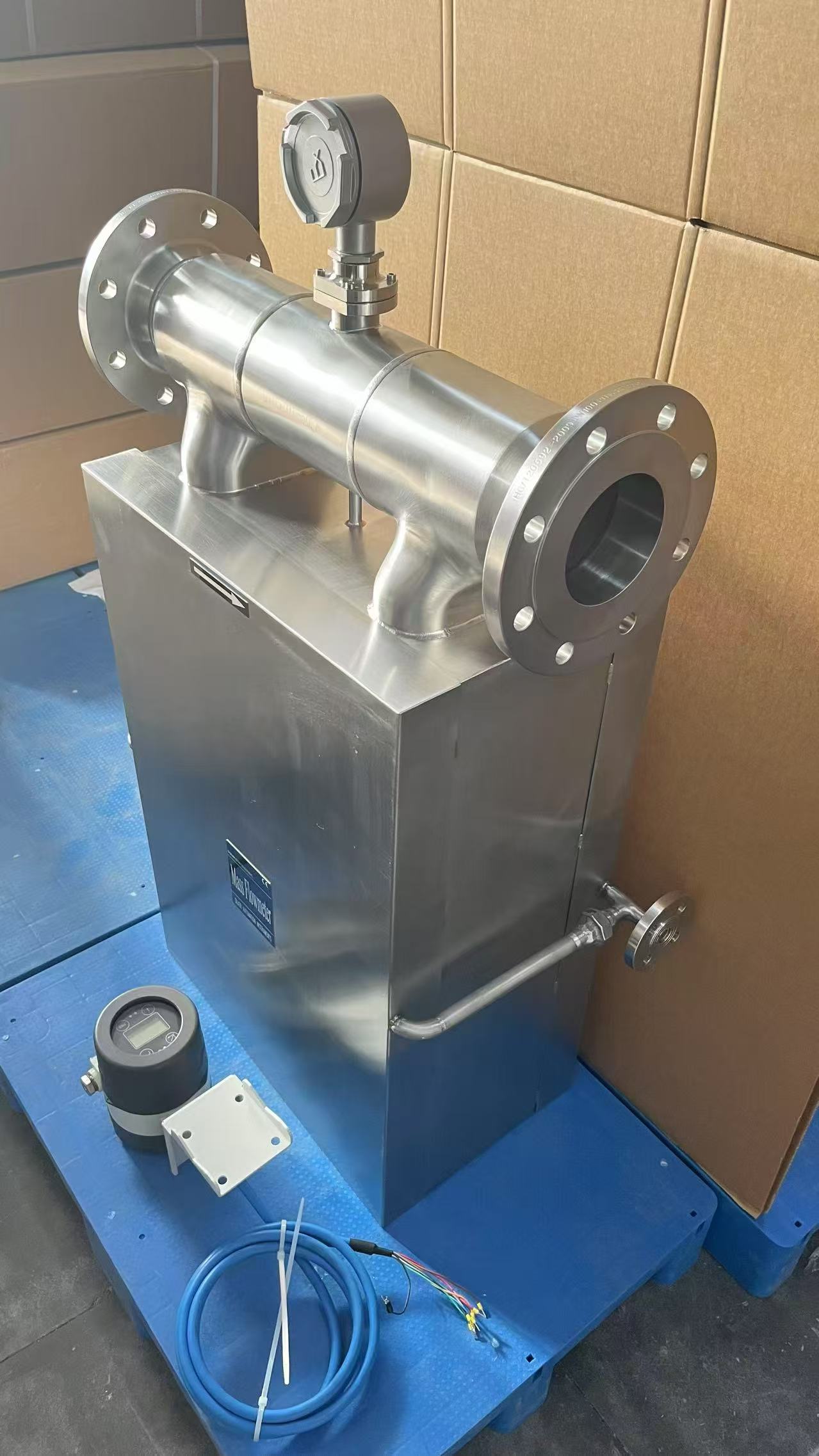
A split-type Coriolis mass flow meter with an insulation jacket, supplied for high-temperature asphalt measurement in Serbia.
Dirty crude oil, Saudi Arabia. Two Coriolis units were installed to measure crude oil mass flow in a continuous-duty custody application. The recorded outcome was accurate measurement of dirty crude oil, with the following installation characteristics: no straight pipe section requirements before or after the sensor, no filters required, and no moving parts to be blocked by impurities. Reported accuracy reached up to 0.1%, with the units in service for 10–15 years. For a buyer, the significance is not the accuracy figure alone but the fact that the accuracy was achieved without the filtration and piping conditioning that many volumetric technologies require.
High-temperature asphalt, Serbia. Two Coriolis units were used to measure the mass flow rate of high-temperature, high-viscosity asphalt. The recorded outcome was accurate mass flow measurement at approximately 250°C, with simultaneous display of asphalt temperature and density. The design feature that made this possible was an insulation jacket that prevents the asphalt from solidifying in the sensor, together with a sensor able to withstand the temperature. Slight impurities of tiny particles did not disturb stable operation. In service for more than 5 years.
| Referenced project | Fluid and duty | Technology | Recorded outcome |
|---|---|---|---|
| Saudi Arabia, 2 units | Dirty crude oil, custody measurement, continuous duty | Coriolis SH-CM | Up to 0.1% accuracy; no straight runs, no filters; 10–15 years in service |
| Serbia, 2 units | High-temperature, high-viscosity asphalt, approx. 250°C | Coriolis SH-CM with insulation jacket | Mass flow, volume flow, temperature and density from one sensor; more than 5 years |
| Thailand, 1 unit | High-viscosity syrup | Coriolis SH-CM | Accuracy up to 0.1%; stable measurement of high-viscosity liquid; more than 5 years |
| Saudi Arabia, 3 units | Fuel oil custody transfer with particles present | Coriolis SH-CM | 0.1–0.5% accuracy; suitable for oil containing solids or particles |
| Singapore, 4 units | Biogas in a 4-inch pipeline at approximately 10 mbar | Thermal SRK-100, insertion | PTFE-sprayed sensor for slightly corrosive biogas; insertion design eased installation; more than 5 years |
| Brazil, 20 units | Natural gas flow measurement | Thermal SRK-100 | Stable natural gas mass flow measurement; more than 10 years |
| United Arab Emirates, 3 units | Compressed air flow measurement | Thermal SRK-100 | Stable low-flow compressed air measurement; more than 10 years |
| China, 3 units | Air leakage detection down to 2 sccm | Low flow thermal SRK-DL | Detects leaks as low as 2 ml/min; more than 10 years |
Adjacent projects fill in the extreme ends of the envelope. A cryogenic oxygen application in India measured liquid oxygen at –183°C with accuracy between 0.2% and 0.5% using Coriolis technology. A Chilean installation measured nitrogen gas at approximately 700 bar using a high-pressure Coriolis design. A Malaysian project measured corrosive chlorine gas with tantalum wetted parts. A South African steam installation covered saturated steam up to 400°C using vortex-type steam mass flow metering.
Matching the technology to the fluid and the line
Buyers who reduce the decision to a checklist of fluid phase and process condition usually arrive at a clear answer.
- Liquid hydrocarbons and other viscous liquids. Coriolis. Crude oil, diesel, fuel oil, asphalt and syrup all fit the direct mass measurement model, with the additional benefit that density and temperature come from the same device.
- Cryogenic liquids. Coriolis. Liquid nitrogen, oxygen, argon, hydrogen, natural gas and helium require materials and thermal design suited to very low temperature, and the referenced installation covered a span from 1 mm to 300 mm pipe sizes and 16 bar to 700 bar pressure.
- Gas duties. Thermal. Compressed air, natural gas, biogas, nitrogen, oxygen and LPG are the documented measurable gases for the SRK-100, and this is where the insertion thermal mass flow meter is at its most economical.
- Very low gas flows. Low flow thermal. The SRK-DL is specified from 2 sccm upward, which is the range needed for air leak detection, semiconductor, medical, analytical instrument, fuel cell and environmental monitoring duties.
- Steam. Steam is a separate case. The STLU-VFN steam mass flow meter is a vortex-type instrument for saturated and superheated steam, DN15 to DN300, with built-in temperature and pressure compensation, a maximum steam temperature of 500°C and ATEX approval.
Constraints to verify before specification
Because this article is written for the research and evaluation stages of a purchase, the practical value lies in the constraint list rather than in a preference statement. The following points decide whether a chosen technology survives contact with the plant.
- Straight pipe runs and filtration. The referenced dirty crude installation ran with no straight pipe sections before or after the sensor and no filters, because a Coriolis sensor has no moving parts and does not rely on a developed flow profile. Projects that cannot match these conditions should treat the constraint as a decisive selection criterion rather than a detail.
- Temperature margin. The SH-CM is specified from –200°C to 350°C. The SRK-100 gas temperature range is –20°C to 300°C. The steam meter reaches 500°C. A fluid at 250°C sits inside the Coriolis envelope but still demands an insulation jacket if it solidifies on cooling.
- Pressure rating. The micro Coriolis SH-CMF-FE is offered at 30 bar or 100 bar, while high-pressure Coriolis designs have been delivered for nitrogen service at approximately 700 bar. Buyers should confirm the actual rating of the offered configuration rather than the product family.
- Wetted material. Stainless steel 316L for the SH-CM, stainless steel 304 for the thermal meters, tantalum for aggressive chlorine, and PTFE-sprayed sensors for slightly corrosive biogas are all documented configurations. Material selection is a chemistry question, not a marketing one.
- Hazardous area classification. Zone 2 ATEX certification exists across the Coriolis and thermal families, and the steam meter is also ATEX approved. The certificate scope and validity dates should be checked against the project documentation.
- Output and communication. 4-20 mA, pulse and frequency are available across the range; MODBUS RTU, HART, Profibus-DP and Profibus-PA are available on the Coriolis platform, and RS485/RS232 on the thermal platform. A digital mass flow meter integrated over MODBUS reduces the analogue conversion steps in a control system.
- Accuracy basis. A stated accuracy of ±1% full scale, as on the low flow thermal meter, is not the same claim as ±0.25% to ±0.5% of reading on a Coriolis meter. The basis of the accuracy statement matters as much as the number.
- Commercial parameters. Documented capability data for this supplier include OEM/ODM production, logo customization, a monthly capacity of 2000 units, a minimum order quantity of 1 unit, a lead time of 10-12 working days, calibration testing as the quality control step, and remote after-sales support.
Certification, standards and what they do not prove
Certification is a frequent requirement in hazardous and commercial measurement, and it is also frequently misunderstood. Three separate documents apply to the products discussed here.
- CE certification for flow meters was issued to Silver Automation Instruments by Ente Certificazione Macchine Srl under certificate number 1N220422.SAIUW36, based on standard EN IEC 61326-1:2021, valid for the EU market.
- ATEX certification under certificate number ICR/VC/HM251296 was issued by ICR for Zone 2 hazardous areas, based on IEC 60079-0:2018+A11:2024, EN 60079-1:2014+A11:2024 and EN IEC 60079-31:2024, valid from 2025-12-09 to 2030-12-09.
- A second ATEX certificate, ECM 22 ATEX-B 0S05, was issued by Ente Certificazione Maccine srl for Zone 2, based on EN IEC 60079-0:2018/AC:2020, EN 60079-1:2014 and EN60079-31:2014, and applies to the global market.
- ISO 9001:2015 certification under certificate number 79625Q0002107R0S was issued by ZHONGHONG CERTIFICATION (JIANGSU) CO., Ltd, valid from 2025-07-10 to 2028-07-09, covering the quality management system.
What these documents establish is safety, electromagnetic compatibility and quality system conformance. They do not establish accuracy on the buyer's actual fluid. For that, two external references are worth adding to the evaluation file: ISO 6996:2024, which specifies requirements for meter verification using master Coriolis mass flow meters, particularly for bunkering applications, and NIST Handbook 44 (2024 Edition) Section 3.37, which provides technical requirements for mass flow meters in commercial measurement in the United States.
One limitation applies to both technologies and is often left out of vendor documents. Certification covers the instrument as a type, not the installation. A correctly certified meter installed with an unsuitable insulation strategy, an unrepresentative calibration fluid or an incorrectly configured output will still produce poor numbers.
Market context: two technologies growing at different speeds
Published market data helps buyers contextualize supply and pricing, provided the divergence between sources is acknowledged. The global flow meter market was valued at approximately USD 10.64 billion in 2024 and is projected to reach USD 15.17 billion by 2030, according to Grand View Research. Within that market, Coriolis flow meters accounted for approximately 22% of global share in 2024 according to Fortune Business Insights, with the Coriolis meters segment itself estimated at USD 2.35 billion in 2024 by Market Research Future.
Thermal flow metering occupies a smaller but growing niche. Market Research Future estimated the thermal flow meter market at USD 1.728 billion in 2024 with a projected CAGR of 4.83%. On the supply side, Fortune Business Insights identifies Emerson (Micro Motion) and Endress+Hauser as the two largest companies in the flow meter market with 12% and 14% share respectively, which explains why premium imported Coriolis pricing remains a common reference point in procurement discussions.
Those headline figures should be treated carefully. Total market estimates vary substantially between research houses, ranging from approximately USD 9.1 billion (MarketsandMarkets) to USD 10.64 billion (Grand View Research) to a USD 20.2 billion 2025 forecast from Fact.MR, largely because different studies include different secondary flow meter types. Thermal sub-segment estimates diverge in the same way. A buyer building a cost model should therefore use market data as directional context and rely on project-specific quotations for budgeting.
Comparison with traditional volumetric approaches
Coriolis and thermal meters are not the only options, and a fair comparison acknowledges where conventional technologies remain sensible.
Volumetric meters — turbine, positive displacement and oval gear types — measure volume and therefore require a density correction to produce a mass figure. Mechanical designs contain moving parts that are generally more sensitive to solids, wax and high viscosity, and many of them assume a clean, fully developed flow profile, which is difficult to maintain in a dirty crude line. Electromagnetic flow meters avoid moving parts but require a conductive liquid and still deliver volume, not mass, and vortex meters depend on a stable vortex-shedding regime that low-viscosity and low-flow conditions can complicate.
The trade-off runs both ways. Coriolis meters carry a higher capital cost and greater physical weight, especially in larger line sizes, and the SH-CM envelope ends at approximately 300 mm and 350°C, so very large or very hot lines fall outside the family. Entrained gas and two-phase conditions are a well-known practical concern for Coriolis measurement in crude service, and asphalt service requires the additional insulation engineering described earlier rather than a standard configuration.
Thermal meters carry their own boundaries. They are designed for gases, so liquids such as crude and asphalt are outside their scope entirely. Their accuracy depends on the calibration gas, which means a change in gas composition, moisture content or condensation behaviour can shift the measurement without any fault in the instrument, and a fouled sensor in a dirty gas stream will drift. Insertion designs need correct insertion depth and orientation, and the low-flow SRK-DL is calibrated to ±1% full scale rather than to a percentage of reading.
Outlook
Three developments are likely to shape this comparison over the next few years. The first is verification: standards such as ISO 6996:2024 for master-meter verification of Coriolis devices, and NIST Handbook 44 Section 3.37 for commercial mass flow measurement, are pushing buyers to ask not only what a meter can measure but how that performance is proven over time. The second is digital integration: MODBUS RTU, HART, Profibus-DP and Profibus-PA on the Coriolis platform and RS485 with MODBUS on the thermal platform make it easier to move mass flow data directly into a control or custody-transfer system without analogue conversion losses. The third is the economics of gas measurement, where the thermal segment is projected to grow at a mid-single-digit CAGR and insertion designs continue to offer a low-installation-cost route to air, natural gas and biogas monitoring.
None of this changes the underlying rule. Dirty crude and viscous liquids remain Coriolis territory, and clean, known gases remain thermal territory. What is changing is the level of documentation buyers now expect before they accept either answer.
Frequently asked questions
What is the fundamental difference between a Coriolis and a thermal mass flow meter?
A Coriolis mass flow meter derives mass flow from the phase shift of a vibrating measuring tube as fluid passes through it, so mass is measured directly and density, temperature and volume flow can be derived from the same sensor. A thermal mass flow meter infers mass flow from the heat removed from a heated sensor by a flowing gas, which makes the measurement dependent on the thermal properties of the specific gas and therefore on calibration for that gas. Both approaches avoid the density correction step required by purely volumetric meters, but they are built for different phases of fluid.
Can a thermal mass flow meter measure viscous liquids such as asphalt or crude oil?
No. The thermal mass flow meters described here are specified for gases — air, compressed air, nitrogen, natural gas, biogas, oxygen and LPG — with a gas temperature range of –20°C to 300°C and line sizes from DN15 to DN2000. Liquid duties such as crude oil, fuel oil, asphalt and syrup fall to Coriolis technology, whose fluid temperature range extends from –200°C to 350°C.
Does a Coriolis meter need straight pipe runs or upstream filtration when measuring dirty crude oil?
In the referenced Saudi crude oil installation, no straight pipe section was required before or after the sensor and no filters were installed; impurities did not block the sensor because it contains no moving parts, and accuracy reached up to 0.1%. This does not remove the general engineering practice of protecting any meter from oversized debris, but it does show that the measurement principle itself does not demand the piping conditioning and filtration that many volumetric technologies require.
What should be checked first when a viscous liquid solidifies at ambient temperature?
Heat retention becomes the primary design constraint. The Serbian asphalt project operated at approximately 250°C and relied on an insulation jacket to prevent the asphalt from solidifying in the sensor, while the same sensor reported mass flow, volume flow, temperature and density simultaneously. Buyers handling similar fluids should confirm the insulation strategy, the maximum continuous fluid temperature and the sensor material before confirming accuracy figures.
Which certification documents matter for a hazardous-area installation?
Three categories apply. CE certificate 1N220422.SAIUW36, issued by Ente Certificazione Macchine Srl against EN IEC 61326-1:2021, covers the EU market. ATEX certificate ICR/VC/HM251296 issued by ICR covers Zone 2 under IEC 60079-0:2018+A11:2024, EN 60079-1:2014+A11:2024 and EN IEC 60079-31:2024, valid from 2025-12-09 to 2030-12-09. ATEX certificate ECM 22 ATEX-B 0S05, issued by Ente Certificazione Maccine srl, also covers Zone 2 for the global market. ISO 9001:2015 certificate 79625Q0002107R0S, issued by ZHONGHONG CERTIFICATION (JIANGSU) CO., Ltd, covers the quality management system and is valid from 2025-07-10 to 2028-07-09.
How do the two technologies compare on commercial terms and lead time?
Documented project records show insertion thermal mass flow meters positioned as the lower-capital-cost option on gas duties, with delivery recorded within one week in one compressed air project and within five to seven working days in a natural gas project. On the Coriolis side, referenced projects record capital cost materially below premium imported equivalents, including one cryogenic oxygen project priced at approximately one-fifth of the premium alternative. Supplier capability data for this portfolio lists OEM/ODM production with logo customization, a monthly capacity of 2000 units, a minimum order quantity of 1 unit, a 10-12 working day lead time and calibration testing as the quality control step. Actual commercial terms should always be confirmed against a project-specific quotation.
About the supplier referenced in this article
Silver Automation Instruments is a Chinese instrumentation manufacturer founded in 2010, based at No. 108 Jiang dong Middle Road, Jian ye District, Nanjing, Jiangsu, and serving industrial process customers through a 10,000 m2 facility with 80 employees and an annual output of 60,000 units. Its product range covers Coriolis, thermal, electromagnetic, vortex, turbine and oval gear flow meters, pressure instruments, level measurement, and data logging and control equipment, with 95% of output exported to markets including Southeast Asia, South America and Africa. A 20-person R&D team supports customization requests. A downloadable technical brochure covering the product range described in this article is available at https://cdn.socialarks.com/sbsp//common/2026/0320/69bd07061b3e7.pdf.
This article is an independent technology comparison. Specifications, project outcomes and certification details are stated as documented by the manufacturer and by published third-party sources; buyers should validate every figure against project-specific documentation and calibration certificates before purchase.