
Corrugated Cardboard Digital Printing Machine: Matching Applications to Configurations
Corrugated Cardboard Digital Printing Machine: Matching Applications to Configurations
A corrugated cardboard digital printing machine is not one product but a configuration family. Printhead count, print width, substrate thickness, feeding method, and imaging mode decide which orders a machine can accept profitably — and those choices should follow the application, not the other way around.
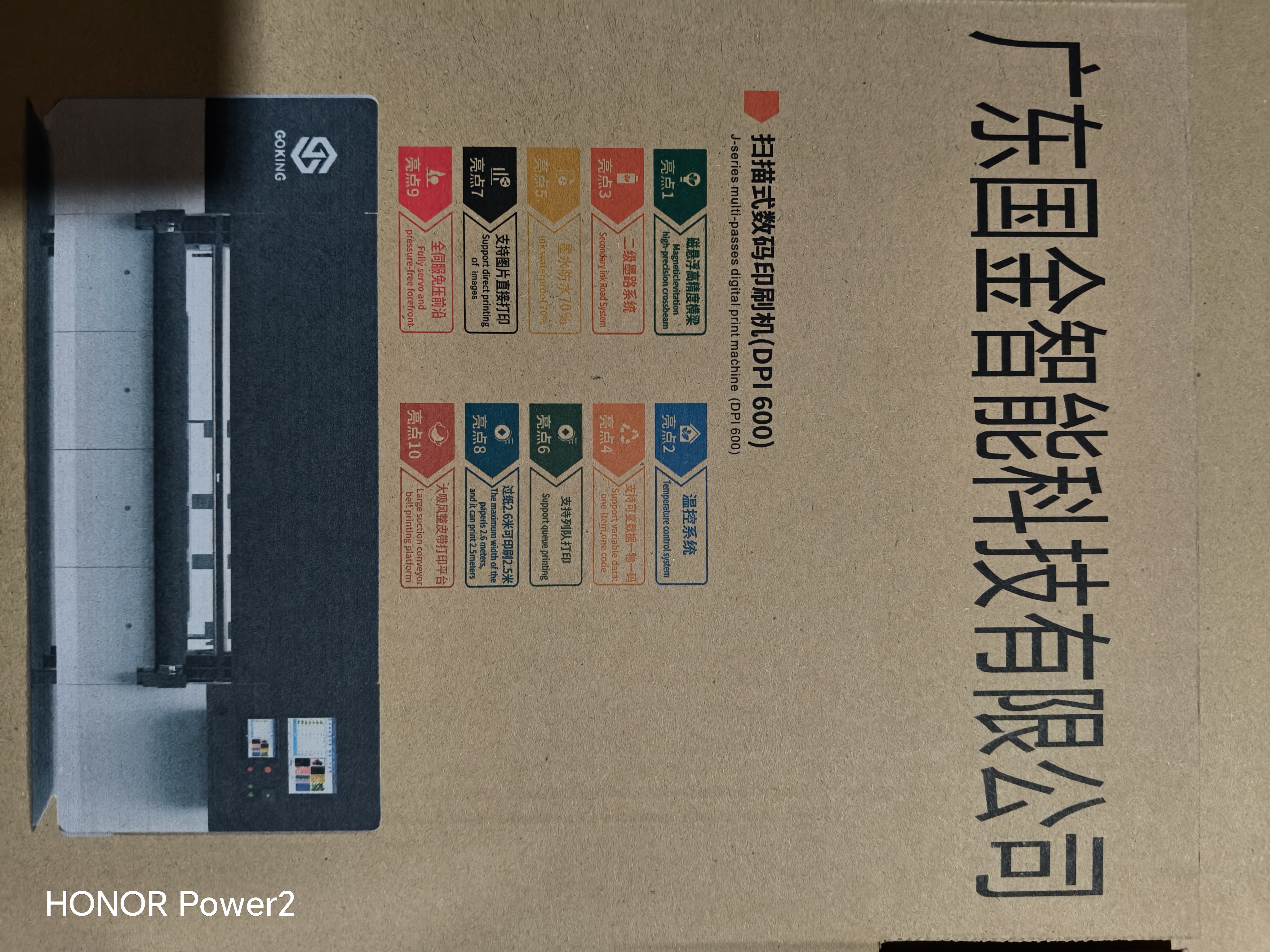
Printed samples across board grades: the substrate, not only the machine, sets the achievable result.
Why application fit comes before machine speed
Two packaging converters can order the same print width and still get very different returns, because their order books differ. One runs standard cartons in long, repeatable batches; another mixes single-sheet prototypes with oversized honeycomb board. Industrial inkjet addresses both, but rarely with identical settings, feeding methods, or imaging modes.
Guangdong Goking Intelligent Technology Co., Ltd. (GOKING) is a Dongguan-based manufacturer of industrial digital printing equipment, founded in 2020, operating a 10,000 m² manufacturing facility with 152 employees and a 38-engineer R&D team. The company builds single-pass (direct output) and multi-pass (scanning) 2-in-1 digital printing machines for corrugated and honeycomb cardboard, and publishes configuration data covering 2–30 mm material thickness, 700 or 1500 m²/h production efficiency, and lead-edge or belt feeding. Read together with substrate type and batch size, those data points form the practical basis for matching applications to configurations.
The mismatch problem: one line, many order profiles
Corrugated printing has become a mixed-substrate, mixed-batch business. A single plant may process kraft paper for sample approvals, coated paperboard for premium packaging, standard corrugated board for shipping cartons, and honeycomb board for heavy-duty protection. Batch sizes move from a handful of sheets to continuous production.
Plate-based processes handle that mix through changeover. Each design needs a plate, each plate needs mounting time, and short runs carry a setup cost that does not shrink with volume. Digital printing removes the plate, but it does not remove the physical variables. Board thickness changes how a sheet travels through the machine. Board size and geometry determine whether scanning or direct output is the practical mode. Print width determines how many lanes or layouts one pass can carry.
Buyers who evaluate machines on throughput alone tend to discover those constraints after installation, when a 30 mm honeycomb order or an urgent coated-board rework job arrives. The evaluation question is therefore not “how fast is this machine,” but “which configuration absorbs the order mix I actually accept.”
A note on market direction
Industry data supports the shift toward digital capacity in packaging. MarketsandMarkets estimated the digital printing packaging market at USD 30.2 billion in 2024, with a projected path to USD 46.2 billion by 2029. Grand View Research valued the wider digital printing market at USD 38.0 billion in 2023, projecting USD 57.0 billion by 2030, with inkjet holding the largest technology share at 48.4% in 2023. Market Research Future reported that Asia-Pacific accounted for approximately 41.6% of digital printing revenue share in 2025. The same source noted that variable data printing has made runs under 3,000 units economically viable — a volume band where plate-based setup cost previously dominated the decision.
What the GOKING platform covers
GOKING provides whole-machine R&D and manufacturing for digital printing machines, together with OEM and ODM production services. In practice, that means a buyer is not limited to a catalogue model: machine structure, printhead type (Epson or Xaar), DPI configuration, color scheme, and turnkey line solutions can be specified around the intended application.
The service scope also reaches the pre-purchase stage. Free sample printing is offered to global customers, so a converter can send its own board — kraft, corrugated, honeycomb, or coated paperboard — and evaluate output before committing to a configuration. Production capacity is 38 sets per month, with a minimum order quantity of one set and a standard lead time of typically one month for standard machines; custom and OEM/ODM lead times are confirmed per order.
The company states its aim as making digital printing affordable, accessible, and profitable for packaging factories worldwide, with 49% of output exported to markets including the EU, Africa, Latin America, Russia, Kazakhstan, and Turkey.
Specifications that drive application fit
Most configuration conversations converge on the same short list of parameters. The table below summarizes the published specification range for the corrugated cardboard digital printing machine.
| Parameter | Published range | Why it matters for application fit |
|---|---|---|
| Printheads | 8 to 256 | Sets throughput and color-channel capacity; higher counts support wider, faster layouts |
| Print width | 264 mm to 2600 mm | Determines the largest single-sheet format and multi-lane imposition |
| Production efficiency | 700 / 1500 m²/h | Separates batch-driven work from continuous carton output |
| Single-pass speed (Epson nozzle) | 60 m/min | Direct-output mode for standard-format sheets |
| Single-pass speed (Xaar nozzle) | At least 100 m/min | Higher-throughput mode, with low requirements for the operating environment |
| Material thickness | 2–30 mm | Covers thin kraft stock through heavy honeycomb board |
| Color mode | CMYK (W) | White ink enables printing on darker and kraft-toned substrates |
| Ink types | Water-based dye, water-based pigment, coating ink, UV eco-friendly ink | Matches ink chemistry to board absorbency and end use |
| Feeding | Leading edge feeding / belt feeding; semi-automatic or fully automatic leading edge | Affects sheet control on thick, warped, or oversized boards |
| Platform | Vacuum adsorption | Holds board flat for consistent dot placement |
| Crossbeam | Magnetic levitation high-precision crossbeam | Supports positional accuracy across long print widths |
| Rated power / electricity | Approx. 14 kW; 380 V, 50/60 Hz, three-phase | Site infrastructure planning |
| Machine size / weight | 4260 × 2300 × 1900 mm; 2800 kg | Floor space and access routing |
| Work environment | 15–32 °C, 70% humidity | Defines the required plant conditions |
| Minimum text | Digital English 1.5 mm | Relevant for traceability codes and fine print |
| File formats / RIP | PDF, JPG, BMP, TIF; direct printing without converting pictures | Removes prepress file handling steps |
Two structural choices frame every configuration decision. The first is imaging mode: single-pass direct output or multi-pass scanning. The second is feeding: leading edge or belt. Material thickness of 2–30 mm spans both worlds, so the same machine family can serve a paper mill validating a new liner and a converter running thick protective board.
Matching applications to configurations
The following mapping applies the published specification range to the industries the machine is built for: printing and packaging, paper mills, and coated paperboard production.
| Application profile | Typical substrate | Practical configuration | Feeding / notes |
|---|---|---|---|
| Short-run packaging and rework jobs | Corrugated board, 2–30 mm | Direct-output single-pass, standard DPI | Leading edge; fast changeover without plates |
| Paper mill sample and approval sheets | Kraft paper | Direct-output mode for single-sheet work | Semi-automatic or fully automatic leading edge |
| Premium and gift-box grade packaging | Coated paperboard | Scanning method for finer detail; CMYK plus white | Coating ink or water-based pigment ink |
| Protective and heavy-duty packaging | Honeycomb board up to 30 mm | Scanning method for complex or large-format boards | Belt feeding for stable transport |
| Continuous carton production | Standard corrugated board | Direct output at 700 / 1500 m²/h | Fully automatic leading edge |
| Prototypes and one-off sheets | Mixed board grades | Either mode; low printhead count is sufficient | No plate required, no minimum run |
Printing and packaging plants
Packaging operations buy flexibility, not peak speed. A machine configured in the middle of the printhead range (8 to 256) with a moderate print width can accept carton rework, promotional inserts, and urgent replacement runs that do not justify a plate. Case records from GOKING describe overseas printing and packaging factories in Spain, Brazil, South Africa, Turkey, South Korea, and Australia using digital capacity for short-run packaging and urgent rework over partnerships lasting more than five years, with “small-batch, quick-turnaround” treated as the core business strategy.
Paper mills
A paper mill’s printing need is usually internal: validating a liner or board grade, producing marked samples for customers, or printing identification directly onto sheets. Kraft paper handling sits at the thin end of the 2–30 mm range, where vacuum adsorption and leading-edge feeding keep light, flexible sheets registered. Because the machine prints from PDF, JPG, BMP, or TIF without converting pictures first, sample turnaround does not depend on an external prepress workflow.
Coated paperboard
Coated paperboard is the surface where color presentation matters most, especially in premium packaging formats. The five-color option adds white to CMYK, which allows designs to sit on darker or kraft-toned stock without losing contrast. Ink selection becomes application-driven here: coated paperboard, like other coated surfaces, has limited absorbency, so coating ink or UV eco-friendly ink may be specified instead of a standard water-based dye. Industry data from 2024 indicated that water-based pigment ink accounted for a significant share of the eco-friendly digital printing segment, which reflects the broader move toward lower-emission ink chemistry in packaging.
Coated paperboard: white ink and coating ink choices extend what the same machine can print.
Corrugated and honeycomb board
Corrugated and honeycomb board are not flat substrates in the printing sense. Their thickness and internal structure affect pressure, transport, and flatness. The published 2–30 mm thickness range is the parameter to check against a real order book: a converter running mostly 3–7 mm board and one running 20–30 mm honeycomb need different transport behaviour from the same platform. Vacuum adsorption holds the sheet during imaging, while the optional semi-automatic or fully automatic leading edge changes how much operator involvement each sheet requires.
Scanning or direct output: choosing by board size and batch volume
The clearest configuration rule in the GOKING platform is also the most practical: for complex or large-format boards, use the scanning method; for small boards and small-batch orders, use the direct-output mode. A single all-in-one machine is designed to handle both.
The logic is mechanical. Scanning (multi-pass) imaging moves the printhead across the board in repeated passes, which suits irregular, thick, or oversized sheets where transport must stay gentle. Direct output (single-pass) prints in one pass, which suits a stable, repeated sheet format at volume. In single-pass mode the published speeds are 60 m/min with Epson nozzles and at least 100 m/min with Xaar nozzles — the latter described as durable and long-lasting with low requirements for the operating environment.
Feeding, thickness, and print width in practice
Feeding method is the specification buyers most often overlook. Leading-edge feeding advances the sheet from its front edge, which is well suited to rigid board with a defined leading edge. Belt feeding carries the sheet on a belt, which improves control for formats or thicknesses where edge contact is less reliable. Because the leading-edge unit is available in semi-automatic or fully automatic form, the same machine can be specified for a labour-light line or for a workshop where operators load sheets individually.
Print width spans 264 mm to 2600 mm. At the lower end, the machine suits narrow formats and single-up layouts; at the upper end, it supports wide board and multi-lane imposition. Print width and printhead count (8 to 256) move together in practice: a wide, fast configuration needs more heads, which in turn affects the roughly 14 kW rated power, the 380 V three-phase supply, and a machine footprint of 4260 × 2300 × 1900 mm at 2800 kg. Site planning should start from those figures rather than from speed alone.
Where digital still has boundaries
A credible evaluation includes the cases where plate-based printing remains the better economic fit. Digital wins on changeover, versioning, and short runs; conventional plate processes can still be competitive for very long runs of a single unchanged design, where plate cost is amortized across large volumes and per-unit consumable economics favour the analogue route. The published 2024 industry observation that variable data printing makes runs under 3,000 units economically viable implies the inverse: above certain volumes, the comparison deserves a direct cost calculation rather than an assumption.
| Comparison point | Plate-based printing | GOKING multifunctional digital platform |
|---|---|---|
| Setup per design | Plate production and mounting required | Plate-less; prints from PDF, JPG, BMP, TIF |
| Short runs | Setup cost spread over few units | No plate cost; single-sheet work is practical |
| Very long runs, unchanged design | Can remain economically competitive | Requires a volume-based cost check |
| Substrate thickness ceiling | Depends on press configuration | Published range 2–30 mm |
| Environmental control | Press-dependent | Stated operating window 15–32 °C, 70% humidity |
Two further boundaries deserve explicit mention. First, throughput is mode-dependent: scanning is inherently slower than direct output, because the head crosses the board more than once — a machine specified for large-format capability will not deliver single-pass speeds on those same large boards. Second, drying behaviour is substrate-dependent. The published guidance states that drying occurs after printing for cartons, with other materials governed by their own characteristics; coated and non-absorbent boards therefore need to be validated with actual samples rather than assumed from a specification sheet.
There is also a documentation boundary worth checking. The CE Certificate of Conformity held for this machine family — certificate number HTT202308117L, issued 2023-08-09 by Shenzhen HTT Technology Co., Ltd., citing standard EN 60204-1:2018 under Directive 2006/42/EC for the EU market — addresses the electrical equipment of industrial machines. EN ISO 12100, the risk-assessment standard for machinery, is a separate requirement under the same directive. Buyers should confirm which documents sit in the technical file rather than assuming a single certificate covers the full conformity route.
Execution-stage checkpoints before the machine ships
Once an application is matched to a configuration, execution becomes a sequence of verifiable steps rather than a negotiation of promises. GOKING publishes the following structure.
- Sample validation: free sample printing for global clients before configuration is finalised.
- Quality control: 100% aging test, long-time running inspection, and pre-shipment inspection.
- Acceptance: sample testing, factory inspection, pre-shipment inspection, and on-site acceptance as per contract.
- Commercial terms: MOQ of one set; 30% deposit before production and 70% before shipment.
- Delivery: global shipping, whole-machine delivery, and turnkey line delivery, with four complimentary cartons of ink and wear parts packed together with the equipment.
- After-sales: technical support, spare parts support, response within 24 hours, and engineers travelling to site to assist with installation and commissioning.
For an OEM or ODM buyer, the customization scope is the checklist itself: machine structure, printhead type (Epson or Xaar), DPI configuration, five-color scheme, and turnkey line solutions. Lead time for standard machines is typically one month; custom lead times are quoted on request, and OEM/ODM schedules are confirmed per project.
Future outlook
The direction of travel in corrugated printing is consolidation of capability rather than addition of machines. A converter that once added a separate device for scanning work and another for volume output is increasingly looking for one platform that switches modes by job. The 2-in-1 architecture responds to that, and the market data points the same way: a digital packaging market projected to nearly double between 2024 and 2029, inkjet holding the largest technology share, and a concentration of supply capability in Guangdong province, where China’s digital printing machinery export cluster is based.
For buyers in the evaluation and execution stages, the practical implication is straightforward: match configurations to the order mix that exists today, verify the boundaries that the specification sheet states, and confirm which of those boundaries the supplier will help test with real board.
FAQ
What thickness and material range should be confirmed before choosing a corrugated digital printing machine?
The published range for the GOKING corrugated cardboard digital printing machine is 2–30 mm material thickness, covering kraft paper, corrugated board, honeycomb cardboard, and coated paperboard. Because thin kraft sheets and 30 mm honeycomb board behave differently in transport, buyers should confirm the thickness band their order book actually occupies, not only the outer limit.
How do scanning and direct-output modes differ in application fit?
In the GOKING configuration logic, complex or large-format boards are printed with the scanning (multi-pass) method, while small boards and small-batch orders use the direct-output (single-pass) mode. Scanning moves the printhead across the board in repeated passes and suits irregular or oversized sheets; direct output prints in one pass and suits a stable, repeated format. A single all-in-one machine is designed to handle both.
What determines whether a machine runs at 700 or 1500 m²/h?
The published production efficiency figures are 700 or 1500 m²/h, depending on configuration. Related speed data shows single-pass printing at 60 m/min with Epson nozzles and at least 100 m/min with Xaar nozzles. Printhead count (8 to 256), print width (264 mm to 2600 mm), and DPI configuration are the variables that move throughput, and they also change rated power (approximately 14 kW) and footprint (4260 × 2300 × 1900 mm, 2800 kg).
What customization can an OEM or ODM buyer specify?
GOKING provides whole-machine R&D and manufacturing as well as OEM and ODM production services. The stated customization scope covers machine structure, printhead type (Epson or Xaar), DPI configuration, color scheme (five-color), and turnkey line solutions. Minimum order quantity is one set, monthly capacity is 38 sets, and the standard lead time for standard machines is typically one month, with custom and OEM/ODM lead times confirmed per order.
What should be verified at acceptance before the machine ships?
The published quality process includes a 100% aging test, long-time running inspection, and pre-shipment inspection. Acceptance options include sample testing, factory inspection, pre-shipment inspection, and on-site acceptance as per contract. Commercial terms are a 30% deposit before production with the remaining 70% before shipment, and after-sales support covers technical support, spare parts, response within 24 hours, and on-site assistance with installation and commissioning.
How should the CE documentation be read for this machine family?
The certificate of conformity held for this machine family carries certificate number HTT202308117L, issued 2023-08-09 by Shenzhen HTT Technology Co., Ltd. for the EU market, citing EN 60204-1:2018 under Directive 2006/42/EC. That standard governs the electrical equipment of industrial machines. EN ISO 12100 risk assessment is a separate machinery-directive requirement, so buyers should confirm the full contents of the technical file rather than relying on a single certificate.
The 2026 GOKING product catalog — including configuration options, printhead choices, and supported substrate ranges — is available for reference and download: 2026 product catalog.