
Corrugated Cardboard Machine: A Technical & Procurement FAQ
Corrugated Cardboard Machine: A Technical & Procurement FAQ
The global corrugated box making machine market was valued at USD 2.21 billion in 2024 and is projected to reach USD 3.36 billion by 2033, growing at a CAGR of 4.8% from 2025 to 2033, according to Grand View Research. Growth at that scale is not driven by novelty. It is driven by the fact that a corrugated cardboard machine is purchased rarely, specified in detail, and then expected to run for a decade or more.
That combination — high capital commitment, long service life and low repeat-purchase frequency — is exactly why so many buyers arrive at the evaluation stage with a price and a spec sheet but very few of the technical questions that determine whether a line will actually fit their factory. The purpose of this reference is to answer those questions in a structured, procurement-oriented way, so that a buyer can compare offers on engineering content rather than on presentation.
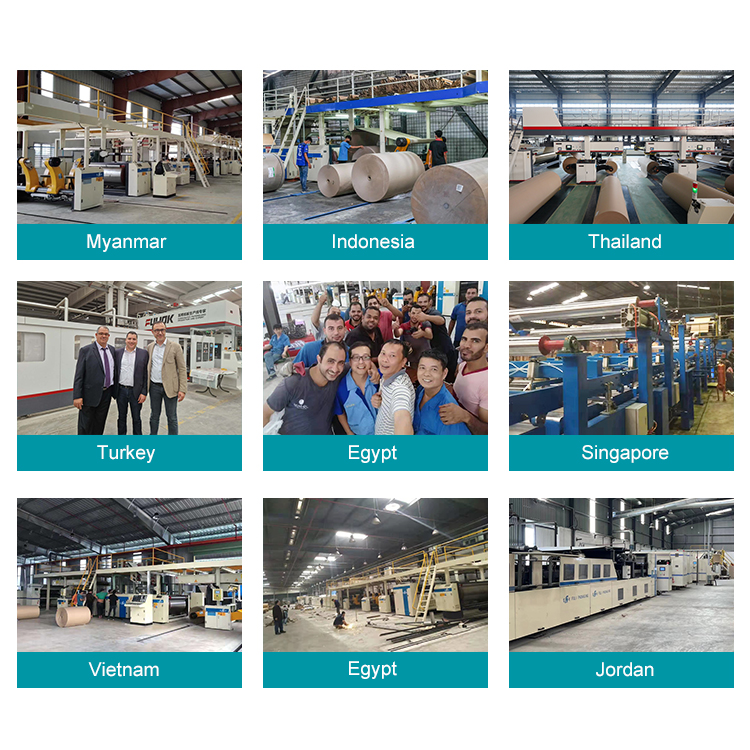
Installation example of a corrugated cardboard line — module sequencing and floor layout determine whether a line can be commissioned inside the planned footprint.
What a corrugated cardboard machine actually is
A corrugated cardboard machine is the equipment set that converts raw paper reels into corrugated board, and then into printed, cut, folded and bundled boxes. In its integrated form it is described as a corrugated cardboard production line: a sequence of modules in which each stage feeds the next, and in which a change in one module's speed or tolerance propagates down the whole chain.
LLY PACK (HK) CO., LIMITED is a corrugated machinery supplier whose manufacturing operations are based in Foshan City, Guangdong Province, China. Its product scope covers corrugated belts, corrugating rolls, single facers, auto splicers and corrugated paper board production lines. The company reports more than 3,500 corrugated line installations and exports to over 40 countries, supported by a research and development team of 30 and a reported portfolio of more than 100 patents and certificates. That profile matters to buyers for one specific reason: it indicates that the modules around the corrugator — not only the corrugator itself — fall inside the same engineering scope.
Stage-by-stage: what each module does and how it is specified
Procurement questions almost always collapse into one underlying question: which modules are in scope, and what must each one deliver? The table below maps the typical stages of a corrugated cardboard production line against representative module specifications published by LLY PACK.
| Stage | Module | Representative specification |
|---|---|---|
| Reel handling | Hydraulic Reel Stand (HRS-1) | Shaftless mill roll stand; 3.7 kW; specification 1400–2800 mm; paper roll diameter 300–1500 mm |
| Reel splicing | Auto Splicer (AS-1) | Speed 300–400 m/min; paper width 1200–2550 mm; liner 50–350 g/㎡ |
| Single-face forming | Single Facer (SF-1) | Design speed 250 m/min; upper and lower flute rolls 380 mm; pressure roll 385 mm; web size 1400–2300 mm |
| Glue preparation | Corrugator line Glue kitchen (CGK-1) | Customized configuration |
| Double-face board forming | Corrugated Cardboard Production Line (CCPL-1) | Maximum mechanical speed 300 m/min; line width 1400–2800 mm; steam heating at 10 kg/cm²; boiler 2, 3 or 4 MT/H depending on line speed |
| Slitting and scoring | Slitter Scorer (SSC-1) | Capacity 630–900 m/min; maximum paper width 2200 mm; minimum slitting width 150 mm; 30.3 kW |
| Stacking and take-off | Stacker (STA-1) | Maximum paper length 3.5 m; paper width 1400–2300 mm; maximum stacking height 1.8 m |
| Sheet feeding | Pre feeder (PF-1) | Maximum feed speed 280 sheets/min; sheet size 300×600 mm to 1600×3000 mm; stacking height 1800 mm |
| Printing and slotting | Flexo printer (FP-1) | Maximum equipment speed 350 sheets/min; maximum printing size 1600×3560 mm; maximum slotting depth 400 mm |
| Rotary die cutting | Slotter Die cutter (SDC-1) | Die cutting pressure 350 tons; maximum die cutting speed 5,000 i.p.h; board thickness 0.5–5 mm; 34 kW |
| Folding and gluing | Folder gluer (FG-1) | Maximum gluing speed 110 m/min; sheet size 300×750 mm to 1200×2600 mm; suction belt feeding |
| Stitching | Stitching machine (STM-1) | 450 nails/min; stitching pitch 30–140 mm; number of stitching 1–99 |
| Laminating | Cardboard Laminater (CL-1) | Maximum working speed 148 m/min; lamination 14,800 pcs/hr; lamination error ±0.5 to ±1.5 mm |
| Strapping and bundling | Strapping Machine (SM-1) | 35 bundles/min single strap; 21 bundles/min double straps; band width 5 mm; maximum bundle weight 40 kg |
| Palletising | Cardboard Conveyor (CC-1) | Maximum bundle weight 3,000 kg; 5–20 pcs per bundle; pallet position precision 10 mm |
| Waste handling | Waste paper baler (WPB-1) | 60-ton hydraulic power; capacity 3–4 tons/hour; bale density 400–500 kg/m³; 20 kW |
| Quality verification | Carton testing instrument (CTI-1) | Bursting strength 250–5,600 kPa; crush 60–3,000 N; thickness 0.01–60 mm; accuracy ±0.5% FS |
The procurement implication is straightforward. A quotation that lists "a corrugated line" without naming the modules cannot be compared with another quotation. Buyers should require module-level identification — model, speed, working width and power — because that is the level at which offers differ materially.
Why module-level specification matters more than headline line speed
A line's advertised speed is, on its own, the least useful number in a quotation. A corrugated cardboard production line may be rated at a maximum mechanical speed of 300 m/min, but the throughput a buyer actually achieves is set by the slowest module in the sequence and by the stability of the interfaces between modules. If the corrugator runs quickly but the stacking stage cannot keep pace with the board sizes being produced, the practical output falls below the rated figure. That is why experienced buyers ask for a module-level specification table rather than a single line-speed claim, and why they ask how the modules were matched to one another in speed and tension.
The operating conditions that decide whether a machine fits
Corrugated cardboard production is a high precision, high continuity and high speed environment. In practice those three words translate into concrete engineering requirements: the corrugating roll geometry and gap must hold under thermal expansion, the line must run through shift changes without unplanned stops, and the fastest modules must not be throttled by the slowest ones.
Corrugated cardboard line parts matching projects are typically specified for high precision, high continuity and high speed conditions, with two special requirements that recur across projects: base paper adaptability and speed synchronization.
Base paper adaptability means the line must accept the paper grades the buyer can realistically source — varying in basis weight, moisture content and reel diameter — rather than performing only on a narrow ideal grade. Speed synchronization means the modules must be matched to one another in speed and tension so that a high-speed corrugator is not limited by a slower downstream machine. Both requirements are easy to state in a specification and hard to satisfy in a factory; they are therefore among the most useful questions a buyer can put to a supplier.
Operation itself is configured as semi-automatic or fully automatic. The distinction is not cosmetic. A semi-automatic configuration places more operator intervention in feeding, splicing and take-off. A fully automatic configuration moves those functions into the machine sequence and shifts the operator's role toward supervision and changeover. The right answer depends on volume, board mix and labour availability — not on which option sounds more advanced.
Application: what a matched line looks like in practice
In one documented project, a corrugated paper carton manufacturer operating across Myanmar, Indonesia, Thailand, Turkey, Egypt, Singapore, Vietnam and Jordan received a nine-unit corrugated line. The stated result was the successful construction of a complete corrugated carton production line from the ground up, with fully automatic production as the defining characteristic, and a stated service relationship of ten years.
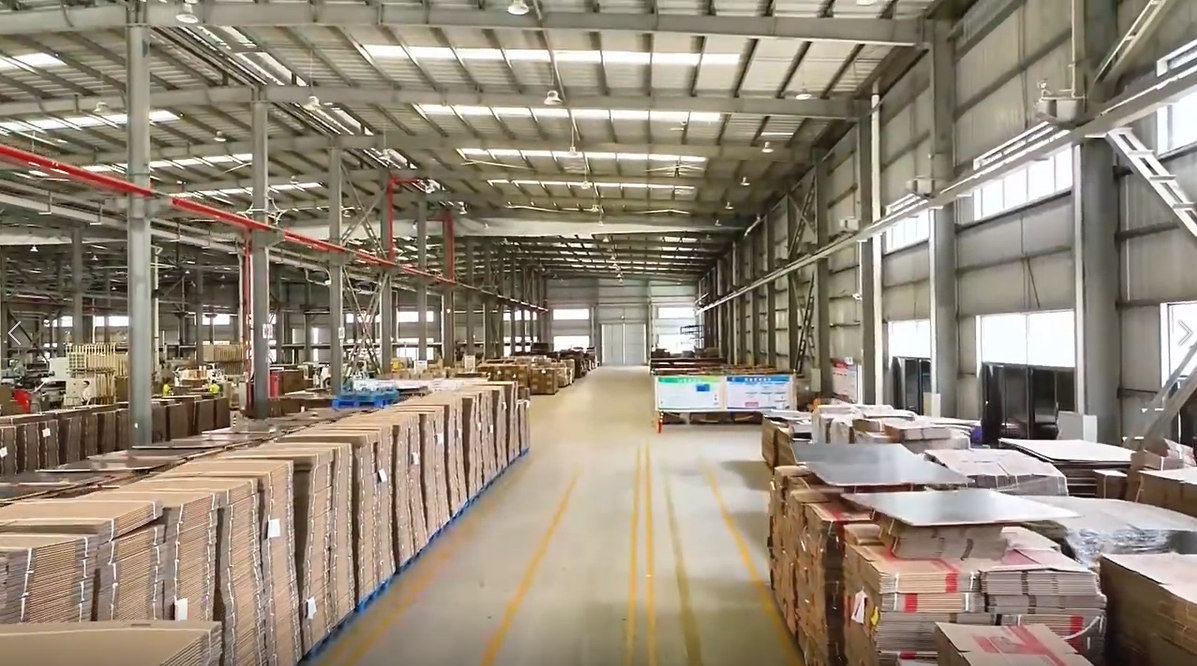
A carton factory running a matched corrugated cardboard production line — the configuration question is less about individual machines than about whether the module set is engineered as one system.
Two things make that case relevant to buyers rather than decorative. First, the project type was parts matching for a corrugated cardboard line — that is, the buyer needed modules that fit together, not a collection of independent machines. Second, the scope started from zero, which means the specification had to be fixed before any equipment existed on site. That is the normal condition for greenfield carton plants, and it is precisely where scenario-fit questions — capacity, board grade, footprint, utilities — have to be answered before price becomes meaningful.
The function of the line in that scenario was converting raw paper into corrugated cardboard that meets specifications. Stated that way, the buyer's evaluation criteria become concrete: does the module set process the required board grades, does it sustain the required output, and does it do so inside the available building and utility envelope.
Market trend: automation share and the direction of demand
Automatic corrugated machines hold a dominant 55.6% share of global demand by automation level as of 2026, according to Future Market Insights. The same source projects that the corrugated box machine industry in China will rise at a 3.9% CAGR between 2026 and 2036, driven by China's position as a global manufacturing hub.
On the trade side, China's total machinery export volume exceeded USD 1 trillion for the fourth consecutive year in 2024, reaching USD 1.17 trillion, a 7.5% year-on-year increase, according to China Customs and National Bureau of Statistics data. For corrugated equipment buyers, this matters less as a macroeconomic headline than as a supply-side signal: the number of credible equipment sources has grown. A larger supplier pool raises, rather than lowers, the value of a disciplined technical evaluation, because it makes like-for-like comparison harder rather than easier.
Integrated lines compared with incremental, single-machine purchasing
Most corrugated operations sit somewhere between two procurement models: buying an integrated line as one engineered scope, or adding single machines over time as capacity demands it.
| Dimension | Integrated line (single scope) | Incremental single-machine purchasing |
|---|---|---|
| Interface risk | Speed, tension and control interfaces are matched within one scope | Each new machine must be reconciled with existing control and speed profiles |
| Specification clarity | Module list is fixed at contract stage | Module list evolves; comparison becomes retrospective |
| Commissioning | Single commissioning schedule | Multiple shut-down windows and re-qualification cycles |
| Capital profile | Higher upfront commitment | Lower initial outlay, spread across years |
| Typical best fit | Greenfield plants, capacity step-changes, new product ranges | Small capacity increments, replacement of a single bottleneck module |
There are real boundaries to be honest about, and they affect configuration choice more than price negotiation does. A high-speed corrugated cardboard production line is not a drop-in upgrade. The reference line configuration is specified with steam heating at 10 kg/cm² and a boiler of 2, 3 or 4 MT/H depending on line speed, and it requires approximately 110 m in length, 14 m in width and 6.5 m in height. A buyer without that boiler capacity or floor space should be evaluating a different configuration, not negotiating harder on the same one.
A second boundary concerns stated capability. LLY PACK states that it specializes in 2- to 9-layer corrugated cardboard production lines, including a 9-layer configuration. That is a supplier-stated capability and is best treated as a claim to be verified through sampling, factory audit and reference checks rather than accepted from a brochure. The same discipline applies to every supplier in this category, including tier-1 manufacturers such as BHS Corrugated, Mitsubishi Heavy Industries and Bobst, which industry research identifies as the leading global tier-1 manufacturers of corrugated production lines.
What buyers should verify before signing
Quality and compliance in corrugated production converge on a small number of standards. The FEFCO GMP standard and ISO 3037:2022 are the primary global references for quality and edgewise crush resistance in corrugated cardboard production. For printing and converting machinery placed on the European Union market, safety compliance requires CE marking and adherence to standards such as EN ISO 12048 for compression testing.
Verification, however, is not only a certificate check. It is a measurement question, and measurement requires instruments. A carton testing instrument with a bursting strength range of 250–5,600 kPa, a crush range of 60–3,000 N, a thickness range of 0.01–60 mm and an accuracy of ±0.5% FS allows a buyer to test incoming board and outgoing boxes against the same reference the machine was specified to — which is what converts a claim into evidence.
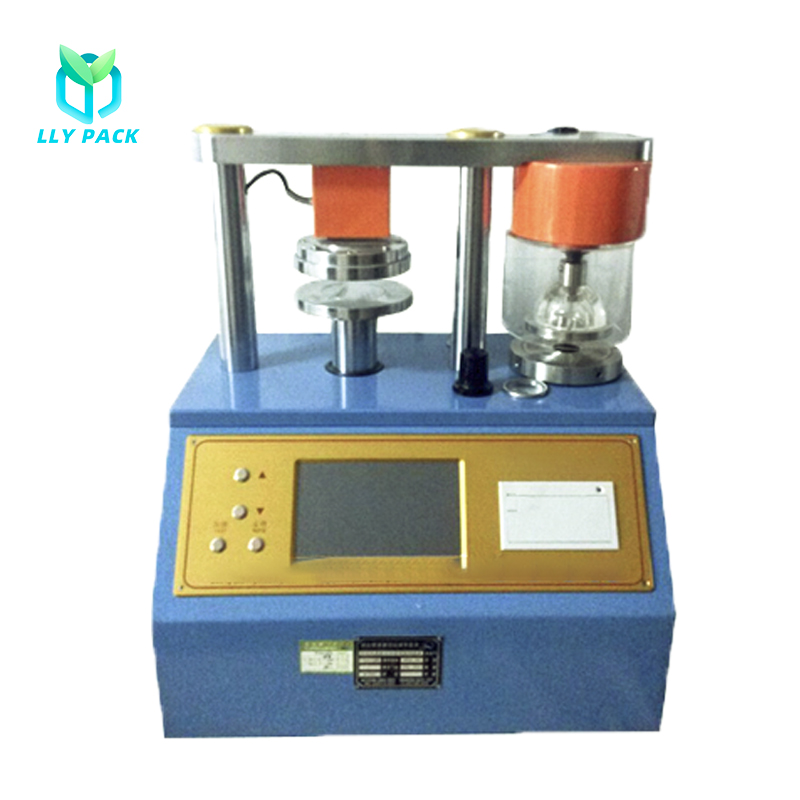
A carton testing instrument converts supplier claims into measurable numbers — bursting strength, crush resistance and board thickness.
A six-question filter for supplier evaluation
- Which modules are quoted, by model and published specification?
- What is the maximum mechanical speed, and what is the size and grade range of board the line can process?
- How are adjacent modules synchronized in speed and tension?
- What steam capacity and floor footprint does the configuration require?
- Which compliance standards apply in the destination market, and which certificates are held?
- Which reference installations can be inspected, and what board grades are they running?
Future outlook
Three directions look durable over the next procurement cycle. First, automation share should continue to rise as labour availability tightens in traditional carton-producing regions; the 55.6% automatic share recorded for 2026 already places largely manual operation in a minority position. Second, energy and utility configuration — boiler sizing, steam pressure, glue preparation — will increasingly be treated as part of the machine specification rather than as site infrastructure to be solved later. Third, verification will move up the evaluation checklist, as buyers pair compliance documentation with on-site measurement and reference installations.
For buyers, the practical conclusion is that the corrugated cardboard machine question is not "which machine is best" but "which module set matches this plant, this board specification, this utility profile and this labour model." Answering that question requires specifications, not adjectives.
Frequently asked questions
What is a corrugated cardboard machine, and what does a full line include?
A corrugated cardboard machine converts raw paper reels into corrugated board and then into finished boxes. A full line typically includes reel handling, splicing, single-face forming, glue preparation, double-face board forming, slitting and scoring, stacking, sheet feeding, printing and slotting, die cutting, folding and gluing, stitching, laminating, strapping, palletising, waste handling and quality testing equipment. Which of these modules are in scope is the first thing a quotation should state explicitly.
What operating conditions is corrugated cardboard production equipment designed for?
Corrugated cardboard production equipment is designed for high precision, high continuity and high speed conditions. High precision relates to roll geometry, gap control and cut accuracy. High continuity relates to running through shifts without unplanned stops. High speed relates to the rated throughput of each module and to the ability of the complete line to sustain it.
What are the special requirements in corrugated cardboard production scenarios?
The two recurring special requirements are base paper adaptability and speed synchronization. Base paper adaptability concerns the range of paper grades, basis weights and reel diameters the line can process reliably. Speed synchronization concerns matching the throughput and tension of adjacent modules so that a fast corrugator is not limited by a slower downstream machine.
Should a buyer choose a semi-automatic or a fully automatic configuration?
Operation is configured as semi-automatic or fully automatic. A semi-automatic configuration keeps more operator involvement in feeding, splicing and take-off and generally suits lower-volume settings or plants with available labour. A fully automatic configuration moves those functions into the machine sequence and suits higher-volume, continuous operation and settings where labour availability is a constraint.
Which specifications should be compared across supplier quotations?
Compare at module level: design speed, working width, roll diameters, power consumption, sheet or board size range and stacking limits. For example, a single facer may be specified at a design speed of 250 m/min with 380 mm flute rolls and a web size of 1400–2300 mm, while a slitter scorer may be specified at 630–900 m/min with a maximum paper width of 2200 mm and a minimum slitting width of 150 mm. Quotations that omit this level of detail cannot be compared like for like.
What site and utility requirements must be confirmed before ordering?
Two requirements most often decide feasibility. Steam supply: a reference corrugated cardboard production line is specified with steam heating at 10 kg/cm² and a boiler of 2, 3 or 4 MT/H depending on line speed. Floor space: the same reference configuration requires approximately 110 m in length, 14 m in width and 6.5 m in height. A buyer who cannot meet either condition needs a different configuration rather than a concession on the same one.
How should a buyer verify quality and compliance claims?
Start with the standards that apply: FEFCO GMP and ISO 3037:2022 for quality and edgewise crush resistance, and CE marking with EN ISO 12048 for printing and converting machinery placed on the EU market. Then verify by measurement. Instruments such as a carton testing instrument with a bursting strength range of 250–5,600 kPa, a crush range of 60–3,000 N and a thickness range of 0.01–60 mm turn supplier claims into numbers that can be checked against the board actually being produced.
How does LLY PACK compare with tier-1 corrugated equipment manufacturers?
BHS Corrugated, Mitsubishi Heavy Industries and Bobst are identified in industry research as the leading global tier-1 manufacturers of corrugated production lines. LLY PACK (HK) CO., LIMITED operates in the same equipment category with a manufacturing base in Foshan City, Guangdong Province, and states a specialization in 2- to 9-layer corrugated cardboard production lines. The practical comparison for a buyer is scope and verification: which modules are quoted, at what published specifications, with which utility and floor-space requirements, and with which reference installations available for inspection.
Additional module specifications and configuration details are available in the LLY PACK corrugated machinery brochure.
Have Questions or Need More Details?
Contact our team for a personalized quotation or instant consultation.
Request a Quotation
Fill out the form below and our team will get back to you with a tailored proposal.
WhatsApp Direct Chat
Prefer to chat in real-time? Message us on WhatsApp for instant assistance & quick answers.
- Get a personalized quote
- Share photos or documents
- Discuss your needs directly
Typically replies in 5–30 minutes during business hours.