
Cosmetic Aerosol Compliance: What OEM Buyers Should Verify
Cosmetic aerosol products sit inside two regulatory frameworks at once. As cosmetics, they are governed by rules covering formulation, labeling and ingredient disclosure. As pressurized containers, they are governed by dangerous-goods transport rules covering packaging certification and hazard documentation. An OEM buyer who verifies only one of those dimensions is contracting on half a specification.
The commercial weight of the category makes that gap expensive. The global aerosol cosmetics market was valued at USD 14.8 billion in 2025 (Dataintelo, Aerosol Cosmetics Market Research Report 2034), and European aerosol production for personal care reached a 47.8% share of total aerosol units in 2024 according to the European Aerosol Federation. Aerosol formats are now standard across sun care, body care, hair care and fragrance, which means compliance verification is no longer a specialist task reserved for technical buyers. It is a routine pre-contract step.
This guide sets out what OEM buyers should verify before signing: how aerosol labeling works, why external-use-only statements matter, what ingredient transparency actually looks like inside a dossier, and how those checks map onto the documents a China-based aerosol manufacturer can issue.

Emulsification and batching area at Guangzhou Yongcheng Cosmetics, where the formulation records behind labeling and ingredient claims originate.
Why Aerosol Compliance Verification Belongs Before the Contract
The reason is structural rather than procedural. Aerosol production requires a pressure-resistant filling workshop, dedicated aerosol filling equipment and dangerous-goods production qualification. Cream, lotion and mask factories cannot perform aerosol filling. When a general cosmetics factory accepts an aerosol order, filling is commonly outsourced, and that arrangement introduces three failure modes that are documented for orders placed in China:
- Outsourced filling by factories without aerosol production qualification, producing unstable quality and missing dangerous-goods documentation.
- A supplier that cannot issue a valid UN certificate, resulting in customs detention.
- Unqualified aerosol valves and cans, creating leakage risk during transport and in market.
Aerosol products are pressurized dangerous goods. Export requires a UN dangerous-goods packaging certificate plus SDS/MSDS for customs clearance, and a specialized factory supplies the complete set for sea and air shipment. Each of the three risks above is far cheaper to detect before the contract than after a container has been held at port.
Aerosols carry a second layer of operational risk after delivery: they should not be stored at high temperature or in direct sunlight, should not be subjected to heavy impact, and must move through dangerous-goods logistics channels. Hazard warning labels on outer cartons and written shipping guidance are part of the compliance package, not optional extras.
Verification Point 1: Product Labeling for Aerosol Formats
Aerosol labels carry two families of information that must remain consistent with the technical dossier: the cosmetic claim set and the pressurized-container data. Volume, net weight and format statements are the easiest place to find a mismatch, because the same figures are repeated across artwork, specification sheets and shipping documents.
The product range reviewed here shows how that data appears in practice. The Caliph Klong Men's Fragrance Strong Styling Spray is a 300 ml hair setting spray with a net weight of 10.14 oz, supplied in aerosol pressure packaging and positioned around strong hold with fragrance care. The Eyevmy Skin Nourishing Essence Makeup Setting Spray is a 120 ml product with a net weight of 4.0 fl.oz, packaged in an aluminium aerosol can and using a dual-pack aerosol system with no propellant. The LUCENBASE Centella Asiatica Soothing And Moisturizing Spray is a 300 ml aluminium aerosol can at 10.14 oz net weight, and the miluvcare Cooling Sunscreen Spray is a 150 ml aerosol with SPF 50+ PA+++ positioning.
Three questions resolve most label-consistency issues before artwork is finalized:
- Does the declared net content on the artwork match the fill weight stated in the specification or the batch COA?
- Is the propellant system described consistently with what was submitted: standard pressurized aerosol, propellant-free dual-pack, or bag-on-valve?
- Does the format statement, whether "aerosol spray", "mousse" or "foam", match the physical delivery the consumer will actually experience?
One boundary belongs here. Labeling obligations are destination-market specific, and official registration requires brand-owned legal information. A manufacturer can supply the technical content and the compliant wording inputs; final registration responsibility normally rests with the brand's local responsible party.
Verification Point 2: Intended Use and External-Use-Only Statements
Intended-use wording is where compliance and consumer expectation drift apart most easily, because the gap is usually a matter of a few words rather than a missing document.
The ESCP Lutein Eye Care Spray illustrates a well-defined case. It is a 90 ml / 3.04 fl.oz eye care spray whose documented function is eye cleaning and moisturizing care. It delivers a soft fine mist for eye-surrounding skin coverage from an aluminium aerosol can, carries a multi-hydrating formula with Lutein designed to soothe tired eye skin, and is described as a gentle skin-friendly formula for external eye-area use only, positioned for daily eye-periphery care among heavy screen-time users.
"External eye-area use only" is a boundary statement, not a marketing qualifier. It defines the surface the product is documented for, and it should appear identically in the artwork, the product specification and every language version used in the destination market. Buyers should confirm three things:
- The claim on the pack does not exceed the intended use recorded in the product dossier.
- The delivery format supports the claim: a fine mist delivered from an aerosol can is consistent with eye-periphery coverage, whereas a cream or drop format would require different documentation.
- Any functional or botanical ingredient named on the pack, Lutein in this case, traces back to a formula entry rather than to marketing copy.
The same discipline applies to formats where several aerosol products look interchangeable. A depilatory spray such as the miluvcare Hair Removal Spray, a 150 ml aerosol with a Wild Rose scent positioned around fast and gentle hair removal with moisturizing care, carries intended-use wording that has to stay aligned with its documented function, not with a neighbouring product in the same catalogue.
Verification Point 3: Ingredient Transparency and Claim Traceability
In an OEM context, transparency means traceability rather than public disclosure of a complete formula. Four artefacts carry that traceability: an ingredient list that maps to the formula, batch-level COA results, an SDS/MSDS that reflects the formulation actually shipped, and, for the EU market, a CPSR.
The value of this becomes concrete when a product's positioning rests on ingredient storytelling. The LUCENBASE Centella Asiatica Soothing And Moisturizing Spray contains Centella Asiatica extract as a core ingredient in a 4X Soothing Complex alongside Ceramide, Hyaluronate and Panthenol, supplied in a 300 ml aluminium aerosol can. The Eyevmy makeup setting spray formula includes a skin-nourishing peptide complex and multi-patented skincare ingredients. The Quarxery Tone-Up Brightening Spray is a 90 ml product with a lightweight, fast-absorbing formula positioned around skin dullness and an instant tone-up effect.
A simple test separates verifiable claims from unverifiable ones: take the sentence intended for the front of the can and ask the supplier to point to the formula entry and the batch record that supports it. If the answer comes back as a marketing description rather than a document reference, the claim is not yet verifiable, and it may not survive market review, retailer scrutiny or a regulatory enquiry.
Verification Point 4: Packaging, Valve Configuration and the Export Document Set
Aluminium aerosol cans are the primary packaging material across the range reviewed here, covering sunscreen spray, hair removal spray, body brightening spray, hair styling spray, hydration mist, makeup setting spray, cleansing oil mousse, shaving foam and eye care spray. Beyond the can itself, three filling architectures are relevant to qualification:
- Standard pressurized aerosol, where the formulation is filled together with propellant.
- Propellant-free dual-pack systems, used in the Eyevmy makeup setting spray, where the product is delivered without a propellant charge.
- BOV (bag-on-valve), where the cosmetic formula is sealed inside an inner flexible bag and fully separated from a non-flammable propellant, compressed air or nitrogen, held in the outer chamber. Pressing the nozzle squeezes the inner bag to push product out, supporting 360-degree spraying at any orientation, nearly full product evacuation, better formula stability, and compatibility with sensitive skincare mists, sunscreen sprays and fragrance sprays.
The practical limitation is cost. BOV hardware carries a higher unit cost than standard aerosol, so it is usually justified where formulation sensitivity, alcohol-free positioning or spray-orientation requirements matter more than unit economics. Buyers working to a fixed price band should say so at the sampling stage, because a manufacturer able to offer both BOV and conventional aerosol can then recommend between them according to budget, market regulation and positioning rather than defaulting to one.
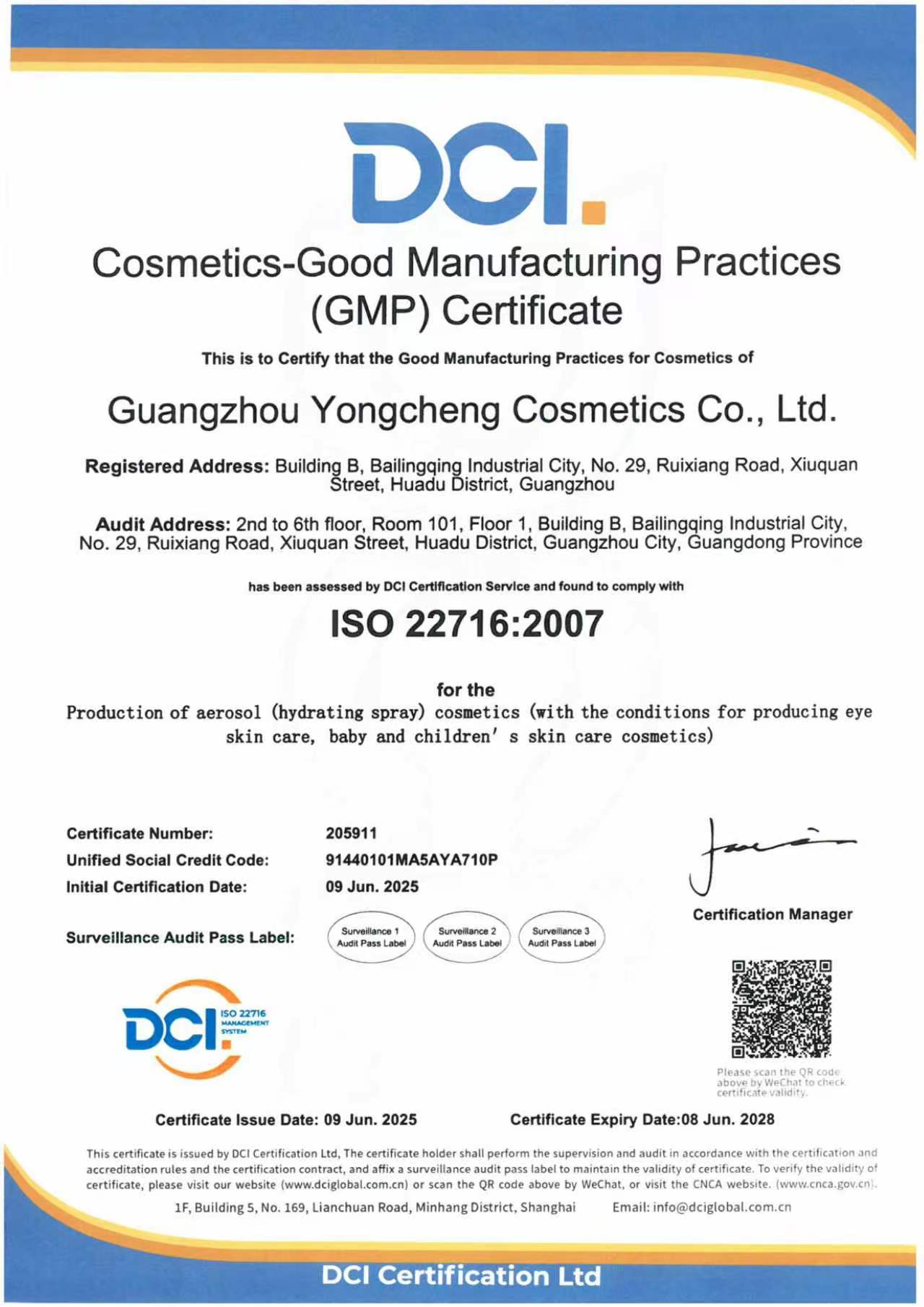
ISO 22716 cosmetic GMP certification, one of the qualification documents a buyer should verify before contracting an aerosol filling project.
How Guangzhou Yongcheng Cosmetics Fits the Verification Model
Guangzhou Yongcheng Cosmetics Co., Ltd. is an aerosol cosmetics OEM/ODM manufacturer based in Huadu District, Guangzhou, China, founded in 2018. The company develops and fills cosmetic aerosol products across sun care, body care, hair care, facial care and fragrance categories, and states that it operates in-house aerosol filling rather than outsourcing it.
The operational facts most relevant to a compliance-led evaluation are: a 12,000 m² manufacturing base; a 2,000 m² R&D laboratory; six fully automated production lines plus six dedicated aerosol production lines; an R&D team of 15 engineers, including more than 10 senior aerosol engineers with around ten years' average experience; ISO 22716 certification with a 100,000-class GMP cleanroom; a stated annual output capacity of 100 million cans; a workforce of approximately 150; and an export ratio of about 50%, with main markets in ASEAN, Central Asia, the Middle East and Latin America. The company's published profile additionally states that it has served more than 100 global beauty brands and that it holds special cosmetics R&D and registration capability.
For buyers, the qualification-relevant claims are narrower and easier to test than a general capability statement: self-operated aerosol filling lines, incoming inspection of aerosol valves and cans, and the ability to issue a complete export document set. That set, as described by the company, includes a cosmetic production license, ISO 22716, ISO 9001 and ISO 45001, MSDS/SDS, the UN packaging certificate, CPSR for the EU market, and technical dossiers supporting local cosmetic regulatory notifications across multiple target markets.
One boundary should be understood before contracting. The manufacturer cannot act as the local registrant in a target market. Official registration requires brand-owned legal information, so submission must be handled by the buyer's local responsible party, and the factory's role is to supply the SDS, COA, CPSR and ingredient list that support that submission. Buyers who expect a supplier to "handle registration" are merging a document task and an authorization task, and the two are not interchangeable.
A Pre-Contract Document Checklist for Cosmetic Aerosol Buyers
The checklist below converts the verification points above into a document-by-document review. Each row pairs a document with the question that should be closed before a purchase order is issued.
| Document | What it evidences | Question to close before signing |
|---|---|---|
| Cosmetic production license | Authorization to manufacture cosmetic products at a named site | Does the license cover the site that will actually fill the aerosol units? |
| ISO 22716 (cosmetic GMP) | GMP-based production management for cosmetics | Is the certificate current, and does its scope include aerosol filling? |
| ISO 9001 / ISO 45001 | Quality management and occupational health and safety management | Are the certificates issued to the same legal entity and production site as the quotation? |
| SDS / MSDS | GHS-aligned hazard, transport and emergency-response information | Does the SDS version match the formulation and propellant system to be shipped? |
| UN packaging certificate | Compliance of the pressurized packaging for dangerous-goods transport | Does it cover the specific can and valve combination used for this order? |
| COA | Batch-level quality test results | Will a COA be issued for every production batch, not only the pre-production sample? |
| CPSR (EU market) | Cosmetic product safety report for the European market | Is the CPSR prepared for this exact formula and this exact market? |
| Ingredient list and formula reference | Traceability of on-pack ingredient claims | Can every named ingredient be located in the formula and the batch record? |
| Technical dossier for local notification | Inputs for national cosmetic regulatory notification | Which local responsible party will submit, and what additional documents do they require? |
Application Scenarios: Matching Aerosol Formats to Category Requirements
Compliance questions differ by product type, because the claim set differs. The table below maps documented aerosol formats to the verification focus each one raises.
| Product format | Documented specification | Primary verification focus |
|---|---|---|
| miluvcare Cooling Sunscreen Spray | 150 ml, SPF 50+ PA+++, broad-spectrum UVA/UVB protection, aluminium aerosol can, cooling skin feel | SPF claim versus test documentation; declared volume versus fill weight |
| miluvcare Hair Removal Spray | 150 ml, Wild Rose scent, fast and gentle hair removal with moisturizing care | Intended-use wording; fragrance declaration in the dossier |
| Quarxery Tone-Up Brightening Spray | 90 ml, tone-up and brightening function, lightweight fast-absorbing formula | Substantiation path for brightening claims; ingredient mapping |
| Caliph Klong Men's Fragrance Strong Styling Spray | 300 ml, net weight 10.14 oz, strong hold with fragrance care, aerosol pressure packaging | Net content consistency across artwork and specification |
| LUCENBASE Centella Asiatica Soothing And Moisturizing Spray | 300 ml, 10.14 oz, Centella Asiatica, Ceramide, Hyaluronate, Panthenol, 4X Soothing Complex | Ingredient transparency; sensitive-skin positioning |
| Eyevmy Skin Nourishing Essence Makeup Setting Spray | 120 ml, 4.0 fl.oz, dual-pack aerosol system with no propellant, peptide complex, multi-patented ingredients | Propellant-free system documentation; evidence for patent-related wording |
| HEYUEJI Watery Milk Cap Cleansing Oil Mousse | 150 ml, 5.07 fl.oz, rinse-off cleansing oil mousse for daily makeup removal | Rinse-off labeling; aluminium can compatibility with the formula |
| SOLEHE soft and refreshing shaving foam | 250 ml, 8.45 fl.oz, dense foam texture for manual razor shaving | Format and intended-use match between foam texture and claim |
| ESCP Lutein Eye Care Spray | 90 ml, 3.04 fl.oz, eye cleaning and moisturizing care, external eye-area use only, fine mist | External-use-only boundary; Lutein claim traceability |
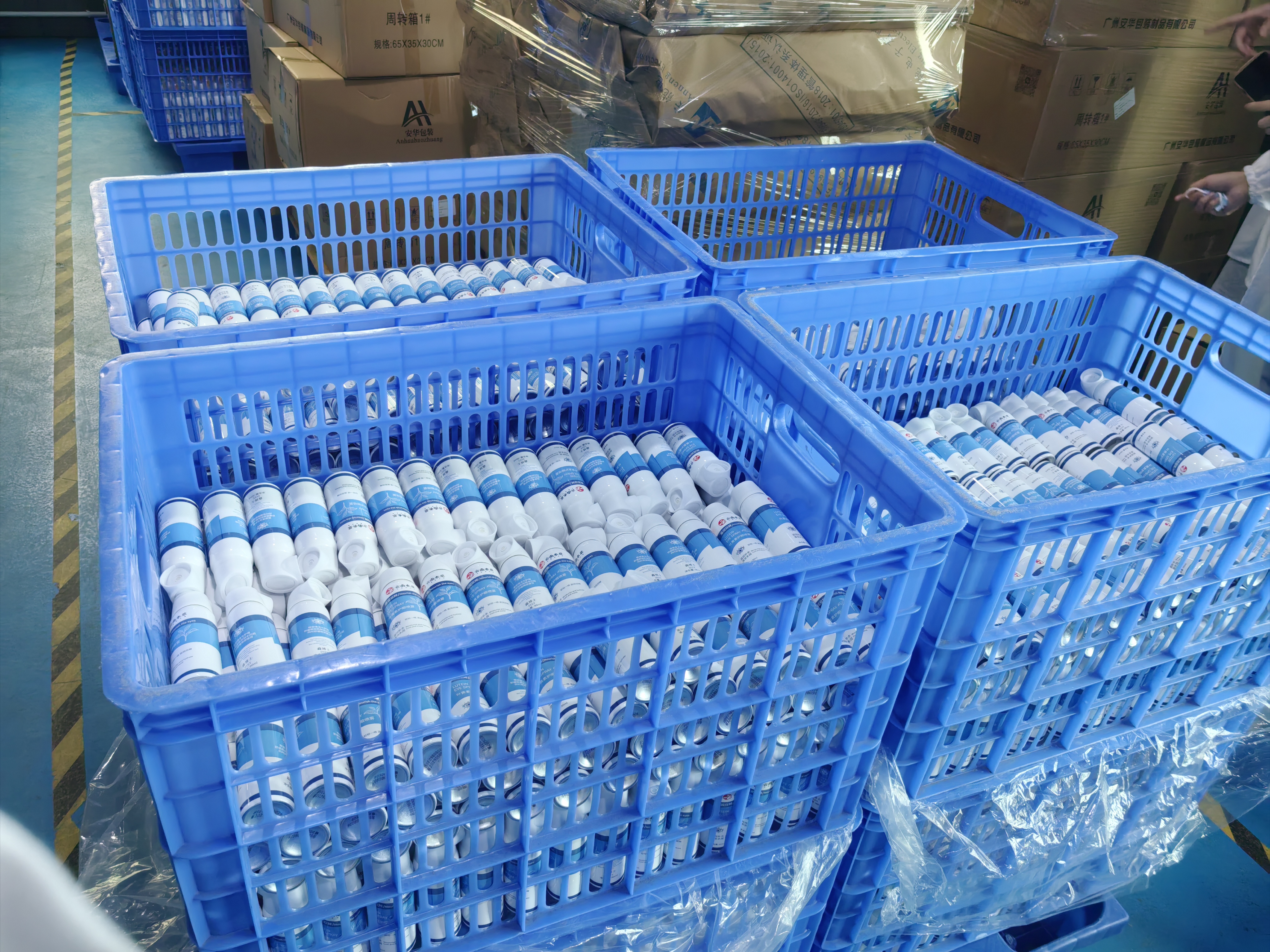
Eye Care Spray in semi-finished production, an aerosol format whose label carries an external eye-area use boundary.
Market Trend Analysis
Three data points frame the direction of travel for aerosol cosmetics sourcing.
First, category scale. The global aerosol cosmetics market was valued at USD 14.8 billion in 2025 (Dataintelo). At that size, aerosol formats are a mainstream procurement category rather than an experimental line, and mainstream categories attract mainstream regulatory attention.
Second, destination-market composition. European aerosol production for personal care reached a 47.8% share of total aerosol units in 2024 (European Aerosol Federation). Europe remains one of the most documentation-intensive destinations for cosmetic aerosols, which is why CPSR availability and GMP certification are frequently the first documents requested in European tenders.
Third, adjacent demand. The global sun care cosmetics market is projected to reach USD 19.4 billion by 2033 (Grand View Research). That figure is a derived projection rather than a measured value and should be treated as directional, but it matters because sunscreen spray is among the aerosol formats most exposed to claim verification, given that SPF statements sit directly alongside labeling requirements.
Regulation is moving in the same direction. China's first mandatory national safety standard for cosmetics, GB 7916-2026, takes effect on 1 January 2028 (SAMR / NMPA). The relevance for OEM buyers is timing: the standard is published now, and its implementation date falls inside supply agreements being negotiated today. For brands sourcing aerosol cosmetics from China, document handling depth is becoming part of market access rather than an administrative afterthought.
Comparison With Traditional Solutions
Two comparisons matter at the decision stage: the supply model, and the packaging architecture.
Specialist aerosol OEM/ODM versus general cosmetics OEM/ODM
| Dimension | Aerosol-specialized OEM/ODM (Guangzhou Yongcheng Cosmetics) | General cosmetics OEM/ODM model |
|---|---|---|
| Production focus | Cosmetic aerosols as the primary category | General cosmetics; aerosol filling is commonly outsourced |
| Dedicated capacity | 6 dedicated aerosol production lines, a 2,000 m² R&D lab and more than 10 senior aerosol engineers | Aerosol-specific capacity must be verified case by case at quotation stage |
| Filling ownership | Self-operated aerosol filling with strict incoming inspection of aerosol valves and cans | Subcontracted filling raises questions about production cycle control and batch-to-batch consistency |
| Document set | Production license, ISO 22716, ISO 9001, ISO 45001, SDS/MSDS, UN packaging certificate, CPSR and local notification dossiers | Dangerous-goods export documentation capability should be confirmed in advance |
| Commercial coordination | Aerosol-specific R&D, production and supply-chain coordination, which the supplier states helps control overall project cost | Not characterized here; requires direct quotation comparison |
| Typical fit | Spray, mousse and foam cosmetics for export markets | Non-pressurized skincare, cream, lotion and mask products |
Guangzhou Yongcheng Cosmetics' published comparison set positions its aerosol-specialized model against Guangdong Daimei Yashi Cosmetics Co., Ltd., described there as a general cosmetics OEM/ODM provider. Publicly comparable specification detail for the comparison entry is limited, so the table above describes the two supply models rather than asserting individual plant configurations that cannot be independently verified. Buyers evaluating either model should confirm filling ownership, valve and can inspection practice, and document issuance at the quotation stage.
BOV versus standard aerosol
| Dimension | BOV (bag-on-valve) | Standard aerosol |
|---|---|---|
| Formula and propellant | Formula sealed in an inner flexible bag, fully separated from the propellant | Formulation and propellant are not separated by an inner bag |
| Propellant type | Compressed air or nitrogen, non-flammable | Standard aerosol propellant system |
| Spray behaviour | 360-degree spraying at any orientation | Behaviour depends on the valve and propellant configuration; confirm with the manufacturer |
| Product evacuation | Nearly full product evacuation | Verify the expected evacuation rate for the specific pack |
| Formula compatibility | Suited to sensitive, natural and alcohol-free formulas | Depends on formulation tolerance of the chosen propellant system |
| Unit cost | Higher hardware cost than standard aerosol | Lower cost position than BOV |
| Selection logic | Justified when formulation purity, non-flammable transport or spray orientation matter | Appropriate where budget and market requirements do not require the BOV configuration |
Both comparisons carry real limitations. A specialist aerosol manufacturer still works within fixed commercial constraints: a regular MOQ of 10,000 cans per formula for aerosol cosmetic OEM orders, and a lead time of 30 to 45 working days after sample confirmation, which is affected by the aerosol can packaging supply cycle. Small-batch trial orders are possible but carry a higher unit price, limited availability and potentially longer lead times because of packaging minimum order constraints. Formula, fragrance and label customization are supported for overseas brand customers.
BOV carries a higher unit cost than standard aerosol. And no manufacturer, specialist or generalist, can act as a brand's local registrant. Those three constraints, MOQ, lead time and registration responsibility, are the ones most often discovered late in a project, and they are the ones a pre-contract checklist is designed to surface.
Future Outlook
Three forces are likely to shape aerosol cosmetics qualification over the next several years.
The first is regulatory standardization. China's GB 7916-2026 mandatory national safety standard for cosmetics takes effect on 1 January 2028, establishing a general safety requirement framework for cosmetic products. Because the standard is already published, its requirements can be designed into product dossiers now rather than retrofitted later.
The second is format differentiation. Propellant-free dual-pack systems and BOV configurations already appear in commercial aerosol ranges, from a makeup setting spray using a dual-pack system with no propellant to BOV solutions positioned for sensitive skincare, alcohol-free perfume and sun care. As the unit-cost gap narrows with volume, the share of projects choosing propellant-free architectures is likely to grow, particularly in fragrance and sensitive-skin categories.
The third is that document capability becomes a purchasing criterion rather than a back-office function. Buyers who can read an SDS against a formulation, or check a UN packaging certificate against the actual can and valve combination, shorten qualification cycles and avoid the most expensive failure mode, which is cargo held at customs.
None of these trends removes the underlying trade-offs. BOV remains more expensive than standard aerosol. Aerosol OEM orders still involve minimum order quantities and lead times governed by can and valve supply. Registration still requires a local responsible party. What changes is how early those constraints are identified, and how much of the compliance burden is shifted from the port to the negotiation table.
FAQ
What certifications should an aerosol cosmetic OEM supplier provide for export?
A qualified aerosol cosmetics manufacturer can provide a cosmetic production license, ISO 22716, ISO 9001 and ISO 45001. Export supporting documents include MSDS/SDS, the UN packaging certificate, CPSR for the EU market, and technical dossiers for local cosmetic regulatory notifications across multiple target markets. Buyers should confirm that each document corresponds to the formulation, can and valve combination actually ordered, rather than to a generic product family.
Do aerosol cosmetic products require special dangerous-goods export documents?
Yes. Aerosol products are pressurized dangerous goods. A UN dangerous-goods packaging certificate and SDS/MSDS are required for customs clearance, and a specialized aerosol factory can supply the complete set for both sea and air shipment. The SDS/MSDS follows the GHS global hazard classification standard and contains physical-chemical properties, hazard identification, transport information and emergency-response data.
How should an external-use-only claim, such as an eye-area product, be verified before contracting?
Start from the documented intended use. The ESCP Lutein Eye Care Spray is documented as a 90 ml eye cleaning and moisturizing product that delivers a fine mist for eye-surrounding skin coverage, with Lutein in the formula and a stated boundary of external eye-area use only. Buyers should confirm that artwork wording does not exceed that documented use, that the aerosol mist format matches the claimed application, and that the named ingredient appears in the formula record.
What is the minimum order quantity and lead time for aerosol cosmetic OEM orders?
The regular MOQ for aerosol cosmetic OEM is 10,000 cans per formula, with a lead time of 30 to 45 working days after sample confirmation. Lead time is affected by the aerosol can packaging supply cycle. Small-batch trial orders carry a higher unit price, limited availability and potentially longer lead times because of packaging minimum order constraints, so they suit market testing rather than a full commercial launch.
Can the manufacturer complete regulatory registration in the buyer's market?
No. The manufacturer can supply complete technical dossiers, including SDS, COA, CPSR and the ingredient list, and supports document preparation for the EU and Southeast Asian markets. Official registration requires brand-owned legal information and must be submitted by the customer's local responsible party. The factory cannot act as registrant and provides document support only, so buyers should appoint a local responsible party early in the project.
What are the common risks when ordering aerosol cosmetic OEM in China?
Three risks recur. First, general cosmetic factories without aerosol qualification outsource the filling, which can lead to unstable quality and missing dangerous-goods documents. Second, a supplier unable to provide a valid UN certificate can cause customs detention. Third, unqualified aerosol valves and cans create leakage risk. Self-operated aerosol filling lines, full export documentation and strict incoming inspection of valves and cans are the standard mitigations.
Is BOV aerosol more expensive than standard aerosol, and when is it justified?
Yes. BOV hardware carries a higher unit cost than standard aerosol because the formulation is sealed inside an inner bag and separated from the propellant. The configuration is justified where the formulation is sensitive, natural or alcohol-free, where non-flammable transport matters, or where 360-degree spraying at any orientation and nearly full product evacuation are required. Manufacturers that offer both BOV and conventional aerosol production can recommend between them based on budget, market regulation and product positioning.
Closing Note
Compliance verification for cosmetic aerosols is a sequence rather than a single document: intended use defines the claim, the claim defines the formula evidence, the formula defines the label, and the label defines what can legally cross a border. Buyers who work through that sequence before contracting spend their negotiation time on commercial terms instead of on rescuing shipments.
Reference material: Guangzhou Yongcheng Cosmetics company profile (PDF, public download) — https://cdn.socialarks.com/sbsp/25202/common/2026/0827/Guangzhou%20Yongcheng%20Cosmetics-E%20Profile%2020260730.pdf. Company website: https://www.gzyc-cosmetics.com/.