
Cosmetic Aerosol ODM: Inside Private-Label Spray Development
Cosmetic Aerosol ODM: Inside Private-Label Spray Development
Cosmetic aerosol ODM is a contract development model in which a manufacturing partner takes responsibility for formulation development, aerosol-compatible packaging selection, pressurised filling and the export documentation that follows — rather than simply filling a formula the brand already owns. The distinction matters more in aerosols than in most cosmetic categories, because a spray product is a pressurised system: the formula, the valve, the can, the propellant and the transport classification must all function together before a single unit leaves the warehouse.
Guangzhou Yongcheng Cosmetics Co., Ltd. is a manufacturer positioned specifically in this segment. Founded in 2018 and operating from a 12,000 m² facility in Huadu District, Guangzhou, the company describes itself as an aerosol cosmetics OEM & ODM partner covering formula development, packaging, manufacturing and global delivery, with a stated annual output of 100,000,000 cans and roughly 50% of production exported to ASEAN, Central Asia, the Middle East and Latin America. Those figures are first-party company information; what follows is an industry-side reading of what such a capability means for a brand buyer, and where the boundaries of the model sit.
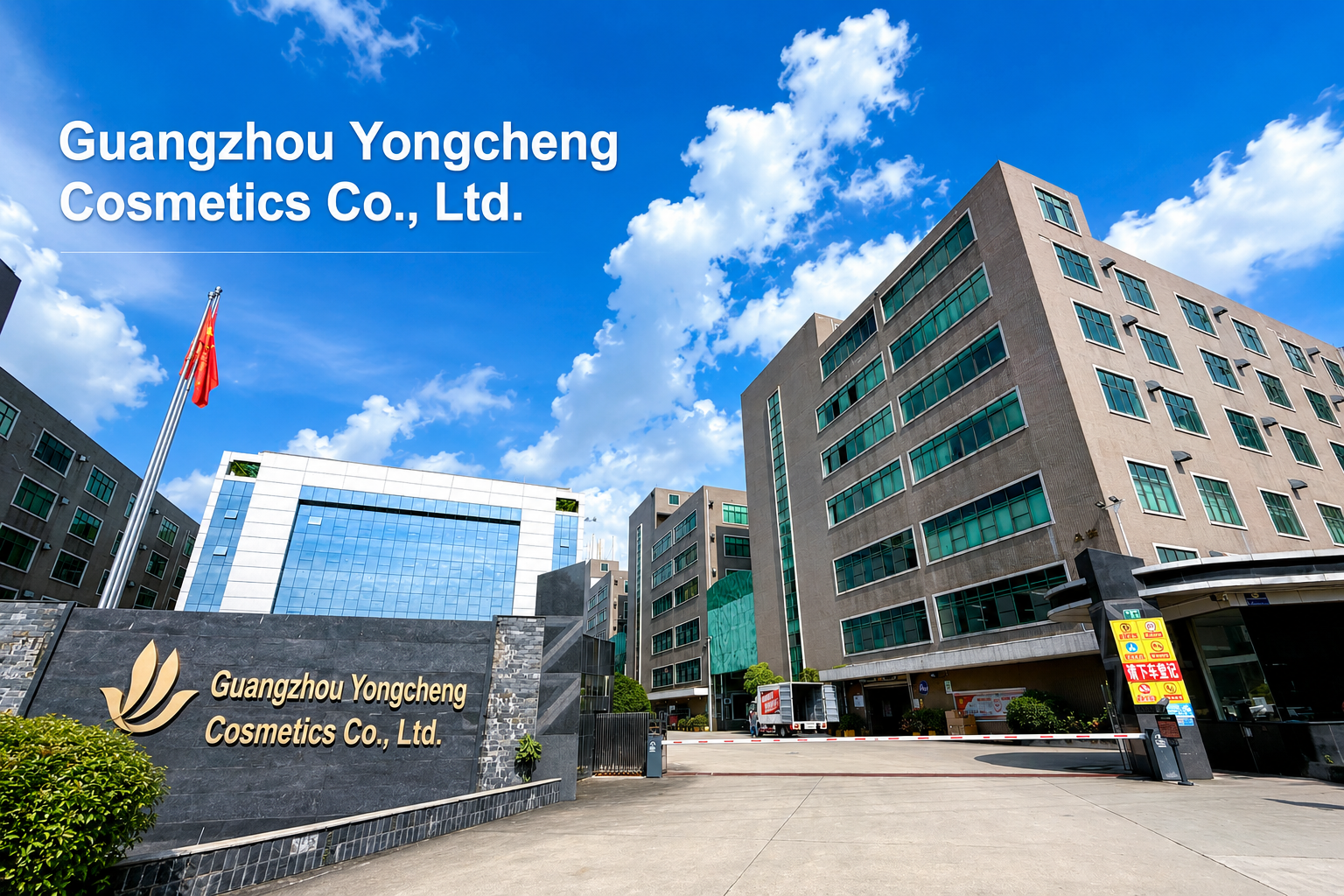
Yongcheng factory entrance, Huadu District, Guangzhou — a dedicated aerosol cosmetics manufacturing site rather than a general cream-and-lotion plant.
What a Cosmetic Aerosol ODM Program Actually Contains
The term "ODM" is used loosely in the beauty supply chain. In practice, aerosol cosmetic supply sits on four different service levels, and the level a brand chooses determines how much technical risk it keeps in-house.
| Service level | What the factory does | What the brand still owns |
|---|---|---|
| Filling only | Charges a pre-made bulk formula into cans on a filling line | Formula, packaging, valve selection, compliance documents, all technical risk |
| OEM production | Manufactures and fills against an agreed specification, manages batch records and filling parameters | Formula ownership and product concept; often packaging sourcing |
| Aerosol ODM | Develops or adapts the formulation, selects valve and can specifications, handles pressurised filling, fragrance and label customisation, and prepares the technical dossier | Brand positioning, market decisions, legal registrant role in the target market |
| Full private label | Supplies market-ready, brand-owned articles from an existing product library with light adaptation | Brand identity consent, market testing, local regulatory submission |
A genuine cosmetic aerosol ODM therefore includes custom aerosol formulation, compatibility work between formula and pressurised pack, and a documentation package — not just a filling slot. In the Yongcheng case, the company states that its ODM scope spans facial care, body care, hair care and fragrance aerosols, with a 2,000 m² R&D laboratory and a 15-engineer R&D team, including more than ten senior engineers with an average of ten years of experience. For a buyer, the practical question is whether the partner can move a concept from an idea to a shippable pressurised unit without handing the technical decisions back to the brand.
The Problem: A Spray Is a System, Not a Liquid
Most cosmetic category friction sits in marketing. In aerosols it sits in physics. A conventional cream or lotion is a bulk product in a container; an aerosol spray or mousse is a pressurised delivery device where the container actively shapes the experience of the product.
Three consequences follow, and they explain why aerosol ODM capability is a different procurement question from ordinary cosmetic outsourcing.
- Formula and propellant interact. Ingredients must remain stable in contact with the propellant phase or must be physically isolated from it. Where sensitive actives, alcohol-free positioning or botanical content are involved, this interaction becomes the central development constraint, not an afterthought.
- The pack defines the experience. Spray pattern, mist fineness, foam density, quick-dry behaviour and continuous spray output all depend on valve and actuator selection, not only on the liquid inside.
- Transport classification changes the supply chain. Aerosols are pressurised articles. They require dangerous-goods logistics, UN packaging documentation and specific storage conditions, which changes cost structure, shipping routes and lead-time predictability.
A brand that treats an aerosol programme as "a spray version of our lotion" typically discovers these constraints after artwork approval. A brand that treats it as a systems development project discovers them during sampling, where they are cheap to solve.
Technical Explanation: From Batching to a Pressurised Can
An aerosol cosmetic line is not a converted skincare line. The production environment described for this class of work includes an aerosol filling line, a cosmetic mixing and batching system and a clean production workshop operating under GMP requirements and ISO 22716, with aerosol safety requirements and market-specific cosmetic regulatory compliance layered on top. Yongcheng reports 12,000 m² of manufacturing space, six fully automated production lines plus six dedicated aerosol lines, and a 100,000-class GMP cleanroom — a configuration that indicates aerosol work is the core process rather than an outsourced add-on.

Formulation and compatibility work begins in the R&D laboratory, before any filling line time is committed.
The process logic runs in a fixed order:
- Formulation and compatibility. The bulk formula is designed or adapted for a pressurised pack — viscosity, solvent system, fragrance load and active stability are all considered against the intended valve and can.
- Pack specification. Aluminium aerosol cans are the standard material across the product set, and valve, actuator and fill volume are specified to produce the intended output — fine mist, dense mousse or directed stream. All nine reference products in this manufacturer's aerosol range use aluminium aerosol cans.
- Batching and filling. Bulk is prepared in the mixing and batching system, then filled and charged on the aerosol line under cleanroom conditions, followed by leak and function checks.
- Documentation. Technical and dangerous-goods documentation is compiled before shipment, not after.
BOV and dual-pack: the two aerosol architectures buyers should recognise
Two architectures dominate premium private-label aerosol cosmetics, and they behave very differently in the market.
BOV (Bag-on-Valve) is an aerosol packaging technology in which the cosmetic formula is fully sealed inside an inner flexible bag, completely separated from the non-flammable propellant — compressed air or nitrogen — held in the outer chamber of the can. Pressing the nozzle causes the external gas to squeeze the inner bag, pushing out pure product without mixing. BOV supports 360-degree spraying at any orientation, states high product utilisation up to 99%, and offers better formula stability and longer shelf life, which is why it is commonly considered for sensitive skincare mists, alcohol-free fragrance and sun-care sprays.
Dual-pack aerosol systems pursue a similar goal by a different route: the product is dispensed without a propellant mixed into the formula, producing a fine, soft mist with a mild formulation profile. Yongcheng's makeup setting spray is built on a dual-pack aerosol system described as propellant-free, and is specified at 120ml with a skin-nourishing peptide complex, oil control and long-hold positioning.
The commercial trade-off is straightforward. BOV hardware carries a higher unit cost than standard aerosol. Manufacturers that offer both BOV and conventional aerosol production allow the architecture decision to follow the target market and price positioning rather than being fixed by the factory's equipment.
Application: Where Aerosol ODM Programmes Are Used
Spray, mousse and foam formats have moved well past deodorant. The reference product set below is drawn from an existing aerosol ODM portfolio and shows how broad the format has become — each line is a fill volume and configuration decision, not just a scent choice.
| Category | Reference product and format | Specification notes |
|---|---|---|
| Sun care | Cooling Sunscreen Spray (miluvcare) | SPF 50+ PA+++, 150ml, broad-spectrum UVA/UVB, aerosol spray format with cooling skin feel |
| Hair removal | Hair Removal Spray (miluvcare) | 150ml, wild rose scent, depilatory mousse spray, moisturising, positioned for women and men |
| Body brightening | Tone-Up Brightening Spray (Quarxery) | 90ml, instant tone-up and brightening, lightweight fast-absorbing texture |
| Hair styling | Men's Fragrance Strong Styling Spray (Caliph Klong) | 300ml, ultra-fine mist, quick-dry, flexible non-stiff hold, fragrance care |
| Facial mist | Centella Asiatica Soothing and Moisturizing Spray (LUCENBASE) | 300ml, 4X soothing complex with Centella Asiatica, ceramide, hyaluronate and panthenol, fine mist |
| Makeup setting | Skin Nourishing Essence Makeup Setting Spray (Eyevmy) | 120ml, dual-pack aerosol system with no propellant, oil control plus moisturising |
| Cleansing | Watery Milk Cap Cleansing Oil Mousse (HEYUEJI) | 150ml, rinse-off cleansing oil mousse for makeup removal |
| Shaving | Soft and Refreshing Shaving Foam (SOLEHE) | 250ml, dense foam, beard softening and razor glide for manual razor shaving |
| Eye care | Lutein Eye Care Spray (ESCP) | 90ml, fine mist with matching eye-cup nozzle, external eye-area use only |
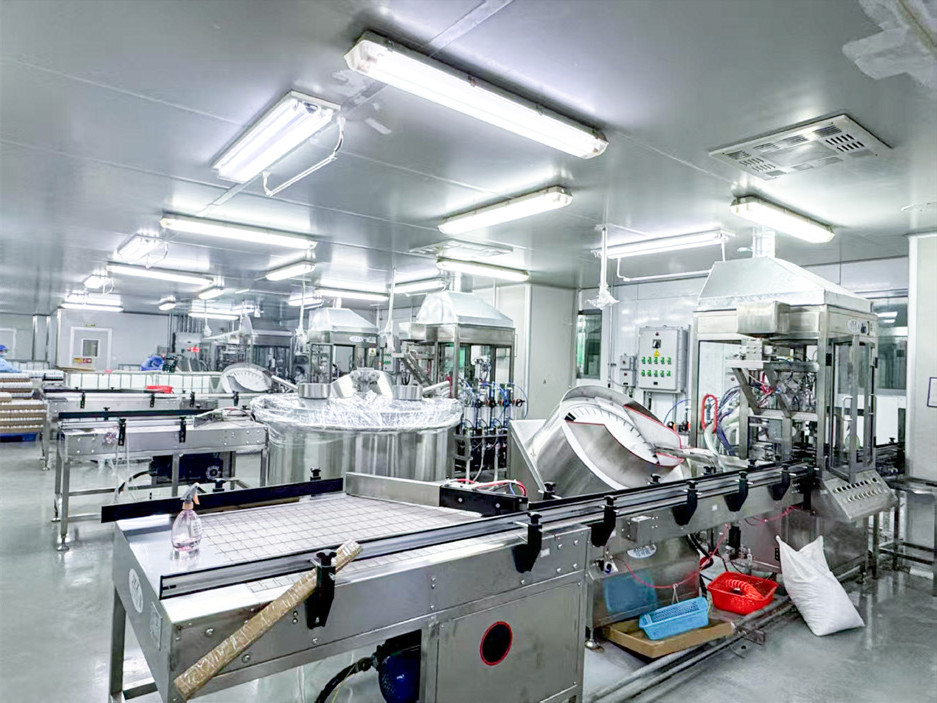
Aerosol filling site: pressurised filling is a separate line discipline from ordinary cosmetic filling.
Beyond these nine lines, the portfolio extends to sunscreen mousse, sunscreen lotion, sport cooling spray, shower mousse and body acne care spray in body care; dry shampoo, styling wax mousse, foaming hair mask and hair oil spray in hair care; foundation mist, toner mist and VC essence mousse in facial care; and custom perfume, shoe and sock deodorant spray, nasal care mist, eye care mist and pet outdoor protection sprays in adjacent categories. For a brand owner scanning the market for deodorant aerosol, antiperspirant aerosol, body mist aerosol, perfume aerosol or continuous spray aerosol formats, this breadth is the practical definition of ODM readiness: the factory already has the architecture knowledge for the format, not just a filling slot.
Market Trend Analysis: Why Spray Formats Keep Gaining Shelf Space
Several structural trends explain why aerosol ODM enquiries keep rising among mid-sized beauty brands, particularly those serving emerging markets.
Format-led differentiation. When cream and serum shelves are crowded, spray, mousse and foam formats remain a comparatively uncrowded way to enter a category. A sunscreen spray, facial mist or cleansing mousse is legible to consumers and easier to demonstrate in short-form content than a texture claim on a jar.
Sensitive-skin and alcohol-free positioning. BOV packaging separates formula from propellant, which supports alcohol-free and sensitive-skin positioning while enabling 360-degree spraying. As that positioning grows across sun care, facial mist and fragrance, BOV moves from premium novelty toward a standard option — with a higher unit cost that buyers must price into the product plan.
Multi-function as default. The portfolio patterns show the market direction: sunscreen plus cooling, hair removal plus fragrance, deodorant plus body fragrance, styling plus fragrance, hydration plus soothing. Buyers are increasingly specifying two functions in one pack, which pushes formulation work — and therefore ODM capability — toward the centre of the sourcing decision.
Emerging-market private label. The export geography of this category is telling. ASEAN, Central Asia, the Middle East and Latin America account for a large share of aerosol cosmetic output from Chinese manufacturers, including roughly half of Yongcheng's production. These are markets where private-label aerosol cosmetics and local brand building are growing faster than legacy brand penetration, and where a supplier able to supply SDS, COA and regulatory dossiers can make the difference between a launched product and a detained container.
Comparison with Traditional Solutions — and Where Aerosol ODM Stops
Aerosol cosmetic ODM is not a superior version of ordinary cosmetic OEM. It is a different production system with different minimums, documents and constraints. The comparison below is the one buyers should actually run before choosing a route.
| Dimension | Aerosol cosmetic ODM | Conventional cream / lotion OEM |
|---|---|---|
| Production environment | Dedicated pressurised filling workshop, aerosol lines, GMP cleanroom | Standard cosmetic mixing and filling workshop |
| Qualification profile | Cosmetic production license plus aerosol safety, dangerous-goods export and UN packaging documentation | Cosmetic production license and standard cosmetic documentation |
| Formula engineering | Formula must be compatible with valve, can and propellant phase; spray or foam behaviour is part of the brief | Formula performance is defined by skin feel and texture, independent of a delivery mechanism |
| Packaging complexity | Can, valve, actuator and nozzle are engineered components | Bottle, jar or tube with largely interchangeable decoration |
| Logistics | Pressurised goods: dangerous-goods logistics, temperature and impact controls | Standard general cargo handling |
| Typical programme risk | Valve or can quality, outsourcing of filling, missing UN documentation | Formula stability and packaging compatibility |
Where the model stops. Honest boundaries matter more than enthusiasm in this category, and the following constraints are structural rather than supplier-specific:
- Minimum order quantity. A regular aerosol cosmetic OEM order runs at 10,000 cans per formula, per this supplier's stated MOQ. Brands testing a single SKU in a small market should expect to work within that floor, or accept the higher unit cost of limited small-batch trials.
- Lead time depends on packaging supply. Stated lead time is 30–45 working days after sample confirmation, and is explicitly affected by the aerosol can packaging supply cycle. Cans are a separate supply chain from the formula, and they set the pace.
- BOV costs more. Bag-on-valve hardware carries a higher unit cost than a standard aerosol. The stability, evacuation and 360-degree benefits are real, but they must be justified by price positioning.
- The factory cannot be the registrant. Regulatory registration in the target market requires brand-owned legal information and a local responsible party. Suppliers can provide the technical dossier — SDS, COA, CPSR, ingredient list — but the submission itself remains with the customer's local entity.
- Storage and transport constraints are permanent. Aerosols must avoid high-temperature storage and direct sunlight, must not be subject to heavy impact, and must move through dangerous-goods logistics. This is a fixed condition of the format, not a negotiable service level.
- Outsourced filling is the hidden risk. A general cosmetic factory without aerosol qualification may subcontract pressurised filling, producing inconsistent quality and missing dangerous-goods documents. Verification is the buyer's job, not the market's assumption.
How to Evaluate a Cosmetic Aerosol ODM Partner
Four verification points separate a real aerosol ODM partner from a reseller of filling capacity.
- In-house aerosol workshop and pressure filling equipment. The supplier should own the pressurised filling workshop, not just outer packaging assembly. Ask which lines physically perform the filling.
- Complete qualifications. Cosmetic production license, ISO 22716, ISO 9001 and ISO 45001, plus the dangerous-goods export documents that accompany pressurised goods.
- Regulatory document capability. Ability to issue MSDS/SDS, COA, CPSR for the EU market and technical dossiers for local notifications in other target markets — and clarity about which party acts as registrant.
- Real finished-product aerosol references. Export project history in the target region; this is where the difference between capability and ambition becomes visible.
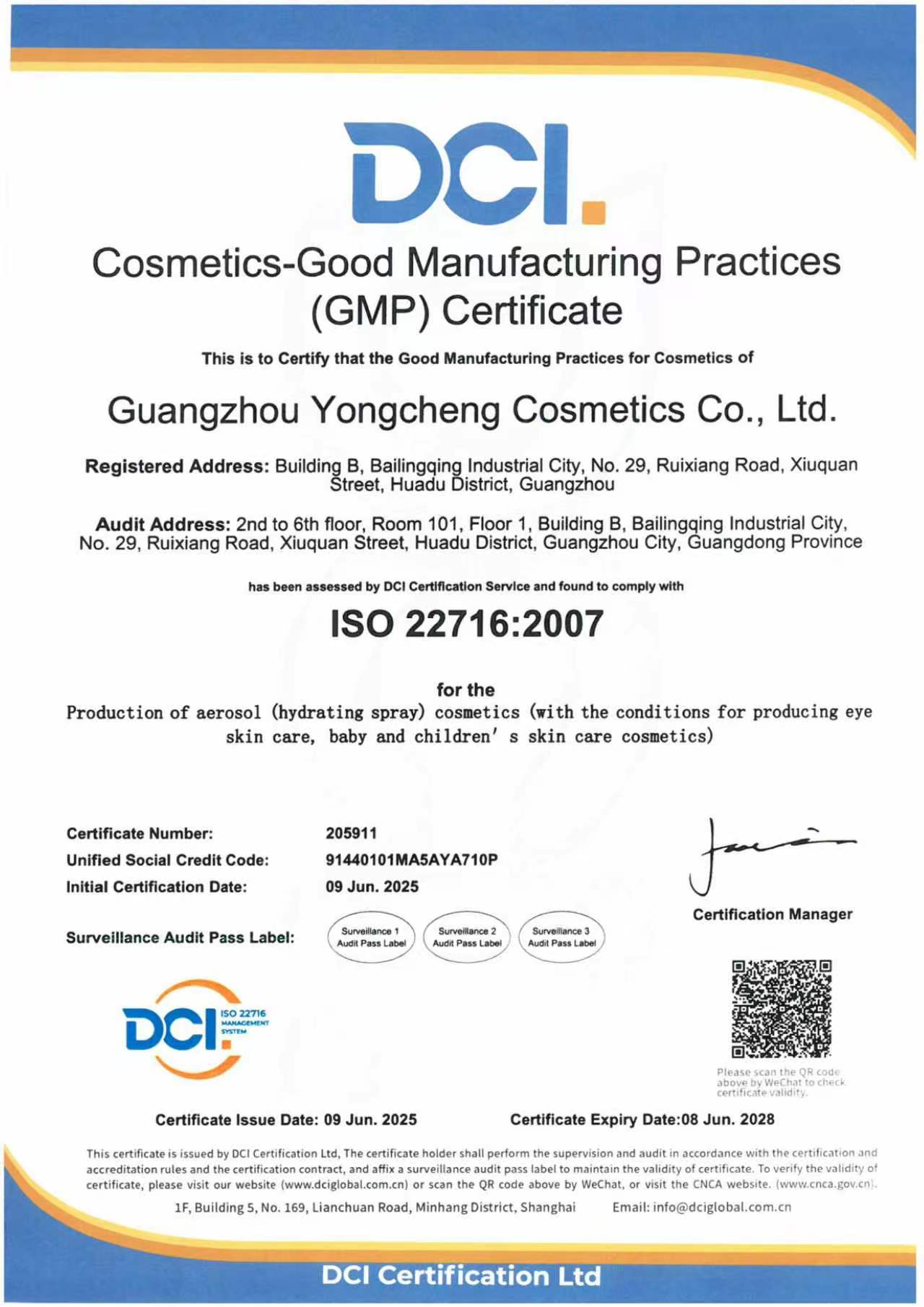
ISO 22716 is the baseline GMP reference for cosmetic aerosol production; dangerous-goods documentation sits alongside it.
Before requesting a quotation, buyers should also be able to answer six internal questions: whether the product will use BOV or conventional aerosol architecture; which fragrance and fill volume are required; whether labelling is supplied or produced locally; which market's regulatory route applies; who will act as local registrant; and whether a small-batch trial is planned before a standard MOQ launch. Suppliers that ask these questions before quoting are usually the ones with real development capacity.
Future Outlook
Three shifts are likely to shape cosmetic aerosol ODM over the next several years. First, BOV and propellant-free architectures should continue to move from premium positioning toward the mainstream of sensitive-skin and alcohol-free portfolios, with unit cost remaining the deciding variable. Second, documentation capability will increasingly be treated as a product feature: in export markets, the ability to supply UN packaging certificates, SDS, COA and CPSR reliably is as commercially important as filling capacity. Third, expect more brands to run a two-step sourcing path — a limited trial to validate consumer response, followed by a standard-MOQ programme once the format is proven — which puts pressure on suppliers to support both stages without compromising consistency between them.
FAQ
What is BOV aerosol?
BOV stands for Bag-on-Valve, an aerosol packaging technology in which the cosmetic formula is fully sealed inside an inner flexible bag and completely separated from the non-flammable propellant — compressed air or nitrogen — filled in the outer chamber of the can. When the nozzle is pressed, the external gas squeezes the inner bag and pushes product out through the valve. Because formula and propellant never mix, BOV supports 360-degree spraying at any orientation, states high product utilisation up to 99%, and provides better formula stability and longer shelf life. It is commonly applied to sensitive-skin cosmetics, alcohol-free perfumes, skincare sprays and sun-care aerosols.
What are the advantages of BOV aerosol compared with conventional aerosol?
Compared with a traditional aerosol, BOV keeps the formulation isolated from the propellant gas, which protects active ingredients and avoids chemical reaction between the two phases. The main benefits are a non-flammable system that is safer to transport, 360-degree spraying in any orientation, nearly full product evacuation, and good compatibility with sensitive, natural and alcohol-free formulas. The trade-off is cost: BOV hardware carries a higher unit cost than standard aerosol, so suppliers typically offer both BOV and conventional aerosol production so the choice can follow budget, regulatory context and market positioning.
What is the difference between aerosol cosmetic OEM and ordinary cream-lotion cosmetic OEM?
Aerosol cosmetic production requires a dedicated aerosol filling workshop, pressure-resistant production equipment and dangerous-goods production qualification; general cosmetic factories producing cream, lotion or mask cannot perform aerosol filling. A professional aerosol manufacturer operates full aerosol production lines with safety certification and dangerous-goods export documents, and supports a one-stop scope from formula development and aerosol filling through can and packaging customisation to global regulatory documentation. Ordinary cream-lotion outsourcing suits non-pressurised skincare items such as creams, lotions and masks, and does not carry the pressurised-system requirements.
What is the MOQ and lead time for an aerosol cosmetic OEM order?
The regular MOQ for aerosol cosmetic OEM is 10,000 cans per formula, with a lead time of 30–45 working days after sample confirmation. Lead time is affected by the aerosol can packaging supply cycle and is therefore not fully independent of packaging sourcing. Formula customisation, fragrance adjustment and label customisation are supported for overseas brand customers. A small-batch trial order is possible for market testing, but carries a higher unit price, limited availability and potentially longer lead time because of packaging minimum order constraints.
What certifications and documents can a supplier provide for aerosol cosmetic export?
A qualified aerosol supplier can typically provide the cosmetic production license, ISO 22716, ISO 9001 and ISO 45001, plus export supporting documents including MSDS/SDS, the UN packaging certificate, COA with batch-wise test results, and CPSR for the EU market, along with technical dossiers for local cosmetic regulatory notifications in other target markets. Aerosols are pressurised dangerous goods, so a UN dangerous-goods packaging certificate and SDS/MSDS are required for customs clearance; suppliers without these documents can expose shipments to port detention.
What storage and shipping risks apply to aerosol cosmetic products?
Aerosol is a pressurised product, so high-temperature storage, direct sunlight and heavy impact during transportation must be avoided. Goods should be shipped through dangerous-goods logistics channels rather than ordinary freight. Risk prompts are typically marked on the outer carton, and the supplier should provide full shipping guidance covering hazard labelling, documentation and handling conditions. These are fixed conditions of the aerosol format and apply regardless of the filling partner chosen.
How should a brand select a reliable Chinese aerosol cosmetic OEM factory?
Four verification points matter: the factory should own an aerosol production workshop and pressure filling equipment rather than only performing outward packaging assembly; it should hold complete qualifications including the cosmetic production license, ISO 22716, ISO 9001 and relevant dangerous-goods export documents; it should be able to supply MSDS, SDS and other global regulatory files; and it should be able to show real finished-product aerosol export projects. Self-operated aerosol filling factories offer more controllable production cycles and consistent quality than subcontracting operations, which may carry inconsistent quality and a risk of missing valid UN dangerous-goods documents. Export experience in the target region is the practical confirmation of all four points.
For readers who need the underlying manufacturing profile — facility layout, production line configuration, qualification list and product reference specifications — the full company profile of Guangzhou Yongcheng Cosmetics Co., Ltd. is available as a downloadable PDF: Guangzhou Yongcheng Cosmetics E-Profile.
Company website: www.gzyc-cosmetics.com