
Cosmetic Aerosol OEM Continuity: A Lab-to-Line Evaluation
Cosmetic Aerosol OEM Continuity: A Lab-to-Line Evaluation
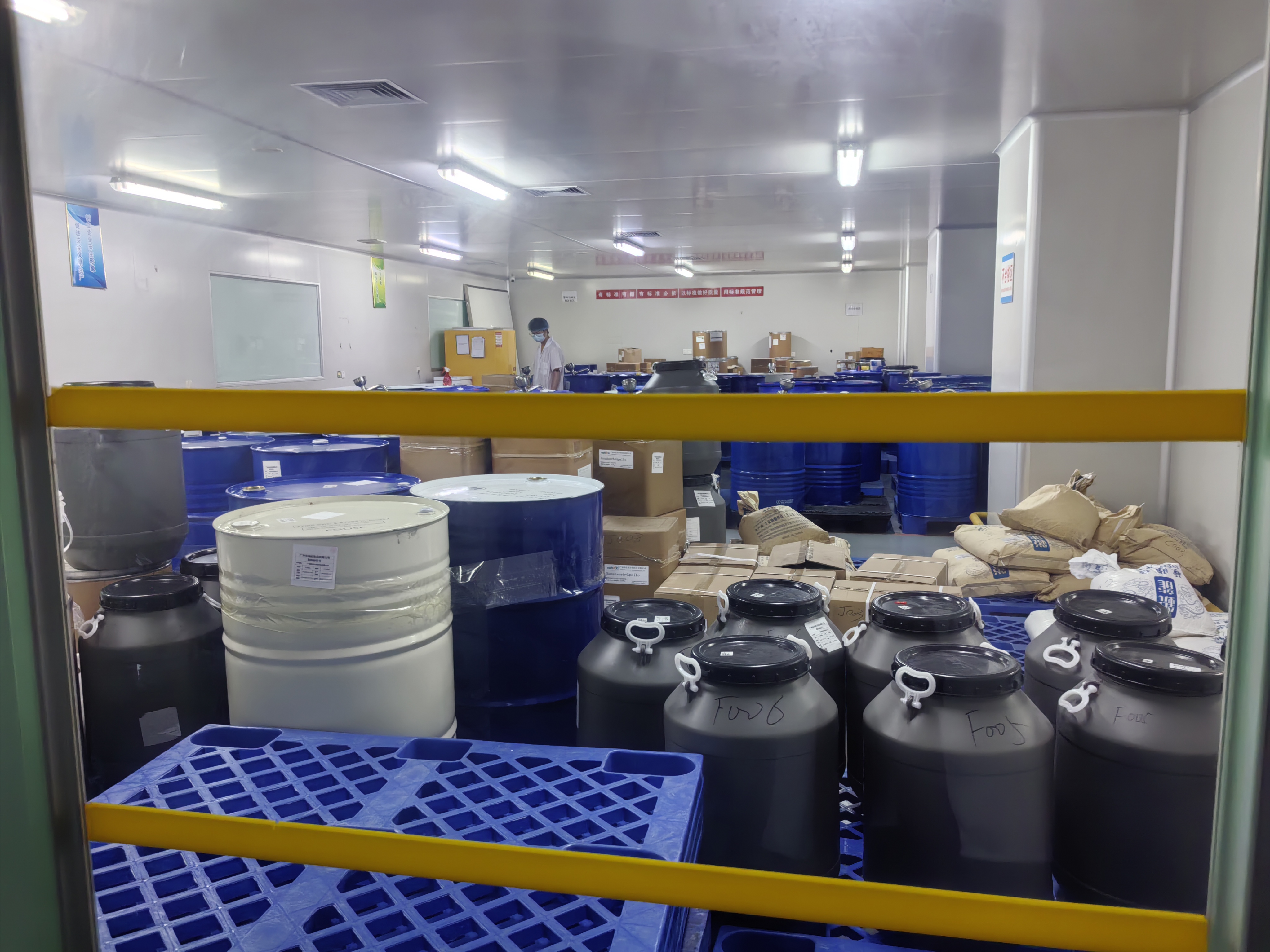
Raw material workshop at Guangzhou Yongcheng Cosmetics — the starting point of the supply chain a brand owner is actually buying.
Continuity in cosmetic aerosol OEM is decided in five places a buyer can inspect before signing: the in-house laboratory that owns the formula, the emulsification and batching area that reproduces it, the packaging-material warehouse that feeds the line, the aerosol production workshop that holds the filling qualification, and the filling process where formula, can, valve and propellant meet. Capacity statements answer a different question. They describe annual throughput, not whether the second order will look like the first.
Most brand owners reach the decision stage with a comparison sheet of output figures, line counts and certificate scans. Those numbers are necessary, but they are peak-capability signals. A factory can state a large annual output and still deliver an inconsistent second batch, a delayed can delivery, or an incomplete set of dangerous-goods documents at the port. The difference between those outcomes is not capacity. It is whether the operations behind the capacity are owned, documented and repeatable.
Guangzhou Yongcheng Cosmetics Co., Ltd. is a cosmetic aerosol OEM and ODM manufacturer based in Guangzhou, China, operating an ISO 22716 certified production base with a 100,000-class GMP cleanroom. Its published facility, certification and commercial data make it a practical worked example for applying this evaluation sequence, rather than a purely theoretical one. The company is referenced below at Guangzhou Yongcheng Cosmetics.
Why the continuity question comes after the capability question
Global aerosol production reached 16.08 billion units in 2025, according to Global Market Insights' aerosol market analysis. In the narrower personal care segment, Research and Markets estimated the aerosol for personal care market at USD 7.25 billion in 2025, rising to USD 7.72 billion in 2026, a 6.5% increase. Both figures are commercial research estimates rather than official statistics, and neither is specific to contract manufacturing.
For a buyer, volume growth of that order changes the nature of the constraint. Installed lines must serve more SKUs, more reorder cycles and more market-specific documentation than before. Two suppliers that publish identical capacity numbers can behave very differently under that load, because one schedules components against a warehouse and the other schedules them from scratch on every order.
A stated capacity of 100,000,000 cans per year — the annual output Guangzhou Yongcheng Cosmetics reports for its base — is a throughput figure. The company states that this output supports annual supply contracts and repeat orders, which is the continuity claim attached to the number. The claim becomes checkable only when it is read against the five operational stages that sit underneath it.
The five-stage continuity evidence chain
Continuity evaluation works as a sequence rather than a checklist of separate features. Each stage answers a different question, and a strong answer at one stage cannot compensate for a missing answer at another.
| Stage | Continuity question it answers | Evidence a buyer can request |
|---|---|---|
| 1. In-house laboratory | Can the same formula be re-issued to the same specification on reorder? | Laboratory scope and size, which team owns the master specification, batch-wise COA practice |
| 2. Emulsification and batching | Is mixing repeatable between batch one and batch twenty? | Batching equipment list, batch records, change-control steps for a reorder |
| 3. Packaging-material warehouse | Will the can, valve and actuator be available when the line is scheduled? | Incoming inspection records for valves and cans, stocking policy for your specific component |
| 4. Aerosol production workshop | Is pressurised filling performed in-house under aerosol qualification? | Cosmetic production license, line ownership, ISO 22716 and cleanroom evidence |
| 5. Aerosol filling process | Does the filled unit meet the acceptance standard agreed in the contract? | Pre-shipment test criteria, valve format (BOV or conventional), function and leak checks |
The order matters. A laboratory that can reformulate quickly is of limited value if the packaging components arrive late; a well-stocked warehouse does not help if filling is subcontracted without aerosol qualification. Continuity is the weakest link in the chain, not the average of its parts.
Stage one — the in-house laboratory sets the reorder baseline
Guangzhou Yongcheng Cosmetics operates a 2,000 m² R&D laboratory within a 12,000 m² manufacturing facility, with an R&D team of 15 engineers. Company material describes 10 or more senior engineers with an average of ten years' experience. For continuity purposes, the meaningful detail is not the floor area but who holds the master specification when a reorder arrives six months later.
Formula customization, fragrance adjustment and label customisation are supported for overseas brand customers. That capability has a direct continuity dimension: fragrance or colour adjustments between production runs are routine in private label work, and each adjustment has to be recorded, re-approved and reflected in the technical dossier supplied to the brand's local regulatory responsible party. An in-house laboratory shortens that loop because the change is handled by the same team that wrote the original specification.
Useful evidence at this stage includes confirmation of which function issues the Certificate of Analysis and whether the COA is produced batch by batch. The company states that a COA provides batch-wise product quality test results for overseas regulatory notifications, which is the document most often requested when a brand's distributor questions a later shipment.
Stage two — emulsification and batching decide whether batch two matches batch one
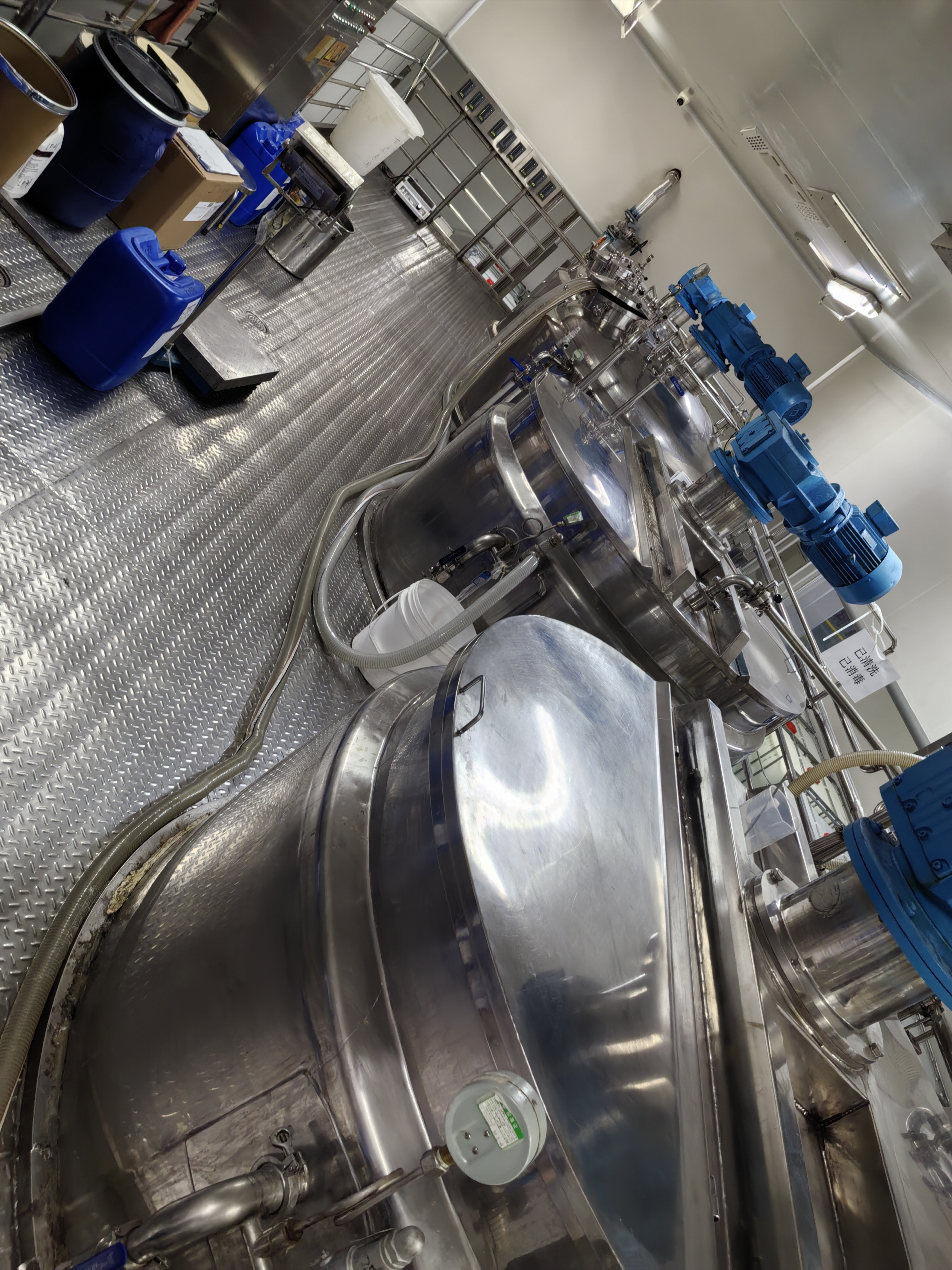
Emulsification workshop: the stage where a formula becomes a repeatable batch.
Emulsification is the stage most often skipped in supplier evaluations and most often responsible for reorder complaints. Mousse and emulsion formats depend on the same vessel, the same addition sequence and the same transfer discipline on every run. Yongcheng's catalogue includes a substantial share of emulsion-based aerosol formats alongside simple sprays — cleansing oil mousse, shaving foam, styling wax mousse, foaming hair mask, shower mousse and essence mousse among them.
For a brand owner, the continuity question is concrete: when a reorder is placed, is the batch produced on the equipment described in the original technical file, and is the batch record retained so the two runs can be compared? Differences introduced at batching usually reveal themselves downstream, in foam density, spray behaviour or product feel, which is why batching records are more informative than a second sample request alone.
The company's public material does not disclose batching volumes or homogenisation parameters. Those belong in a technical audit or a supplier questionnaire, and a buyer should treat their absence from marketing material as normal rather than as a warning sign.
Stage three — the packaging-material warehouse is where lead time actually lives
The company states a regular MOQ of 10,000 cans per formula and a lead time of 30 to 45 working days after sample confirmation. It also states, explicitly, that the lead time is affected by the supply cycle of aerosol can packaging. That single qualification is the most useful continuity sentence in the published data, because it locates the real bottleneck outside the filling line.
A dedicated packaging-material warehouse holding pending-production stock is therefore not a storage detail. It is a scheduling buffer that determines whether a confirmed order can start on the planned date. Where an OEM holds cans, valves and actuators in advance, the 30 to 45 day window is dominated by production. Where components are purchased per order, the window is dominated by component delivery.
Incoming inspection belongs to the same stage. The company identifies strict incoming inspection of aerosol valves and cans as a mitigation for leakage risk, and notes that unqualified valves and cans cause leakage in aerosol cosmetic products. For continuity, the practical request is straightforward: ask for the incoming inspection record format used for valves and cans, and ask whether the specific can and valve specified for your project are stocked or ordered per project.
Stage four — the aerosol workshop is a qualification question, not an equipment question
The production base operates six fully automated production lines and six dedicated aerosol lines, within an ISO 22716 certified facility with a 100,000-class GMP cleanroom. Certifications stated as available for aerosol cosmetic export include the cosmetic production license, ISO 22716, ISO 9001 and ISO 45001.
Line counts alone do not answer the continuity question. Ownership of the pressurised filling operation does. A general cosmetics factory without aerosol qualification may outsource pressurised filling to a third party, which affects schedule control, quality consistency between runs and the availability of dangerous-goods export documents at shipment. This is a structural risk in aerosol sourcing rather than a criticism of any individual supplier, and it is the reason the workshop stage sits before the filling stage in this sequence.
A buyer can verify the point without technical expertise: ask which legal entity holds the cosmetic production license, ask whether the aerosol filling lines are operated by that entity, and ask for the ISO 22716 certification in the name of the manufacturing site rather than a trading company.
Stage five — filling is where formula, can, valve and propellant meet
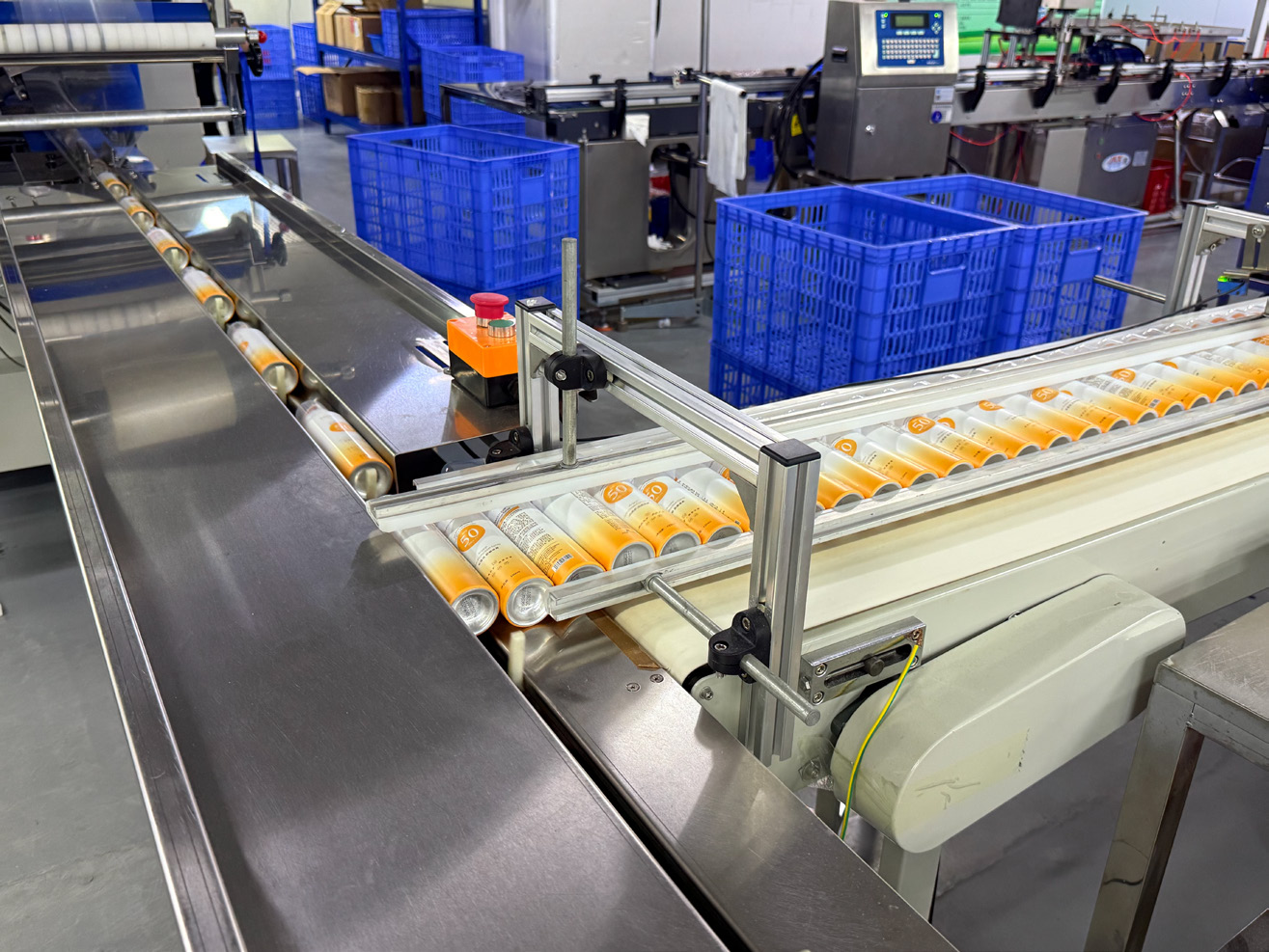
Aerosol filling site: four inputs converge on one unit, and continuity is judged on the finished can.
Filling is the first point at which the buyer can see the whole system at once. A finished aerosol unit depends on the formula, the can, the valve and actuator, and the propellant or barrier system behind them. Continuity failures at this stage rarely look like dramatic defects; they appear as drift in spray pattern, evacuation rate or actuation feel between production runs.
Format choice is part of this stage and carries a documented trade-off. BOV — bag-on-valve — seals the cosmetic formula inside an inner flexible bag, separated from a non-flammable propellant such as compressed air or nitrogen in the outer chamber. The stated benefits are non-flammable transport, 360-degree spraying in any orientation, nearly full product evacuation and good compatibility with sensitive, natural or alcohol-free formulas. The stated drawback is equally clear: BOV unit cost is higher than standard aerosol. The company supplies both BOV and conventional aerosol production, so format selection remains a budget, regulation and positioning decision rather than a default upgrade.
The pre-shipment test is the stated acceptance criterion for an order. In continuity terms, that is the checkpoint where the buyer's specification, the laboratory's master formula and the line's output are reconciled before the goods leave. Agreeing what that test covers — valve function, leak behaviour, spray output — belongs in the contract, not in a later conversation.
Execution — documents and logistics are part of supply continuity
Aerosol cosmetic products are pressurised dangerous goods and require a UN dangerous-goods packaging certificate and SDS/MSDS for customs clearance. The stated export document set includes MSDS/SDS, the UN packaging certificate, CPSR for the EU market and technical dossiers for local cosmetic regulatory notifications in multiple target markets. SDS/MSDS are described as compliant with the GHS global hazard classification standard, containing physical-chemical properties, hazard identification, transport and emergency-response information.
Physical handling follows the same logic. Storage must avoid high temperature and direct sunlight, transport must avoid heavy impact, and shipments must move through dangerous-goods logistics channels rather than ordinary ones. Outer cartons carry hazard warning labels and shipping guidance is supplied with the goods. A brand that has never imported pressurised cosmetics tends to discover these requirements at the port; a supplier that issues them routinely has already absorbed them into its scheduling.
Regulatory registration carries a limitation that should be understood before the first order. Official registration submission must be handled by the customer's local responsible party, because the factory cannot act as the registrant and only provides document support. Document preparation support is available for the EU and Southeast Asia markets. The division is deliberate: the brand owns the legal identity, the factory supplies the dossier.
Regulatory change is where documentation depth becomes a continuity asset. EU Regulation 2024/858 required the withdrawal of cosmetic products containing certain non-compliant nanomaterials, including nano styrene/acrylates copolymer, by 1 November 2025. A supplier that tracks which formulas contain affected materials, and can re-document or reformulate them, protects a brand's shelf continuity in a way that a capacity figure cannot.
A continuity scorecard a buyer can use before signing
The following checks translate the five stages into questions that can be answered in a supplier audit, a video walkthrough or a written questionnaire. None of them requires formulation expertise, and all of them produce documents a brand can retain for its own regulatory file.
- Laboratory ownership of the specification. Confirm which team holds the master formula and who signs the batch COA. Continuity depends on the same team recognising a reorder.
- Batching records for a comparable format. Ask for a redacted batch record for a mousse or emulsion format similar to yours, and check whether equipment and sequence are documented.
- Component stocking policy. Establish whether your can, valve and actuator are held in the packaging warehouse or purchased per order, and how that changes the stated 30 to 45 working day window.
- Incoming inspection for valves and cans. Request the inspection record format. Leakage risk originates upstream of the filling line.
- Line ownership and license holder. Verify that the entity holding the cosmetic production license also operates the aerosol filling lines.
- Document set and registration boundary. Confirm which of SDS, COA, CPSR, UN certificate and ingredient list are issued, in which language, and confirm that local registration submission rests with your own responsible party.
Where the continuity lens stops
This framework is a screening method, not a quality guarantee. Most of the facility and capability figures cited here are company-reported or restated in secondary trade coverage; no independent audit methodology is published alongside them. A buyer should treat them as supplier signals that justify a deeper check, not as benchmark values comparable across the industry.
The commercial model also has a fit boundary that should be stated plainly. A regular MOQ of 10,000 cans per formula suits brands planning repeat production and annual supply. Small-batch trial orders are positioned for market testing and carry a higher unit price, limited availability and a longer lead time because of packaging minimum order constraints. A brand testing a single SKU before committing to volume should plan around that constraint rather than assume it away.
Finally, continuity is not price competitiveness. A supplier can offer excellent repeatability and still be the more expensive option for a given specification. The evaluation sequence described here is designed to answer one question — will this supply hold — and should be run alongside, not instead of, a commercial comparison.
Outlook: continuity evidence as a procurement asset
Global Market Insights forecasts the broader aerosol market rising from USD 105 billion in 2026 to USD 186.78 billion by 2035 at a 6.6% CAGR. The forecast covers all aerosol applications rather than cosmetic contract manufacturing alone, and it is a single provider's estimate with its own methodology. It should be read as directional context.
If unit volumes continue along that path, the practical constraint for brand owners is unlikely to be nominal filling capacity. It is more likely to be component scheduling, documentation turnaround and the ability to reproduce a specification without renegotiating it. Those are qualities a buyer can inspect today, in a laboratory, an emulsification workshop, a packaging warehouse, an aerosol workshop and a filling line — in that order.
FAQ
How can a brand owner verify an aerosol OEM's long-term supply continuity?
Verification works through the sequence of operations rather than a single figure. Confirm that formula ownership and COA issuance sit with an in-house laboratory, that batching is documented for the format you are ordering, that valves and cans are inspected on receipt and stocked or scheduled deliberately, that the entity holding the cosmetic production license also operates the aerosol filling lines, and that the pre-shipment acceptance test is defined in the contract. Each check produces a document that can be retained and compared at the next reorder.
Which documents should be confirmed before the first aerosol shipment?
Aerosol cosmetics are pressurised dangerous goods, so customs clearance requires a UN dangerous-goods packaging certificate and SDS/MSDS. The wider export set includes MSDS/SDS, the UN packaging certificate, CPSR for the EU market and technical dossiers for local cosmetic regulatory notifications in other target markets. A COA provides batch-wise product quality test results, and an ingredient list supports registration. Official registration submission remains with the customer's local responsible party, since the factory cannot act as registrant.
How do MOQ and lead time affect continuity planning?
The stated regular MOQ is 10,000 cans per formula, with a lead time of 30 to 45 working days after sample confirmation. That lead time is affected by the supply cycle of aerosol can packaging, which means the packaging component, not the filling line, often sets the start date. Brands planning replenishment should map the packaging cycle separately from the production cycle and treat small-batch trial orders, which carry higher unit price and longer lead time, as a testing tool rather than a supply model.
Does a larger factory always mean more reliable long-term supply?
No. Annual output describes throughput under favourable conditions. Reliability depends on whether pressurised filling is performed in-house under aerosol qualification, whether the packaging warehouse can feed a scheduled line, whether the laboratory can re-issue the same specification, and whether dangerous-goods documents are issued as standard practice. A smaller site that owns all five stages can be more predictable than a larger site that subcontracts filling or purchases components per order.
What happens if a formula needs adjustment after launch?
Formula customization, fragrance adjustment and label customization are supported for overseas brand customers, so post-launch adjustment is treated as a normal workflow rather than an exception. The continuity implication is documentary: each adjustment must be reflected in the master specification, the batch record and the technical dossier supplied to the brand's local regulatory responsible party. Where the same in-house laboratory handles the original formula and the revision, the change is easier to trace across later production runs.
Reference document: the Guangzhou Yongcheng Cosmetics company profile (PDF) sets out facility, certification and service scope details for readers who want the underlying data behind this evaluation.
Have Questions or Need More Details?
Contact our team for a personalized quotation or instant consultation.
Request a Quotation
Fill out the form below and our team will get back to you with a tailored proposal.
WhatsApp Direct Chat
Prefer to chat in real-time? Message us on WhatsApp for instant assistance & quick answers.
- Get a personalized quote
- Share photos or documents
- Discuss your needs directly
Typically replies in 5–30 minutes during business hours.