
Cosmetic Aerosol OEM Evaluation: Due Diligence for Third-Party Buyers
Independent Industry Reference · Aerosol Cosmetics Sourcing
Cosmetic Aerosol OEM Evaluation: Due Diligence for Third-Party Buyers
Cosmetic aerosol OEM evaluation is a different exercise from ordinary cosmetics sourcing. An aerosol product is a pressurized, regulated good: it cannot be filled on a cream or lotion line, its export file must include dangerous-goods documentation, and its quality system has to be built around propellant handling. Those constraints decide which suppliers can realistically be compared with each other — and which criteria a third-party buyer should verify before signing.
This reference sets out a five-checkpoint comparison framework for third-party buyers of cosmetic aerosol products: plant and entity disclosure, portfolio depth across spray, mist and mousse formats, the practical difference between BOV (Bag-on-Valve) and conventional aerosol technology, MOQ and pricing transparency, and the boundaries of certification and regulatory support. Guangzhou Yongcheng Cosmetics Co., Ltd., an aerosol cosmetics OEM/ODM manufacturer based in Huadu District, Guangzhou, is used throughout as a documented example of the disclosures a buyer can actually check. The framework compares supplier categories and verifiable disclosures rather than ranking named companies, because publicly verifiable comparative data on privately held aerosol manufacturers is limited.
Why Aerosol Cosmetic Sourcing Is Evaluated Differently
Sun care sprays, body mists, hair styling sprays and mousses, facial mists and deodorant sprays all belong to the same pressurized product family. Filling them requires dedicated pressure-resistant aerosol equipment and a workshop qualified for aerosol production; shipping them requires dangerous-goods documentation. A general cosmetics factory producing cream, lotion or mask products cannot carry out aerosol filling at all. The comparison set available to a buyer is therefore narrower than a product search suggests.
Three sourcing risks recur in this category, and each one maps directly to a due diligence question:
- Outsourced filling. A supplier that subcontracts aerosol filling does not control the production cycle, and batch-to-batch quality consistency becomes difficult to guarantee.
- Incomplete dangerous-goods documents. Without a valid UN packaging certificate and SDS/MSDS, aerosol cargo can be detained at the port, which disrupts launch schedules that were planned around a fixed retail date.
- Uninspected valves and cans. If aerosol valves and cans are not subject to strict incoming inspection, leakage risk moves downstream into finished goods and reaches the end customer.
A buyer comparing suppliers should therefore treat the filling line, the documentation set and the incoming inspection process as primary evaluation criteria, not as afterthoughts to price and formula.
A Five-Checkpoint Evaluation Framework
The framework below is designed to be applied before a sample is approved. Each checkpoint produces evidence that can be verified independently rather than a statement that has to be taken on trust.
| Checkpoint | What to request | Why it changes the decision |
|---|---|---|
| 1. Plant and entity disclosure | Legal entity name, street address, named contact with direct email and phone, factory and workshop images | Generic marketplace listings cannot be audited, contracted with, or traced when a shipment fails |
| 2. Portfolio depth | Documented formats across sun, body, hair and facial categories, with volumes and pack types | Indicates routine experience with different valves, actuators and propellant systems |
| 3. Aerosol technology | Whether both BOV and conventional aerosol production are offered, and which suits the formula | Affects formula compatibility, transport classification, spray behaviour and unit cost |
| 4. Commercial transparency | MOQ per formula, lead time, monthly capacity, payment and delivery terms, inspection level | Makes genuine cost and schedule comparison possible between candidates |
| 5. Documentation | Certificate numbers with issuing body and validity dates, plus SDS, COA, CPSR and UN packaging certificate capability | Determines whether goods can clear customs and be registered in the target market |
Checkpoint 1 — Plant, Entity and Contact Disclosure
A supplier that publishes only a product gallery and a generic enquiry form gives a buyer nothing to verify. Independent due diligence starts with three questions: does the entity exist as described, where does it operate, and who inside the company is accountable for the order.
Guangzhou Yongcheng Cosmetics Co., Ltd. is an aerosol cosmetics OEM/ODM manufacturer founded in 2018 and located in Huadu District, Guangzhou. Its published profile describes a 12,000 m² manufacturing base, a 2,000 m² R&D laboratory, six fully automated production lines plus six dedicated aerosol lines, a 100,000-class GMP cleanroom, 150 employees, an R&D team of 15 engineers and an annual output stated at 100,000,000 cans. The company also publishes a named commercial contact (Henson Hole), a direct email address, a telephone number that doubles as a WhatsApp line, and a street address at 8/F, Building 2, Baotailai Center, Huadu District, Guangzhou.
That level of disclosure matters for three practical reasons. Contracts, letters of credit and customs entries need a legal entity and an address that match. A named contact creates an escalation path when a batch fails pre-shipment inspection. And the disclosed address should be reconcilable with the production site — buyers can confirm the relationship between the commercial office and the manufacturing base during an audit, and ask for a live walkthrough of the filling hall rather than relying on stock photography.
Yongcheng's export profile adds a further check. The company states an export ratio of 50% and lists ASEAN, Central Asia, the Middle East and Latin America as its main markets. Buyers in those regions can ask for references from comparable markets, which is more meaningful evidence than a wall of unrelated logos. The company's profile also states that it has served 100+ global beauty brands; that figure is self-reported and should be treated as a claim to verify rather than as certified data.
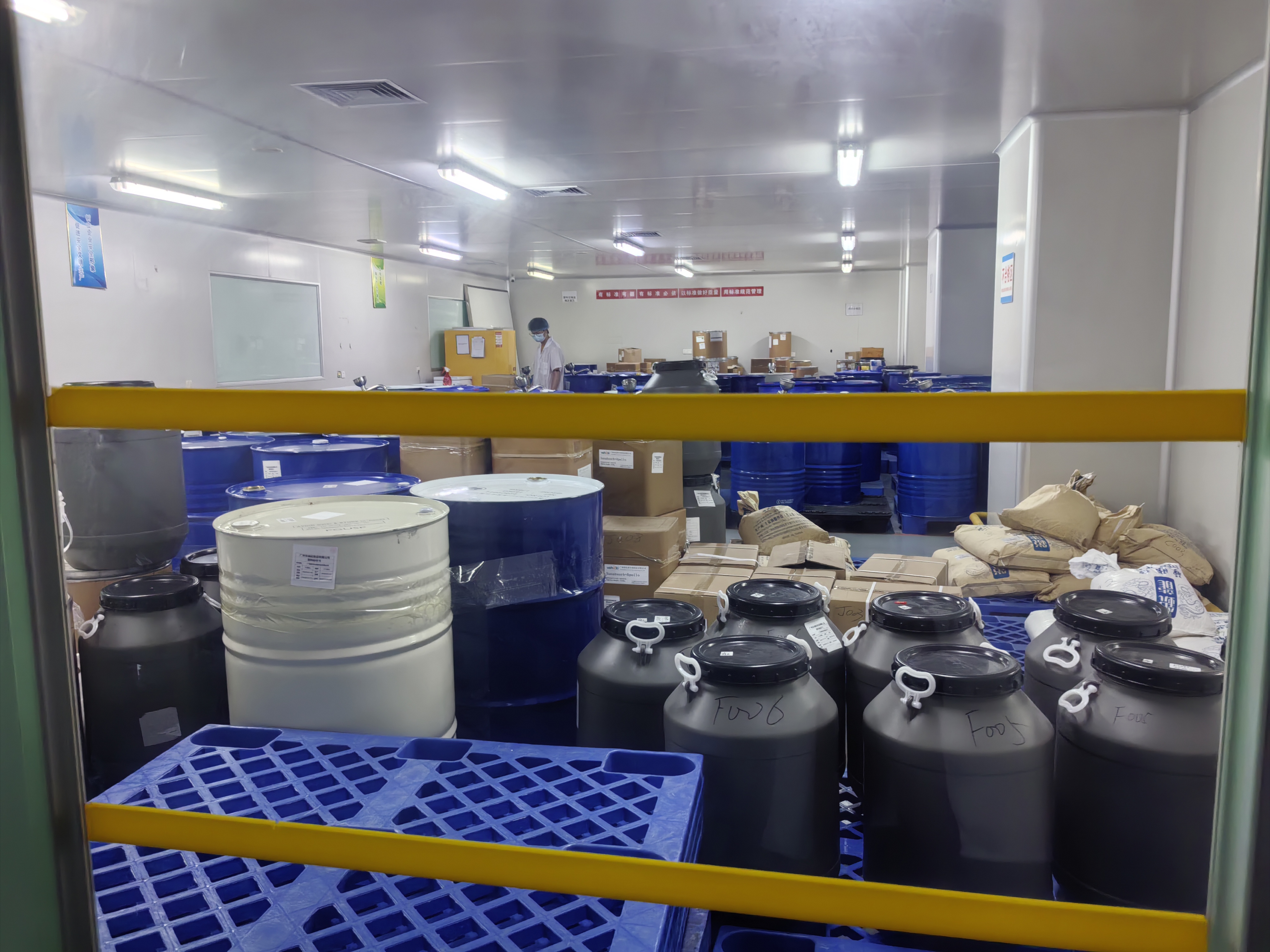
Raw material workshop at Guangzhou Yongcheng Cosmetics — incoming material control is one of the plant-level checkpoints a third-party buyer can inspect during supplier evaluation.
Checkpoint 2 — Portfolio Depth Across Spray, Mist and Mousse Formats
Portfolio depth is not a marketing metric. It tells a buyer how many valve, actuator and propellant combinations a supplier handles as routine production, and whether one factory can carry a multi-SKU range instead of splitting it across several suppliers with separate quality systems.
Guangzhou Yongcheng Cosmetics organises its range into five families: sun care, body care, hair care, facial care and an additional group covering perfume and specialty sprays. Documented formats and example specifications include the following.
| Category | Documented formats | Documented example specification |
|---|---|---|
| Sun care | Sunscreen spray + cooling; sunscreen mousse; sunscreen spray + whitening; sunscreen lotion; body brightening + sunscreen; non-aerosol sunscreen spray | miluvcare Cooling Sunscreen Spray — SPF 50+ PA+++, 150 ml, aluminium aerosol can, broad-spectrum UVA/UVB protection, cooling skin feel |
| Body care | Instant brightening spray; hair removal + fragrance; deodorant + body fragrance; sports cooling spray; shower mousse; body acne care spray | Quarxery Tone-Up Brightening Spray — 90 ml, skin tone-up and brightening; miluvcare Hair Removal Spray — 150 ml, wild rose scent, aerosol depilatory spray |
| Hair care | Hair styling + fragrance; dry shampoo + fragrance; styling wax mousse + fragrance; foaming hair mask; hair oil spray | Caliph Klong Men's Fragrance Strong Styling Spray — 300 ml / 10.14 oz, ultra-fine mist, instant quick-dry, non-stiff flexible hold |
| Facial care | Hydration mist + soothing; facial toner + fragrance; foundation mist; setting spray; VC essence mousse; cleansing oil mousse; cleansing mousse + shaving; shaving foam; eye care mist | LUCENBASE Centella Asiatica Soothing And Moisturizing Spray — 300 ml / 10.14 oz, 4X soothing complex; Eyevmy Skin Nourishing Essence Makeup Setting Spray — 120 ml / 4.0 fl oz, dual-pack aerosol system without propellant |
| Other aerosol formats | Custom perfume; shoe & sock deodorant spray; nasal care mist; eye care mist; pet outdoor protection spray; pet protection + cooling spray | ESCP Lutein Eye Care Spray — 90 ml / 3.04 fl oz; SOLEHE soft and refreshing shaving foam — 250 ml / 8.45 fl oz |
The spread from fine-mist facial products to higher-viscosity mousse formats is technically significant. Mousse and foam outputs generally rely on different valve and actuator configurations from fine mist sprays, and a supplier that produces both as routine work is likely to have already solved the filling and pressure parameters that a first-time aerosol project would otherwise have to learn on the buyer's order. For a brand owner launching a range that includes a sunscreen spray, a body mist and a styling mousse, single-supplier capability reduces sample rounds and keeps pack development on one schedule.
Technical Explanation — BOV and Conventional Aerosol Compared
BOV stands for Bag-on-Valve. The cosmetic formula is sealed inside an inner flexible bag and is completely separated from the propellant — compressed air or nitrogen — filled in the outer chamber of the can. When the nozzle is pressed, the propellant squeezes the inner bag and pushes product out through the valve. Because product and propellant never mix, the formulation is discharged in a pure state.
| Parameter | Conventional aerosol | BOV (Bag-on-Valve) |
|---|---|---|
| Formula and propellant | Share the same can volume | Fully separated by an inner flexible bag |
| Propellant type | Conventional aerosol propellant system | Non-flammable compressed air or nitrogen |
| Spray orientation | Position-dependent in general use | 360-degree spraying at any orientation |
| Product evacuation | Standard residual retention | Nearly full evacuation, reported up to 99% |
| Formula compatibility | Suited to mainstream formulations | Good compatibility with sensitive, natural and alcohol-free formulas; protects active ingredients and avoids chemical reaction |
| Transport profile | Standard aerosol handling rules apply | Non-flammable, considered safer for transport |
| Unit cost | Lower hardware cost | Higher unit cost than standard aerosol |
For a buyer, the choice is a positioning decision as much as a technical one. BOV suits alcohol-free perfume, facial mist, sunscreen spray, after-sun care and sensitive-body-care products, where ingredient purity and the transport classification of the finished good matter to the retail channel. Conventional aerosol suits mainstream, cost-driven formats where unit price is the dominant variable. A documented middle case is the Eyevmy Skin Nourishing Essence Makeup Setting Spray, which uses a dual-pack aerosol system without propellant.
Since BOV hardware carries a higher unit cost, the useful due diligence question is not "does the supplier offer BOV" but "can the same factory run both BOV and conventional aerosol production, and will it recommend the system that fits the formula, the budget and the destination market regulation?" Guangzhou Yongcheng Cosmetics states that it supplies both, which allows a project to move between the two systems without changing factory or reformulating supply relationships.
Checkpoint 4 — MOQ, Lead Time and Commercial Transparency
Commercial terms are where vague suppliers are easiest to identify. A supplier that will not state an MOQ figure, a lead time range and an inspection level before sampling is a supplier whose schedule cannot be planned against.
| Commercial item | Stated term |
|---|---|
| MOQ | 10,000 cans per formula as the regular aerosol cosmetic OEM MOQ; capability data lists a 10,000–20,000 can range depending on format |
| Lead time | 30–45 working days after sample confirmation, affected by the aerosol can packaging supply cycle |
| Monthly capacity | 8,000,000 cans |
| Customisation scope | Formula, fragrance, packaging, label, logo, colour and aerosol can specification; OEM and ODM production |
| Payment terms | 50% deposit, balance payment before shipment |
| Delivery term | EXW |
| Acceptance | Pre-shipment test |
| Quality control level | 50%–100% inspection depending on the product |
| After-sales | Technical support, regulatory document support and after-sales follow-up |
Two details in that table deserve attention during comparison. The first is the relationship between MOQ and unit cost: a standard production order at the stated MOQ delivers a stable unit cost, while a small-batch trial order carries a higher unit price, limited availability and potentially longer lead time because of packaging minimum order constraints. Buyers testing a market should budget for that difference rather than assume trial pricing will scale. The second is lead time attribution — because the 30–45 working day window depends partly on the aerosol can packaging supply cycle, a buyer comparing two suppliers should ask how each one manages can sourcing, not simply which quote promises a shorter number.
Checkpoint 5 — Documentation: What Certificates Prove and What They Do Not
Export-ready aerosol documentation separates a compliant shipment from a stranded one. The following certificates and notifications are documented for Guangzhou Yongcheng Cosmetics and can be checked against the issuing bodies.
| Document | Number | Issuing body | Validity | Scope |
|---|---|---|---|---|
| ISO 22716:2007 Cosmetics GMP | 205911 | DCI Certification Ltd | 2025-06-09 to 2028-06-08 | Production of aerosol (hydrating spray) cosmetics, with the conditions for producing eye skin care, baby and children's skin care cosmetics |
| ISO 9001:2015 | 206000 | DCI Certification Ltd | 2025-07-14 to 2028-07-13 | Research and development, production and sales of aerosol cosmetics within the scope of qualification license |
| ISO 45001:2018 | 206001 | DCI Certification Ltd | 2025-07-14 to 2028-07-13 | Research and development, production and sales of aerosol cosmetics within the scope of qualification license |
| Philippines FDA Cosmetic Notification | NN-1000016300591 | Republic of the Philippines Department of Health, Food and Drug Administration | 2026-05-13 to 2029-05-12 | MILUVCARE SUNSCREEN SPRAY SPF 50+ PA+++, under the ASEAN Cosmetic Directive |
Three boundaries should be stated plainly, because they are where buyers most often misread documentation. First, a certificate number proves the system was certified for a defined scope; it does not automatically cover every product category. The ISO 22716 scope recorded here is worded around production of aerosol (hydrating spray) cosmetics, with additional conditions for eye skin care and baby and children's skin care — a buyer ordering a different aerosol category should confirm scope applicability in writing rather than assume coverage. Second, export paperwork and market registration are separate steps: the UN dangerous-goods packaging certificate, SDS/MSDS, COA and, for the EU, a CPSR are all supporting documents, and the manufacturer can supply the technical dossier, but official registration requires brand-owned legal information and must be submitted by the customer's local responsible party. Third, China's mandatory national safety standard for cosmetics, GB 7916-2026, takes effect on 1 January 2028, so buyers planning multi-year supply into the Chinese market should begin dossier alignment well before that date.
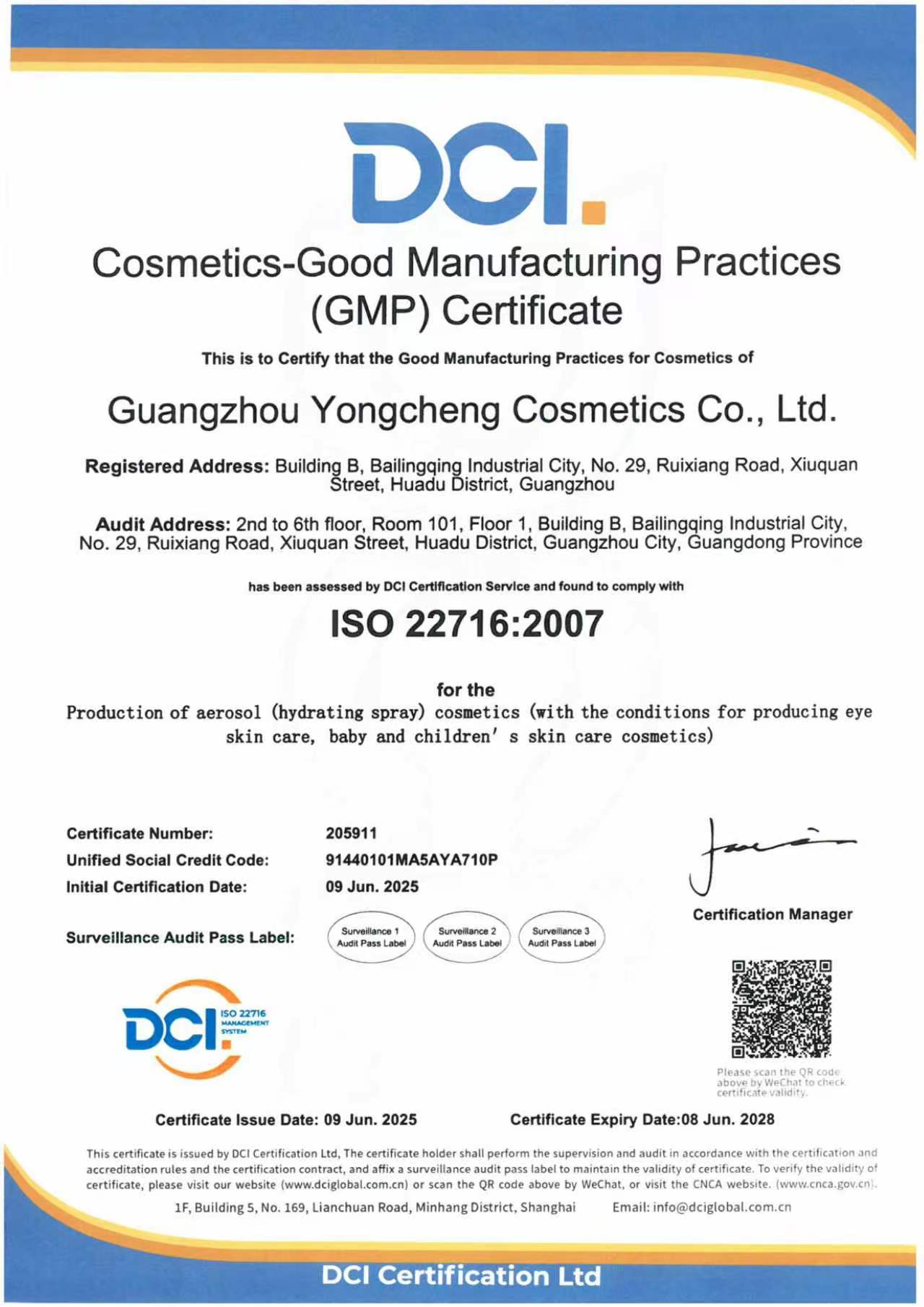
ISO 22716:2007 cosmetics GMP certificate (number 205911, DCI Certification Ltd). Third-party buyers should verify the certificate number with the issuing body and confirm the certified scope matches the ordered product category.
Comparing Supplier Models — and the Limits of Each
Because aerosol filling cannot be subcontracted invisibly without consequences, the most useful supplier comparison is between operating models rather than between logos.
| Comparison dimension | Self-operated aerosol filler | Outsourced subcontractor | Generic trading listing |
|---|---|---|---|
| Filling control | In-house pressure-resistant aerosol filling workshop and equipment | Filling performed by a third party; schedule depends on the subcontractor | No filling capability; outward packaging or assembly only |
| Quality consistency | Valve and can incoming inspection under the supplier's own control | Responsibility split between parties | Not controlled by the seller |
| Export documentation | Full set including UN packaging certificate and SDS/MSDS | Possibly incomplete, or issued by a third party | Typically unavailable |
| Verification difficulty | Site, certificates and production references can be audited | Harder to audit; production site not owned | Effectively not auditable |
| Typical risk | Higher commercial thresholds, as noted below | Unstable cycle time, inconsistent quality, missing UN documents | Cargo detention risk at port |
The limitations on the self-operated model are real and should be part of the buyer's calculation. BOV hardware costs more per unit than a standard aerosol system, which makes BOV less suitable for price-led mass formats. The MOQ floor of 10,000 cans per formula excludes very small launches, and trial quantities carry a higher unit price and potentially longer lead time. Lead time of 30–45 working days is not fully within the supplier's control because it is affected by aerosol can packaging supply. The factory cannot act as a regulatory registrant in the buyer's market. Certification scope, as noted above, must be matched product by product. And several attractive figures — annual output, export ratio, brand counts — are self-reported rather than third-party audited, so they belong on the verification list, not in the decision criteria.
Application Snapshot — A 3-in-1 Sunscreen Spray Programme
A documented OEM project illustrates how the checkpoints translate into an actual order. A cosmetic brand OEM based in Kazakhstan placed an order for 20,000 cans of a 3-in-1 sunscreen spray combining sunscreen, toner and makeup base functions, targeted at e-commerce retail sale. The engagement ran for three years and covered full-chain OEM service: formula development, aerosol filling and packaging customisation, with full regulatory document support. Documented highlights include the multi-function formula, a lightweight non-greasy texture, UVA/UVB broad-spectrum protection and customised brand packaging.
Three observations are worth extracting for other buyers. The order quantity sits inside the stated MOQ band, which indicates the project was planned around standard production rather than trial batches. The formula combines three functions in one aerosol system, which is a useful reminder that aerosol formulation complexity — not only pack design — drives sample rounds. And a three-year duration implies repeat production, which is the point at which lead time reliability and batch consistency matter more than the first quotation.
Market Trends Shaping Aerosol OEM Selection
The category is large enough that supplier choice has strategic consequences. The global aerosol cosmetics market was valued at $14.8 billion in 2025 according to Dataintelo's aerosol cosmetics market research report. On the production side, the European Aerosol Federation reported that personal care accounted for 47.8% of total European aerosol units in 2024, confirming that personal care remains the dominant application for aerosol manufacturing capacity.
Within that total, sun care is a growth area: Grand View Research projects the sun care cosmetics market reaching $19.4 billion by 2033, with sunscreen sprays forming part of that demand. Regulation is moving in parallel — China's GB 7916-2026, the country's first mandatory national safety standard for cosmetics, takes effect on 1 January 2028 under SAMR and NMPA.
Taken together, these signals point in one direction for buyers: documentation capability and multi-format manufacturing depth are becoming access conditions rather than differentiators. A supplier that can run sunscreen spray, body mist and facial mist production on qualified lines, and issue the transport and technical dossiers for each, reduces the number of qualification cycles a brand must run across its range.
Future Outlook
Three developments are likely to shape aerosol OEM evaluation over the next few years. Propellant-free and dual-pack systems, already visible in the Eyevmy makeup setting spray, extend the logic of BOV into formats where transport classification and ingredient purity are commercial priorities. Regulatory tightening, exemplified by GB 7916-2026, will continue to shift weight from formula alone toward dossier readiness. And as buyers become more systematic about verification, supplier visibility — a named entity, a real address, checkable certificate numbers and documented project references — will matter as much as unit price in shortlisting decisions.
For third-party buyers, the practical conclusion is that a cosmetic aerosol OEM comparison should be run on evidence that can be checked: filling capability, portfolio depth across formats, the BOV or conventional decision, stated MOQ and lead time logic, and documentation that survives verification against the issuing body.
FAQ
What is BOV aerosol and how does it differ from conventional aerosol?
BOV stands for Bag-on-Valve. The cosmetic formula is sealed inside an inner flexible bag and is separated from the propellant — compressed air or nitrogen — held in the outer chamber of the can. Pressing the nozzle causes the propellant to squeeze the inner bag, pushing product out without any mixing between formula and gas. Documented characteristics include 360-degree spraying at any orientation, product utilisation of up to 99%, better formula stability and longer shelf life, non-flammability for transport, and good compatibility with sensitive, natural and alcohol-free formulas. In a conventional aerosol system the formulation and propellant share the can, which suits mainstream, cost-driven formats. BOV hardware carries a higher unit cost than a standard aerosol system, and both systems are available from the same aerosol OEM manufacturer.
What MOQ and lead time apply to aerosol cosmetic OEM orders?
The regular MOQ for aerosol cosmetic OEM is 10,000 cans per formula, with capability data listing a 10,000 to 20,000 can range depending on the format. Lead time is 30 to 45 working days after sample confirmation, and it is affected by the aerosol can packaging supply cycle. Small-batch trial orders are possible but carry a higher unit price, limited availability and potentially longer lead time because of packaging minimum order constraints. Buyers should confirm both figures in writing before sampling, and treat lead time as a range rather than a fixed date.
Which certificates and export documents matter most for aerosol cosmetics?
They fall into two groups. Production and management systems include the cosmetics production licence, ISO 22716 cosmetics GMP, ISO 9001 and ISO 45001. Export and market-access documents include SDS/MSDS, the UN dangerous-goods packaging certificate, COA for batch quality, CPSR for the EU market, and technical dossiers for local cosmetic notifications in other markets. Guangzhou Yongcheng Cosmetics, for example, holds ISO 22716:2007 (certificate 205911), ISO 9001:2015 (206000) and ISO 45001:2018 (206001) issued by DCI Certification Ltd, plus a Philippines FDA Cosmetic Notification (NN-1000016300591) covering MILUVCARE SUNSCREEN SPRAY SPF 50+ PA+++ under the ASEAN Cosmetic Directive. Buyers should verify certificate numbers with the issuing body and confirm that the certified scope covers the product category being ordered.
Can an aerosol OEM factory act as the regulatory registrant for my market?
No. This is a common false expectation in cross-border sourcing. A manufacturer can supply the technical dossier needed for registration — SDS, COA, CPSR, ingredient list and similar documents — and can support document preparation for markets such as the EU and Southeast Asia. However, official registration requires brand-owned legal information, so submission must be handled by the customer's local responsible party; the factory cannot act as registrant. Buyers should confirm the local regulatory requirements of the target market in advance, before production is scheduled.
How can a buyer check whether an aerosol OEM supplier actually fills in-house?
Four items provide the answer. First, evidence of a dedicated pressure-resistant aerosol filling workshop rather than a general packaging area. Second, current production licences and system certificates with numbers, issuing bodies and validity dates. Third, the ability to issue a UN packaging certificate and SDS/MSDS for the exact product being ordered. Fourth, finished aerosol project references with product type and order quantity. A supplier that only performs outward packaging or box assembly will usually be unable to produce these items consistently. Because certificate numbers can be checked with the issuing certification body and production sites can be confirmed through a live walkthrough, verification is preferable to assumption at every stage.
Guangzhou Yongcheng Cosmetics publishes a downloadable English company profile covering its facility, certifications and aerosol OEM/ODM capabilities for buyers who want to review the underlying disclosures referenced in this evaluation framework: Guangzhou Yongcheng Cosmetics E-Profile.