
Cosmetic Filling Line Qualification: Trial, Rotary and Tube Records
Cosmetic Filling Line Qualification: Trial, Rotary and Tube Records
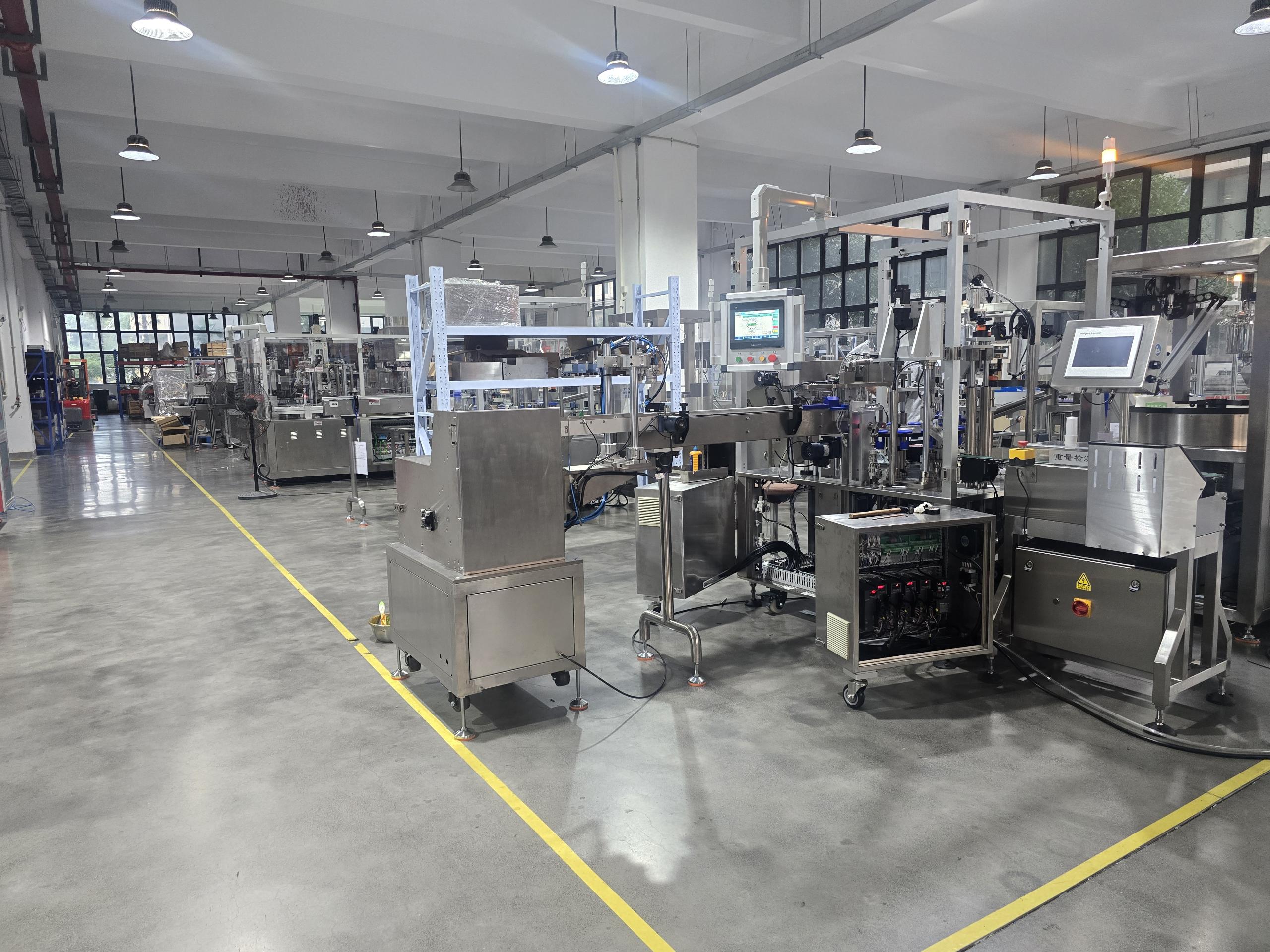
A cosmetic filling machine qualification review is not a request for a certificate. It is a matching exercise between three documents that are usually filed together and read separately: the certificate and its scope list, the machine record for the exact model and configuration being built, and the material evidence for the parts that contact the product. GIENICOS, the brand of Shanghai GIENI Industry Co., Ltd., a Shanghai-based manufacturer of cosmetic filling and packaging equipment founded in 2011, maintains a certificate set that shows both how that matching works and where it typically breaks.
Buyers moving from research into evaluation rarely need a yes/no answer to “do you have CE?” Every record in this set cites the same two standards, so the answer would be technically true and commercially empty. The question that decides approval is narrower: which certificate number names the machine being ordered, at what level of the equipment list, and with which options included.
Why “Is It CE?” Is the Wrong First Question
A single yes/no answer collapses four distinctions that a cosmetic line buyer has to keep separate: the model designation, the level of the equipment list the certificate covers, the option set actually ordered, and the material grade of the parts that touch the formulation. A certificate can be validly issued and still not name the machine on your purchase order, because it lists a designation series rather than every configuration sold under that series.
The nine CE records in the GIENICOS set show that variety at once. One is written around a complete hot filling line and enumerates seven components inside it. One covers a rotary filling machine across ten model designations. One addresses melting tanks, which are material-preparation units rather than fillers. Reading all nine as a single “compliance” fact is exactly where a technical approval loses precision — and where an unclosed question survives into factory acceptance testing.
Reading the Scope List as a Scope Document
The certificate number and the scope line do different jobs. The number identifies the document and the issuing laboratory; the scope line identifies what the document is about. For buyers who want the file in one view, the set supplied for this review looks like this.
| Certificate | Scope as listed | Issuing laboratory | Issued |
|---|---|---|---|
| AT185114C4000321 | HOT FILLING LINE: MT melting tank, JYF filling machine, JCT cooling machine, automatic bottle loading machine, automatic cap loading machine, check weigher, JTB labeling machine (JHF-1 to JHF-10) | Hunan Anbotek Compliance Laboratory Limited | 2024-07-17 |
| AT1814C502723151 | Air cushion CC cream filling machine: JQL-04C, JQR-02C, JQL-02C | Hunan Anbotek Compliance Laboratory Limited | 2025-09-05 |
| AT1814C500649151 | Lipstick filling machine: JLG-10, JLG-12, JSM, FSM-5, FSM, JLG | Hunan Anbotek Compliance Laboratory Limited | 2025-01-15 |
| ATGZAHS190528008-M1 | Melting tank: MT-1, MT-4, MT-6, TSP, TSF, MT | Anbotek (Guangzhou) Compliance Laboratory Limited | 2019-06-05 |
| AT58250SC100097 | Multifunctional filling production line: JYF-2 to JYF-12 | Anbotek (Guangzhou) Compliance Laboratory Limited | 2021-04-19 |
| AT58250SC000523 | Single nozzle hot filling line: JSFL | Shenzhen Anbotek Compliance Laboratory Limited | 2020-07-31 |
| AT18250SC100526 | Powder mixer: JY-CR50, JY-CR15, JY-CR20, JY-CR30, JY3-CR100, JY3-CR150, JY3-CR200, JY3-CR300 | Anbotek (Guangzhou) Compliance Laboratory Limited | 2021-07-06 |
| AT18250SC100525 | Powder compacting machine: JBC, JTC, ZL, ZL-F, JAC | Anbotek (Guangzhou) Compliance Laboratory Limited | 2021-07-06 |
| AT18250SC100524 | Rotary filling machine: JR-02-E, JR-01-E, JR-01-M, JR-02-M, JR-01-L, JR-02-L, JR-01-N, JR-02-N, JR-01-P, JR-02-P | Anbotek (Guangzhou) Compliance Laboratory Limited | 2021-07-06 |
Two scope styles appear. Certificate AT185114C4000321 is written at line level: it names a HOT FILLING LINE and then enumerates the MT melting tank, the JYF filling machine, the JCT cooling machine, an automatic bottle loading machine, an automatic cap loading machine, a check weigher and the JTB labeling machine, with model series JHF-1 to JHF-10. Certificate AT18250SC100524 is written at unit level across a designation series: ROTARY FILLING MACHINE, followed by ten designations from JR-02-E to JR-02-P. A buyer comparing the two is comparing a bill of equipment with a product family. Both are legitimate documents; they answer different questions, and neither substitutes for the other.
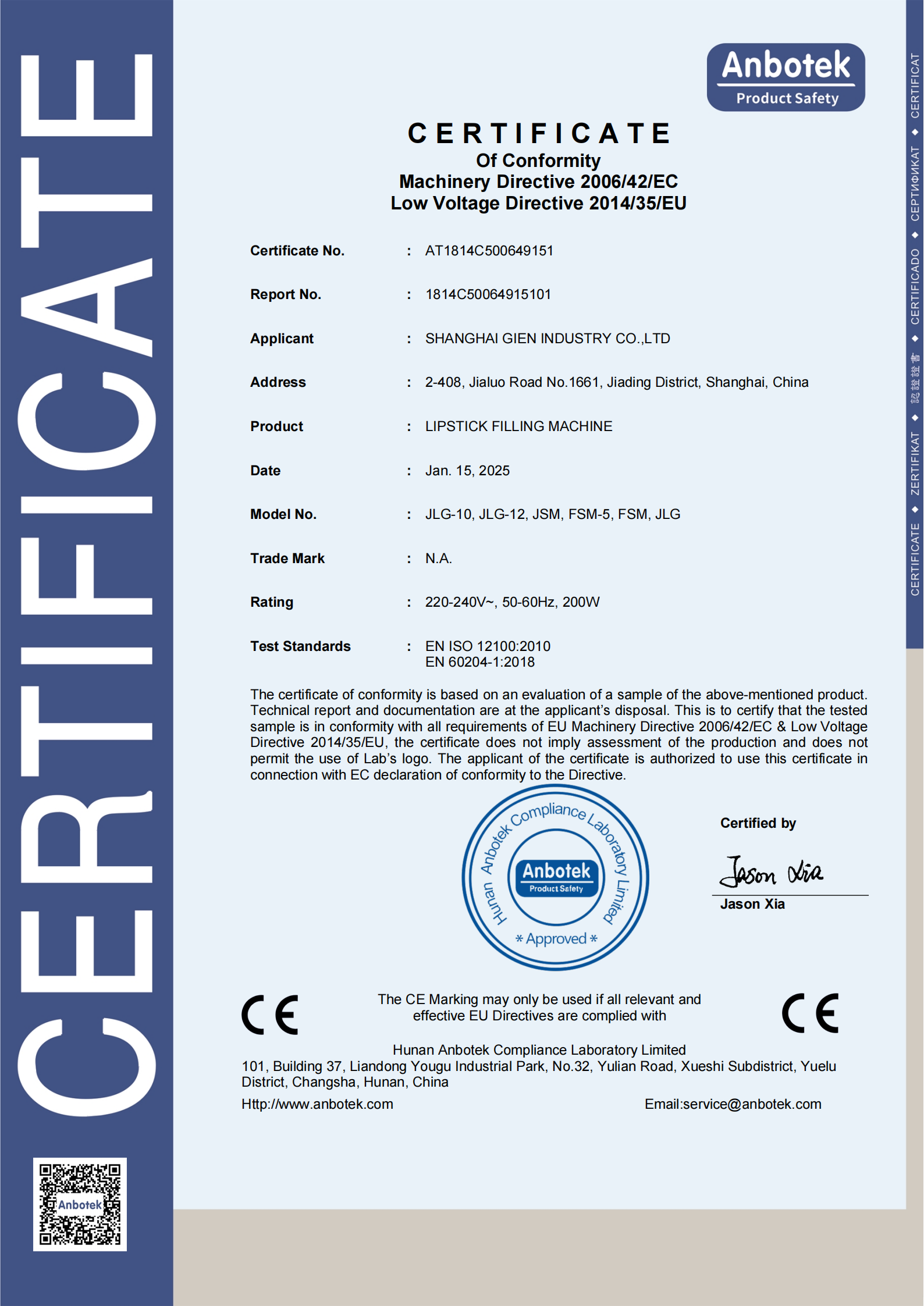
The records also differ in age. The earliest is dated 5 June 2019 for melting tanks; the most recent are dated 15 January 2025 for lipstick filling machines and 5 September 2025 for the cushion filling machines JQL-04C, JQR-02C and JQL-02C, which are among the newest additions to the filing. Confirming the current validity period with the issuing laboratory in writing is a routine step, and it belongs in the file rather than in an assumption drawn from a long-dated expiry field.
Trial Sample Filling Machine: Qualification Before Scale-Up
A trial machine exists to let a buyer observe dosing, cleaning and changeover on a real formulation before committing to a line. The JLG-10H Trial Sample Filling Machine is made of SS316L stainless steel, and that is the relevant first fact: a trial result only transfers to production if the contact material and the cleanable geometry correspond to the production unit being quoted.
The designation is the second fact, and this is where a qualification review earns its keep. The lipstick filling machine certificate AT1814C500649151 lists JLG-10, JLG-12, JSM, FSM-5, FSM and JLG. The trial machine is identified as JLG-10H. That difference is a question to close, not a conclusion to draw: ask the supplier to state in writing which record names the exact designation being ordered, and if a suffix marks a sample or trial configuration, ask which document covers that configuration and whether the production unit ordered under a second designation is covered separately.
Two further documents belong in the trial file. The first is the wetted-parts list — nozzles, tank, hopper, seals and any product hose — with the material designation for each item, because a machine-level statement that the equipment is stainless steel does not identify the grade of each contact part. The second is the cleaning provision for the assemblies the formulation touches. Trial decisions to scale up usually follow a cleaning trial as much as a dosing trial, and the modular structural design used across this portfolio, with fast disassembly for key assemblies, is the property that makes such a trial measurable rather than impressionistic.
Rotary Nail Polish Lines: Unit or Line Qualification?
Rotary architecture places filling stations on a rotating table, so output, dosing and capping become functions of station count and configuration rather than of a single filling head. That has a documentation consequence: the certificate has to be read together with a configuration record that states nozzle count, container diameter range, filling-volume range and rated speed.
GIENICOS lists nail polish filling among its machine categories, and the certificate set contains a rotary filling machine record, AT18250SC100524, that names ten JR- designations. As supplied, that scope line does not name a nail polish designation. The productive question for a buyer is therefore not whether rotary filling is certified, but which of the listed designations the ordered nail polish configuration carries — and if none does, which separate record applies.
For scale, a rotary machine elsewhere in the same portfolio, the JQR-01A automatic rotary mascara and lipgloss filling and capping machine, is documented at 40–45 pieces per minute, a 2–14 mL filling range, ±0.1 g filling precision, container diameters of 10–125 mm and container lengths of 40–90 mm excluding the cap, on 380 V or 220 V with 7 kW and 0.6–0.8 MPa air. Those figures belong to a different product and are useful precisely as a template: this is the level of detail a nail polish line's configuration record should reach before a certificate scope can be judged against the equipment.
Formulation is the buyer's own responsibility to raise. Where a nail polish base carries handling or ventilation implications, the buyer's EHS and regulatory functions should state their requirements before the electrical and pneumatic configuration is frozen. Customization here covers voltage, logo, automation degree, tank size, filling method and speed request, so the window to specify closes earlier than most buyers expect.
Semi Automatic Rotary Capping: A Component Question
The JR-01X Semi Automatic Rotary Capping Machine is documented as servo capping at 30–40 pieces per minute with adjustable torque, for round and square bottles, on single-phase 220 V, 1.5 kW, 7 A and 0.5–0.8 MPa air. It is described as able to operate with a single-nozzle filling machine, which places it in the small-batch and semi-automatic segment rather than in a fully integrated line.
Capping units sit awkwardly in a compliance file because they are usually bought as part of a line. The hot filling line record in this set treats capping the same way: it enumerates an automatic cap loading machine among the line components rather than naming a capping model. That is a defensible line-scope treatment, but a buyer purchasing the capping machine as a stand-alone unit should ask which record covers the unit itself, because a line-scope certificate describes the assembly, not the individual machine sold separately.
The parameter record carries two practical checks that are easy to miss. Single-phase 220 V at 7 A is a different circuit from the three-phase supply that tube and hot filling lines require, so the site electrical schedule has to include it; a three-phase-only installation plan will stop the capping station at commissioning. And adjustable torque is stated as a capability, not as a range. If cap qualification requires a documented torque window rather than an adjustable setting, ask for the numeric range before approval, because that value has to be traceable to the machine that arrives.
Tube Filling and Sealing: Where Options Change the Evidence
The GFS-40/60 Tube Filling and Sealing Machine is documented as servo filling at 5–250 mL for the GFS-40 and 5–200 mL for the GFS-60, at 30–40 and 60–80 pieces per minute respectively, for tubes of 10–50 mm diameter and 60–210 mm length in plastic, aluminum and laminate, on three-phase 380 V with 5.0 kW or 5.3 kW, and machine dimensions of 1900 × 850 × 1900 mm or 1890 × 1083 × 2072 mm. Tube loading, eye-mark detection, filling, sealing, coding, cutting and discharge are integrated, and the documented applications include foundation, lip gloss, cream, skin-care and sun-care products.
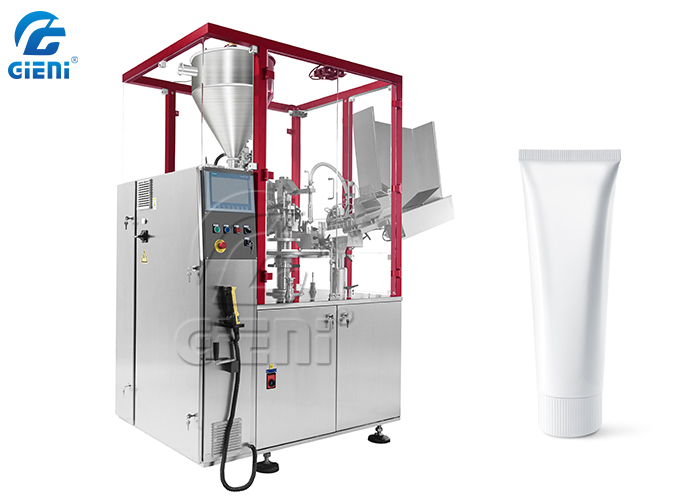
Three option-level facts change what the evidence has to say. The machine is supplied with one tank, with level control, heating and mixing optional — so a heated or stirred configuration introduces a different wetted and temperature-controlled set from the base machine, and the material evidence must describe the option ordered rather than the catalogue default. Tube material changes the sealing configuration: aluminum, plastic and laminate tubes do not seal on the same parameters, so the sealing station record should be matched to the tube actually being run. And the two models are separate specifications, not a speed setting — a 60–80 pieces per minute requirement should be quoted and documented as a GFS-60, not as a GFS-40 run faster.
On the qualification itself, no tube filling or sealing model is named in the nine certificate records supplied for this review. That is a finding about the file, not about the machine. A supplier may hold a record that was not included in this extract, or may qualify a tube filler as a component within a line scope. The correct action is to ask in writing which document names the tube model and its configuration, and to hold approval until that document is in hand. Absence from one file proves nothing in either direction; a named scope line does.
What the Cited Standards Do and Do Not Establish
EN 60204-1:2018 addresses the electrical equipment of machines; EN ISO 12100:2010 sets out general principles for risk assessment and risk reduction in machine design. Both appear in all nine records, and together they tell a buyer that the electrical design and the risk-assessment process were documented against recognized European standards.
Neither is a hygiene standard, a material standard or a performance standard. A certificate citing them does not establish surface finish, cleaning validation, material grade or output. Hygiene evidence sits elsewhere in the file: material designations for contact parts, cleanable geometry, and manufacturer design statements — such as the JTB labeling machine being described as designed to meet GMP production requirements, or the JQL-04C cushion filling machine's SUS316L wetted parts being described as meeting cosmetic GMP hygiene requirements. Those are statements of design intent tied to a specific model, and they should be read as such: useful, checkable, and separate from the CE scope line.
Product-Contact Materials: Reading the Designations Correctly
Two designations appear across the records: SS316L, stated for the JLG-10H trial machine, and SUS316L, stated for the wetted parts of the JQL-04C cushion filling machine and for the product-contact parts of the loose powder line. SUS316L is the Japanese Industrial Standards designation for the low-carbon 316L austenitic grade, and SS316L is used in the same sense in supplier documentation. They point to the same material family, but a qualification file should not rest on an abbreviation alone.
Three checks turn the abbreviation into evidence. Separate the structure from the contact set: the JR-01X is described as stainless steel and aluminum-alloy structure, and the tube machine as stainless steel, which describes the machine build rather than the grade of every part the product passes. Second, ask for the wetted-parts list by item and grade, and state in the purchase order whether a mill or material certificate is required and in what form. Third, tie the material claim to the option ordered, because a heated tank, a mixed tank or a different nozzle set changes the list.
A Parameter Record the Buyer Can Actually Check
| Scope example | Values in the supplied record | Document or question that closes the gap |
|---|---|---|
| Trial Sample Filling Machine, JLG-10H | SS316L construction stated for the model | A written designation statement matching JLG-10H against the lipstick filling scope (JLG-10, JLG-12, JSM, FSM-5, FSM, JLG), plus the itemised wetted-parts list |
| Rotary nail polish configuration | Rotary filling record lists JR-02-E to JR-02-P designations | Which designation the ordered configuration carries; nozzle count, volume range and container range in the same statement |
| Semi Automatic Rotary Capping Machine, JR-01X | Servo capping; 30–40 pcs/min; adjustable torque; round and square bottles; 220 V single phase; 1.5 kW; 7 A; 0.5–0.8 MPa | Whether it is qualified as a stand-alone unit or as a capping station inside a line-scope record; the numeric torque range if the cap specification needs one |
| Tube Filling and Sealing Machine, GFS-40 / GFS-60 | Servo filling 5–250 mL or 5–200 mL; 30–40 or 60–80 pcs/min; tubes 10–50 mm diameter, 60–210 mm length; plastic, aluminum, laminate; 3P 380 V; 5.0 kW or 5.3 kW | The record naming the tube model; wetted-parts list for the tank option ordered; sealing configuration for the tube material to be run |
The table is deliberately narrow. It contains only values that appear in the supplied records and ends each row with the document or question that closes the gap. A buyer who can complete every row holds a qualification file; a buyer holding a certificate and a quotation holds a starting point.
Beyond the CE File: Trade Codes and Site Conditions
Customs classification belongs in the same folder. Cosmetic filling machines fall under HS heading 8422.30, with 8422.30.91 covering machinery for opening, filling and closing containers in the Harmonized Tariff Schedule published by USITC. An invoice description that matches the certificate scope wording saves a broker from resolving questions that a precise description answers in advance.
Site conditions are the second non-certificate item that delays approval. The capping machine needs 0.5–0.8 MPa air on a single-phase circuit; the JQR-02C cushion filling machine requires 0.6–0.8 MPa at 300 L/min or more; the tube and hot filling lines run on three-phase 380 V. Voltage is itself a customization item in this portfolio, alongside tank size, filling method, automation degree and logo, so the utility schedule should be agreed at the same moment as the machine specification rather than after it.
Why Documentation Scrutiny Is Rising With Automation
Market research adds context, not proof. Future Market Insights, in material dated 11 April 2026, valued the global cosmetic filling machines market at USD 476.80 million in 2025 and projected USD 718.63 million by 2036, with automatic filling machines projected to hold a 41.2% share of the technology mix in 2026. Fortune Business Insights, in material dated 20 July 2026, put Asia Pacific at 33.08% of the broader filling machine market in 2025 — a wider category than cosmetic filling alone, and not directly comparable with the cosmetic-specific figure.
The interpretation matters more than the figures. If the automatic share of the mix continues in the same direction, more of what a buyer purchases sits in integrated stations — capping, check weighing, labeling, tube handling — and the unit certificate covers proportionally less of the delivered capability. That is an analytical reading under a stated assumption, not a measured finding, and it explains why qualification work migrates from document collection toward configuration review.
Request List: What to Ask For Before Approval
Eight items turn the discussion above into a file that can be reviewed, signed and archived.
- The certificate PDF with its scope line, number, issuing laboratory, standards cited, issue date and stated validity period, requested for the exact designation on the quotation.
- A written designation statement mapping the ordered model string to the string or strings on the certificate, including any suffix used for trial or sample configurations.
- The configuration record: nozzle count, filling-volume range, container diameter and length range, rated speed, electrical supply, air demand and tank options.
- The itemised wetted-parts list with material designations, and the material certificate form your quality system requires.
- Cleaning and disassembly provisions for the assemblies the formulation contacts, described at assembly level rather than as a general design principle.
- A statement of whether integrated components — capping, labeling, check weighing — are qualified by a line-scope record or by their own documents.
- The utility schedule and site drawing, checked against 220 V single-phase and 380 V three-phase requirements and against the stated air pressure and consumption.
- The acceptance record: GIENICOS states 100% outgoing quality control testing before shipping, a quoted lead time of 45–80 days at a one-unit minimum order, and a 12-month warranty from machine acceptance covering manufacturing defects, excluding wearing consumable parts and man-made damage, with spares and freight carried by the manufacturer.
Outlook
Three changes would make this kind of review faster, and all three sit within a supplier's control. Designation-level scope statements, listing the suffixes and variant codes covered under each model family, would remove the JLG-10 against JLG-10H class of question at source. Configuration annexes attached to the certificate — nozzle count, volume range, container range, tank options — would let a buyer test scope against the quotation without a separate exchange. Option-level material evidence would keep the wetted-parts list current when heating, mixing or a different nozzle set is added.
Until then the discipline is the same at every line type: match the string, match the level, match the option, match the material. A qualification file that does all four is short, specific and reviewable; one that does none is a certificate in a drawer.
FAQ
Does one CE certificate cover an entire cosmetic filling line?
It depends on how the scope line is written. Certificate AT185114C4000321 names a HOT FILLING LINE and enumerates the MT melting tank, JYF filling machine, JCT cooling machine, automatic bottle and cap loading machines, check weigher and JTB labeling machine with model series JHF-1 to JHF-10, which is a line-scope record. Certificate AT18250SC100524 names a ROTARY FILLING MACHINE across ten designations, which is a unit-scope record. Buyers should establish which style applies to their order and whether separately purchased components are covered by the line record or need their own document.
Which standards appear in GIENICOS machine certificates?
All nine CE records supplied cite EN 60204-1:2018 and EN ISO 12100:2010. The first addresses the electrical equipment of machines and the second sets out general principles for risk assessment and risk reduction. Neither addresses hygiene, material grade or output, so material and cleaning evidence should be requested as a separate part of the qualification file.
How can a buyer confirm that the exact model on a quotation is covered?
By matching designation strings character for character. The lipstick filling machine certificate, for example, lists JLG-10, JLG-12, JSM, FSM-5, FSM and JLG, while the trial sample filling machine is identified as JLG-10H. Where a suffix differs, the buyer should ask the supplier in writing which record covers the ordered designation and confirm the current validity period with the issuing laboratory named on the certificate.
Do these certificates confirm GMP compliance?
No. The records cite electrical safety and risk-assessment standards. GMP-related evidence appears as manufacturer design statements and material specifications — for instance the JTB labeling machine described as designed to meet GMP production requirements, or the SUS316L wetted parts of the JQL-04C cushion filling machine described as meeting cosmetic GMP hygiene requirements. Buyers should request the wetted-parts list and the cleaning provisions for the model and options actually ordered.
What should a buyer do when a machine type is not named in the certificate file?
Ask which document covers it before approval. A tube filling and sealing machine, for example, is not named in the nine records supplied for this review, and that fact alone establishes neither that a record exists nor that one does not. The qualification step is to obtain the document that names the model and configuration, or a written statement of the alternative qualification route being applied.
What acceptance and warranty evidence accompanies shipment?
GIENICOS states 100% outgoing quality control testing before shipping and a 12-month warranty from the date of machine acceptance covering manufacturing defects, excluding wearing consumable parts and man-made damage, with spare parts and freight carried by the manufacturer. Quoted lead time is 45–80 days with a one-unit minimum order. Warranty scope should be read alongside the spare-parts list for the options ordered.
Reference material for the models discussed above is available in the 2026 GIENICOS catalogue (PDF).
Have Questions or Need More Details?
Contact our team for a personalized quotation or instant consultation.
Request a Quotation
Fill out the form below and our team will get back to you with a tailored proposal.
WhatsApp Direct Chat
Prefer to chat in real-time? Message us on WhatsApp for instant assistance & quick answers.
- Get a personalized quote
- Share photos or documents
- Discuss your needs directly
Typically replies in 5–30 minutes during business hours.