
Cosmetic Filling Lines: Rotary, Inline and Semi-Automatic
Cosmetic filling machines are normally compared on output per minute. The decision that determines whether a line is still efficient three years later is made earlier, and it is an architecture decision: which machine family fits the container format and the behaviour of the bulk material.
For procurement teams working through the final stages of a project, the sequence matters. Container type, fill material behaviour, capping or sealing integration and hot-fill dependency each eliminate entire families of equipment before a single specification sheet is reviewed. A buyer who starts from speed targets will usually end up re-negotiating scope later; a buyer who starts from architecture will usually arrive at a specification that survives a product range change.
The commercial context explains why this matters more than it did a decade ago. Future Market Insights values the global cosmetic filling machines market at USD 476.80 million in 2025 and projects USD 718.63 million by 2036. Asia Pacific accounted for 33.08% of the wider filling machine market in 2025, according to Fortune Business Insights. Within cosmetic filling technology, automatic filling machines are projected to hold a 41.2% share in 2026, per Future Market Insights. Automation is gaining share, but it is not the only rational answer for every plant.
This article sets out a comparison framework for three architecture families — rotary, inline (linear) and semi-automatic or vertical bench equipment — using catalogue examples from GIENICOS, the brand of SHANGHAI GIENI INDUSTRY CO.,LTD, a Shanghai-based manufacturer founded in 2011 that designs and builds cosmetic filling and packaging equipment and exports to the EU, USA and Asia.
Why Format Comes Before Specification
The common failure mode in line procurement is shortlisting by nominal output. Two machines may both be quoted at 40 pieces per minute, but one may require a fixed container pitch while the other accepts a bottle diameter range of 10 to 125 mm. Those are not interchangeable assets.
Architecture choices also compound over time. A rotary platform concentrates filling, brush feeding and capping around one carousel. An inline line distributes the same operations along a conveyor and can be extended with sealing, labelling and check-weighing stations. A semi-automatic unit hands part of the cycle to an operator. Each of these choices produces a different long-term cost profile: tooling inventory, conveyor and sensor maintenance, operator dependency, and the practical ability to add capacity later without replacing the platform.
For buyers at the decision-to-execution stage, the useful question is therefore not "which machine is faster" but "which architecture still fits when the product range changes" — a question that belongs to long-term equipment strategy rather than to a single purchase order.
Four Filters That Narrow the Field
Filter 1 — Container geometry and presentation format
Container dimensions are the hardest constraint because they determine the handling hardware. Catalogue specifications make the point concretely: the JQR-01A Rotary Mascara Filling and Capping Machine accepts containers from 10 to 125 mm in diameter and 40 to 90 mm in length, excluding the cap. The JRS-G3 Toner and Cream Rotary Filling Machine works with holder diameters of 10 to 70 mm. The JRS-G2 Dual Nozzle Servo Toner/Cream Filling Machine specifies a puck inner diameter of 25 to 70 mm, bottle height from 30 mm without cap to 205 mm with cap, and cap diameter of 20 to 55 mm. The JLG-10H Trial Sample Filling Machine is built for small bottles of 12 to 20 mm diameter.
Presentation format matters as much as dimensions. A stick, a pouch, a cushion compact and a nail polish bottle place different demands on positioning, orientation and transfer. The JR-01P Lip Pouch Filling Machine, for example, addresses pouch-type formats with filling volumes of 2 to 10 mL and an output of 20 to 30 pouches per minute, which is a fundamentally different handling problem from a rigid round bottle.
Filter 2 — Fill material behaviour
Viscosity, solids content and temperature sensitivity separate filling technologies. The JRS-G2 specification states a material viscosity of up to 15,000 mPa·s for its dual-nozzle servo filling configuration; above that range, different pump and nozzle logic is normally required. The JMF Vertical Dual Nozzle Filling Machine is positioned for high-viscosity cosmetic materials and runs at 22 to 28 pieces per minute with one operator, using dual 20 L tanks. At the low-viscosity end, the JQR-02E Rotary Liquid Eyeliner Filling Machine uses peristaltic pump filling and processes two pieces per cycle at 30 to 40 pieces per minute.
Powder behaves differently again. The JLF Rotary Loose Powder Filling Machine uses rotary weighing-to-fill at 900 to 1,800 pieces per hour, while the JLF-A Automatic Loose Powder Filling Machine uses dual-nozzle auger filling at 30 to 40 pieces per minute. Weighing and auger dosing are not interchangeable with volumetric piston filling, which is why material characterisation should be completed before any machine comparison.
Stated accuracy figures are conditional, and buyers should read them that way. The JQL-04C BB CC Cushion Filling Machine is specified at ±0.15 g, explicitly "subject to material formula, sponge characteristics, and other factors". The JQL-02N Nail Polish Filling and Capping Machine carries the same ±0.15 g figure with a comparable caveat. Precision claims only become procurement criteria when the material and the container are fixed.
Filter 3 — Whether capping, brush and wiper handling is in scope
For mascara, lip gloss, eyeliner and nail polish, the filling head is only part of the line. Mascara and nail polish containers carry a brush, a wiper or both, and those components must be fed, inserted and torqued to a controlled specification.
The JQR-01N Rotary Nail Polish Filling Machine describes a complete working sequence: bottle feed, filling, brush feed, cap feed, capping and discharge, at filling volumes of 5 to 30 mL and approximately ±0.2 g precision. The JMG Linear High Speed Lipgloss and Mascara Filling Line includes robot-aided bottle loading, brush-cap feeding and inner wiper insertion, with servo torque capping on adjustable torque and speed for cap protection, plus a no-bottle-no-fill detection function and a return-suction anti-drip nozzle to reduce bottle-mouth contamination.
Where capping is handled separately, the JR-01X Semi Automatic Rotary Capping Machine covers round and square bottles at 30 to 40 pieces per minute with adjustable servo torque. Tube formats move to a different operation entirely: the GFS-40/60 Tube Filling and Sealing Machine handles 5 to 250 mL at 30 to 40 pieces per minute, or 5 to 200 mL at 60 to 80 pieces per minute, for tube diameters of 10 to 50 mm and lengths of 60 to 210 mm.
Filter 4 — Hot-fill and cooling dependency
Lipstick, lip balm, eyebrow pencil and eyeliner gel products are filled hot and must solidify under controlled cooling. This is a thermal process, not simply a filling process, and it changes the architecture question. The JHF Hot Filling and Cooling Line offers fill volume bands of 1–20 mL, 20–50 mL, 50–100 mL and 100–200 mL, with 2, 4, 6 or 16 nozzles depending on line configuration and a maximum output of up to 60 pieces per minute with a six-nozzle arrangement. The JPF-12 Eyebrow Pencil and Eyeliner Gel Filling Line specifies a cooling temperature of −1 °C to −2 °C at 45 to 50 pieces per minute.
Once thermal processing is in scope, melting and pre-melting capacity enters the evaluation. The TSP 20 L Cosmetic Hot Pouring Machine provides heating, stirring and vacuum with a sanitary valve without dead angle; the MT 20 SE combines six 20 L tanks for pre-melting multi-colour or multi-formula wax bulk.
Architecture Family 1 — Rotary Configurations
A rotary filling machine indexes containers around a carousel, so several operations can be performed at fixed stations on one platform. The practical consequence is that filling, component feeding and capping can be integrated without a long conveyor, and the machine footprint stays compact — the JRS-G3 measures 2000 × 1700 × 2000 mm, while the JQR-01A measures 2350 × 2150 × 1900 mm.
| Rotary example | Function | Key published parameters |
|---|---|---|
| JQR-01A Automatic Rotary Mascara Filling and Capping Machine | Filling and capping; mascara, lipgloss, foundation liquid | 40–45 PPM; 2–14 mL; ±0.1 g; container diameter 10–125 mm; container length 40–90 mm; 7 kW |
| JRS-G3 Toner and Cream Rotary Filling Machine | Oil, toner, serum and cream filling | 10–300 mL; ≤50 pcs/min; servo piston; ±0.5 g at 20–100 mL; ±0.5% at 101–300 mL; changeover time 15 min |
| JQR-01N Automatic Nail Polish Filling Machine (Rotary Type) | Bottle feed, filling, brush feed, cap feed, capping, discharge | 5–30 mL; ≈±0.2 g; piston, vacuum or pressurised filling; AC220V, 1 phase, 2 kW |
| JQR-02C Rotary Air Cushion CC Cream Filling Machine | Single or dual colour cushion filling | 24–30 pcs/min; maximum 20 mL; 15 L tank with stirring; servo filling and lifting |
| JLF Rotary Loose Powder Filling Machine | Rotary weighing-to-fill for loose powder | 900–1,800 pcs/hour; 25 L tank; 0.4 kW; 670 × 600 × 1400 mm |
Rotary platforms suit plants that run a stable container family at moderate to high volume and want capping inside the same machine boundary. They are also a natural fit for GMP clean-room layouts, where a compact single platform reduces the clean space that must be qualified.
Architecture Family 2 — Inline (Linear) Configurations
Inline architecture places stations sequentially along a conveyor. Capacity scales by adding nozzles per cycle rather than by adding carousel positions, and downstream equipment can be inserted into the sequence as the product range grows.
| Inline example | Function | Key published parameters |
|---|---|---|
| JMG Linear High Speed Lipgloss Mascara Filling Line | Filling, brush-cap feeding, inner wiper insertion, capping | 60–72 pcs/min mid-speed; 80–100 pcs/min high-speed; 10–12 pcs per cycle; servo piston; SUS316L wetted parts |
| JQH-02 Automatic Lipgloss Filling and Capping Machine | High-speed lipgloss filling and capping | 1–20 mL; 60–80 pcs/min; servo piston; ±0.1 g; 3 phase 380V; 13 kW |
| JQL-02N Automatic Nail Polish Filling and Capping Machine | Two-nozzle servo filling and capping | 5–20 mL; 80 pcs/min; ±0.15 g subject to material formula |
| JRS-G2 Dual Nozzle Servo Toner/Cream Filling Machine | Toner and cream filling for skincare bottles | 10–300 mL; viscosity ≤15,000 mPa·s; 45 bottles/min at 50 mL; 40–45 L tank |
| GFS-40/60 Tube Filling and Sealing Machine | Tube filling and sealing; plastic, aluminium and laminate tubes | 5–250 mL and 5–200 mL; 30–40 or 60–80 pcs/min; tube diameter 10–50 mm; tube length 60–210 mm |
Inline lines earn their footprint when a small number of high-volume SKUs justify continuous operation. They are also the natural home for line-level verification, where automatic check-weighing, rejection, labelling and sleeve-shrink labelling are added as stations rather than as separate manual steps. The JLG-10H Trial Sample Filling Machine illustrates how far nozzle multiplication can go in a linear frame: ten nozzles delivering 1 to 19 mL at 100 to 130 pieces per minute for small bottles of 12 to 20 mm diameter.
Architecture Family 3 — Semi-Automatic and Vertical Configurations
Semi-automatic equipment keeps the operator inside the cycle. That is a constraint in high-volume production and an advantage in almost every other situation: short runs, trial batches, unstable container supply, frequent formulation changes, and factories where a full automatic line cannot yet be justified.
- JR-01M/L Semi-automatic Rotary Single Nozzle Filling Machine — 2–14 mL or 10–50 mL by changing spare parts; ceramic or SUS pump options; 30–40 pcs/min; AC220V, 1 phase, 3.8 kW.
- JR-02M/L Semi-automatic Rotary Dual Nozzle Filling Machine — 1–20 mL; ±0.1 g; 30–40 pcs/min; rotary dual-nozzle structure for lipgloss and mascara.
- JMF Vertical Dual Nozzle Filling Machine — high-viscosity materials; dual 20 L tanks; 22–28 pcs/min with one operator; cleaning time approximately 30 minutes.
- JSFL 1-2 Servo Piston Filling Machine — single or dual nozzle; lip balm, lipstick and lip cream; liftable tank for high-viscosity hot filling.
- JLG-10/12 Semi Automatic Lipstick Filling Series — 10 or 12 nozzles; ±0.1 g; configured as a series with cooling tunnel and vacuum releasing machine.
- JSM Semi-automatic Lipstick and Lipbalm Filling Line — 2,160–3,600 pcs/hour with metal mould, 1,800–3,000 pcs/hour with silicone mould; 4–5 operators.
The honest trade-off is labour. Published semi-automatic output figures assume an operator working to the machine's rhythm, so throughput variability across shifts is a real planning factor. For a plant running many SKUs in small batches, that variability is usually cheaper than idle automatic capacity; for a plant running one SKU continuously, it is not.
Comparison Matrix: Mapping Format to Architecture
| Decision dimension | Rotary | Inline / linear | Semi-automatic / vertical |
|---|---|---|---|
| Container change behaviour | Holder or tooling change; JRS-G3 publishes a 15-minute changeover | Station and conveyor re-setting; more components affected | Fastest for short runs; operator sets the pace |
| Typical output band (catalogue) | 24–45 pcs/min filling and capping; up to 50 pcs/min cream and toner; 900–1,800 pcs/hour powder | 60–100 pcs/min on lipgloss and mascara; 80 pcs/min nail polish; 100–130 pcs/min trial-sample filler | 22–28 pcs/min vertical high-viscosity; 30–40 pcs/min semi-automatic rotary |
| Integration scope | Filling, brush feed and capping on one carousel | Sequential stations; easy to append sealing, check-weighing and labelling | Often manual loading; capping handled by a separate unit such as JR-01X |
| Hot-fill and cooling | Requires an external thermal path | Requires an external thermal path | Commonly paired with mould-based cooling tunnels |
| Footprint | Compact single platform | Long; grows with each added station | Small |
| Long-term ownership focus | Tooling inventory and station expandability | Conveyor, sensor and line-balance maintenance | Operator training and labour dependency |
| Typical best fit | Stable container family at moderate to high volume | Few standardised SKUs at sustained high volume | Many SKUs, trial runs and evolving formulas |
This matrix is a screening tool, not a specification. It narrows the family; it does not replace factory acceptance testing on the actual container and bulk material.
When the Product Is Hot-Poured
Hot-pour systems deserve separate treatment because their constraint is thermal rather than mechanical. The JCT Lipstick Cooling Tunnel uses refrigerated air circulation and continuous conveyor-type cooling for lipstick and lip balm moulds after hot filling. The GLU-1300 Automatic Silicone Mold Lipstick Filling Machine runs at 1,000–1,300 pieces per hour with a 112-piece silicone mould, a 30 L material tank, electric oil heating and two LEISTER hot air guns for a lipstick diameter range of approximately 8–17.1 mm.
Multi-colour and multi-formula production adds another layer. The JYF-4 Four-in-one Single Nozzle Multi-colour Hot Filling Line handles four colours with servo piston filling at 2–20 mL, 20–50 mL or 50–100 mL, using 20 L effective tank volume, SUS316L product-contact parts and ±0.1 g precision. In long-run operations, this is where line architecture and colour-change discipline intersect: the number of tanks, the number of nozzles and the cleaning routine determine how many SKUs a single line can realistically carry.
Building the Shortlist: A Six-Step Method
The following sequence works from container and material toward commercial terms, and it keeps the architecture decision ahead of the specification decision.
- Step 1 — Fix the container and the closure. Record diameter, height, cap type, brush or wiper presence and whether the format is a bottle, stick, pouch, tube or pan. Compare against a published handling range such as 10–125 mm container diameter before proceeding.
- Step 2 — Characterise the bulk material. Confirm viscosity band, whether the product is filled hot or ambient, and whether it is a liquid, cream, wax or powder. Viscosity above the stated range of a given filling configuration requires a different pump principle, not a different setting.
- Step 3 — Define integration scope. Decide whether capping, brush insertion and wiper insertion sit inside the machine boundary or on a separate unit. This single decision usually separates rotary from inline candidates.
- Step 4 — Decide the thermal path. If the product is hot-poured, add melting, filling and cooling to the same architecture decision, including mould type and cooling tunnel length.
- Step 5 — Set output against changeover frequency. A 100 pcs/min line that stops frequently for changeover may deliver less usable output than a 40 pcs/min platform with a 15-minute changeover. Model output per shift, not output per minute.
- Step 6 — Validate before commitment. Sample runs on representative equipment de-risk the specification, and acceptance criteria should be written into the purchase order. Standard terms for GIENICOS equipment include MOQ of 1 unit, FAT on site or video inspection before shipment, and delivery terms of FOB, CNF, CIF or DDP.
Market Trend Analysis: What the Numbers Suggest
Three published figures frame the architecture decision. First, the global cosmetic filling machines market was valued at USD 476.80 million in 2025, with a projected value of USD 718.63 million by 2036 (Future Market Insights). Second, Asia Pacific held a 33.08% share of the wider filling machine market in 2025 (Fortune Business Insights), which explains the density of equipment suppliers and spare-part ecosystems in the region. Third, automatic filling machines are projected to hold a 41.2% share of cosmetic filling technology in 2026 (Future Market Insights) — a clear majority position for automation, but not an exclusive one.
Sub-segment forecasts require more caution. One commercial source projects the automatic lipstick filling machines market to reach USD 1.2 billion by 2033, growing at a 5.8% CAGR from 2025 (Strategic Revenue Insights), while other published estimates for what appears to be a narrower definition of the same segment are an order of magnitude smaller. The gap reflects differences in how reports define "machine" versus "production line". For buyers, the practical implication is that sub-segment CAGR figures should be treated as directional signals about investment flow, not as inputs to a capacity calculation.
Two regulatory and trade facts sit alongside the market data. Cosmetic filling machinery falls under HS Code 8422.30, with 8422.30.91 covering machinery used in opening, filling and closing containers, which matters for customs classification and landed-cost modelling. And on the compliance side, GIENICOS products across mascara, lipgloss, eyeliner, CC cream and high-speed filling lines carry CE certification. In an EU-facing project, these two items are usually reviewed before commercial terms.
Where the Framework Breaks Down
A comparison framework is only useful if its boundaries are stated.
- One plant may need more than one architecture. A factory producing both hot-poured lipstick and pressed powder is not choosing between rotary, inline and semi-automatic; it is planning several unit operations. The GTC-series compact powder presses, the GP 050 SE automatic rotary powder press at 50–60 pcs/min with four cavities and the JZF vision-guided robotic compact powder assembly line address a different production logic from a lipgloss filling line.
- Precision figures are conditional. Published tolerances of ±0.15 g on cushion and nail polish platforms carry explicit caveats about material formula and substrate characteristics. A tolerance figure without the material definition is not a specification.
- Changeover data is narrow. The 15-minute changeover published for the JRS-G3 refers to a changeover within a defined holder range, not to a switch between fundamentally different container families.
- Semi-automatic output depends on people. A stated 22–28 pcs/min for one operator is a planning assumption, not a guaranteed machine rate independent of labour.
- Higher-grade configurations cost more. Where SUS316L wetted parts and internationally sourced control components such as Mitsubishi PLC and Schneider electricals are used instead of lower-grade alternatives, the equipment price is typically 10–20% higher. That is a purchasing trade-off to be evaluated against the intended duty cycle and maintenance plan, not an automatic advantage.
- Performance claims should be verified. Comparative durability, downtime and material-waste statements are, by their nature, supplier-reported until demonstrated. Factory acceptance testing and reference visits remain the verification step.
Future Outlook
Automation share is expanding, and the direction of travel in filling equipment follows the wider manufacturing pattern: more sensing, more verification and more data leaving the machine. In practice this appears as robot-aided loading, brush-cap feeding and inner wiper insertion on filling lines, vision-based inspection on assembly equipment, and connectivity options such as MES and remote system integration, automatic check-weighing and rejection, and automatic labelling and sleeve-shrink labelling downstream of the filler.
For buyers, the strategic question is expandability. A line specified today will be asked to run tomorrow's container. Architecture decides whether that change is a tooling order or a new capital project.
Documentation discipline is becoming part of the same conversation. Adjacent powder-processing equipment such as the JY-CR50 and JY-CR200 High Speed Powder Mixers is documented against EN 60204-1:2018 and EN ISO 12100:2010, which shows how electrical safety and machinery risk-assessment standards now attach to individual equipment items rather than to the plant as a whole. Buyers assembling a multi-family line should expect the same documentation logic across every unit.
On the supply side, GIENICOS operates from a 2,000 m² facility in Jiading District, Shanghai, with a 10-engineer R&D team, an annual output of approximately 100 units and around 80% of production exported. The company maintains project partnerships with private-label and contract manufacturers including COSMAX, INTERCOS, Weckerle, VIVA, OXYGEN, ICT and Fiabila, and with brand owners including L'Oréal, Winona and Chando. For buyers evaluating long-term supplier relationships rather than single transactions, that installed base is itself a form of evidence: it indicates where spare parts, tooling and process knowledge are likely to remain available over the equipment's working life.
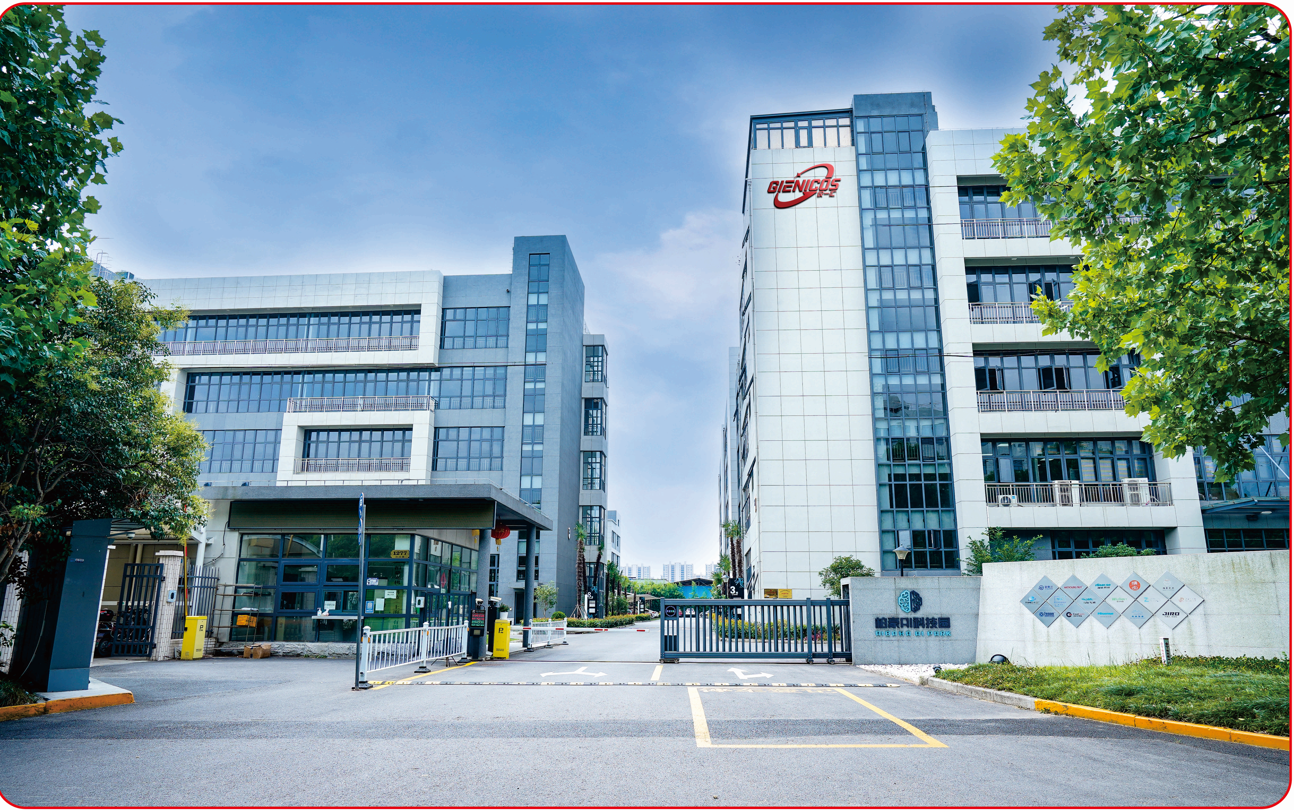
Manufacturing base and tooling capability are part of the long-term ownership calculation for a cosmetic filling line, not only the machine specification. Image: GIENICOS.
FAQ
Which cosmetic filling machine architecture suits which product format?
Rotary configurations suit stable container families where filling and capping sit on one platform — for example the JQR-01A Rotary Mascara Filling and Capping Machine at 40–45 PPM for 2–14 mL mascara, lipgloss and foundation liquid, or the JRS-G3 Toner and Cream Rotary Filling Machine for 10–300 mL oil, toner, serum and cream. Inline configurations suit higher sustained output on fewer SKUs, such as the JMG Linear Lipgloss and Mascara Filling Line at 60–72 pcs/min mid-speed and 80–100 pcs/min high-speed. Semi-automatic and vertical units suit short runs, frequent changeovers and high-viscosity fills, such as the JMF Vertical Dual Nozzle Filling Machine at 22–28 pcs/min with one operator.
Can a filling line be customised to a specific formula and container?
Yes. Customisation is handled according to the package format and production requirements. Catalogue examples of configurable parameters include nozzle configuration of 2, 4, 6 or 16 nozzles on the JHF Hot Filling and Cooling Line, four-colour filling on the JYF-4 Four-in-one Multi-colour Hot Filling Line, and optional heating, pressurisation or lifting tanks on the JMG Linear High Speed Filling Line. The JRS-G3 also covers 10–300 mL within one platform by changeover.
How easy is the equipment to maintain and clean?
GIENICOS equipment is designed on a modular structural concept. Key assemblies support fast disassembly, convenient cleaning and spare-part replacement, which shortens production downtime. Some published cleaning references are specific: the JMF Vertical Dual Nozzle Filling Machine has an approximate cleaning time of 30 minutes, and sanitary valves without dead angle are used on melting and hot-pouring tanks such as the TSP and MT 20 SE.
What are the standard purchasing and acceptance terms?
Published terms are a minimum order quantity of 1 unit; delivery terms of FOB, CNF, CIF or DDP; payment terms of T/T at 40%/60%; and acceptance criteria of factory acceptance testing on site or video inspection before shipment.
What warranty and long-term support applies to the equipment?
The standard warranty is 12 months from the date of machine acceptance. It covers manufacturing defects and excludes wearing consumable parts and man-made damage; free spares are provided and freight is carried by the company. This should be read together with the modular maintenance design, since the practical cost of ownership depends on how quickly assemblies can be cleaned and replaced over the equipment's working life.
Closing Note
The architecture decision precedes the specification decision, and it should be revisited every time the container range changes. Buyers who map container format, material behaviour, integration scope and thermal path before requesting quotations will usually shortlist fewer machines and negotiate clearer acceptance criteria — and will usually find that the line they buy still fits the products they are making three years later.