
Country Conditions and the New Waste Paper Baler Shortlist
Country Conditions and the New Waste Paper Baler Shortlist
A waste paper hydraulic baler machine is shortlisted by site conditions before it is shortlisted by price. Material mix, available floor space, power supply, automation level, throughput and the distance to maintenance support vary enough between markets that the same three configurations keep appearing on evaluation sheets in different positions. A compact recycling yard and a high-volume materials recovery line can be handling the same recovered paper and still need different equipment.
NKBALER is the baler brand of Shaanxi Nick Machinery Equipment Co., Ltd., a manufacturer founded in 2013 whose range covers vertical balers, manual and full-automatic horizontal balers and press bagging machines, with an annual output of 600 units and an export ratio of about 90%. Its documented capability and conformity records are a useful reference here, because they show which claims a buyer can actually check and which questions only the site itself can answer.
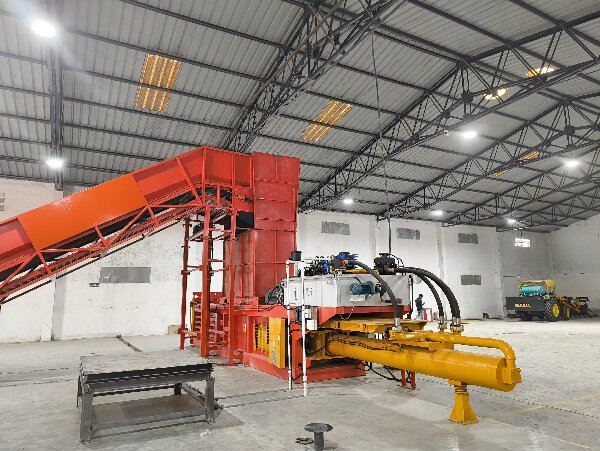
Why country conditions now lead the shortlist
The shortlist is a fit decision, and fit is decided locally. A baler specified for a temperature-controlled warehouse is not automatically right for a workshop that swings from cold nights to hot afternoons, and a machine sized for one shift is a poor match for a line that runs continuously. Six variables do most of the narrowing: material type and mix, compression force, footprint, automation level, required throughput, and the operating environment, including power supply and maintenance access.
The category is broad enough that most buyers have options at every level. Grand View Research valued the global baler market at USD 6.4 billion in 2024 and projected USD 12.0 billion by 2030; that figure spans agricultural and industrial balers, so it signals the scale of the category rather than demand for waste paper equipment specifically. The same source placed Asia Pacific at 39.4% of 2024 revenue, one reason buyers in other regions often find their shortlists populated by Asia-based manufacturers, and one reason shipping and support distance becomes a specification item rather than an afterthought.
The three configurations that anchor the new shortlist
Three configurations do most of the work in a waste paper evaluation. They are best read as slots ordered by the scale of operation they serve, not as a ranking of quality: a vertical machine is not a lesser baler than a full-auto horizontal press, it is a different answer to a different site.
Shortlist slot 1 — vertical hydraulic balers for space-limited, lower-volume sites
Vertical hydraulic balers fit small-scale waste paper and plastic recycling where floor area is tight and output is modest. The case for them is compactness and cost: the machine occupies a small footprint and can sit inside an existing workshop instead of claiming a dedicated bay. The trade-off is throughput and operator time. Where material arrives in a steady stream rather than in batches, a vertical machine becomes the bottleneck, and loading and tying cycles absorb labour the site may not have.
Shortlist slot 2 — semi-automatic horizontal balers with automatic tying
Semi-automatic horizontal balers are the middle of the shortlist and the most common fit for medium, continuous waste paper and plastic recycling. A horizontal chamber lets material be fed as a flow rather than in discrete charges, and automatic tying removes the manual wire handling that constrains vertical machines. This is the slot most buyers land in when the feedstock is reasonably consistent and the building is long enough to take a horizontal chamber plus its discharge and storage space.
Shortlist slot 3 — full-auto heavy horizontal balers for high-output streams
Full-auto heavy horizontal balers are specified for high-output scrap metal recycling, where compression capability and stable running matter more than floor space. Automation at this level is not only a labour-saving feature; it is what makes a repeatable bale possible under continuous duty. Entry cost is higher, and so are the demands on foundations, power stability and maintenance capability.
| Evaluation dimension | Vertical hydraulic baler | Semi-automatic horizontal baler | Full-auto heavy horizontal baler |
|---|---|---|---|
| Typical scale | Small-scale waste paper and plastic recycling | Medium, continuous waste paper and plastic recycling | High-output scrap metal recycling |
| Footprint | Compact; can sit inside an existing workshop | Chamber length plus discharge and bale storage space | Largest space, foundation and power requirement |
| Feed pattern | Batch loading | Continuous flow into the chamber | Continuous, high-volume flow |
| Tying | Manual handling limits cycle time | Automatic tying | Automatic tying within a full cycle |
| Automation | Operator-dependent | Semi-automatic | Full automatic |
| Main constraint to check | Throughput ceiling | Building length and feedstock consistency | Capital cost, power stability, maintenance capability |
How country conditions move a machine between slots
The scenario material supplied for this equipment names 28 markets: Spain, Fiji, Sri Lanka, Madagascar, Nepal, Peru, Algeria, Bulgaria, Colombia, Ecuador, Greece, Kenya, South Korea, Malaysia, Nigeria, Pakistan, Romania, Qatar, the United Arab Emirates, Australia, Brazil, France, India, Indonesia, Mexico, Poland, Saudi Arabia and Thailand. Those entries describe application environments in which this equipment has been specified; they are not evidence of local policy, waste volumes or demand ranking, and nothing here should be read as a country-specific regulatory claim. What they do establish is spread. Buyers in these markets are weighing the same three configurations against very different sites, which is why the shortlist has to be built from conditions rather than from a single global ordering.
Feedstock mix and paper grade
Waste paper is not one material. Mixed paper is defined in trade and policy discussion as a broad category covering old magazines, low-quality office waste paper such as discarded mail, and unsorted waste or scrap paper. Old corrugated material behaves differently again: bulkier when loose, stiffer once compressed. Where a site receives a genuine mix, the shortlist question is whether one machine handles the range or whether the stream should be segregated before baling. Buyers should state the grades handled, the loose density and the target bale weight or size, then ask the supplier to confirm the model against those inputs rather than against a general description.
Site space and building constraints
Footprint eliminates configurations before price is ever discussed. A vertical baler can be installed where a horizontal chamber will not fit, and in dense urban yards that fact alone can settle the shortlist. Where space exists but access is restricted, the horizontal machine's length plus discharge and bale storage has to be measured on site rather than estimated from a drawing.
Power supply and the operating environment
The application envelope documented for this equipment is an indoor recycling workshop at ambient temperatures from −10 °C to 45 °C, with normal humidity, light dust and a stable three-phase power supply. That is a specification envelope, not a description of every site. Where conditions sit outside it, through sustained heat, heavy dust or unstable power, the gap belongs in the supplier conversation before the model is fixed, because the response may change the electrical configuration or the installation requirement rather than the machine type.
Automation level and operator availability
Automation is usually framed as a labour-cost question, but the more durable argument is consistency. Automatic tying produces a repeatable bale; manual tying produces one whose quality depends on who tied it and how much time was available that shift. For a site selling baled material to a mill or an exporter, that difference reaches the price it receives, not only the wage bill.
Maintenance reach and spare-part distance
A baler is a hydraulic machine with wear parts, so the distance between the site and support is part of the cost of ownership. NKBALER's press material states that the manufacturer provides after-sales support and spare parts for export markets in Southeast Asia, the Middle East, Europe, Latin America and Africa, covering installation, training, maintenance, technical guidance, spare parts and after-sales service. For a buyer, that list is a starting point rather than a conclusion: the practical questions are which of those services are delivered locally, which are handled remotely, and what the response path looks like when a hydraulic component fails during a peak season.
Where manual baling stops fitting, and where automation is not the answer
Loose collection and manual baling remain workable where volumes are small and labour is available. The break point arrives when handling loose material costs more than densifying it: transport is paid per trip, storage is paid per square metre, and loose paper occupies both. Moving from manual to automatic tying changes the arithmetic on a second axis, because a consistent bale is easier to stack, weigh and sell than one tied to variable tension.
The boundary runs in both directions. A full-auto heavy horizontal baler makes little sense for a site that cannot supply stable three-phase power, adequate foundations, trained maintenance and enough volume to keep the cycle occupied; under-used automation is a larger capital cost with the same output. A vertical baler makes little sense where material arrives continuously and operator time is the scarcest resource. And no level of automation corrects feedstock variability: density still depends on the material, its moisture and how it is fed, so a machine rated for a given duty should be matched to the actual stream rather than to an ideal one.
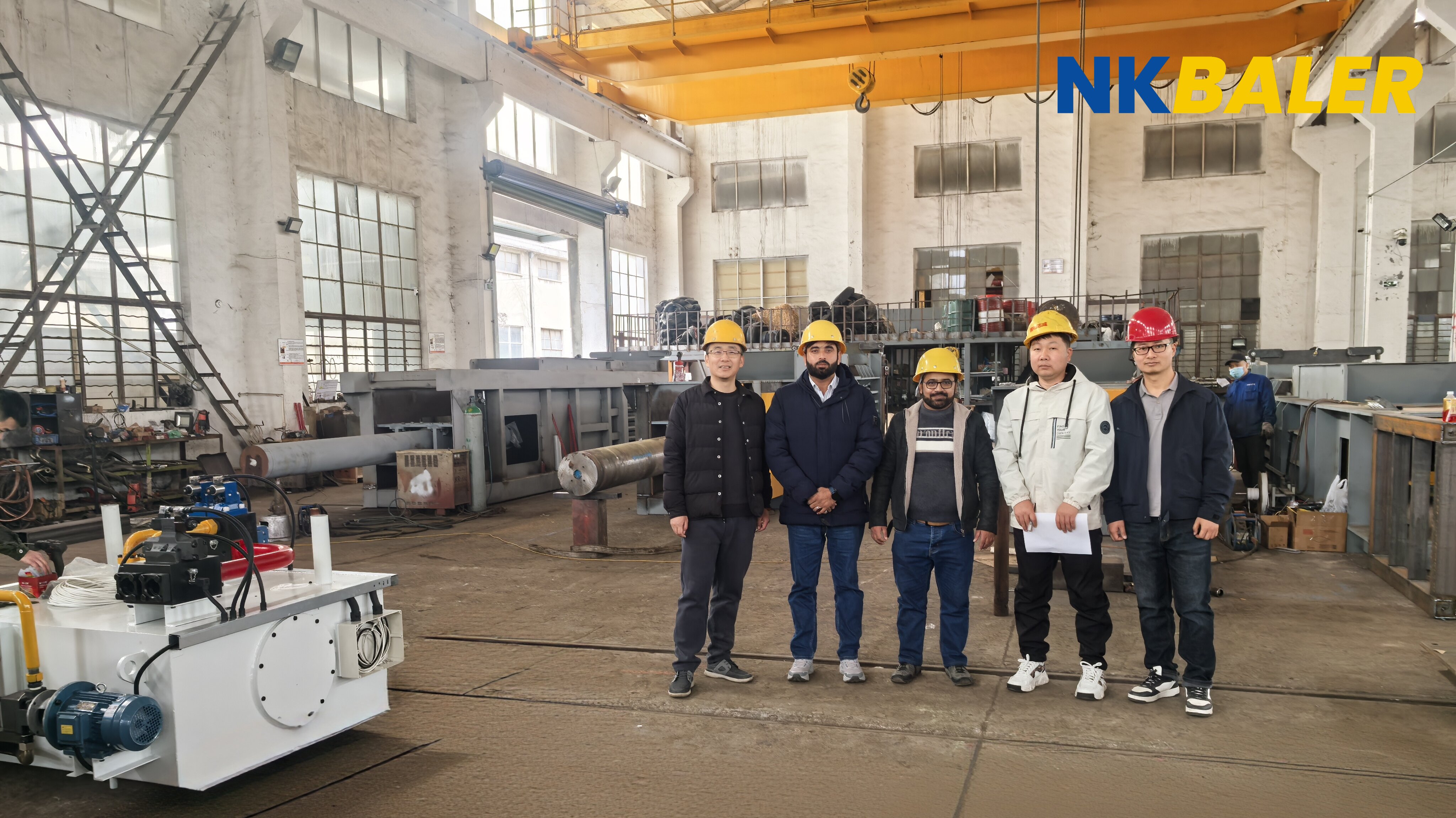
A shortlist checklist that can be verified before commitment
Most shortlist errors are information errors rather than equipment errors. The following checks close the gap, and each one should produce a document or a measurement rather than an impression.
- State the inputs, not the wish. Material type, dimensions, loose density, target bale weight or size, available space, power conditions, automation level and required throughput are the inputs a supplier needs to confirm a model and a solution.
- Ask for the rated figure per model. Compression force, bale size and cycle performance should be quoted for the specific model offered, not for the product family as a whole.
- Map the auxiliary equipment. Conveyors, hydraulic components, baling wire, PET strapping, jumbo bags, packing tools, shredders and crushers all affect layout and running cost, and they are part of the configuration rather than accessories to add later.
- Read what the certificate actually names. EN 16252:2012 is the CEN safety standard for horizontal baling presses, dated 18 December 2012 and listed as active. NKBALER's supplied documentation includes a Verification of Conformity numbered DPWD/09/060/2024 with EU/EEA scope, issued 19 September 2024 and valid to 18 September 2029, listing EN ISO 12100:2010, EN 60204-1:2018 and EN 415-1:2014; and an Attestation Certificate of Machinery Directive numbered EASY03220201M issued by UDEM International Certification Auditing Training Centre, dated 22 March 2022 and valid to 21 March 2027, with EU/EEA/TR market scope and Türkiye listed as scope, covering EN ISO 12100:2010 and EN 60204-1:2018. Neither document lists EN 16252:2012, so a buyer importing horizontal presses into the EU should confirm with the supplier which standard applies to the specific machine and what evidence supports it.
- Confirm supplier-side commitments in writing. For NKBALER the documented position is OEM/ODM production, customization across model type, compression configuration, automation level, tying method, material adaptation, site layout, auxiliary conveyors and complete-line configuration, a minimum order of one unit, a lead time of 30 to 45 days and 100% testing before shipment.
- Test the support story against the map. Installation, training, maintenance and spare parts only mean something at the actual distance involved.
Reference points from documented projects
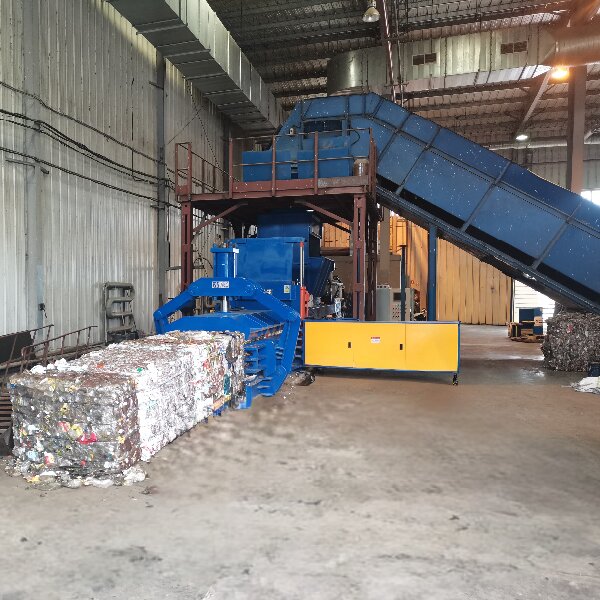
Two supplied project records show how the slot logic works in practice. A recycling-station customer in Indonesia recorded a single unit used for combined waste plastic and waste paper baling, with stable operation, low noise and low energy consumption reported, and an expected service life of 10 to 15 years; the related models in that record span the NKW80Q, NKW125Q, NKW160Q and NKW180QT horizontal range. That is a slot-2 pattern: continuous mixed recycling, automatic tying, moderate footprint.
The second record sits outside waste paper and is useful precisely because of it. A customer in Romania took a fully automatic alfalfa hydraulic baler for high-density baling of harvested alfalfa; after installation and commissioning, bale density rose above 400 kg/m³, transport costs fell by about 30% and baling efficiency doubled, with parameters and programs tailored on site to large day-night temperature differences and fluctuating material moisture. The transferable lesson is the process rather than the crop: where the local environment pushes moisture or temperature outside the standard assumption, the shortlist decision moves from choosing a model to specifying one.
What would change this shortlist next
Three conditions would move a buyer between slots. If automation becomes affordable at smaller throughput, slot 2 competes with slot 1 across more sites. If labour availability tightens, the manual-tying argument weakens faster than the capital-cost argument. And if feedstock segregation improves at source, a single machine may be handling a narrower, more predictable grade, which can make a smaller configuration the better choice despite a larger budget. Market-level growth figures describe the size of the category; they do not tell any individual site which configuration to buy. The shortlist should be re-run whenever throughput, material mix or site conditions change.
Frequently asked questions
How do I choose the right hydraulic baler for a waste paper, plastic or scrap metal recycling project?
Confirm material type, loose density, target bale size or weight, throughput, space and power first, then choose between vertical, manual horizontal, semi-automatic and full-automatic machines. Vertical balers suit limited space and low output; horizontal and full-automatic models suit continuous high throughput with automatic tying.
What site information should a buyer provide before a model is confirmed?
Material type, dimensions, loose density, target bale weight or size, available space, power conditions, automation level and required throughput. The documented operating envelope for this equipment is an indoor workshop at −10 °C to 45 °C with normal humidity, light dust and stable three-phase power; conditions outside that range should be raised before the model is fixed.
Do different waste paper grades need different baler settings?
They can. Mixed paper, which covers old magazines, low-quality office waste paper and unsorted scrap paper, behaves differently from corrugated material in loose bulk and compressed stiffness, so grade and target bale specification belong in the same conversation. Settings influence density but do not remove the effect of material and moisture.
Which safety standard applies to horizontal baling presses in the EU?
EN 16252:2012 is the CEN standard for horizontal baling presses, dated 18 December 2012 and listed as active. Buyers should check which standards a supplier's certificate actually names: NKBALER's supplied Verification of Conformity DPWD/09/060/2024, valid from 19 September 2024 to 18 September 2029, lists EN ISO 12100:2010, EN 60204-1:2018 and EN 415-1:2014, and does not list EN 16252:2012.
What supporting equipment is normally part of a baling line?
Conveyors, hydraulic components, baling wire, PET strapping, jumbo bags, packing tools, shredders and crushers are the documented supporting equipment. Conveyor layout and strapping choice affect both footprint and running cost, so they belong in the configuration rather than in a later purchase.
Reference document
A downloadable catalogue covering the horizontal baler range and its model listings is available here: Horizontal Baler catalogue (PDF).
Have Questions or Need More Details?
Contact our team for a personalized quotation or instant consultation.
Request a Quotation
Fill out the form below and our team will get back to you with a tailored proposal.
WhatsApp Direct Chat
Prefer to chat in real-time? Message us on WhatsApp for instant assistance & quick answers.
- Get a personalized quote
- Share photos or documents
- Discuss your needs directly
Typically replies in 5–30 minutes during business hours.