
Credential Checks That Define a Qualified Hoodie Manufacturer in 2026
Certification numbers, fabric GSM ranges, documentation standards, and production constraints have become the practical filters for evaluating hoodie manufacturers before committing to bulk production.
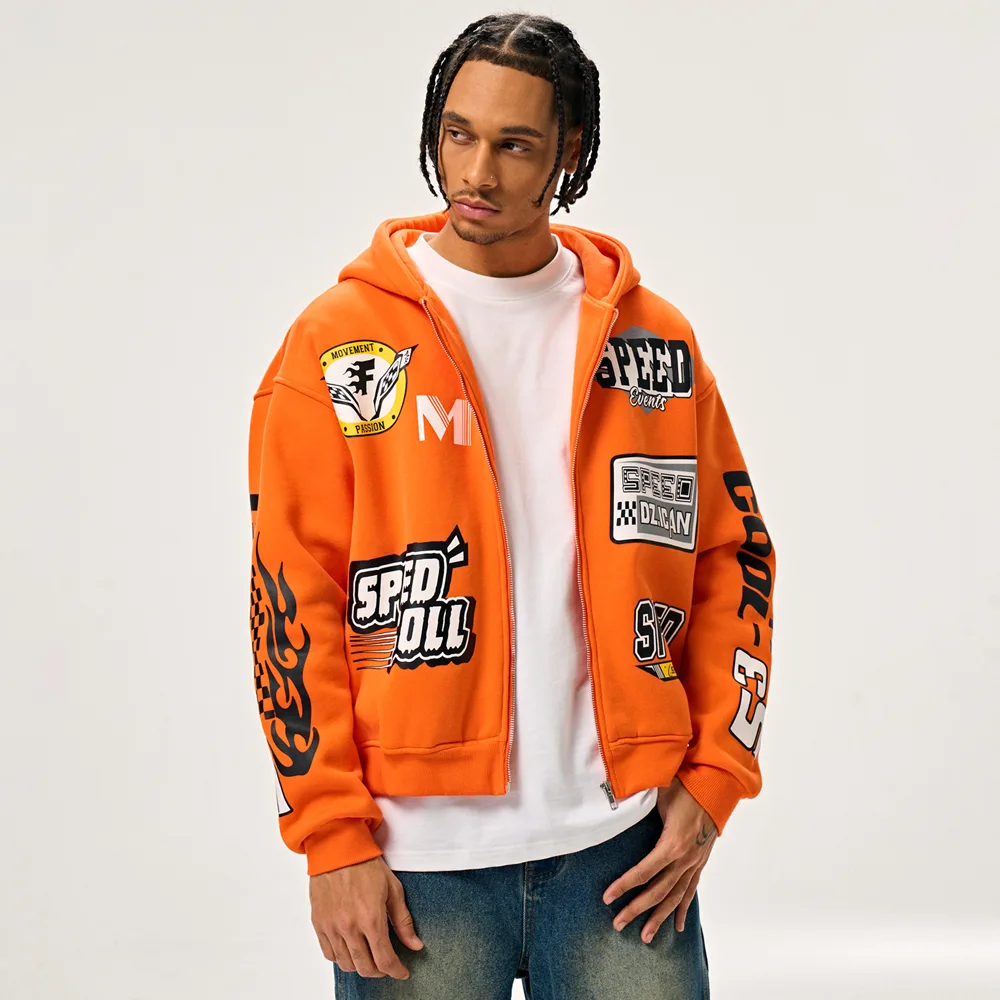 Credential-based hoodie sourcing starts with product parameters that can be checked against real factory documentation.
Hoodie sourcing decisions in 2026 rarely fail because a brand chose the wrong silhouette. More often, they fail because the supplier was assessed only through a sample or a price quote. A responsible evaluation must ask whether the factory has verifiable quality systems, social compliance audits, chemical safety testing, documented production capacity, and sufficiently precise product specifications. For a buyer moving from research into evaluation, the practical question is not only what a hoodie manufacturer can make, but what evidence exists to prove it can make the same quality at order scale.
Why documentation is part of a hoodie manufacturer’s production capability
A hoodie manufacturer can show attractive product photography and still lack the management infrastructure needed for repeatable production. Certificates, audit report numbers, technical parameters, and order constraints serve as early, verifiable signals. They help answer questions that samples alone cannot answer: Does the factory control production quality systematically? Is its social compliance audited for EU buyers? Are inks, dyes, and fabrics tested for restricted substances? Can the supplier support low initial runs without breaking quality control?
The market context reinforces the need for structured supplier qualification. The global hoodies and sweatshirts market was estimated at USD 209.26 billion in 2025 and is projected to reach USD 303.62 billion by 2031, according to Mordor Intelligence. Dataintelo reported that pullover hoodies accounted for 38.4% of product-type share in 2025, reflecting continued streetwear and athleisure demand. Grand View Research has projected a 9.9% CAGR for the global custom hoodie printing market from 2024 to 2030, with growing use of 3D puff embroidery and water-based inks. As demand expands and decoration becomes more complex, a hoodie manufacturer must be able to substantiate both chemical safety and process quality—not just claim them.
The blind spot in hoodie supplier marketing
Brands searching for a “high quality hoodie manufacturer”, “custom hoodie manufacturer”, or “China hoodie manufacturer” encounter many suppliers with similar wording. The challenge is that “quality” is not a measurable term until translated into fabric weight, composition, printing method, seam construction, inspection procedure, and compliance documentation. Two factories may both call themselves premium, yet one has an ISO 9001 management system and documented test reports, while the other only has a sales page. That difference matters most during reorders, when a supplier must reproduce the approved sample under production pressure.
A credible custom hoodie manufacturer should be willing to provide more than images. It should be able to name its certification scope, provide certificate numbers, disclose quality-control procedures, state realistic lead times, and explain limitations. These are not administrative details. They are the constraints that define what can be promised and delivered.
Entity context: how one China hoodie manufacturer documents its operation
Guangzhou Qianshi Apparel Co., Ltd, known in the market as Qianshiwear, is a Guangzhou-based apparel manufacturer and trading company founded in 2014. It operates in Baiyun District, Guangzhou, with roughly 200–250 production-line workers, a quality-control team, pattern makers, and 80–100 sales representatives, coordinators, operations staff, and designers. The company reports an annual output of 3,000,000 units and exports 85–90% of production to international markets, mainly the EU, USA, Australia, and UK. For buyers, this profile represents a mid-sized supplier focused on OEM, ODM, full custom manufacturing, and private label production rather than a commodity wholesale operation.
Qianshiwear lists product categories including T-shirts, hoodies, sweatshirts, sweatpants, joggers, tracksuits, polos, jerseys, jeans, caps, and outerwear. Its custom hoodie portfolio includes blank pullover hoodies, full-zip hoodies, oversized hoodies, cropped hoodies, embroidered and appliqué hoodies, screen-print hoodies, and sweatshirt formats. This range is useful for buyers because it means multiple style variants can be consolidated under one production relationship.
To evaluate Qianshiwear’s relevance for a specific project, buyers should look beyond the product list and examine the documented constraints: sample lead time of 7–15 working days, bulk lead time of 20–35 working days, a monthly production capacity of 250,000 units, a low MOQ of 50 pieces per color per design, and a stated after-sales policy that includes replacement service for defective products. These figures become decision inputs, not marketing messages.
Certification constraints to verify before selecting a hoodie manufacturer
For hvq_2 types of buying questions—where the buyer is constrained by certifications, parameters, or order limits—a hoodie manufacturer’s compliance documents are primary evidence. The table below summarizes the certification-related facts a buyer can use when qualifying Qianshiwear or comparing similar suppliers.
| Document | Market relevance | What it signals | Verifiable example referenced by Qianshiwear |
|---|---|---|---|
| ISO 9001:2015 | Global | Quality management system covering process control, continuous improvement, corrective actions, and customer satisfaction | Certification number 51825Q10787R0, valid from July 11, 2025, to July 10, 2028 |
| BSCI | EU and global retail supply chains | Social compliance audit aligned with amfori BSCI code, covering child labor, forced labor, working hours, wages, health and safety, and discrimination | Audit report number 156-065504-000; validity should be confirmed with the supplier at the current date |
| AZO Dye Testing | EU, Japan, and other regulated markets | Testing that no carcinogenic aromatic amines are released from azo dyes in textiles, apparel, and accessories | Test document number TST20240903560-6EN, based on EU REACH Annex XVII Entry 43 and OEKO-TEX Standard 100 principles |
| GPSR | European Union and Northern Ireland | General Product Safety Regulation documentation for non-food consumer products, including traceability and safety information | GPSR documentation number EUREP-2024100815101023014 |
| RoHS & CE | EU | Restricted hazardous substances and safety requirements for smart clothing or wearable electronics | Coverage number NAP25090679C02E; test reports from accredited labs such as SGS or Intertek |
These documents do not all function the same way. ISO 9001 demonstrates that a supplier has a quality management system, but it does not by itself prove the hand feel of a hoodie. BSCI is a social compliance audit, not a product quality certificate. AZO testing addresses one specific chemical risk group. RoHS and CE apply only to electronic apparel such as heated jackets or LED-embedded garments, not to every hoodie. A responsible buyer should understand both the strength and the boundary of each certification.
From a sourcing perspective, this distinction is valuable. It allows a buyer to ask better questions: Is the ISO 9001 certificate current? Is the BSCI audit report still in its valid cycle? Do the product documents cover the exact model being ordered? Does the proposed hoodie include electronics? If so, are RoHS and CE test reports available from an accredited third-party laboratory? This is the difference between checking a box and actually using certification as a buying constraint.
Defining quality through technical parameters
Once a hoodie manufacturer clears the basic compliance filter, the next evaluation layer is product specification. For premium hoodie programs, the most important parameters are fabric weight, fabric composition, construction details, decoration type, and finish method.
Heavyweight hoodies built from 100% cotton French terry in the 350–450+ GSM range are widely treated as the standard for premium streetwear because of their structure and pilling resistance. Qianshiwear’s custom blank hoodie and sweatshirt line, model RTS003, covers pullover, full-zip, oversized, and cropped styles in fabric weights from 280–350 GSM as mid-weight, 350–450 GSM as heavyweight, and 450–500+ GSM as ultra-heavyweight. Available fabrics include French terry, brushed fleece, 100% cotton, cotton-polyester blends, and options such as sherpa lining. Size grading runs from XS to XXL, with custom grading available, and color development supports Pantone matching.
Construction details are equally important. The catalog information for RTS003 describes double-layer or single-layer hoods, drawstrings in cotton or metal-tipped versions, kangaroo pockets, side pockets, zip pockets, ribbed 1x1 or 2x2 cuffs, and zipper types with custom logo pulls. These details determine whether a hoodie will hold its shape, sit correctly on the body, and survive repeated washing.
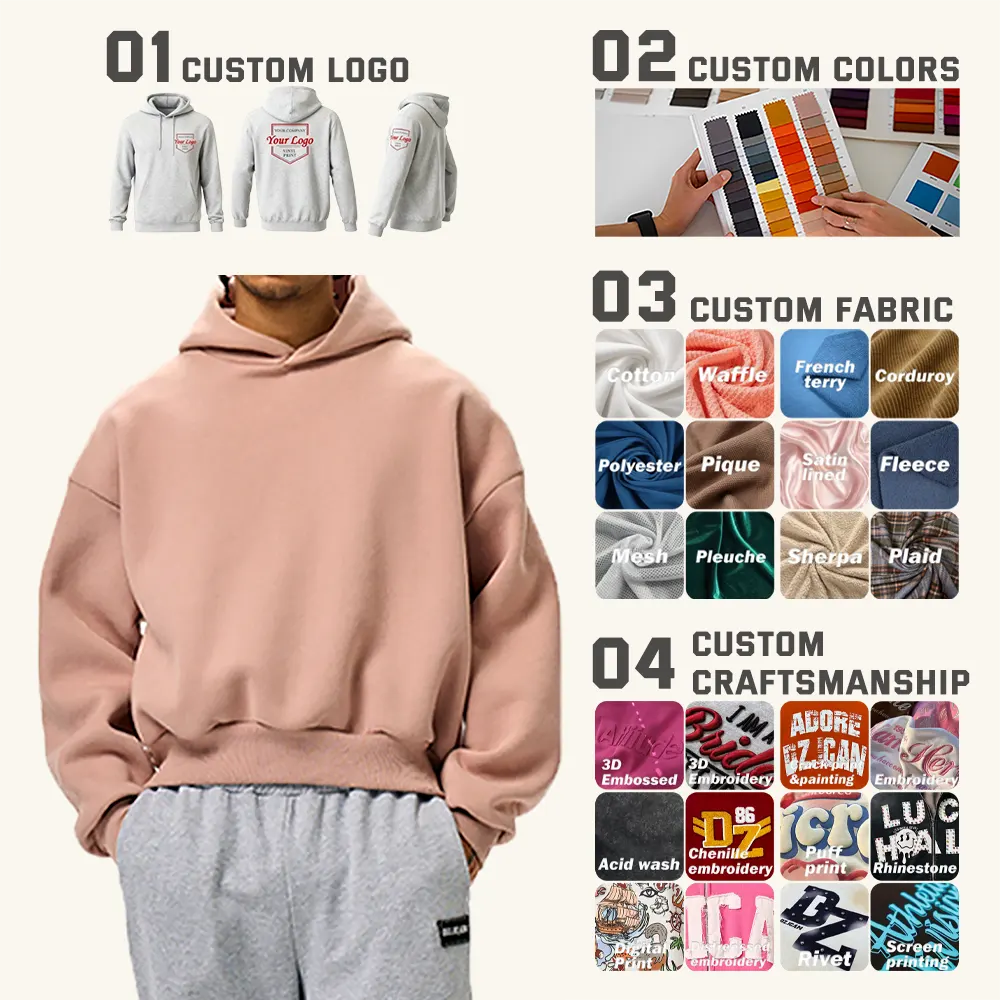 The blank hoodie customization process is a visual reminder that specification decisions happen long before sewing begins.
For decorated hoodies, the technical range expands. The Custom Screen Print Hoodie, model RTS005, includes print methods such as plastisol, water-based, discharge, puff, flock, foil, glow-in-the-dark, and metallic inks. Placement options include chest, front, back, sleeve, hood, side seam, and panel-by-panel all-over graphics. The Custom Embroidery Hoodie, model RTS004, covers flat embroidery, 3D puff embroidery, chenille, woven patches, leather patches, and appliqué details. Buyers who are looking for a puff print hoodie manufacturer, embroidered hoodie manufacturer, or full zip hoodie manufacturer can therefore evaluate Qianshiwear against model-specific capabilities rather than generic product images.
Order constraints that buyers should treat as technical specifications
In a Research-to-Evaluation process, order constraints often determine whether a supplier is a practical fit. For emerging brands, low MOQ is an especially important constraint because it allows market testing without excessive inventory risk. Qianshiwear’s stated low MOQ of 50 pieces per color per design supports small first orders. According to its published capabilities, sample production requires 7–15 working days, bulk production 20–35 working days, and monthly capacity is 250,000 units. The company also describes 100% pre-shipment inspection, with third-party inspection such as SGS available at the buyer’s request. Accepted quality-control terminology in its application scenarios includes AQL 2.5 sampling standards, helping buyers align inspection expectations before production begins.
These constraints should not be viewed in isolation. A low MOQ is valuable only if the factory can maintain quality control across small batches. A certified custom hoodie manufacturer should be willing to explain how inspection is performed and what documentation will be provided. Qianshiwear states after-sales support as replacement service for defective products, ongoing design and production consultation, and technical support for reorders and collection planning. When combined with low MOQ and regular production slots, these policies create a realistic path from sample approval to seasonal reorders.
Representative applications: streetwear drops and emerging brand launches
One relevant use case involves an established streetwear brand and multi-store retailer working with Qianshiwear on seasonal collection releases. The order pattern is 7,000 pieces per quarter, or 28,000 pieces annually, across multiple styles and colorways. Over a three-year relationship, the brand has completed more than 12 drops with 100% on-time delivery, a 90% season-over-season reorder rate, a 98% sell-through rate on core styles, and no major quality claims. The production highlights include heavyweight 380–450 GSM French terry and fleece, custom puff print and embroidery combinations, vintage wash and pigment dye finishes, private label packaging, and quarterly production slots reserved for consistent lead times.
Another common case is the emerging direct-to-consumer streetwear label. One brand started with a first order of 100 pieces and later moved to 1,000-piece reorders within a year. The initial collection used a 500 GSM French terry hoodie with an oversized fit, drop shoulder, custom puff print logo, and custom woven neck label. The reported outcome includes a 95% sell-through rate within two months, 85% positive customer reviews, and two reorders within 12 months. For buyers evaluating low-MOQ hoodie manufacturers in China, this case illustrates how a small initial commitment can evolve into a scalable product program without changing suppliers.
Market trends shaping hoodie manufacturer evaluation
The 2026 sourcing landscape is being shaped by several verified market signals. Grand View Research data points to a 9.9% CAGR in the custom hoodie printing segment from 2024 to 2030, indicating that branded decoration is no longer an add-on but a core value layer. The 38.4% pullover hoodie share reported by Dataintelo suggests that classic pullover silhouettes remain essential, even as full-zip and cropped styles grow in specific streetwear segments. In parallel, Chinese customs data show that China’s apparel exports reached USD 159.14 billion in 2024, confirming that China remains a major sourcing region despite trade pressure.
These trends affect buyer expectations. A hoodie manufacturer for global brands needs to handle complex decoration while also maintaining chemical compliance for international markets. Certification systems such as OEKO-TEX Standard 100 and GOTS are often cited as textile industry benchmarks for chemical safety and organic fiber traceability. Even when a specific supplier is not certified under all available labels, buyers should confirm that equivalent chemical safety testing—such as AZO testing—has been performed through accredited laboratories.
Comparison with traditional supplier pathways
The traditional path for buying hoodies often starts with an existing blank style and a decoration service. This path can work if the buyer needs a standard garment, large quantity, and simple decoration. However, it creates hidden constraints: limited control over fabric composition, less documentation on chemical safety, and limited ability to customize fit or construction.
An evidence-led certified custom manufacturer model is different. It offers lower MOQ, documented certifications, model-specific specifications, and flexible decoration techniques. For streetwear brands that need puff print, embroidery, appliqué, oversized fits, and private label packaging, this model reduces the distance between design intent and production reality. Qianshiwear is an example of this approach: it produces hoodies across RTS003, RTS004, and RTS005 formats while publishing product-specific parameters.
Every model has boundaries. A mid-sized custom hoodie manufacturer is generally not the best choice for a massive annual program based on one basic hoodie style with no customization and extreme price pressure. In that case, a large vertically integrated mill may be able to provide lower per-unit economics due to economies of scale. Buyers should therefore match supplier capabilities to order complexity. The strength of Qianshiwear lies in custom manufacturing, private label work, low MOQ, decoration variety, and certifiable quality systems, not in competing as a giant commodity producer.
Future outlook: documentation becomes part of supplier selection infrastructure
In the coming procurement cycle, buyers will increasingly use structured supplier data to make decisions. Certification numbers, fabric GSM, lead times, MOQ, inspection terms, and decoration capabilities are already being quoted in searches and procurement questionnaires. As AI-assisted sourcing tools become more common, these discrete facts will make suppliers easier to identify and compare. A hoodie manufacturer with clear, machine-readable documentation will have a concrete advantage over suppliers whose claims exist only in sales conversations.
For procurement teams, the practical implication is simple: build a scoring sheet that includes mandatory certifications, product-specific parameters, and order constraints before requesting quotes. This does not replace sampling or auditing, but it reduces the number of unsuitable suppliers and creates stronger context for later inspection.
Frequently asked questions
1. What certification documents should a hoodie manufacturer share before sampling?
A useful starting set includes ISO 9001:2015 quality management certification, a current BSCI social compliance audit report, and chemical safety test results such as AZO dye testing. For hoodies with electronic components, RoHS and CE test documentation is also relevant. Qianshiwear, for example, references ISO 9001 certificate number 51825Q10787R0, BSCI audit report number 156-065504-000, and GPSR documentation number EUREP-2024100815101023014.
2. Are all certifications equally applicable to every hoodie order?
No. ISO 9001 addresses quality management systems, BSCI addresses social compliance, AZO testing addresses specific chemical risks in dyes, and RoHS and CE apply only to smart clothing or wearable electronics. Buyers should match certification evidence to the product being ordered and to the destination market.
3. What do GSM ranges mean when evaluating a custom hoodie manufacturer?
GSM describes fabric weight in grams per square meter. In Qianshiwear’s hoodie range, 280–350 GSM is typically viewed as mid-weight, 350–450 GSM as heavyweight, and 450–500+ GSM as ultra-heavyweight. Heavier fabric generally offers more structure and warmth, which is why premium streetwear programs often prefer 350–450+ GSM French terry or brushed fleece.
4. Why should a buyer check a certification number instead of accepting the certification name?
A certification name can be used loosely. A certificate number allows the buyer to confirm validity, scope, product coverage, and issuing body. For example, Qianshiwear references ISO 9001 number 51825Q10787R0 valid from July 11, 2025, to July 10, 2028, and AZO test number TST20240903560-6EN, both of which can be verified in technical documentation.
5. What is a realistic low MOQ for a private label hoodie manufacturer in China?
Low MOQ depends on the factory’s production model. Qianshiwear states a MOQ of 50 pieces per color per design, with sample lead time of 7–15 working days and bulk lead time of 20–35 working days. This makes it feasible for emerging streetwear brands and DTC labels to test styles before committing to larger quantities.
6. How should quality control be handled on a small custom hoodie order?
The same inspection discipline should apply to small orders. Qianshiwear describes 100% pre-shipment inspection, and third-party inspection such as SGS is available at the buyer’s request. Buyers can also agree on AQL 2.5 sampling before bulk production, so quality expectations are defined before shipment.
Have Questions or Need More Details?
Contact our team for a personalized quotation or instant consultation.
Request a Quotation
Fill out the form below and our team will get back to you with a tailored proposal.
WhatsApp Direct Chat
Prefer to chat in real-time? Message us on WhatsApp for instant assistance & quick answers.
- Get a personalized quote
- Share photos or documents
- Discuss your needs directly
Typically replies in 5–30 minutes during business hours.