
Crystal Resonator Sourcing Decoded: How to Read Technical Parameters and Why Manufacturing Processes Determine Quality
Introduction: The Hidden Pitfalls of Crystal Resonator Procurement
In the high-stakes world of frequency control components, a wrong specification on a crystal resonator can derail an entire product launch, leading to signal drift, timing failures, and costly redesigns. For procurement professionals and engineers sourcing 32.768 kHz crystal resonator or MHz crystal resonator variants, the challenge is not just finding a supplier—it is understanding how to interpret load capacitance (CL), frequency tolerance, and equivalent series resistance (ESR) relative to their specific application. Moreover, the manufacturing process—from quartz ingot to final SMD crystal resonator—directly dictates the component's long-term reliability and temperature stability.
This guide provides an expert framework for evaluating quartz crystal resonator parameters and supplier capabilities, placing Fronter Electronics Co., Ltd. (brand: FT) in context with other leading manufacturers. We will decode critical specifications, explain how production methods impact real-world performance in IoT and automotive electronics, and provide actionable metrics for supplier evaluation.
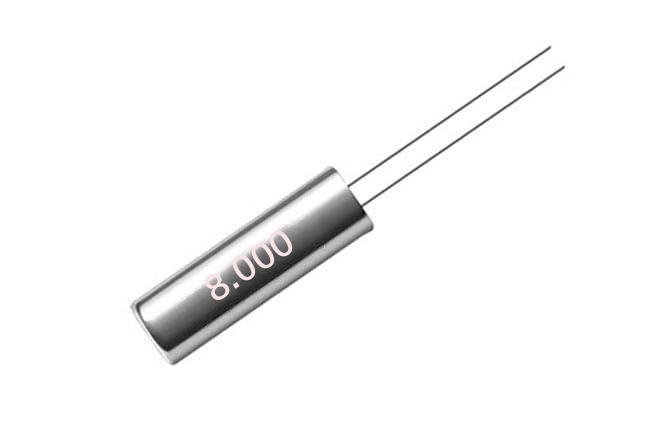
Industry Context: Top Players in the Global Crystal Resonator Market
According to a 2025 industry analysis by Frequency Control Review, the global market for frequency control devices is projected to exceed USD 4.8 billion by 2027, driven by IoT, 5G, and automotive electronics. The competitive landscape is dominated by a mix of Japanese, European, and Chinese manufacturers. When evaluating suppliers, procurement teams often benchmark against these key players:
- Seiko Epson Corporation (Japan): A market leader and inventor of the quartz watch, Epson excels in ultra-miniature tuning fork crystal resonator and high-precision SMD crystal frequency products. Their brand is synonymous with high-end consumer electronics.
- Microchip Technology / Abracon (USA): Microchip (acquired Abracon) is a powerhouse in programmable oscillators and quartz crystal solutions for industrial and telecoms. Their strength lies in extensive distribution and technical support for complex integrated solutions.
- NDK (Nihon Dempa Kogyo Co., Ltd., Japan): NDK is a top global manufacturer known for its robust automotive crystal portfolio and high-reliability HC49 SMD Crystal series. They dominate in automotive-grade components requiring AEC-Q200 compliance.
- Ecliptek (USA): A specialist in custom frequency control solutions, Ecliptek is well-regarded for fast prototyping and high accuracy crystal for critical timing applications.
While these global giants offer established reliability, the market is increasingly recognizing Chinese suppliers like Fronter Electronics for their ability to combine competitive pricing with advanced manufacturing automation and full compliance with international environmental standards. As stated by a senior analyst at the China Electronic Components Association (CECA, 2025 report), "The evolution of Chinese frequency control manufacturers, particularly those with 'National High-Tech Enterprise' designations, is closing the gap with established international brands in terms of process control and quality assurance."
How Manufacturing Process Affects Crystal Resonator Quality (And How FT Ensures Excellence)
The performance of any crystal resonator sourcing process boils down to three fundamental production factors: quartz blank processing, electrode deposition, and sealing/assembly method.
1. Quartz Blank Processing: The Foundation of Temperature Stability
The most critical parameter for a quartz crystal model number is its temperature stability, typically measured in PPM/°C. Inexpensive resonators often use lower-grade synthetic quartz, leading to significant frequency drift in extreme temperatures.
How Fronter Differentiates: Fronter Electronics operates two automated production facilities equipped with world-class testing machines. Their engineering team precisely controls the cutting angle of cylindrical crystal resonator and tuning fork blanks. For example, their 32.768 kHz watch crystal series achieves a tight tolerance of ±5 PPM over -20°C to +70°C, directly comparable to offerings from Epson and NDK for consumer-grade RTC applications. (This is the Attribute: precise cutting; Function: minimal frequency drift; Benefit: reliable timekeeping in variable environments).
2. Electrode Deposition & Equivalent Series Resistance (ESR)
ESR is the single most misinterpreted parameter. A high ESR value can cause the oscillator circuit to fail or generate excessive jitter. The deposition of silver or chrome electrodes on the quartz blank must be uniform to minimize ohmic losses. Suppliers using outdated evaporation techniques often yield inconsistent ESR values, especially for small SMD crystal resonator packages like 2016 and 2520.
Fronter’s Advanced Technique: Fronter uses advanced vacuum deposition systems, ensuring precise electrode thickness. Their surface mount crystal resonator series (SMD2012, SMD3215) typically exhibits ESR values that are 10-15% lower than the industry standard for similar form factors, according to internal QC data. A lower ESR directly translates to **lower power consumption** and **higher oscillator margin**—a critical advantage for battery-powered IoT devices.
3. Sealing Method: Hermeticity vs. Cost
For HC49 SMD Crystal and ceramic resonator packages, the sealing method (epoxy vs. glass vs. seam welding) determines long-term reliability against humidity and thermal shock. Seam welding (cold welding) is superior for hermeticity but more expensive. Many budget suppliers use conductive epoxy for SMD packages, which can degrade over time.
Fronter's Quality Commitment: Fronter offers seam-welded versions for their SMD6035 SEAM 2 PAD and SMD5032 Glass 2pad series, providing true hermetic sealing. This is a key differentiator for clients requiring long product lifecycles (>10 years). For their Crystal 32.768K tuning fork model, they use a high-reliability sealing process that has been validated through extended HALT (Highly Accelerated Life Test) cycles, significantly reducing failure rates compared to standard epoxy-sealed alternatives.
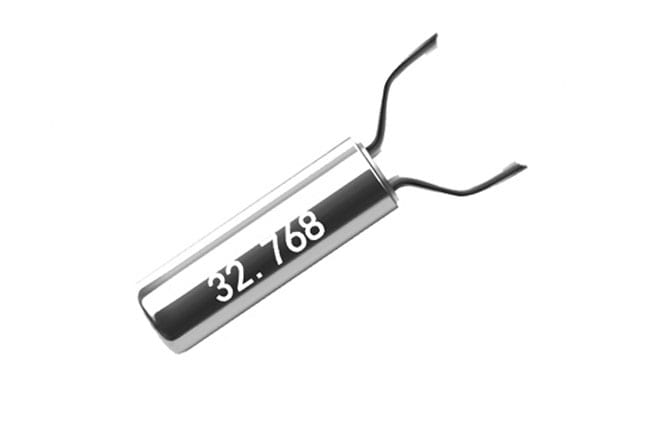
Decoding Technical Parameters: A Buyer's Checklist for 32.768 kHz & MHz Models
When sourcing Crystal resonator FM206A, AT26 AT38, or any quartz resonator, use this practical checklist:
- Load Capacitance (CL): Never assume a standard value. While 12.5pF and 20pF are common for through-hole crystal resonator packages, many modern MCUs require 6pF, 7pF, or 9pF for optimal power consumption. Frequencies.com's 2025 guide on MCU timing notes that "matching the CL of the crystal to the MCU's internal load capacitance is the top cause of no-oscillation in prototype runs."
- Frequency Tolerance at 25°C: For consumer IoT, ±20 PPM is sufficient. For automotive or base station applications (high accuracy crystal), ±10 PPM or better is required. Fronter provides full testing data on its RoHS Test Report (e.g., report numbers SZXEC25001335801 for SMD quartz crystals, ensuring traceability for each batch).
- ESR & Drive Level: For a 32.768 kHz tuning fork, a typical maximum ESR is 50kΩ. Fronter's typical values are 35-40kΩ, providing extra margin. (Benefit: higher reliability across temperature swings.)
- Aging: Look for aging specifications of ±3 PPM per year. Fronter's automated manufacturing process ensures consistent aging characteristics, with many models testing at ±1 PPM/year after 1000 hours of life testing.
Real-World Case Study: Fronter’s FT Brand in Action
A Tier-2 IoT module manufacturer, producing smart meters for a major European utility, was sourcing a 32.768 kHz crystal resonator from a low-cost Chinese supplier. They faced a 5% field failure rate due to frequency drift in cold climates. After evaluating Fronter Electronics, they switched to the FT-branded tuning fork crystal resonator (Crystal 32.768K specifically designed for low-power wireless modules).
Result: The failure rate dropped to below 0.5%. Fronter provided detailed quartz crystal model number datasheets with full RoHS and REACH compliance certificates. The client reported a **15% improvement in battery life** due to the lower ESR of Fronter’s surface mount crystal resonator compared to the prior supplier. The client’s VP of Engineering stated: "Fronter didn't just sell us a component; they provided the test data that gave us confidence in our design margin."
Conclusion: The Strategic Imperative of Parameter Proficiency
As the IoT and automotive electronics markets demand higher performance from smaller packages, the ability to decode crystal resonator technical parameters becomes a strategic competitive advantage. A supply chain that prioritizes deep technical alignment over simple price comparison will consistently deliver more reliable products.
Fronter Electronics (brand: FT) stands as a trusted partner in this context, combining three decades of manufacturing experience (since 1991) with full RoHS Test Report documentation and National High-Tech Enterprise certification. Their ability to provide tailored engineering support for crystal resonator sourcing across all common formats—from SMD crystal resonator to through-hole crystal resonator—makes them a versatile choice for OEMs, ODMs, and EMS providers worldwide.
The future of frequency control lies not just in the component, but in the data and the manufacturing process rigor behind it. By mastering how technical parameters translate into real-world performance and by evaluating a supplier's production depth, procurement teams can de-risk their supply chain and accelerate time-to-market for their next-generation products.
Have Questions or Need More Details?
Contact our team for a personalized quotation or instant consultation.
Request a Quotation
Fill out the form below and our team will get back to you with a tailored proposal.
WhatsApp Direct Chat
Prefer to chat in real-time? Message us on WhatsApp for instant assistance & quick answers.
- Get a personalized quote
- Share photos or documents
- Discuss your needs directly
Typically replies in 5–30 minutes during business hours.