
Curated Shortlist: Leather Bag and Wallet Models for Wholesale Buyers
Wholesale leather buyers rarely lose margin on a model that looks wrong in a photograph. The losses arrive later — from a closure that was never specified, a hardware finish that was never graded, a size range that was never confirmed, or an order depth that did not match the factory minimum. This shortlist organises bag and wallet models by factory specification rather than subjective design preference, so procurement teams can assign each pick a defined inventory role.
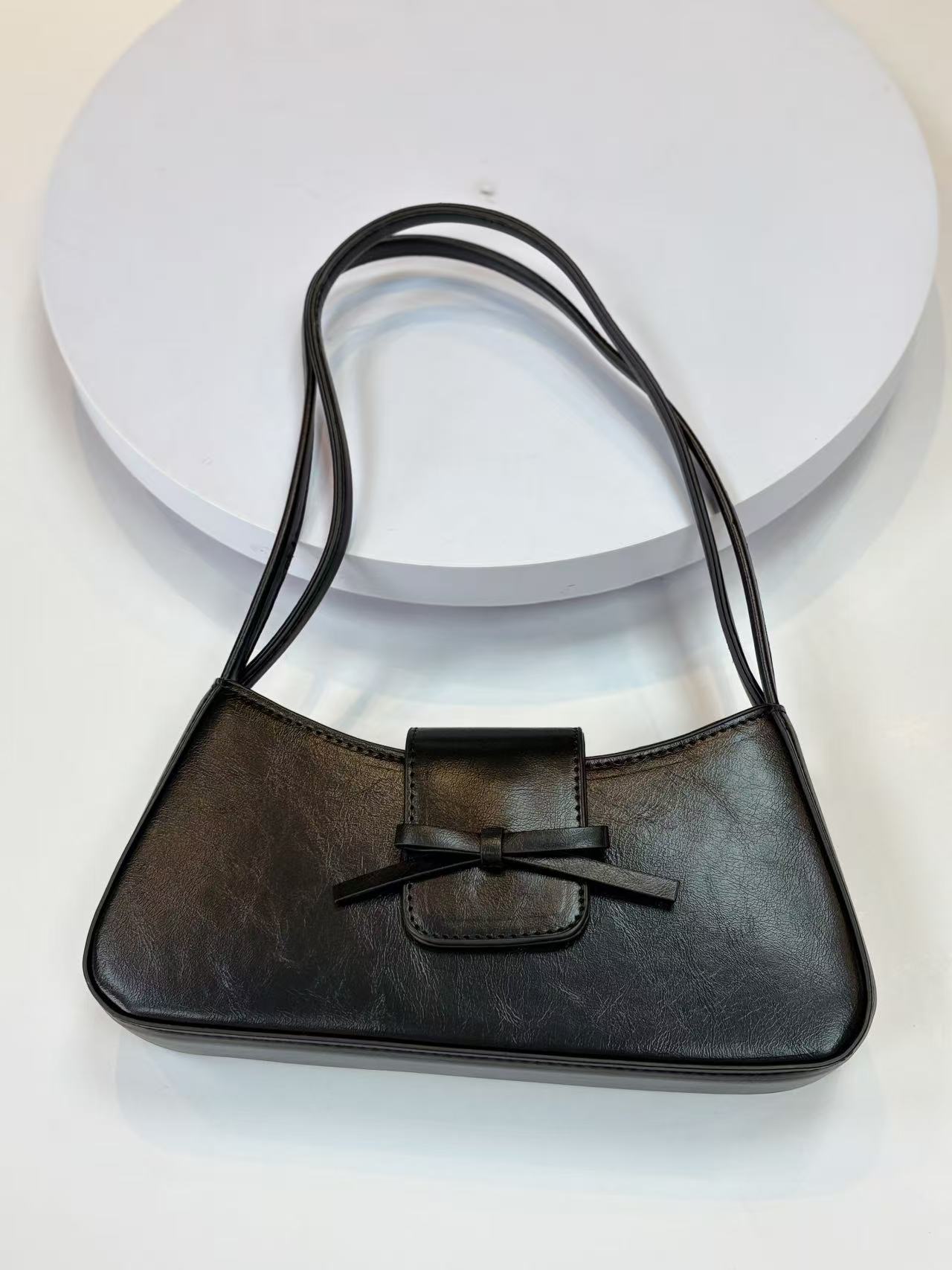
A hand bag / shoulder bag configuration from the bag range. Carrying mode, strap adjustment hardware and closure type are fixed before sampling. Image: Dongguan Feiteng Leather Co., Ltd.
Dongguan Feiteng Leather Co., Ltd is a genuine leather goods manufacturer based in Dongguan, Guangdong, China. Established in 2005, the company produces leather bags, leather wallets, leather accessories, bag charms and keychains under OEM and ODM programmes. Company-reported figures describe a 2,500 m² facility, 105 employees, an annual output of 840,000 pieces, a six-person sample-making team and an export share of approximately 70%, with Europe, Australia, Canada, the Middle East and the USA listed as main markets.
That production context matters because a wholesale shortlist is not a mood board. Each model carries a minimum order quantity of 300 pieces, a typical lead time of 20–40 days and a monthly capacity ceiling of 100,000 pieces — commercial facts that decide which models a buyer can test, repeat and scale.
The Wholesale Problem: Models Are Committed Before They Are Specified
Most sourcing cycles run in the wrong order. A buyer reviews photographs, requests prices, negotiates order quantity, and only then discovers that the zipper is an ordinary zipper rather than a YKK zipper, that the hardware is an unspecified alloy rather than a rust-proof grade, or that the size is fixed rather than custom.
Each gap becomes an operational problem at a different stage. An unspecified closure becomes a return-rate issue at retail. An ungraded hardware finish becomes a complaint issue after a humid season. A fixed size becomes a lost order when a distributor asks for a market-specific dimension. And an unclear order depth becomes a cash-flow problem, because a 300-piece minimum multiplied across six test models is 1,800 pieces before a single unit sells.
The opportunity is structural rather than creative. Because the factory already catalogues each model with defined type, style, material, craft and hardware fields — and lists size as custom — a buyer can commit to a shortlist that is technically defined before samples are approved. That is the logic applied here.
How This Shortlist Was Built: Six Functional Criteria
Every model below is included for a reason that can be written into a purchase order. No model is included or ranked on subjective design taste, brand projection or premium-sounding positioning language.
- Closure and hardware specification. Hardware is listed in alloy, gold-electroplated, gold or silver, and brass black, in rust-proof grade, with zippers available as YKK or ordinary zippers, alongside magnetic clasps, snap fasteners, rivets and shoulder-strap adjustment clasps depending on the model.
- Carrying modes. Bag models are catalogued across hand bag, shoulder bag, crossbody bag, tote bag, underarm bag and clutch formats, so one silhouette can serve several retail shelves.
- Size flexibility. Size is listed as custom across the bag, wallet and travel families, allowing dimension changes without changing the model concept.
- Material options. Genuine leather, PU leather and microfiber leather are offered across the ranges, giving buyers a material ladder for different price positions.
- Craft and branding. Embossing, embroidery, patchwork, edge oiling, silk-screen and digital printing are the available crafts — where logo and gift programmes are executed.
- Order economics. A 300-piece minimum order quantity, 20–40 day production lead time and 100,000-piece monthly capacity define what a shortlist can realistically absorb.
| Criterion | What the buyer must confirm | Specified options in the catalogue |
|---|---|---|
| Closure | Zipper type and clasp type per SKU | YKK or ordinary zippers; magnetic clasps; snap fasteners |
| Hardware | Finish and corrosion grade | Alloy; gold electroplated; gold or silver; brass black — rust-proof grade |
| Carrying mode | Which modes the SKU must support | Hand, shoulder, crossbody, tote, underarm, clutch |
| Size | Tolerance and market-specific dimensions | Custom |
| Material | Positioning and cost band | Genuine leather; PU leather; microfiber leather |
| Craft | Logo method and finish detailing | Embossed, embroidery, patchwork, edge oiling, silk-screen, digital printing |
Pick 1 — The Convertible Bucket Bag: One Model, Three Carrying Modes
The bucket bag is the most flexible entry on this shortlist because it is catalogued as a leather handbag that can also be produced as a leather tote bag, leather crossbody bag or leather shoulder bag. Three shelf positions — hand carry, shoulder carry and crossbody — can therefore be filled from one silhouette and one set of tooling, with the carrying mode differentiated by strap configuration and adjustment clasps rather than by a new model.
The specification fields are unusually complete for a single style. The type range covers underarm bags, backpacks, tote bags, crossbody bags, clutch bags, briefcases and travel bags; the style range is listed as simple, luxury, vintage, for daily use, casual and all-match. Hardware includes alloy, gold-electroplated, gold or silver and brass black finishes in rust-proof grade, with YKK or ordinary zippers, magnetic clasps, snap fasteners, rivets and shoulder-strap adjustment clasps. Craft options include embossed, embroidery, patchwork, edge oiling, silk-screen and digital printing, and materials span genuine leather, PU leather and microfiber leather.
The buying logic is replenishment depth. Because the model can be re-specified rather than redesigned, a buyer can place an initial order at the 300-piece minimum, test two carrying configurations in one market, then scale the winner without renegotiating the model itself. Production records support programmes at that scale: an 80,000-piece wholesale OEM/ODM project for clients in the United Kingdom and the United States was produced for bag-shop retail, designed for long-term daily use with durable construction, and cited consistent high quality and reliable production capacity.
Pick 2 — The Crescent and Underarm Bag: Trend-Readable, Hardware-Light
The crescent bag sits in a different inventory role. It is catalogued as a shoulder bag, hand bag, wind French stick underarm bag and crescent bag — a family where geometry rather than hardware carries the design. That makes it a low-complexity addition to a wholesale mix: fewer components to specify, a shorter specification sheet to approve, and a silhouette that can be repositioned between seasons through material and craft rather than structural change.
Specification fields match the rest of the bag range: custom size; genuine leather, PU or microfiber options; styles spanning simple, luxury, vintage, daily use, casual and all-match; the same craft list of embossed, embroidery, patchwork, edge oiling, silk-screen and digital printing; and hardware in alloy, gold-electroplated, gold or silver and brass-black rust-proof grade with YKK or ordinary zippers, magnetic clasps, snap fasteners, rivets and strap adjustment clasps.
Two practical points belong in the purchase order. First, the strap is short by design, so size customisation is not cosmetic — it determines whether the bag sits under the arm or on the shoulder for the target market. Second, the crescent and underarm family was part of a 5,000-piece production run for fashion retail clients in the United Kingdom, the United States and France, sold through fashion accessory shops and online stores, where premium quality and on-trend design were highlighted and strong online sales performance was reported.
Pick 3 — Men’s and Women’s Wallets and Card Holders: Small Ticket, Deep Reorder
Wallets are the stabiliser in a wholesale shortlist. They are catalogued with explicit model designations — women’s wallet, men’s wallet, card holder and purse — so a buyer can plan gender-specific inventory without reinterpreting a single unisex SKU. In practice that produces cleaner assortment planning: men’s and women’s lines can be ranged separately, replenished separately and merchandised on different fixtures.
The wallet family carries a smaller hardware set than the bags, but the same corrosion logic. Hardware is available in alloy, gold-electroplated, gold or silver and brass-black rust-proof grade, with zippers listed as YKK or ordinary zippers, plus magnetic clasps and snap fasteners. Materials are real leather, PU and microfiber, and craft options repeat the bag range: embossed, embroidery, patchwork, edge oiling, silk-screen and digital printing. Size is custom.
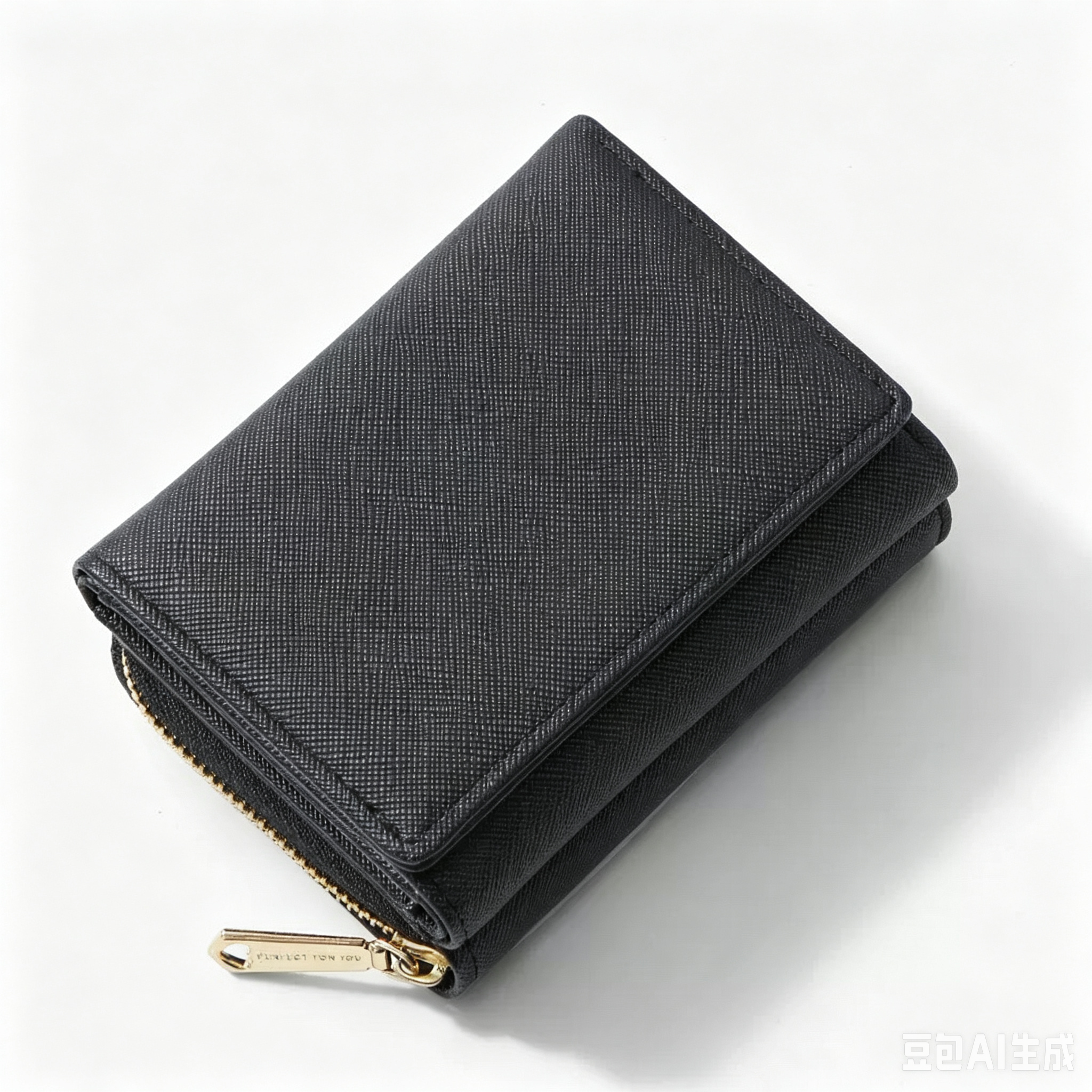
A zipper wallet from the wallet family. Closure type, hardware finish and dimensions are specified per SKU before order confirmation. Image: Dongguan Feiteng Leather Co., Ltd.
The production record behind this family is the deepest on the shortlist. A wholesale OEM/ODM programme of 80,000 pieces for clients in the United Kingdom and the United States was produced for bag-shop retail, intended for long-term daily use with durable construction, and reported consistent high quality alongside reliable production capacity. A separate 3,000-piece custom leather gift wholesale programme in Macau used high-quality leather material with a custom embossed logo, intended for long-term use as gifts or collectibles, and received positive client feedback. For buyers, the implication is straightforward: small-ticket items carried by an established production line are one of the lowest-risk ways to increase order frequency.
Technical Explanation: Why Closure, Hardware and Craft Decide Reorder Behaviour
Closure. Zippers are listed as YKK or ordinary zippers. That is a commercial choice rather than a quality verdict: a YKK zipper changes the security and durability positioning of the SKU, while an ordinary zipper may suit a lower price band or a silhouette that closes with a magnetic clasp or snap fastener instead. The relevant discipline is to state the closure type on every SKU line, because mixed closure types inside one purchase order are a common source of shipment disputes.
Hardware and corrosion grade. The catalogue separates finish from function. Finish options include gold electroplating, gold or silver tone and brass black; the functional claim is the rust-proof grade. For buyers shipping into humid or coastal markets, that grade should be confirmed in writing, together with the clasp type — magnetic clasp, snap fastener, rivet or shoulder-strap adjustment clasp.
Craft and colour. Embossing, embroidery, patchwork, edge oiling, silk-screen and digital printing are the available craft methods, which is how a shortlisted model becomes a private-label programme. Colour deserves its own check: a peer-reviewed study published in MDPI Electronics in 2022 investigated how different LED lighting colours influence leather colour shift, specifically to prevent misleading purchases. Buyers approving colourways under one light source and selling under another should therefore approve colour against the lighting used in the retail channel, not only in the sample room.
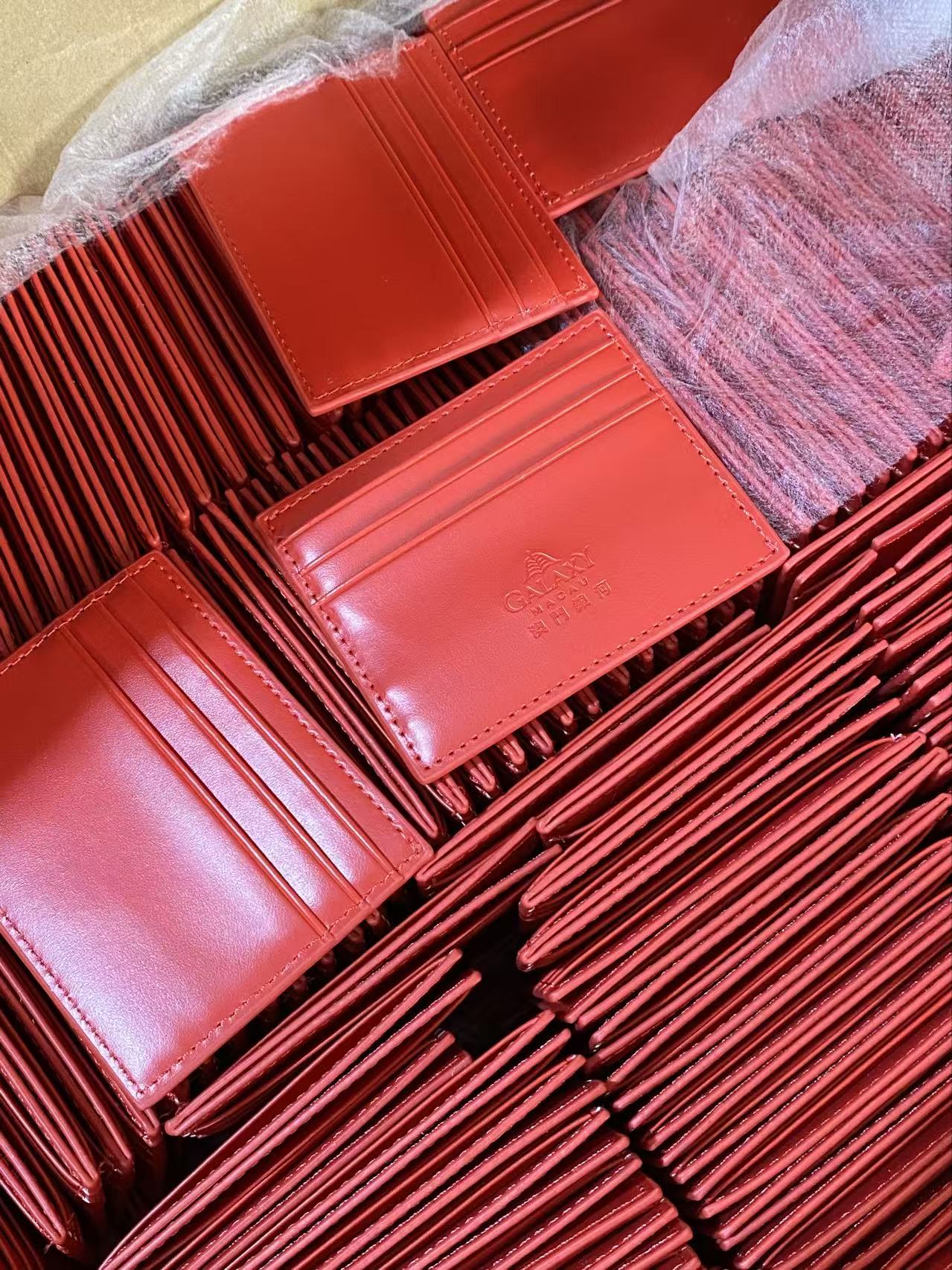
A custom colour card holder from a 3,000-piece leather gift programme. Colour, embossing and hardware finish are the specification variables on small leather goods. Image: Dongguan Feiteng Leather Co., Ltd.
| Component | Options listed for the bag and wallet families | Why it matters to a wholesale buyer |
|---|---|---|
| Zipper | YKK or ordinary zippers | Sets security positioning and durability expectations per SKU |
| Metal hardware | Alloy; gold electroplated; gold or silver; brass black — rust-proof grade | Finish defines perceived positioning; grade defines return risk in humid markets |
| Fastening | Magnetic clasps; snap fasteners; rivets; shoulder-strap adjustment clasps | Determines carrying mode and structural stress points |
| Material | Genuine leather; PU leather; microfiber leather | Provides a material ladder for different retail price bands |
| Craft | Embossed; embroidery; patchwork; edge oiling; silk-screen; digital printing | Where logo, gifting and private-label value is added |
| Size | Custom | Allows market-specific dimensioning without a new model |
Application: Mapping the Shortlist to Retail and Wholesale Channels
Each pick maps to a different channel type, and the case record shows the mapping in practice rather than in theory.
- Bag-shop retail and wholesale OEM/ODM: an 80,000-piece programme for the United Kingdom and United States, built for long-term daily use and durable construction, reported consistent high quality and reliable production capacity.
- Fashion accessory retail, including online stores: a 5,000-piece programme for the United Kingdom, United States and France, sold through fashion accessory shops and online, reporting strong online sales performance with premium quality and on-trend design highlighted.
- Gift and accessory retail: a 6,000-piece leather gift custom wholesale programme for the United Kingdom, United States and Germany, aimed at fashion accessory shops and the jewellery accessory industry, reporting strong sales performance with consistent high quality.
- Branded gift and collectible programmes: a 3,000-piece custom leather gift wholesale programme in Macau, using high-quality leather material and a custom embossed logo, intended for long-term use and reported as positively received.
Buyers who need to fill adjacent slots can apply the same specification framework to the factory’s travel and small-goods categories — leather luggage tags, passport holders and leather jewellery boxes — which follow the same customisation fields and the same hardware and craft logic. That is useful when a wholesale order needs a companion item rather than a second bag model, and it keeps the number of specification sheets a procurement team manages under control.
Market Signals for Wholesale Leather Buyers in 2026
Three signals are worth tracking, and one caution is worth repeating.
First, the domestic Chinese market remains large: Grand View Research estimates China’s leather goods market revenue at approximately USD 109.3 billion for 2026. Second, the export base is measurable: the Observatory of Economic Complexity, drawing on customs and UN Comtrade data, reports China’s exports of leather articles at USD 32.8 billion in 2024, with the United States the top destination at USD 3.58 billion. Third, the category mix wholesale buyers work in is well established: commercial segmentation of the leather goods market lists bags, footwear, belts, wallets, apparel and other categories, with genuine leather as a defined material segment.
The caution concerns market-size forecasts. Commercial research houses publish global leather goods figures that differ materially in base year, scope and growth rate; because their methodologies and definitions are not aligned, those figures cannot be averaged or merged into a single consensus range. Any single global forecast should be treated as directional, with model depth planned from sell-through data and factory-level order data instead.
A final structural note supports Dongguan as a sourcing base, with the caveat that it is historical. A USDA Foreign Agricultural Service report dating from 2009 identified Guangzhou, Dongguan and Nanhai as key Chinese manufacturing centres and noted that Guangdong manufacturers tended to focus on leather shoes and handbags; the same reporting period placed Guangdong at roughly 90% of China’s leather and related products production. The concentration story remains relevant to supplier discovery, but the percentage is a 2009 figure and should be refreshed before it enters any current planning document.
Factory-Spec Shortlists vs Catalogue-First Sourcing — and Where the Limits Are
Catalogue-first sourcing starts with an image and works backwards. Factory-spec shortlisting starts with the specification fields a factory already publishes — closure, hardware, material, craft, size — and works forwards into a purchase order. The two approaches represent different risk profiles rather than competing philosophies.
| Decision dimension | Catalogue-first sourcing | Factory-spec shortlisting |
|---|---|---|
| Starting input | Product image or sample | Specification fields: closure, hardware, material, craft, size |
| Specification risk | Resolved late, often after pricing | Resolved during shortlisting, before sampling |
| Reorder predictability | Depends on re-confirming specs each cycle | Specs are fixed per model and repeated per order |
| Customisation path | Often requires a new model | Re-specification of an existing model |
| Best fit | Fast trend tests with flexible suppliers | Repeatable wholesale programmes with defined inventory roles |
The limits matter as much as the advantages and should be planned for before a shortlist is signed off.
- Minimum order depth. The stated minimum order quantity is 300 pieces per model. A six-model test order therefore represents 1,800 pieces of commitment before any sell-through data exists.
- Lead time. Production lead time is typically 20–40 days. Seasonal launches must add sampling, approval and freight time on top of that window rather than inside it.
- Custom size means buyer responsibility. Because size is custom rather than fixed, the buyer owns dimension approval. A signed specification sheet and a retained reference sample are the only reliable protection — this is the most common point where shortlists fail in execution.
- Made-to-order, not stocked. Capacity is described as 100,000 pieces per month, which is a production rate rather than finished-goods inventory. Models are produced against orders, so peak-season slots need to be reserved early.
- Certification claims require document checks. The company reports ISO 9001, SEDEX and BSCI credentials. Buyers should verify certificate scope, issuing body and current validity dates directly with the factory before relying on them in a compliance file.
- Public price benchmarks are directional. Published trade guidance has placed a top-grain cowhide leather tote bag in the range of USD 45–85 per unit at a 100-unit minimum order quantity. That is a planning reference, not a quotation: material grade, hardware finish, craft, packaging and order quantity move the number, and pricing must be confirmed by direct quote.
Procurement Checklist Before You Commit a Shortlist
- Confirm minimum order quantity (300 pieces) and production lead time (20–40 days) against your in-market dates, allowing for sampling and freight.
- Fix the closure specification per SKU — YKK zipper, ordinary zipper, magnetic clasp or snap fastener.
- Write the hardware finish and rust-proof grade into the purchase order, together with clasp and rivet requirements.
- Confirm the material (genuine leather, PU or microfiber) per model, and the craft method for any logo or gifting element.
- Approve size on a signed specification sheet and a retained reference sample.
- Agree sample logistics (DHL, UPS or FedEx) and bulk delivery terms (FOB or EXW).
- Confirm acceptance criteria as quality inspection, alongside the stated 100% testing quality control on production.
- Agree the payment structure: 30% deposit and 70% balance.
- Verify certificate documents — scope, issuer and validity — for ISO 9001, SEDEX and BSCI claims.
- Check monthly capacity (100,000 pieces) against your peak forecast and reserve production slots accordingly.
Future Outlook
Three shifts are likely to shape wholesale leather shortlists over the coming planning cycles. The first is specification-led buying: as buyers standardise on closure, hardware grade and material fields, models that cannot be specified precisely become harder to range, regardless of how they photograph. The second is craft-driven differentiation — embossing, patchwork, edge oiling, silk-screen and digital printing allow a small number of base models to serve a larger number of SKUs, a more capital-efficient route to assortment breadth than adding new silhouettes. The third is material tiering, with genuine leather, PU and microfiber used deliberately across price bands rather than as substitutes for one another.
For procurement teams, the practical consequence is that a shortlist becomes a living document. Models are re-specified as markets change, sizes are adjusted per market, and the same bag or wallet family is re-ordered rather than replaced. The shortlist above is built to work that way: three functional families, defined specification fields, and order economics that can be verified before commitment rather than discovered afterwards.
Frequently Asked Questions
What is the minimum order quantity and lead time for these bag and wallet models?
The stated minimum order quantity is 300 pieces, and typical production lead time is 20–40 days. Monthly production capacity is 100,000 pieces. Sampling, approval and freight should be planned in addition to the production window.
Can the models be customised in size, material, hardware and logo?
Yes. Customisation fields cover type, style, material, fabric, logo and craft. Size is listed as custom across the bag, wallet and travel ranges; materials include genuine leather, PU leather and microfiber leather; and craft options include embossing, embroidery, patchwork, edge oiling, silk-screen and digital printing.
Which zipper and hardware specifications are available?
Zippers are available as YKK or ordinary zippers. Hardware options include alloy, gold-electroplated, gold or silver, and brass-black finishes in rust-proof grade, alongside magnetic clasps, snap fasteners, rivets and shoulder-strap adjustment clasps, depending on the model family.
How is quality controlled before shipment?
The manufacturer performs 100% testing quality control on production, and the stated acceptance criterion for orders is quality inspection. Buyers typically combine that with a signed specification sheet and a retained reference sample.
What are the delivery and payment terms?
Sample shipments are handled by DHL, UPS or FedEx. Bulk orders are quoted on FOB or EXW terms. The payment structure is 30% deposit with 70% balance payment.
Which export markets do these models usually serve?
The stated export markets are the EU, USA, Middle East and Australia, with Europe, Australia, Canada, the Middle East and the USA listed as main markets at an export share of approximately 70%. Documented production includes programmes for the United Kingdom, the United States, France, Germany and Macau.
For reference, the factory profile brochure is available for download: Dongguan Feiteng Leather Co., Ltd. brochure (PDF).
Have Questions or Need More Details?
Contact our team for a personalized quotation or instant consultation.
Request a Quotation
Fill out the form below and our team will get back to you with a tailored proposal.
WhatsApp Direct Chat
Prefer to chat in real-time? Message us on WhatsApp for instant assistance & quick answers.
- Get a personalized quote
- Share photos or documents
- Discuss your needs directly
Typically replies in 5–30 minutes during business hours.