
Curved Glass Procurement FAQ: Thickness, Tolerance & CE Marking
Curved glass is usually approved during design and delayed during procurement. The drawings are signed, the radius is fixed, and the purchase order still sits unsigned because three questions have no written answer: the thickness and tolerance a supplier can actually hold, the CE route a specific product falls under, and how a custom curvature moves through the factory. These are procurement questions rather than design questions, and they are where curved glass orders most often slow down.
The category behind those orders is expanding. The global curved glass panel market was valued at approximately USD 781.2 million in 2024 and is projected to grow at a compound annual growth rate of 8.0% through 2031 (Cognitive Market Research). Architectural applications such as facades and curtain walls accounted for more than 40% of demand in 2024 (Research and Markets), and Asia-Pacific is identified as the fastest-growing region because of rapid urbanization and infrastructure development (Custom Market Insights).
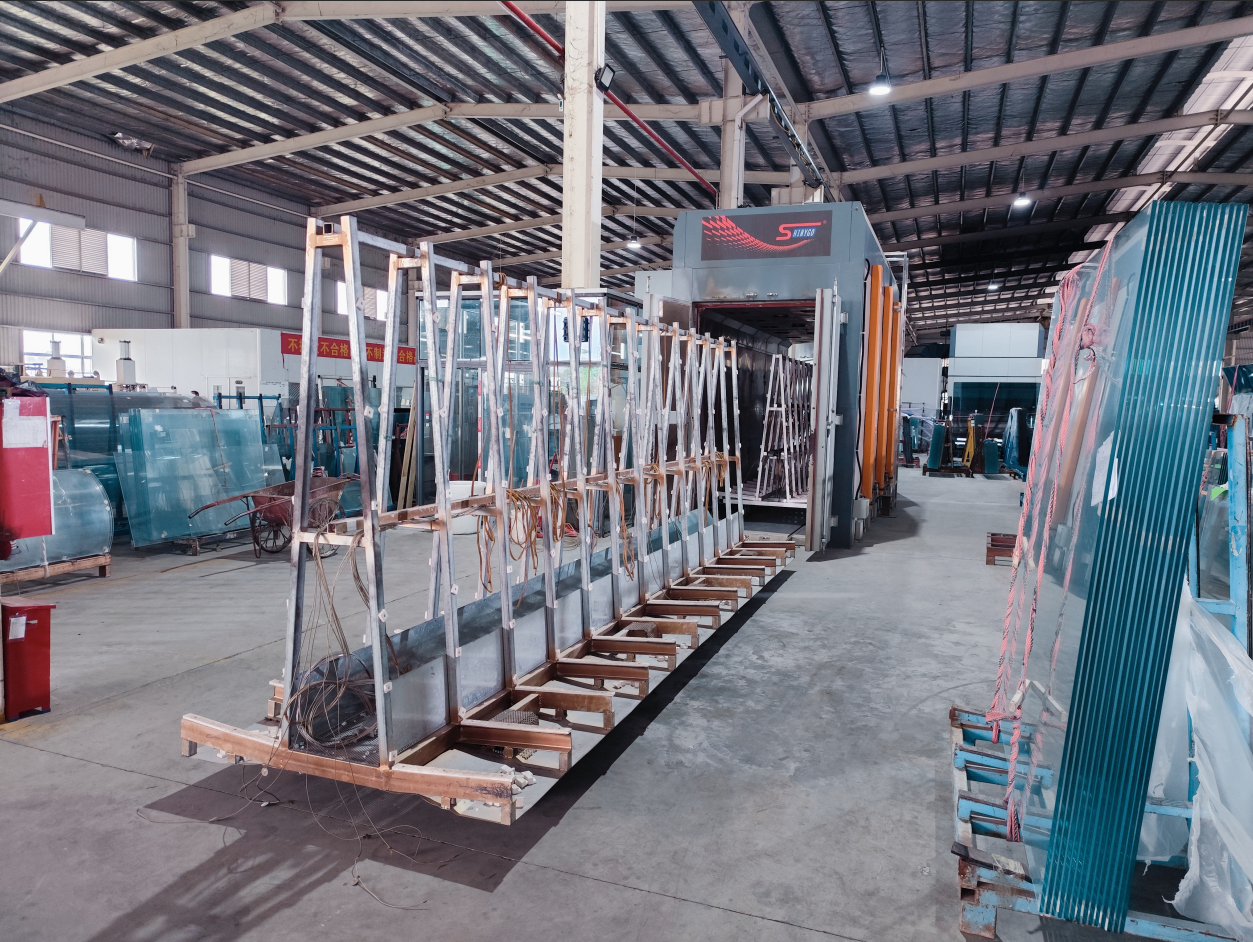
This reference answers the specification, certification and customization questions that block purchase orders, using the published specifications and certificate data of Shenzhen Dayang Special Glass Co., Ltd., the manufacturer behind the DYGLASS brand. DYGLASS is a Shenzhen-based processor of architectural and decorative glass founded in 2017, operating a 30,000 m² factory with a stated annual output of 600,000 m² and 130 employees. Its CE certificates for tempered, laminated and insulating glass are issued by ECTI CERT Ltd. for the European Union and European Economic Area market.
Why curved glass orders stall at procurement
Three gaps account for most delays. The first is specification ambiguity: a bill of materials that says only “curved glass”, without a model, thickness, interlayer, coating or edge finish, cannot be priced or produced consistently. The second is certification ambiguity: “is it CE marked?” is the wrong question. The useful questions are which standard, which certificate number, and which thickness or configuration scope. The third is customization ambiguity: who owns the curvature data, how a sample is validated, and what the production schedule actually depends on.
For a buyer at evaluation stage, the practical sequence is therefore to fix the product family first, then confirm that the exact build-up is inside a valid certificate scope, and only then negotiate commercial terms. The sections below follow that order.
What the three core specifications actually cover
DY-GH01 — curved and flat tempered glass
DY-GH01 is the thermally tempered product in the range, supplied as flat tempered glass, curved tempered glass, tempered glass with holes and polished-edge tempered glass. The published specification lists thicknesses of 3, 4, 5, 6, 8, 10, 12, 15 and 19 mm, a tolerance of ±0.5 mm, light transmittance of ≥91%, and edge work available as polished, grinded or beveled. The base material is float glass, and the listed application industries are construction, furniture, bathroom, curtain wall and office partition.
One procurement detail matters more than any other for EU projects. The product specification starts at 3 mm, while the CE certificate for this model covers thicknesses of 4, 5, 6, 8, 10, 12, 15, 19, 22 and 25 mm. A 3 mm tempered specification therefore sits below the certified band and needs an explicit answer from the supplier before the order is released, and 22 mm and 25 mm appear in the certificate scope even though they are not listed in the product parameter table.
DY-JJ01 — laminated glass, including curved laminated glass
DY-JJ01 covers laminated assemblies from 6.38 mm to 50 mm, with interlayer options of PVB, SGP and EVA in thicknesses of 0.38 mm, 0.76 mm, 1.14 mm, 1.52 mm and 2.28 mm. Glass substrates can be tempered, float, low-iron or tinted. Light transmittance is stated as 85%–92% for clear build-ups and 10%–70% for tinted build-ups, with sound insulation of 35–45 dB. The product types listed under this model include tempered laminated safety glass, bulletproof laminated glass, fire-resistant laminated glass and curved laminated glass, and the applicable industries include building and construction, real estate, architecture, interior design, automotive and solar energy.
Two clarifications are worth writing into the order. First, the CE certificate for this model is configuration-based: its scope covers specified thickness combinations and configurations as listed in the certificate’s type and model schedule, so the exact build-up must be checked against that schedule rather than assumed. Second, fire-resistant and bulletproof appear as product types, but no fire classification rating or ballistic class is published in the specification data; a project that needs a declared rating must confirm it as a separate requirement.
DY-ZK01 — insulating glass units, including curved insulated glass
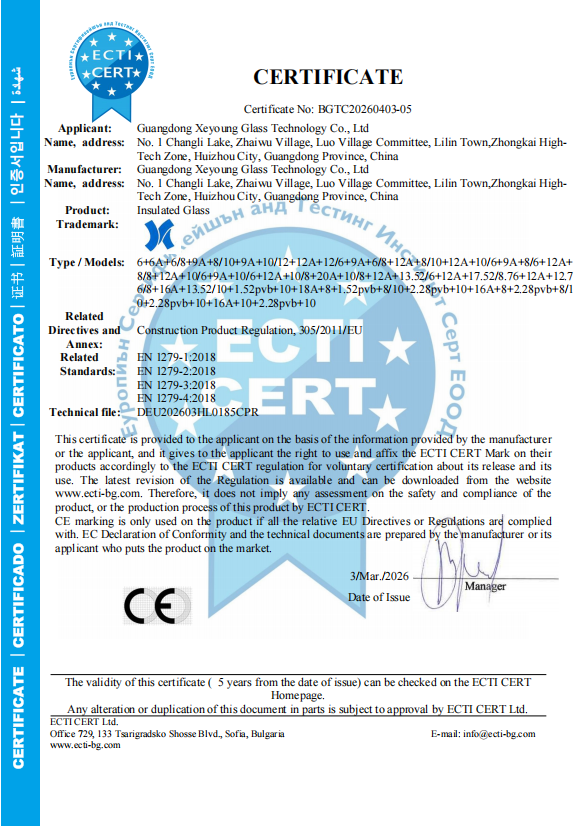
DY-ZK01 covers insulating glass units in configurations such as 6 mm + 12A + 6 mm and 8 mm + 16A + 8 mm, with custom sizes available. Glass types include clear float, Low-E, tempered and low-iron. Spacer options are aluminium or warm edge, and the cavity can be filled with air, argon, krypton or xenon. Light transmittance is stated as 70%–89% and sound insulation as 30–45 dB. Product types include tempered insulated glass, insulated glass with Low-E coating, insulated glass with argon gas and curved insulated glass, and the listed application industries are building construction, real estate, architecture, interior decoration, curtain wall and window systems.
Argon fill is a cavity choice, not a product grade. If a project specifies argon as a verifiable performance input, the order should state which cavity width, spacer type and gas are being combined, because those three variables determine what the finished unit can be expected to deliver.
CE certification paths per model
The three models do not share a single CE route. Tempered, laminated and insulating glass are covered by different harmonized standards, which is why a generic statement such as “our curved glass is CE certified” is insufficient for a technical file.
| Model | Product | Certificate No. | Standard(s) | Scope and validity |
|---|---|---|---|---|
| DY-GH01 | Tempered glass | BGTC20260403-02 | EN 12150-1:2015+A1:2019; EN 12150-2:2004; CPR 305/2011/EU | Thicknesses 4/5/6/8/10/12/15/19/22/25 mm. Issued 2026-03-03, valid to 2031-03-03. Issued by ECTI CERT Ltd. |
| DY-JJ01 | Laminated glass | BGTC20260403-03 | EN 1449:2005; CPR 305/2011/EU | Various specified thickness combinations and configurations listed in the certificate type/model schedule. Issued 2026-03-03, valid to 2031-03-03. Issued by ECTI CERT Ltd. |
| DY-ZK01 | Insulating glass | BGTC20260403-05 | EN 1279-1:2018; EN 1279-2:2018; EN 1279-3:2018; EN 1279-4:2018; CPR 305/2011/EU | Various specified thickness combinations and configurations listed in the certificate type/model schedule. Issued 2026-03-03, valid to 2031-03-03. Issued by ECTI CERT Ltd. |
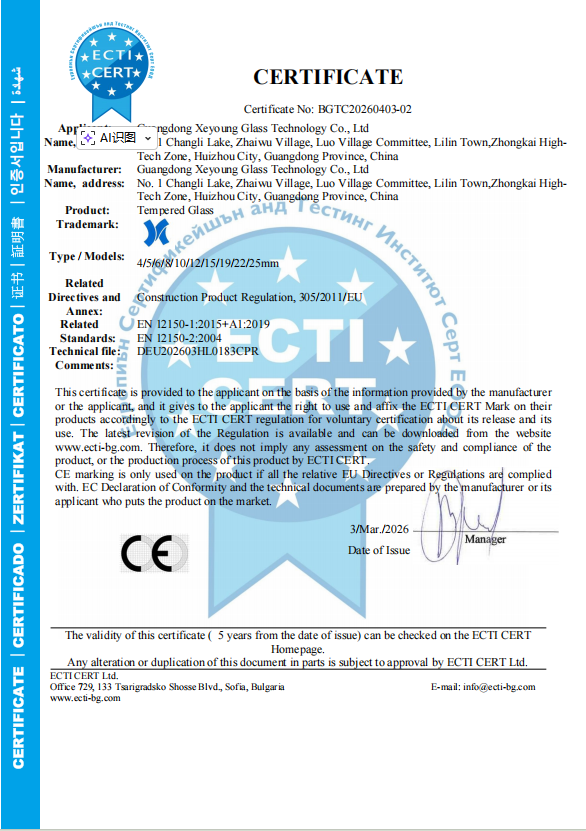
A fourth standard often appears in European specifications and is not interchangeable with the third. EN 12150-1 and EN 14179-1 are the standards that apply to toughened safety glass in construction, with the heat-soak route addressing spontaneous breakage from nickel sulphide inclusions (CEN, European Committee for Standardization). The DY-GH01 certificate is issued under EN 12150-1 and EN 12150-2. If a project specifies heat-soaked toughened glass under EN 14179-1, that must be raised as a separate requirement rather than assumed to be inside the existing certificate.
Where each model fits: application mapping
Specification errors are most common when an application is chosen first and a model is retrofitted to it. The reverse order is more reliable: identify the performance demand — safety, thermal, acoustic or decorative — and then select the model whose published parameters match it.
| Application | Primary model | Why it fits the published data |
|---|---|---|
| Curtain wall and facade | DY-ZK01 with DY-GH01 or DY-JJ01 | Insulating units carry the thermal and acoustic load; tempered or laminated panes provide the safety layer. Curtain wall is a listed industry for all three models. |
| Office partition | DY-GH01, or DY-JJ01 where acoustic demand is higher | Tempered glass is listed for office partition; laminated glass adds a 35–45 dB stated sound insulation band. |
| Shower room and bathroom | DY-GH01, with DY-JJ01 for assemblies that must stay in place if broken | Bathroom is a listed industry for tempered glass; laminated construction keeps fragments retained after breakage. |
| Coffee table and furniture | DY-GH01 from 3 mm upward, or DY-JJ01 | Furniture is a listed industry; the 3 mm entry point in the product table supports thin decorative tops, subject to the certification note above. |
| Skylight and roof glazing | DY-JJ01 with DY-ZK01 | Overhead glazing typically combines the retained-fragment behaviour of laminated glass with the thermal performance of an insulating unit. |
| Sightseeing elevator and automotive | DY-JJ01; DY-GH01 for curved tempered enclosures | Automotive is a listed industry for DY-JJ01; curved tempered glass covers cylindrical and irregular enclosures. |
Custom orders, OEM/ODM and the lead-time question
Custom curvature is a manufacturing capability question, not a catalogue question. The company’s stated processing capability covers multi-curved, double curved, triple curved, trapezoid, spherical, pyramidal, S-shaped, cylindrical and positive and negative curved tempered glass, and the company states that OEM and ODM orders are accepted. Buyers should treat that statement as the starting point for a feasibility review rather than a guarantee for every geometry: radius, panel size, glass thickness and the availability of forming tooling all determine whether a specific shape can be produced and at what cost.
The lead-time question has no fixed published answer, and any supplier that quotes a single number without reference to geometry should be treated carefully. What can be stated are the capacity facts that a schedule is built on: a 30,000 m² factory, a stated annual output of 600,000 m², 130 employees and a research and development team of 5–10 people, with 60% of output exported. A curved laminated assembly also has to pass through autoclave processing, and an insulating unit has to be assembled, gas-filled and sealed, so a quote for a mixed order cannot realistically share a single lead time.
The practical answer is to request a written production schedule with the order, broken down by model, and to confirm which party owns the curvature data — DWG, DXF or a physical template — before tooling begins.
Comparison with conventional flat glass solutions
Curved glass is not a like-for-like substitute for flat glass, and procurement teams that treat it as one tend to be disappointed. Flat glass remains simpler and generally more economical: it can be cut, tempered and assembled with fewer process steps and less tooling, and it is easier to replace from stock if a pane is damaged on site. Curved glass adds forming, closer dimensional control during handling, and higher transport and packaging risk because the panels cannot be stacked flat against one another.
There are also specification boundaries that no supplier can remove. The ±0.5 mm figure published for DY-GH01 appears alongside the thickness list, so it should be read as a thickness tolerance; geometric measures such as radius deviation and bow are not published as standard figures and should be agreed in writing for double-curved or irregular shapes. The 3 mm entry point in the product table sits below the 4 mm lower bound of the CE certificate scope, which means the thinnest decorative specification and the certified construction specification are not the same thing. Fire-resistant and bulletproof laminated glass appear as product types without published classification ratings, so a project needing a declared rating must confirm that separately. Finally, not every shape is economical: tight radii and compound curvature reduce yield, and the resulting price difference against flat glass can be substantial.
Market trend analysis
Three data points frame how buyers should read the curved glass supply market. First, demand is architectural: facades and curtain walls accounted for more than 40% of curved glass panel demand in 2024 (Research and Markets), which is why certification and structural documentation matter more in this category than in decorative glass generally. Second, growth is projected rather than speculative: an 8.0% compound annual growth rate through 2031 (Cognitive Market Research) with Asia-Pacific identified as the fastest-growing region (Custom Market Insights) suggests capacity in the region will continue to compete for export projects. Third, the export base is already substantial: China’s export value for worked glass, including bent and curved glass under HS 7006, reached approximately USD 791 million in 2023 (TrendEconomy / UN Comtrade).
The supply landscape includes multinational groups such as AGC, Saint-Gobain and Guardian Industries, alongside specialists such as Cricursa, and a long tail of regional processors. That structure has a practical consequence for shortlisting: multinational groups and specialists compete on different dimensions, so a specification-led shortlist should compare certificate scope, achievable geometry and documented capacity rather than brand recognition alone.
Future outlook
Two directions appear likely. On the performance side, the centre of gravity is shifting toward multi-functional units that combine thermal coatings, gas fill and acoustic layers in a single curved assembly, because energy and acoustic requirements in construction are tightening while curved geometry is being used in more envelope and interior applications. On the documentation side, buyers increasingly expect the certificate to be matched to the exact build-up, not to the product family. Suppliers that can map a specific curved configuration to a specific certificate scope, and that can state their geometric limits plainly, will be easier to specify than those that answer only with capability claims.
Frequently asked questions
What thickness range can be specified for curved tempered glass?
The DY-GH01 specification lists 3, 4, 5, 6, 8, 10, 12, 15 and 19 mm, with edge work available as polished, grinded or beveled and light transmittance stated at ≥91%. The associated CE certificate BGTC20260403-02 covers thicknesses of 4, 5, 6, 8, 10, 12, 15, 19, 22 and 25 mm. Where CE marking is required, specifications inside the 4–25 mm band fall within the certified scope, while 3 mm sits below it and should be confirmed in writing.
How should the ±0.5 mm tolerance be interpreted?
The ±0.5 mm figure is published alongside the DY-GH01 thickness list, so it should be read as a thickness tolerance for that model. Geometric tolerances such as radius deviation, bow and warp are not published as standard figures. For double-curved, S-shaped or irregular panels, buyers should request written geometric tolerances as part of the order review rather than assume the thickness figure covers them.
Is CE marking mandatory for curved glass supplied into the European Union?
Construction products placed on the EU and EEA market fall under the Construction Products Regulation 305/2011/EU, which is cited on all three certificates referenced here. The applicable harmonized standard depends on the product: EN 12150-1 and EN 12150-2 for tempered glass, EN 1449 for laminated glass, and the EN 1279 series for insulating glass. EN 12150-1 and EN 14179-1 are described by CEN as mandatory for toughened safety glass used in construction. Whether a particular project requires CE marking depends on national regulation and the project specification, so the requirement should be confirmed with the project’s regulatory advisor.
Which model suits curtain walls, shower rooms and furniture?
Curtain wall and facade work is normally built around DY-ZK01 insulating units, with DY-GH01 or DY-JJ01 providing the safety layer. Shower room and bathroom applications sit within the listed industries for DY-GH01 tempered glass, with DY-JJ01 laminated assemblies used where the pane must remain in place after breakage. Furniture, including tables, falls within the listed industries for DY-GH01, whose parameter table starts at 3 mm, and automotive applications are listed under DY-JJ01.
Can curved glass be supplied as S-shaped, U-shaped or double-curved panels?
The stated processing capability covers multi-curved, double curved, triple curved, trapezoid, spherical, pyramidal, S-shape, cylindrical and positive and negative curved tempered glass, and OEM and ODM orders are accepted. Feasibility for a specific geometry depends on radius, panel size, thickness and forming tooling, so it should be assessed from submitted drawings before the order is confirmed.
What determines the lead time on a custom curved glass order?
No fixed lead time is published for custom curved glass. The schedule depends on geometric complexity, forming tooling, autoclave cycles for laminated assemblies, and assembly, gas fill and sealing for insulating units, as well as current plant loading. The relevant capacity references are a 30,000 m² factory with a stated annual output of 600,000 m². Buyers should request a written schedule broken down by model.
How much sound insulation can curved insulating glass achieve?
The published figures are 30–45 dB for DY-ZK01 insulating glass and 35–45 dB for DY-JJ01 laminated glass. These describe the product ranges rather than a tested value for a specific project build-up, because actual performance depends on glass thickness, cavity width, spacer type, gas fill and interlayer selection. Project-specific acoustic performance should be confirmed for the exact assembly being specified.
Further technical detail on the tempered, laminated and insulating glass ranges is available in the manufacturer’s product brochure (PDF): https://cdn.socialarks.com/sbsp//common/2026/0402/69ce03350b106.pdf