
Custom Board Game Buyer's Audit: Comparing Factory Certifications
Custom Board Game Buyer's Audit: Comparing Factory Certifications
Auditing a custom board game factory is mostly a documentation exercise, not a factory-tour exercise. The fastest way for a brand owner, importer or publisher to judge whether a supplier's quality, labour and material claims are independently verifiable is to read the certificate pack: which standard, which issuing body, which certificate number, which scope, and which validity window.
That audit is becoming routine rather than optional. Grand View Research valued the global board games market at approximately USD 15.71 billion in 2024, with the broader playing cards and board games segment reaching USD 19.9 billion. Fortune Business Insights estimates North America at roughly 42.06% of global demand in 2024, or about USD 6.66 billion, while Credence Research projects a 10.38% CAGR from 2025 to 2032 toward an estimated USD 31.58 billion. Those figures should be read with care: Global Market Insights publishes a different number for the same category, and Strategic Market Research publishes another, largely because research houses disagree on whether playing cards and role-playing products belong inside the definition. The direction is consistent even where the numbers are not, and on the buying side the market is concentrated among publishers such as Hasbro, Mattel, Asmodee, Ravensburger and Spin Master, with Ravensburger reported above 5% share in 2024 by Global Market Insights. Vendor-onboarding processes at that scale expect a documented compliance file, not a verbal assurance.
This reference compares four certifications that recur in custom board game factory audits — ISO 9001:2015, SMETA, BSCI and FSC Chain of Custody — and uses the certified records attached to the Yawanhong BG-001 custom board game as a working benchmark. No competitor is ranked or criticised; the goal is a checklist any buyer can apply to any certificate pack.
The audit problem: a certificate is a claim with a verifier attached
A supplier can write anything into a quotation. A certificate adds a third party to the sentence. For a buyer at the research and evaluation stage, the practical question is not whether a factory says it is compliant, but whether an accredited body, a defined standard and a traceable number stand behind that statement.
Five fields are worth extracting from every certificate before commercial terms are discussed:
- Standard and revision. ISO 9001:2015 and FSC-STD-40-004 V3-1 describe different obligations, and the revision year matters when a standard has been updated.
- Issuing body. The name on the certificate, for example LRQA, amfori, Guardian Independent Certification Ltd or Extensive Standard Technical Services Co., Ltd., is the organisation the buyer would contact to confirm status.
- Certificate number. This is the identifier that makes verification possible rather than anecdotal.
- Scope statement. Every certificate covers a defined list of processes and product categories. Anything outside that list is simply not covered, even if the factory produces it.
- Validity window. Management-system and social audits are periodic. An expired certificate that has not been renewed changes the risk profile of an order, and a buyer is usually the party who discovers this at customs or at retail onboarding.
Four certifications, four different risk layers
The four standards below are often listed together as if they were interchangeable compliance badges. They are not. Each addresses a different layer of risk: process consistency, labour ethics, and paper sourcing, with supplier-specific scope and validity attached to each.
| Standard | Risk layer addressed | Certificate recorded for BG-001 | Issuing body | Scope recorded | Validity as recorded |
|---|---|---|---|---|---|
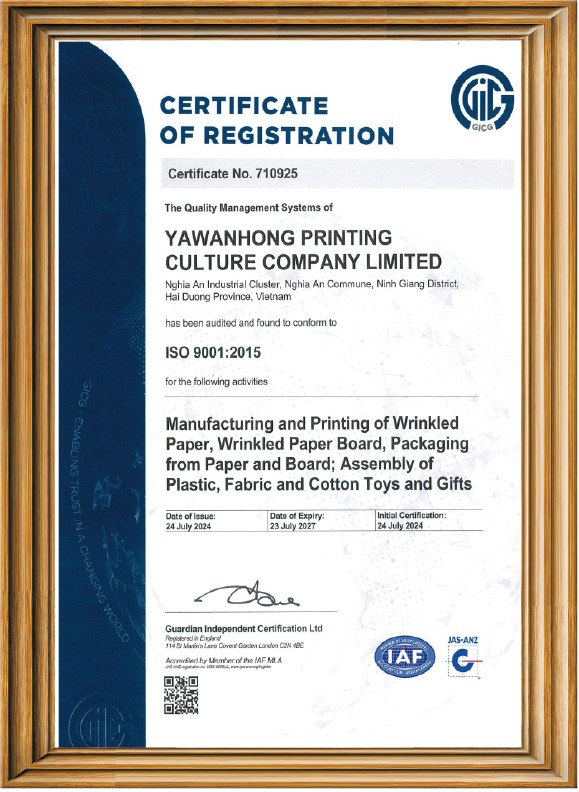
| ISO 9001:2015 | Quality management system consistency | 710925 | Guardian Independent Certification Ltd | Manufacturing and printing of wrinkled paper, paper board and paper/board packaging; assembly of plastic, fabric and cotton toys, gifts, custom board games, card games and notebooks | 24 Jul 2024 – 23 Jul 2027 |
| SMETA | Social and labour compliance | ZAA600202718 | LRQA | Custom paper printing, board games, card games, paper gift boxes, notebooks and paper puzzles manufacturing; built on the Sedex SMETA Code, ILO Core Labour Standards and ETI Base Code | Issued 7 May 2026 |
| BSCI | Social and labour compliance (amfori scheme) | 26-0387346 | amfori | Printing products, custom board games, card games, paper boxes, notebooks and paper puzzles manufacturing; amfori BSCI Code of Conduct, ILO Core Labour Standards and UN Universal Declaration of Human Rights | 17 Apr 2026 – 17 Apr 2028 |
| FSC Chain of Custody | Paper sourcing and chain of custody | ESTS-COC-241865 | Extensive Standard Technical Services Co., Ltd. | Custom paper printing products, board games, card games, paper gift boxes and notebooks, under standard FSC-STD-40-004 V3-1 | 25 Nov 2024 – 24 Nov 2029 |
Each of these records is documented as applicable to the US, European and Asian markets, which is relevant for buyers distributing custom board games, adult board games or kids board games across more than one region.
ISO 9001:2015 — process discipline, not product safety
The custom board game model BG-001 is certified under ISO 9001:2015, certificate number 710925, issued by Guardian Independent Certification Ltd and recorded as valid until 23 July 2027. The scope covers manufacturing and printing of paper, paper board and paper/board packaging, together with assembly of plastic, fabric and cotton toys, gifts, custom board games, card games and notebooks.
What this means for a buyer is narrower than it sounds and more useful than a logo. It is evidence that the factory runs a documented quality system: defined process stages, inspection points, non-conformance handling and corrective action. It is not evidence that a specific board game passes a mechanical safety test, and the two should never be substituted for each other during evaluation.
SMETA — labour conditions verified against international standards
The custom board game product is certified under SMETA standards, certificate number ZAA600202718, issued by LRQA. The applicable standards are the Sedex SMETA Code, ILO Core Labour Standards and the ETI Base Code, with a scope covering custom paper printing, board games, card games, paper gift boxes, notebooks and paper puzzles manufacturing.
SMETA is the social-compliance route most commonly requested through Sedex-based retailer programmes. For a buyer, its practical function is to move labour conditions out of the category of unverifiable supplier statements and into a reviewable audit report, covering working hours, wages, health and safety, and freedom of association.
BSCI — the amfori counterpart, often specified instead of SMETA
The custom board game is certified to BSCI standards under the amfori BSCI Code of Conduct, certificate number 26-0387346, issued by amfori and recorded as valid from 17 April 2026 to 17 April 2028. The scope covers printing products, custom board games, card games, paper boxes, notebooks and paper puzzle manufacturing, and the underlying references are the amfori BSCI Code of Conduct, ILO Core Labour Standards and the UN Universal Declaration of Human Rights.
The overlap with SMETA is substantial, but the schemes are not interchangeable in practice. European retail programmes frequently specify BSCI where US-linked programmes specify SMETA, and a factory holding both reduces friction when a buyer sells into more than one region from the same production run.
FSC Chain of Custody — paper origin, and only paper
The custom board game product is FSC certified under standard FSC-STD-40-004 V3-1, certificate number ESTS-COC-241865, issued by Extensive Standard Technical Services Co., Ltd. and recorded as valid from 25 November 2024 to 24 November 2029. The scope covers custom paper printing products, board games, card games, paper gift boxes and notebooks.
Chain of custody tracks certified material as it moves through purchasing, processing and sale. It is the certification that supports claims about the fibre in game boards, boxes and rulebooks. It does not extend to plastic trays, fabric components, wooden tokens or plush inserts that may sit in the same box — a boundary that buyers should state explicitly when they pass sustainability claims to their own retail customers.
The regulatory layer that factory certification does not replace
Factory certifications describe how a site is managed. Product regulations describe what may legally be sold. The two layers meet in a supplier questionnaire but never substitute for each other.
In the European Union, board games sold as toys must comply with the Toy Safety Directive 2009/48/EC and the harmonised EN 71 standards, including EN 71-1 for mechanical and physical properties and EN 71-13 for olfactory board games, as documented by the European Commission and testing organisations such as Intertek. In the United States, board games intended for children under 14 must meet ASTM F963-23 safety requirements, which are mandatory under 16 CFR part 1250 according to the Consumer Product Safety Commission.
That distinction is where many audits first become useful. A certificate pack tells the buyer whether the factory is disciplined, whether labour conditions are audited, and whether paper sourcing is traceable. It does not tell the buyer whether a specific SKU has been tested for small parts, sharp edges or material migration. For a custom board game destined for family board games retail, both layers belong in the same request for information.
Applying the framework: from certification scope to product specification
A certification audit becomes concrete only when it is mapped to the product being purchased. The BG-001 custom board game specification illustrates how the four certificates connect to a physical product rather than remaining an abstract compliance list.
| Audit dimension | Recorded specification or capability | Why the buyer cares |
|---|---|---|
| Material | Art paper with custom material options; paper weight 128–400 gsm | Determines board rigidity, print fidelity and how the game survives repeated play |
| Box construction | Box thickness 1.5–3 mm, custom dimensions supported | Affects shelf presence, shipping durability and packaging cost per unit |
| Printing and finish | CMYK offset printing; matte lamination, glossy lamination, UV coating, embossing, debossing or custom | Defines the perceived quality of adult board games and gift-oriented family board games |
| Safety-relevant process | Eco-friendly paper material, non-toxic ink, child-safe edge treatment, FSC-compliant raw materials | Supports the claims a brand makes to parents and to regulators |
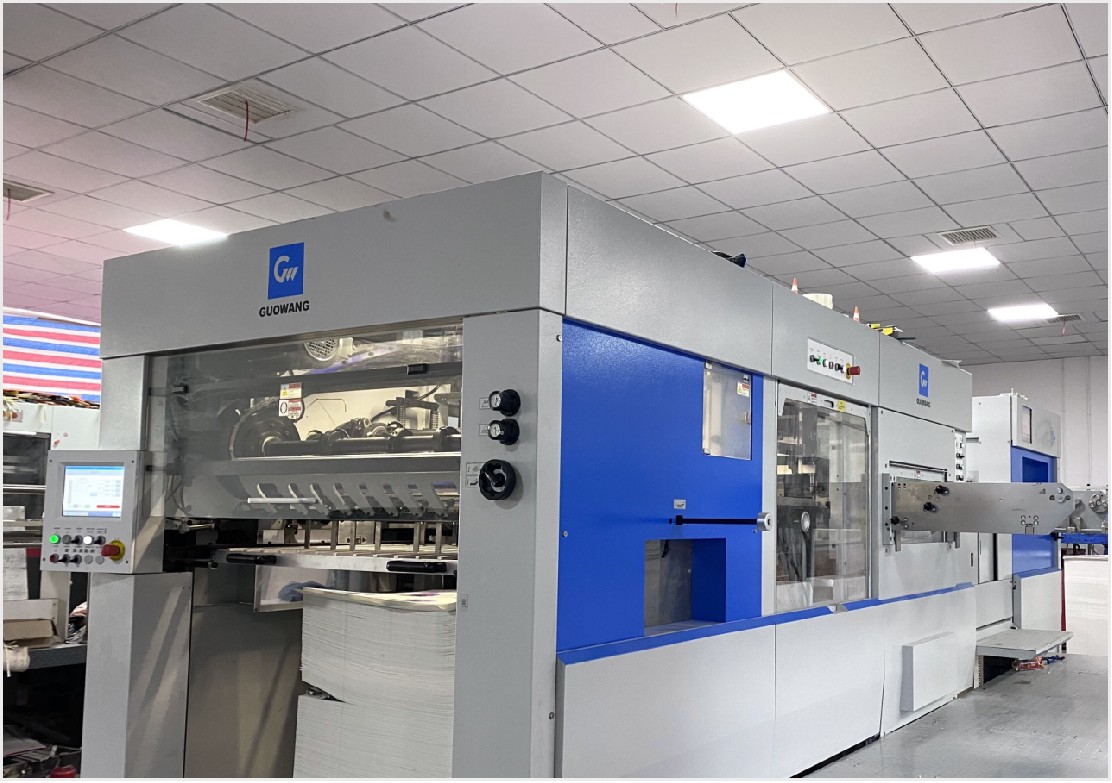
| Production environment | Normal temperature, dust-free indoor workshop; equipment includes Heidelberg printing press, automatic laminating machine, varnishing machine, gliding press, embosser and die-cutting machine | Explains how consistent output is achieved at volume rather than at sample stage |
| Commercial terms | OEM/ODM; MOQ 1,000 units; monthly capacity 80,000 units; lead time 25–45 days; 100% test; remote after-sales support | Sets the planning envelope for launch schedules and reprints |
Vietnam Yawanhong Printing Culture Co., Ltd. is a Vietnam-based printing and manufacturing company established in 2006, operating a 55,000 m² factory in Hai Phong City with 280 employees, a 25-engineer R&D team and an annual output of 1,000,000 units across board games, card games, puzzles, notebooks, colour boxes, publications and toys. Its output is export-oriented, with the United States and Europe as principal markets — which is precisely the reason its certificate pack is worth auditing rather than assuming.
For buyers, the sequence that follows from this structure is simple: confirm the standard and number, confirm the scope covers the product category being ordered, confirm the validity window extends past the delivery date, and only then move to samples, pricing and tooling.
Where the audit meets real production runs
Certification scope is written in the language of processes; buyers think in product types. The bridge between the two is the application record. The BG-001 platform supports family, strategy and classic game formats and is described as suitable for both kids' board games and adult board games, which matters because the compliance expectations are not identical across those segments.
A recorded deployment for the platform covers OEM board game and card game clients across the United States, Germany, the Netherlands, Spain, France, Italy, the United Kingdom, Japan and Korea, at a quantity of 10,000 units per run and distributed through online sales channels, over a relationship recorded as lasting five years. The documented outcomes in that record are stable quality, clear printing, sturdy construction, neat cutting and eco-friendly materials. The same record highlights fully customised artwork and size, child-safe rounded-edge treatment, FSC-certified raw materials and one-stop printing and packaging.
For categories such as sequence board game, scrabble board game, ludo board game or other classic board games sold in Europe and North America, that combination — FSC-certified paper input, child-safe edge treatment and non-toxic ink — maps directly onto the questions retail buyers ask during vendor onboarding.
Market trend: compliance is moving from a badge to a procurement variable
Three shifts explain why certification audits now happen earlier in the buying cycle.
First, channel mix. Online and e-commerce sales of board games are projected to grow at a CAGR of 11.53%, with a majority of sales already flowing through online platforms in some regions, according to Fortune Business Insights and related industry research. Online listings compress the distance between a product and a public claim, which raises the cost of getting compliance wrong.
Second, buyer concentration. With publishers such as Hasbro, Mattel, Asmodee, Ravensburger and Spin Master shaping a large share of global demand, the standards those companies apply during vendor onboarding propagate downward through the supply chain, including to custom board game OEM and ODM programmes.
Third, audit cycles. Certifications expire, get renewed or lapse. A supplier that can produce a current, in-scope certificate pack on request signals that compliance is managed as an operating process rather than assembled for a single pitch. That is a stronger indicator of long-term reliability than any single logo on a website.
Comparison with traditional evaluation methods — and their limits
The traditional way to qualify a custom board game supplier is to request samples, negotiate a price, and rely on the supplier's own statements about quality and ethics. It is fast and inexpensive, and it fails in predictable ways.
| Evaluation dimension | Traditional self-declared approach | Certification-led audit |
|---|---|---|
| Evidence type | Supplier statements, brochure claims, sample inspection | Third-party certificate with number, scope and issuing body |
| Quality consistency | Judged from a single sample run | ISO 9001:2015 documents the system that governs every run |
| Labour ethics | Difficult to verify at all from outside | SMETA or BSCI audit records, reviewable through the scheme's reporting structure |
| Material origin | Generic sustainability language | FSC chain of custody defines which paper inputs are traceable |
| Maintenance | Has to be re-established at every order | Validity windows make renewal tracking a defined task |
The limits are real and should be stated before any purchasing decision.
- Certification is site-level, not SKU-level. ISO 9001:2015 and the social audits describe management systems and working conditions; they do not certify an individual board game. Per-product testing against EN 71 or ASTM F963-23 remains a separate obligation.
- FSC scope is limited to paper. Plastic trays, fabric bags, wooden tokens and plush items fall outside chain-of-custody certification, so sustainability claims must be qualified accordingly.
- Certificates expire. The FSC record runs to 24 November 2029 and the ISO record to 23 July 2027, while social audits renew on shorter cycles. A buyer ordering eighteen months ahead of a launch should confirm which certificates will still be valid at delivery.
- Commercial constraints remain. A minimum order of 1,000 units and a lead time of 25–45 days suit planned launches and reprints but not emergency restocks or very small test batches. Third-party B2B industry reporting places typical custom board game lead times in the 30–45 day range, so quoted windows should always be confirmed per project rather than assumed.
- Certification does not measure design or play quality. Artwork accuracy, rulebook clarity and gameplay appeal sit outside every standard discussed here and must be evaluated through samples and playtesting.
- Audits do not replace incoming inspection. A certified factory can still ship a batch that needs checking. Certification sets the baseline of process control; batch inspection remains the buyer's own safeguard.
Future outlook
The direction of travel is toward more documented supply chains, not fewer. Retail programmes continue to push social-compliance evidence upstream, paper sourcing claims are increasingly expected to be traceable rather than descriptive, and buyers distributing through e-commerce channels face a longer tail of regulatory exposure than store-only sellers once did.
For that reason, the practical question for a buyer is not whether a supplier holds four certificates today, but whether the supplier can keep holding them: whether renewal dates are tracked, whether scope statements are updated when product lines change, and whether the factory can produce a clean certificate pack on request without a month of preparation. Suppliers that treat compliance as an operating discipline — rather than a sales asset — are the ones that remain qualified as the standards themselves continue to evolve.
A certification audit will not choose a manufacturing partner on its own. It does something more useful: it removes a category of risk from the decision, so that the remaining evaluation focuses on design capability, print quality, cost structure and delivery reliability.
FAQ
Which certifications should a custom board game factory hold for the US and EU markets?
At minimum, buyers typically look for a quality management certificate such as ISO 9001:2015, a social-compliance audit under either SMETA or BSCI, and, where paper-based sustainability claims are made, FSC chain-of-custody certification. The BG-001 custom board game is documented under all four: ISO 9001:2015 (certificate 710925, Guardian Independent Certification Ltd), SMETA (ZAA600202718, LRQA), BSCI (26-0387346, amfori) and FSC (ESTS-COC-241865, Extensive Standard Technical Services Co., Ltd.). These records are applicable to the US, Europe and Asia markets. None of them replaces product-level testing required by the Toy Safety Directive 2009/48/EC and EN 71 in the EU, or ASTM F963-23 under 16 CFR part 1250 in the US.
What is the difference between SMETA and BSCI?
Both are social-compliance audit schemes built around international labour standards, but they run through different systems and different retailer expectations. SMETA operates through Sedex and rests on the Sedex SMETA Code, ILO Core Labour Standards and the ETI Base Code; the BG-001 SMETA certification was issued by LRQA under number ZAA600202718. BSCI operates through amfori and references the amfori BSCI Code of Conduct, ILO Core Labour Standards and the UN Universal Declaration of Human Rights; the BG-001 BSCI certification was issued by amfori under number 26-0387346 and recorded as valid from 17 April 2026 to 17 April 2028. The audit scope overlaps, so the choice usually depends on which scheme the buyer's retail customers accept.
Does FSC certification cover the entire board game, or only the paper components?
It covers the paper-based chain of custody, not the entire assembled product. The BG-001 FSC certification, number ESTS-COC-241865, was issued by Extensive Standard Technical Services Co., Ltd. under standard FSC-STD-40-004 V3-1 and is recorded as valid from 25 November 2024 to 24 November 2029, with a scope covering custom paper printing products, board games, card games, paper gift boxes and notebooks. Plastic trays, fabric components, wooden tokens and plush elements in the same box sit outside that scope, so sustainability claims should be limited to the paper portions of the product.
Is ISO 9001:2015 the same as toy safety certification?
No. ISO 9001:2015 certifies a quality management system, meaning documented processes, inspection stages and corrective action. The BG-001 ISO 9001:2015 certificate, number 710925 issued by Guardian Independent Certification Ltd, covers manufacturing and printing of paper and paperboard packaging plus assembly of toys, gifts, custom board games, card games and notebooks. Toy safety is a separate, product-level requirement: board games for children under 14 in the United States must meet ASTM F963-23 under 16 CFR part 1250, and toys sold in the EU must comply with the Toy Safety Directive 2009/48/EC and harmonised EN 71 standards.
How can a buyer verify a supplier's certificate number?
Verification starts with the issuing body named on the certificate, because that is the organisation holding the record. For the BG-001 certifications, those bodies are Guardian Independent Certification Ltd (ISO 9001:2015, number 710925), LRQA (SMETA, number ZAA600202718), amfori (BSCI, number 26-0387346) and Extensive Standard Technical Services Co., Ltd. (FSC, number ESTS-COC-241865). A buyer should confirm three things: that the number exists in the issuing body's records, that the scope statement includes the product category being ordered, and that the validity window extends past the planned delivery date.
What order volume and lead time do these certified qualifications relate to?
The BG-001 platform is offered under OEM and ODM supply with a minimum order quantity of 1,000 units, a stated monthly capacity of 80,000 units and a lead time of 25–45 days, with 100% testing and remote after-sales support. Export markets are recorded as the US, EU, UK and Asia. Third-party B2B industry reporting places typical custom board game lead times in the 30–45 day range, so buyers planning seasonal launches should confirm the window for their specific artwork, component count and packaging configuration rather than assuming the lower end of any published range.
Reference material
A full manufacturing profile, including factory information and product categories, is available in the Yawanhong VN Group global manufacturing brochure.