
Custom Board Game Scenarios: Promotion, Family Play, Learning
In 2024, the global board games market was valued at approximately USD 15.71 billion, and the wider playing cards and board games segment reached USD 19.9 billion, according to Grand View Research. Credence Research projects a compound annual growth rate of 10.38% between 2025 and 2032, reaching an estimated USD 31.58 billion. Those figures describe demand at the category level. They do not describe what an individual buyer is asking a factory to produce — and that is where the specification conversation actually begins.
A custom board game is no longer only an entertainment product. Enterprises commission them as promotional and brand-display objects. Households buy them for shared play. Educators and publishers adapt them for early learning. Retail and e-commerce brands treat the box itself as packaging that must protect components and carry brand identity at the same time. These downstream uses pull the same production line in different directions: a promotional game has to match a corporate identity, a children's game has to survive repeated handling, and a retail game has to survive shipping, storage and shelf display.
Vietnam Yawanhong Printing Culture Co., Ltd. (Yawanhong) is a Vietnam-based printing and toy manufacturer established in 2006. It operates a 55,000-square-meter facility with approximately 280 staff, a 25-engineer R&D team and an annual production capacity of 1,000,000 units. Its custom board game model, BG-001, is designed for this spread of end uses: mass customized printing production combined with manual interactive play.
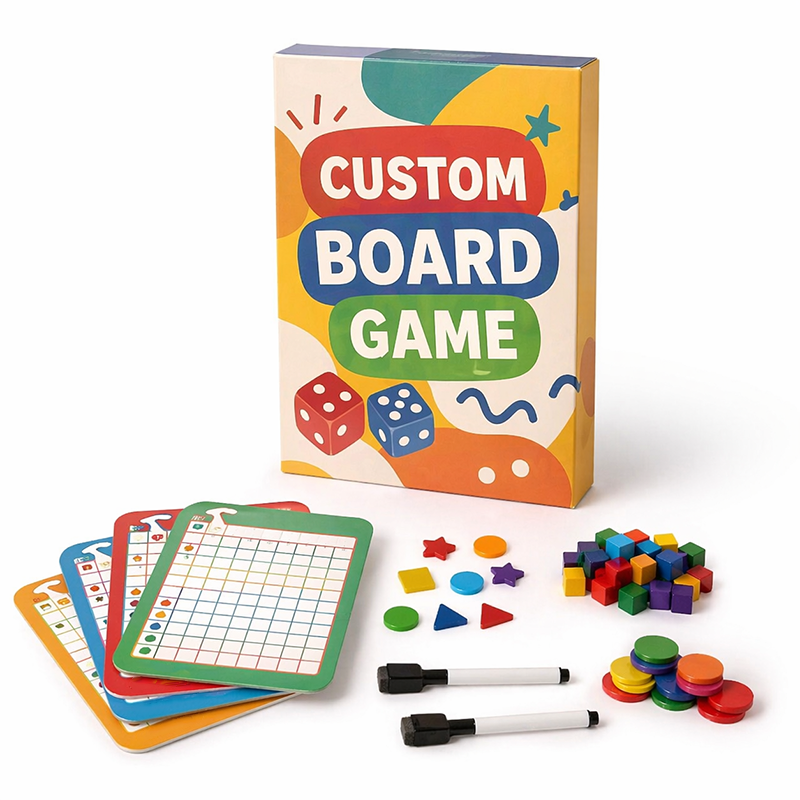
Why the end-use scenario decides the specification
Two board games can be printed on the same press and still be fundamentally different products. The difference is rarely the printing method. It is the handling profile of the person who ends up holding the game.
- Promotion and brand display. The game functions as a keepsake. Visual fidelity on the box, board and components matters more than abrasion resistance, because the object is usually kept, displayed or gifted rather than played daily.
- Family play. The game is opened repeatedly. Laminated surfaces, stable box construction and self-explanatory components become the primary quality signals, because the product is judged by how it holds up after the twentieth session.
- Kids education. Material safety dominates. Edge treatment, ink chemistry and raw-material sourcing move to the top of the specification list, ahead of decorative finishes.
- Packaging for protection and brand display. The box is a physical marketing asset. Box thickness, print registration and surface finish determine whether the product still looks presentable after warehouse stacking and e-commerce delivery.
The commercial backdrop explains why buyers are paying more attention to this distinction. Fortune Business Insights reports that North America held the largest regional share of the board games market in 2024, at approximately 42.06%, valued at USD 6.66 billion. Online and e-commerce channels are also expanding: industry research cited by Fortune Business Insights projects 11.53% CAGR for online board game sales, with 65% of global sales already occurring through online platforms in some regions. When a large share of purchases happens without the buyer physically opening the box first, the printed surface and the packaging structure carry more of the purchase decision than they did in a purely retail-shelf environment.
What a BG-001 custom board game project actually contains
BG-001 is a custom board game belonging to the board game category, intended for the printing, game, toys and manufacturing industries. It supports family, strategy and classic game types and is suitable for both kids and adults. Because the platform is built around buyer-supplied artwork and dimensions rather than a fixed catalogue title, the specification is agreed per order. The core ranges are consistent, however.
| Specification | BG-001 range |
|---|---|
| Model | BG-001 (custom board game) |
| Paper weight | 128–400 gsm / custom |
| Box thickness | 1.5–3 mm / custom |
| Printing process | CMYK offset printing |
| Surface finish | Matte lamination / glossy lamination / UV coating / embossing / debossing / custom |
| Size | Customized dimensions supported |
| Material | Art paper, custom |
| Other formats on the same platform | Card game, puzzle, notebook, color box |
| Applicable industries | Printing, game, toys, manufacturing |
The process behind the specification
Print quality and finish are not abstract promises; they are the output of specific equipment. The production environment for this product family includes a Heidelberg printing press, an automatic laminating machine, a varnishing machine, a gliding press, an embosser and a die cutting machine. In practical terms, offset printing fixes colour consistency across a run, lamination and varnishing determine how the surface behaves under handling, die cutting defines the board and component shapes, and embossing or debossing adds a tactile brand element that survives on the box long after the printed image has been seen once.
The operating environment matters as much as the machine list. These projects run under normal temperature and dust-free indoor workshop conditions, which is a basic precondition for clean offset output and for avoiding surface contamination between lamination and packing. Application scenarios of this type are typically based in Vietnam and China, and products from this manufacturing base are exported internationally.
Mass customized printing plus manual interactive play
The operation mode of this product family has two halves, and both affect planning. The first half is mass customized printing production: every order is printed to the buyer's artwork, dimensions and finish rather than taken from stock, but it is produced at industrial volume. The second half is manual interactive play: boards, tiles, tokens, cards and instructions are handled and assembled by hand before packing. That second half is the reason component count — not print volume — usually drives labour time on a custom board game order, and it is also the reason a game with many small pieces requires a different production discussion than a simple roll-and-move board.
Application 1: enterprise promotion and brand display
In a promotional context, a custom board game performs a function that printed collateral cannot: it occupies space in someone's home or office instead of being filed away. That changes what the buyer should specify. Corporate colour accuracy, logo treatment on the box, and a finish that reads as considered rather than disposable are the priority. UV coating and lamination are the usual choices when the object is meant to look sharp in photographs and on a desk; embossing or debossing is used when the brand mark needs to be perceptible by touch as well as by sight.
BG-001 supports this use directly. Because dimensions are customized and the box format is part of the same production platform, a promotional edition can be sized to a specific gift, mailer or event format rather than forced into a standard box. The same platform also produces card game, puzzle, notebook and color box formats, which allows a single campaign to be delivered as a coordinated set of printed objects without splitting the order across unrelated suppliers.
Application 2: family play and shared interaction
Family use is the scenario where durability and clarity matter most. BG-001 supports family, strategy and classic game types and is suitable for both kids and adults, which means one product has to satisfy two very different players at the same table. In practice, buyers designing for family board games and family game night formats tend to specify heavier paper within the 128–400 gsm range, laminated surfaces that resist repeated folding and handling, and rules presentation that a first-time player can follow without assistance.
The category also includes the familiar formats that dominate household collections — sequence-style tile games, letter-tile word games, ludo-style race games, strategy board games and classic board games. For manufacturers, the relevant point is not the individual title but the shared physical demand: repeated set-up, repeated packing, and components that will be handled by children. Adult-oriented variants, including board games for adults and adult games designed for social settings, tend to trade some durability tolerance for stronger visual and tactile design, which shifts the finish specification toward heavier lamination and specialty coatings.
Application 3: kids education and child-safe production
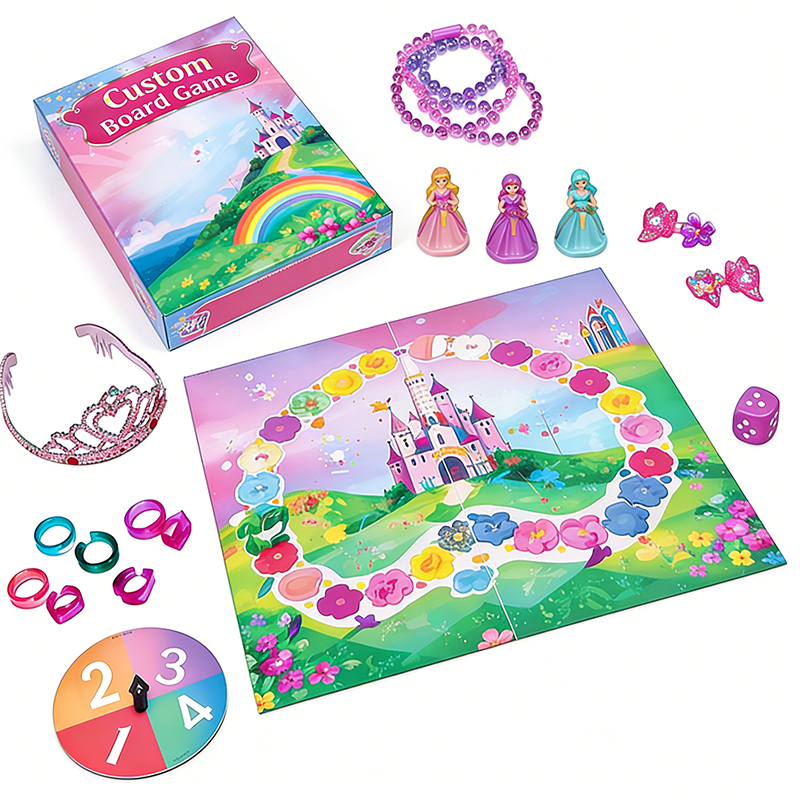
Education is the application where the specification is least negotiable. A game used in a classroom or a learning programme is handled by many children, often without supervision, and it is assessed by parents and institutions on safety first. Four requirements drive this scenario for the BG-001 platform: eco-friendly paper material, non-toxic ink, child-safe edge treatment, and FSC-compliant raw materials.
Each of those four requirements affects a different production step. Eco-friendly paper selection constrains which grades are usable within the 128–400 gsm range. Non-toxic ink affects the printing decision itself, since the ink chemistry has to be compatible with both the paper stock and the intended end market. Child-safe edge treatment addresses die-cut components and board edges, which is a finishing concern rather than a printing one — it is the reason die cutting and edge handling are specified together rather than separately. FSC-compliant raw materials address the sourcing question, which buyers in Europe and North America increasingly ask about during supplier qualification.
The regulatory frame is regional. Board games sold in the EU must comply with the Toy Safety Directive 2009/48/EC and the harmonized EN 71 standards — for example EN 71-1 for mechanical properties and EN 71-13 for olfactory games. In the United States, board games for children under 14 must meet ASTM F963-23 safety requirements, which are mandatory under 16 CFR part 1250. These are product-level requirements, and they sit alongside — not on top of — the factory-level credentials described below.
Application 4: packaging for product protection and brand display
In retail and e-commerce distribution, the box is doing two jobs at once. It has to protect the board, tokens and cards from compression and moisture during transport, and it has to present the product on a shelf or in a product photograph. Box thickness of 1.5–3 mm and the choice between matte lamination, glossy lamination and UV coating are the two specification levers that most directly control that outcome. Matte finishes tend to read as premium and hide fingerprints; glossy finishes and UV coating produce higher contrast in photographs, which matters when a significant share of sales happens online.
Custom dimensions are equally practical here. When a box is built to a buyer's own size rather than a standard one, the pack can be designed around the components instead of forcing the components to fit a generic box — which reduces empty volume, improves the unboxing experience, and keeps the printed brand surface proportionate to the product.
Certification evidence and what it does and does not cover
For buyers sourcing from Asia for US, European and Asian markets, four credentials are commonly requested: ISO 9001:2015, SMETA, amfori BSCI and FSC. They answer different questions, and treating them as interchangeable is one of the more common sourcing mistakes.
| Credential | What it addresses | What it does not replace |
|---|---|---|
| ISO 9001:2015 | Quality management system: documented process control, consistency and corrective action | Product-level safety testing for a specific market |
| SMETA | Supplier ethical audit covering labour practices, working conditions and related social criteria | Material composition or print quality verification |
| amfori BSCI | Social compliance assessment of the supply chain, used widely by European buyers | National product conformity or customs documentation |
| FSC | Responsible sourcing of forest-based raw materials such as paper and board | Ink chemistry, edge safety or finished-product testing |
The practical reading is straightforward. These four credentials support factory qualification and supply-chain due diligence, which is why they are relevant for export into Europe and North America, where Yawanhong directs its export business. They are system-level and sourcing-level evidence. They do not, on their own, certify that a finished board game complies with EN 71 in the EU or ASTM F963-23 in the United States, because those are product-level requirements applied to the specific item in the specific market.
Where custom board games are not the right answer
A credible application guide has to state the boundaries as clearly as the benefits. Custom board games are not the optimal format in every case.
- Manual assembly sets a floor on labour time. Because the interactive play components are handled manually, a game with many small tokens and cards takes more production time than a simple board, and that ratio does not improve much with print volume.
- Custom dimensions and special finishes add process steps. Embossing, debossing and bespoke box sizes are additional operations rather than variations of the same operation. External B2B reporting places standard custom board game lead times in the region of 30–45 days for one-stop supply orders, but that figure should be treated as an industry reference point requiring verification against the specific project, since tooling and component count can extend it.
- Factory certification is not product certification. ISO 9001:2015, SMETA, amfori BSCI and FSC do not satisfy EN 71 or ASTM F963-23. Buyers targeting children's markets still need product-level conformity work, and planning should budget for it.
- Format fit matters. For a very small one-off quantity, or for an audience that will never physically open a box, digital outreach or simpler printed collateral may deliver the objective with less production planning. A custom board game earns its cost when the object is meant to be kept, handled and displayed.
Custom board games compared with traditional promotional and play formats
The comparison below is deliberately format-level rather than brand-level, because the decision a buyer faces is usually about format fit before it is about supplier choice.
| Dimension | Custom board game (BG-001) | Off-the-shelf published game | Digital-only promotion | Printed brochure or catalogue |
|---|---|---|---|---|
| Brand presence on the object | Full — box, board and components printed to buyer artwork | Limited, typically to a sleeve or sticker | Interface only, often transient | Full on the cover, but single-use |
| Requires active participation | Yes — manual interactive play | Yes | Variable, often low | No |
| Physical retention in the home or office | High | High | Low | Low |
| Customization of dimensions and finish | Custom size, 1.5–3 mm box thickness, lamination, UV, embossing, debossing | None | Not applicable | Page size and cover finish only |
| Material safety workload | Required for children's markets — eco-friendly paper, non-toxic ink, child-safe edges, FSC materials, plus EN 71 / ASTM F963-23 testing | Depends on the publisher; buyer has little control | Minimal | Minimal |
| Production planning | Longer: custom tooling, manual component assembly; industry reference 30–45 days (verify per project) | Shortest — available from stock | Fastest | Short |
| Best fit | Keepsake promotion, family play, education, retail packaging | Fast volume gifting with no brand control need | Reach and measurement | Information distribution |
Market outlook for scenario-driven board game production
Three directional signals are worth tracking for planning purposes. First, category growth is projected rather than flat: a 10.38% CAGR from 2025 to 2032 would take the market to an estimated USD 31.58 billion, and much of that expansion is expected in the custom and licensed segments where brand owners, not publishers, commission the product. Second, channel mix is shifting online, with online board game sales projected at 11.53% CAGR; a product whose box photographs well and survives delivery is better positioned than one designed purely for shelf presence. Third, compliance expectations are tightening in the two largest demand regions — North America, which held approximately 42.06% of 2024 demand, and Europe, where the Toy Safety Directive and EN 71 framework already apply.
Taken together, these signals point to a simple expectation: buyers will increasingly select manufacturers on the basis of documented process credentials, material sourcing and scenario-specific production capability, rather than on unit price alone. A supplier able to produce a promotional edition and a certified children's edition on the same platform — with the same paper weight, box thickness and finish options, but a different safety specification — reduces the number of separate qualification processes a brand has to run.
Frequently asked questions
What is a custom board game, and how does it differ from a published game?
A custom board game is a board game produced to a buyer's own artwork, dimensions and finish specification instead of being picked from a publisher's catalogue. Model BG-001 belongs to the board game category and is intended for the printing, game, toys and manufacturing industries. It supports family, strategy and classic game types and is suitable for both kids and adults, and it can also be produced as a card game, puzzle, notebook or color box on the same platform.
Which applications can a custom board game realistically support?
Four downstream applications are well established: enterprise promotion and brand display, family play and interaction, kids education, and packaging for product protection and brand display. The correct specification depends on which of these applies, because a promotional keepsake, a household game and a classroom learning tool place different demands on durability, finish and material safety even when they share the same printing process.
What printing and material specifications are used in custom board game production?
The BG-001 platform uses a paper weight range of 128–400 gsm, box thickness of 1.5–3 mm, CMYK offset printing, and surface finishes that include matte lamination, glossy lamination, UV coating, embossing and debossing, with dimensions and material (art paper as an option) customizable per order. Production equipment includes a Heidelberg printing press, an automatic laminating machine, a varnishing machine, a gliding press, an embosser and a die cutting machine, operating in normal temperature and dust-free indoor workshop conditions.
How do ISO 9001:2015, SMETA, amfori BSCI and FSC relate to selling into the USA and Europe?
These four credentials support supplier qualification: ISO 9001:2015 covers quality management systems, SMETA and amfori BSCI cover social and ethical supply-chain assessment, and FSC covers responsible sourcing of forest-based raw materials. They are relevant to buyers sourcing for US and European markets. They do not replace product-level conformity, since EU board games for children must comply with Toy Safety Directive 2009/48/EC and harmonized EN 71 standards, and US board games for children under 14 must meet ASTM F963-23 under 16 CFR part 1250.
What are the limitations of a custom board game project?
Three limitations matter most. Component assembly is manual, so games with many small pieces take longer to produce than simple boards. Custom dimensions, embossing, debossing and specialty finishes are additional process steps; external B2B reporting cites standard lead times of roughly 30–45 days with one-stop supply, which should be verified per project. And factory certifications do not certify the finished product — children's markets still require product-level testing against the applicable regional standard.