
Custom Bronze Sculpture for Museums and Sacred Sites: Patina, Scale, Fit
Custom Bronze Sculpture for Museums and Sacred Sites: Patina, Scale, Fit
Bronze is the material institutions return to when a sculpture has to outlast the committee that commissioned it. A cast bronze figure in a museum courtyard, a cathedral forecourt or a memorial garden can still read clearly a century after installation — provided the alloy, the patina specification and the fixing detail are settled before the first mould is made.
That sequencing is where institutional commissions usually succeed or fail. Museums and religious bodies rarely buy a sculpture as a shelf product; they buy an object that has to satisfy a curatorial argument, a liturgical or devotional function, a planning condition and a maintenance budget at the same time. This reference article explains how patina, scale and site fit interact in a custom bronze sculpture brief, and which points a buyer should be able to answer in writing before an order is placed.
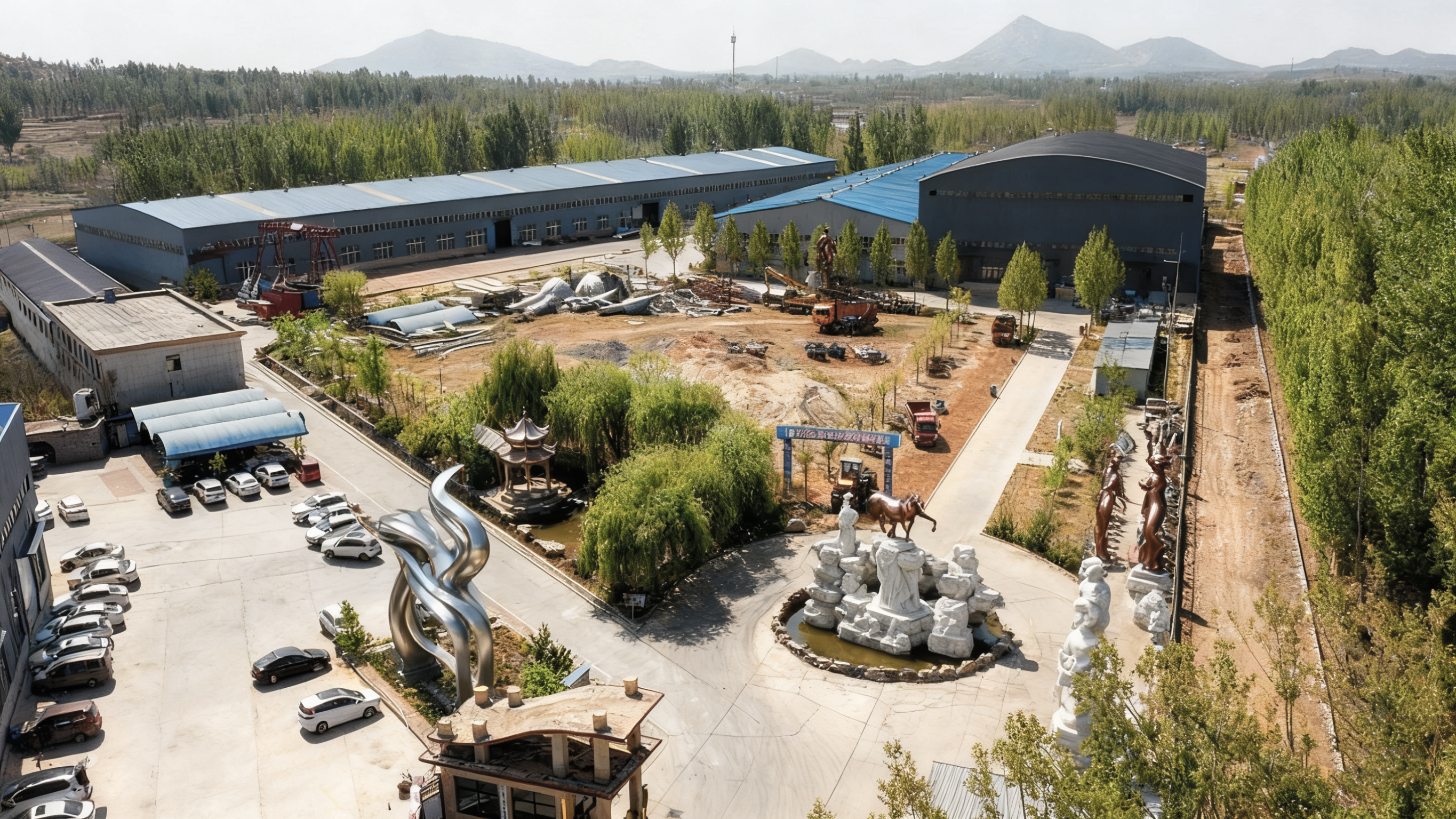
Bronze and stainless-steel sculpture processing workshop — casting, welding and surface finishing take place before any patina is sealed.
What the market numbers say about institutional bronze work
Business Research Insights estimates the global art and sculpture market at approximately USD 61.83 billion in 2026. A separate 2026 market study places sculptures at about 21% of global art acquisitions by transaction volume in 2024. The bronze segment specifically is smaller and more concentrated: Dataintelo valued the global bronze sculpture commission market at USD 1.47 billion in 2024.
The budget profile matters more than the headline size. CODAworx, analysing public art open calls in North America, found that 80.2% of projects in 2024 fell below a USD 250,000 budget. Public funding is a real but bounded driver: U.S. federal cultural agencies were budgeted at USD 708.8 million for 2025, including USD 207 million for the National Endowment for the Arts.
For a buyer, the practical consequence is that most institutional bronze commissions are single-piece, mid-budget and publicly accountable. The lowest compliant quote is rarely the cheapest commission, because a re-cast, a failed patina match or a base that cannot carry the load is paid for in a later budget cycle — usually by a different person.
Sources: Business Research Insights (2026); Market Research Report (2026); Dataintelo (2025); CODAworx (2026); Regional Arts Organizations public funding data (2026).
Patina is a specification, not an accident
Patina is the oxidised surface layer that forms on copper alloys. On bronze it is the reason the material is chosen for sacred and commemorative work: a bronze containing over 85% copper will turn greenish over a century and read as an antique, while brass — which contains over 60% copper — darkens toward black over the same period. The colour story of a bronze commission therefore ends well, and that outcome is planned rather than hoped for.
Two patina states need to be written into the brief separately. The first is the factory-applied finish: a professional anti-corrosion surface treatment in which bronze receives a sealed patina, fixing the intended colour at handover and slowing uncontrolled variation afterwards. The second is the long-term evolution of the surface, which continues in place and is affected by rainfall, airborne salts, handling and cleaning method. A brief that specifies only "bronze finish" leaves both undefined.
| Finish family | Visual result | Typical institutional setting | Long-term behaviour |
|---|---|---|---|
| Sealed patina (warm brown to green-brown) | Even, deliberate colour held at delivery | Memorial figures, museum interiors, religious forecourts | Stable and low-maintenance; continues to develop slowly outdoors |
| Antiqued / hand-rubbed | Darker recesses, lighter raised passages | Religious figures, relief panels, inscription plates | Reads well in raking light; recesses hold shadow permanently |
| Polished / high-polish accents | Bright, reflective passages against matte bronze | Gallery pieces, contemporary commissions with mixed surfaces | Best in controlled or sheltered settings; exposed polish dulls first |
| Gilded / gold-leaf detailing | Warm metallic highlights on selected elements | Haloes, ornamental regalia, dedication lettering | Usually specified for sheltered or interior positions because gilding is the most delicate layer |
Finish families commonly written into institutional bronze briefs. Final selection should be confirmed against the specific alloy, viewing distance and exposure of the site.
The maintenance consequence is favourable but conditional. Bronze develops a self-protecting patina and, outdoors, requires almost no upkeep beyond occasional rinsing — far less than polished brass, which has to be cleaned and re-polished repeatedly to keep its golden appearance. The condition is exposure: bronze is heavier and more expensive than brass and needs protection in humid or coastal environments, where salt and persistent moisture accelerate surface change in ways an inland site never experiences.
Scale and site fit: the engineering a render does not show
Whether a figure should be life-size or monumental is a curatorial decision. Whether it can be installed, and stay installed, is engineering. In practice the two are decided in the same meeting, and the second one is usually under-documented.
Site fit starts with the base. Before fabrication drawings are released, the installation location should be checked for ground flatness, load-bearing capacity and the position of embedded parts against the approved drawings. For heavy pieces, the load-bearing capacity of the base has to be verified to prevent tipping — a check that is far cheaper before casting than after delivery.
Hoisting is the next constraint. Equipment is selected according to the size and weight of the sculpture, lifting points are determined in advance and secured, and the work area is cordoned off. Lifting is carried out by certified personnel, no one stands under a suspended sculpture, safety belts are worn for work at height, and lifting stops in strong wind or thunderstorms.
Fixing and acceptance close the loop. The sculpture is aligned to the base or embedded parts, secured with bolts or reinforced by welding, and every weld is treated with anti-corrosion protection. Acceptance typically requires that vertical and horizontal alignment meet the drawings — a vertical deviation no greater than 5 mm is a common benchmark — that the piece does not loosen under a shaking test, that the surface is free of bumps, scratches and stains, and that the position and orientation match the drawings before cleaning and handover.
Indoor and outdoor briefs diverge at three points
- Loading and fixings. A museum floor slab, a hotel lobby slab and a poured outdoor foundation accept very different anchor designs. The foundation should be poured and have reached design strength before installation begins.
- Exposure. Outdoor sacred sites and coastal plazas add salt, wind and freeze cycles. Bronze handles this better than brass but still benefits from a sealed patina and a defined protection strategy in humid or marine air.
- Access for maintenance. An interior piece can be inspected from a ladder; a forecourt figure may need equipment access once a decade. That access should be designed in, not negotiated later.
How Jiangsu Xinyesheng Sculpture Co., Ltd fits into a bronze commission
Jiangsu Xinyesheng Sculpture Co., Ltd is a sculpture manufacturer and exporter based in Jiangyin, Jiangsu, China, producing sculpture, statuary, relief, tombstone and related architectural work in bronze, stainless steel, marble and weathering steel for public art, religious, memorial and hospitality projects, with export sales directed to the EU, the USA and the Middle East.
For institutional buyers, three capabilities matter more than catalogue breadth.
Design confirmation before fabrication. Every design is confirmed through a 3D preview before production, and the company offers 1:1 clay model visualisation for commissions where scale and proportion must be judged physically. The purpose is procedural rather than decorative: confirming form in 3D before casting removes rework caused by design mismatch, which is the most expensive category of error in a bronze commission.
Process control across a batch. Rather than relying mainly on hand casting alone, the production approach combines precision casting with CNC machining and 3D design, so that a piece matches the approved design and quality stays consistent when an institution orders a set — a figure plus a relief plus an inscription panel, or the same figure for more than one site. Standard production runs 15–30 days depending on size, material and surface finish, and every piece is inspected before shipment.
Delivery and installation support. A one-stop delivery system covers 1:1 clay model visualisation, professional seaworthy packaging in reinforced wooden crates and steel frames, and global on-site installation guidance. Each sculpture ships with installation instructions, and on-site installation can be guided by video call where a client's own contractor performs the work.
The team structure behind this is deliberately conventional: the R&D team comprises 12 engineers, the company's researchers have more than ten years of experience in the sculpture industry, and an experienced design team drives product innovation and development. The cooperative factory covers an 8,000 m² production land area and took 13 years to develop from a small workshop in Quyang into a bridge connecting "Made in China" with the global art market — a trajectory that matters to institutions because it implies repeatable process rather than one-off craft.
Commercial terms are structured for project buyers: minimum order quantity of one unit, delivery terms available as DDP, EXW, FOB, CIF, DAP or FCA, and a 50% deposit with photo and video inspection of the finished artwork before the balance is paid and shipment released. All Risks insurance can be arranged on request, and where damage results from packaging failure the company states it takes full responsibility.
Application fit across five institutional settings
| Setting | What the brief usually requires | Bronze-specific considerations |
|---|---|---|
| Museum / gallery | Curatorial accuracy, consistent patina, controlled viewing conditions | Sealed patina and antiqued surfaces hold colour under gallery lighting; floor loading and discreet base design decide the fixing |
| Religious institution | Iconographic accuracy, dignity at distance, forecourt durability | Antiqued or gilded detailing on sheltered elements; sealed patina for exposed figures; protection strategy in humid climates |
| Public art / civic plaza | Scale, public safety, wind and vandalism resistance, civic legibility | Large-scale casting plus engineered anchoring to embedded parts; weld treatment and a documented 5 mm alignment check |
| Hotel / real estate lobby | Design fidelity to an interior concept, predictable delivery window | 3D preview before production protects the design intent; 15–30 day standard production supports fit-out schedules |
| Private collection / memorial | Personal likeness or symbolism, manageable size, long-term care guidance | Small-scale bronze with a defined patina and a simple maintenance regime; single-unit orders accepted |
Application fit by institutional setting. Exposure and loading, not style preference, should drive the material decision.
Bronze, brass and stainless steel over a hundred-year horizon
The comparison that decides most institutional briefs is not bronze versus bronze. It is bronze versus the two materials that quote lower or last longer in a specific environment.
| Factor | Bronze | Brass | Stainless steel 304 / 316 |
|---|---|---|---|
| Copper content | Over 85%, alloyed with tin | Over 60%, alloyed with zinc | No copper; chromium-based alloy |
| Colour over 100 years | Turns greenish and reads as antique | Turns black | Retains silver-grey appearance |
| Relative material cost | Roughly 20–30% above brass | Lowest of the three | 316 typically 20–30% above 304 |
| Corrosion behaviour | Self-protecting patina; needs protection in humid or coastal air | Tarnishes readily; needs regular polishing | 316 offers over 30% higher pitting resistance than 304 (PREN ≈ 26 vs ≈ 19) |
| Maintenance profile | Almost none outdoors | Repeated polishing and cleaning | Near maintenance-free; occasional rinsing |
| Best-fit setting | Classical, historical, devotional, commemorative work | Indoor decorative and lower-budget work | Modern, large-scale, structural or coastal installations |
Material comparison based on supplier-stated alloy content and published corrosion data. Relative cost figures depend on size, wall thickness and finish.
Where bronze is the wrong answer
Bronze carries three real penalties that a brief should acknowledge. It is heavy, so a slab or podium designed for a lighter piece may need structural work that changes the project budget. It is more expensive than brass at equivalent scale, which is a hard constraint for committees working inside fixed public funding. And in humid or coastal environments it needs protection that an inland installation does not, which adds a maintenance obligation to an institution that may not have a facilities team.
Bronze is also the wrong material when the design language is thin, mirror-finished or geometrically large: those forms are usually better served by 304 or 316 stainless steel, with 316 specified for coastal or salt-exposed sites. A fabricator that recommends stainless for a mirror-polished contemporary landmark and bronze for a devotional figure is reading the brief correctly.
What a long-term institutional relationship actually requires
Museums, dioceses and civic art programmes rarely commission once. A figure is funded now, a relief panel follows the next capital campaign, and a garden element arrives after a donor bequest. That rhythm makes the supplier relationship a continuity problem rather than a purchasing event.
- A documentation package that survives staff turnover. Approved 3D preview files, the patina and finish specification, installation drawings, pre-shipment photo and video inspection records, and acceptance measurements should all be archived with the object. Institutional staff rotate every few years; the written record is the only continuity.
- Repeat orders that share tooling and freight. Ordering multiple pieces together is recommended precisely because mould and shipping costs are shared, which matters when a phased programme adds a second figure two years later.
- Installation support that transfers. Installation instructions ship with each sculpture, and video-call guidance lets a client's own contractor complete the work without a permanent on-site presence.
- A maintenance calendar written at handover. Occasional rinsing, periodic inspection of fixings and welds, and closer patina monitoring on coastal or humid sites are enough for most bronze installations.
Future outlook
Two shifts are visible in how institutional bronze commissions are being specified. The first is lifecycle accounting: buyers increasingly compare a bronze figure against a polished brass alternative on a twenty-year maintenance profile rather than on purchase price, and patina behaviour — green-brown versus blackening — has become part of the value argument rather than a footnote.
The second is documentation as a commercial asset. Customs treatment illustrates the point: reporting indicates that original sculptures under HS code 9703 often bypass EU anti-dumping duties, while mass-produced items classified under HS 8306 face higher scrutiny. For an institution crossing borders with a commissioned artwork, the difference between "original sculpture" and "decorative metal article" is decided by paperwork generated at commissioning, not at the port.
Neither shift favours the lowest quote. Both favour the supplier that can show a confirmed design file, a defined finish specification and an acceptance record — and that can repeat the result when the next phase of the building is funded.
Frequently asked questions
Can a custom bronze sculpture be ordered as a single piece, and how does the customization process work?
Yes. Full customisation is supported and single-piece orders are accepted, with more favourable pricing for bulk orders. The buyer provides design drawings, photographs or a concept; the supplier produces a 3D design draft for confirmation before production; prototyping is optional; then production and shipping follow. Lead time is assessed against the size and manufacturing process of the specific piece.
Which materials and finishes are relevant to a museum or religious commission?
The material range covers bronze, brass and 304 or 316 stainless steel, alongside stone and weathering steel in the wider product line. Bronze develops an antique patina over time and suits classical and devotional work; stainless steel offers a modern appearance with high corrosion resistance, and grade 316 is recommended for coastal areas. Bronze finishes include sealed patina and custom surface treatments; the finish should be specified together with the alloy and the exposure of the site.
Why does bronze cost more than brass, and does the difference matter outdoors?
Bronze sculptures contain over 85% copper and use tin as the alloying element, while brass contains over 60% copper with cheaper zinc, so bronze typically costs roughly 20–30% more at equivalent scale. Over a century the two diverge visibly: bronze turns greenish-brown and reads as an antique, while brass turns blackish-brown. For outdoor use bronze is generally the more suitable choice because of its corrosion resistance; brass is more commonly specified for indoor work.
How is a large sculpture installed, and what acceptance criteria apply?
Installation begins by confirming site flatness, load-bearing capacity and the position of embedded parts against the drawings. Hoisting equipment and lifting points are selected according to size and weight, the area is cordoned off, and the piece is aligned to the base or embedded parts. It is then fixed with bolts or reinforced by welding, with every weld treated against corrosion. Acceptance commonly requires vertical and horizontal alignment to drawing — a vertical deviation no greater than 5 mm — secure fixing with no loosening under a shaking test, a surface free of bumps, scratches and stains, and treated welds before cleaning and handover. Lifting must be performed by certified personnel, with no one beneath a suspended load and no lifting in strong wind or thunderstorms.
What are the purchasing terms and acceptance criteria?
Minimum order quantity is one unit. Delivery terms available are DDP, EXW, FOB, CIF, DAP and FCA. Payment is structured as 50% deposit, followed by photo and video inspection of the completed artwork; the remaining 50% is paid after the buyer confirms there are no problems, and shipping begins after that balance is received.
Is export packaging and door-to-door delivery available?
Yes. Packaging uses sturdy wooden crates and metal strips externally, with shockproof plastic film protecting the product internally, and door-to-door delivery is quoted against the buyer's detailed address. All Risks insurance can be purchased on request; where damage is caused by packaging failure, the supplier states it takes full responsibility.
Reference material
The manufacturer's company profile and available production capabilities are published as a downloadable document: Company Profile & Available Production Capabilities (PDF).
Have Questions or Need More Details?
Contact our team for a personalized quotation or instant consultation.
Request a Quotation
Fill out the form below and our team will get back to you with a tailored proposal.
WhatsApp Direct Chat
Prefer to chat in real-time? Message us on WhatsApp for instant assistance & quick answers.
- Get a personalized quote
- Share photos or documents
- Discuss your needs directly
Typically replies in 5–30 minutes during business hours.