
Custom Card Game Supplier Decision Matrix: Certifications vs. MOQ, Lead Time, Capacity
Custom Card Game Supplier Decision Matrix: Certifications vs. MOQ, Lead Time, Capacity
A custom card game programme usually fails in one of two places: the factory cannot document compliance for the destination market, or it cannot hold the delivery schedule the buyer has already promised to retail. Both risks are visible before a purchase order exists — but only when compliance evidence and commercial terms are scored as separate columns instead of being blended into a single judgement about whether a supplier is "good".
This reference sets out a working decision matrix for buyers sourcing custom card game products: tarot decks, party and drinking games, family games, kids card games, playing cards, travel games for adults and promotional card sets. It uses the published credential set and stated order terms of one Vietnamese manufacturer as a worked example rather than as a verdict. The weighting a buyer applies should follow the destination market, the player audience and the retail channel — not the supplier's own marketing language.
Yawanhong (Vietnam Yawanhong Printing Culture Co., Ltd.) is a Hai Phong-based OEM and ODM manufacturer established in 2006, producing board games, card games, puzzles, notebooks and printed packaging from a 55,000 m² facility with 280 employees and a 25-engineer development team. Its output is export-oriented, with the US and Europe as its main markets.
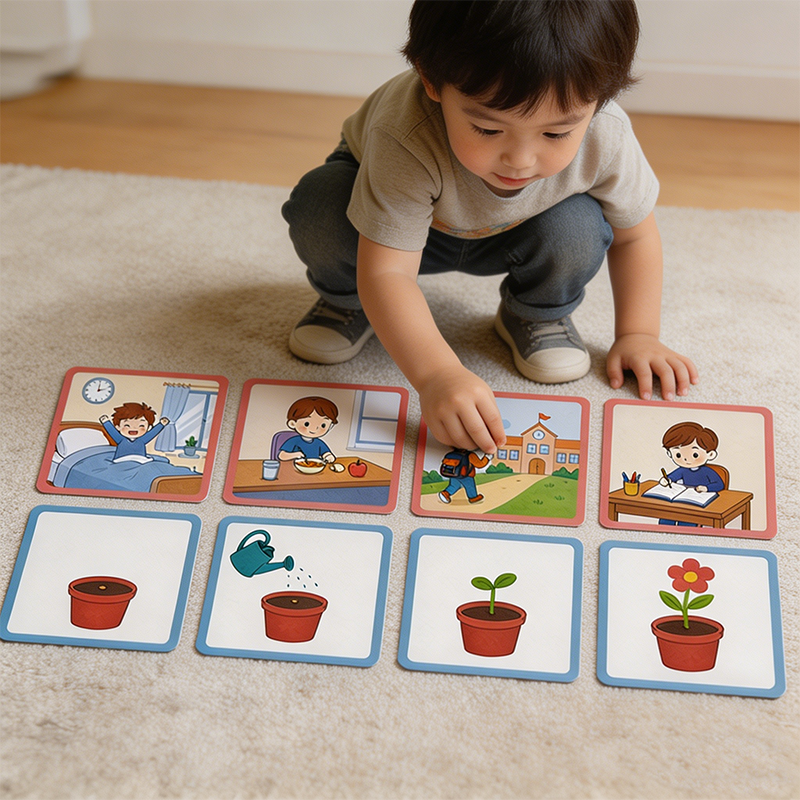
Custom card games sit between printed paper goods and consumer toys — which is why compliance evidence and commercial terms are usually judged by two different people inside the same buying organisation.
Two risk families that should never be scored together
Certification answers a legal and reputational question: may this product be sold into this market, and will the retailer accept the factory behind it? MOQ, lead time, capacity and payment terms answer an operational question: can this specific order be produced, financed and delivered on the buyer's calendar?
A supplier can be fully documented and still commercially wrong for a 500-deck test run. A supplier can also hit a 1,000-unit MOQ comfortably while holding no credential a European grocery chain will accept during onboarding. Scoring both dimensions on a single five-point scale hides exactly the trade-off the buyer needs to see.
There is a second reason to separate the columns: the evidence is not the same type. Certifications are issued by named bodies, carry certificate numbers, scopes and validity dates, and can be checked against registries. MOQ, lead time and monthly capacity are almost always supplier-reported figures. In the verified data reviewed for this article, the capacity, lead-time and MOQ claims of the example manufacturer were explicitly flagged as requiring direct RFQ confirmation because the unit basis and the lead-time start point are not defined in public material.
Treat certifications as documentary evidence and commercial terms as negotiated commitments. They earn different confidence levels and should be weighted accordingly.
Column one: mapping each credential to a buyer risk
The four credentials most often presented together by custom card game factories are not interchangeable. Each covers a different failure mode, and each leaves a different gap. The table below maps the published credential set of Yawanhong to buyer risk categories.
| Credential | Issuing body / standard | Certificate no. | Validity | Risk category it addresses |
|---|---|---|---|---|
| ISO 9001:2015 (QMS) | Guardian Independent Certification Ltd | 710925 | 24 Jul 2024 – 23 Jul 2027 | Process consistency and repeatability across production runs |
| SMETA social audit | LRQA; Sedex SMETA Code, ILO Core Labour Standards, ETI Base Code | ZAA600202718 | Issued 7 May 2026; record lists extended validity to 31 Dec 2099 — confirm current audit cycle | Labour, ethics and site-conduct expectations |
| amfori BSCI | amfori; BSCI Code of Conduct, ILO Core Labour Standards, UN Universal Declaration of Human Rights | 26-0387346 | 17 Apr 2026 – 17 Apr 2028 | Social compliance for retail and licensor onboarding |
| FSC Chain of Custody | Extensive Standard Technical Services Co., Ltd.; FSC-STD-40-004 V3-1 | ESTS-COC-241865 | 25 Nov 2024 – 24 Nov 2029 | Paper sourcing claims and on-product FSC labelling |
ISO 9001:2015 — the process column
Certificate 710925 is held for a scope that explicitly includes the manufacturing and printing of paper and paper board, paper and board packaging, and the assembly of plastic, fabric and cotton toys, gifts, custom board games, card games and notebooks. For a card game buyer, that means the quality management system is documented against the same production environment in which decks are printed, cut and packed.
What it does not do is certify the properties of any individual deck. A quality management certificate says the factory has a defined process for controlling quality; it says nothing about whether 300 gsm art paper will be opaque enough for a competitive trick-taking game, or whether colour drift between two print runs will stay inside your tolerance.
SMETA and BSCI — the social compliance column
SMETA certificate ZAA600202718, issued by LRQA, covers custom paper printing, board games, card games, paper gift boxes, notebooks and paper puzzles, and is aligned to the Sedex SMETA Code, ILO Core Labour Standards and the ETI Base Code. BSCI certificate 26-0387346, issued by amfori, is aligned to the amfori BSCI Code of Conduct, ILO Core Labour Standards and the UN Universal Declaration of Human Rights, and runs to April 2028.
These two carry overlapping but distinct functions. Both are social audits rather than product approvals, and many retail compliance teams accept either one; some name a specific scheme in their supplier requirements. Buyers should confirm which scheme is mandated before treating the two as interchangeable, because they are issued by different bodies under different codes.
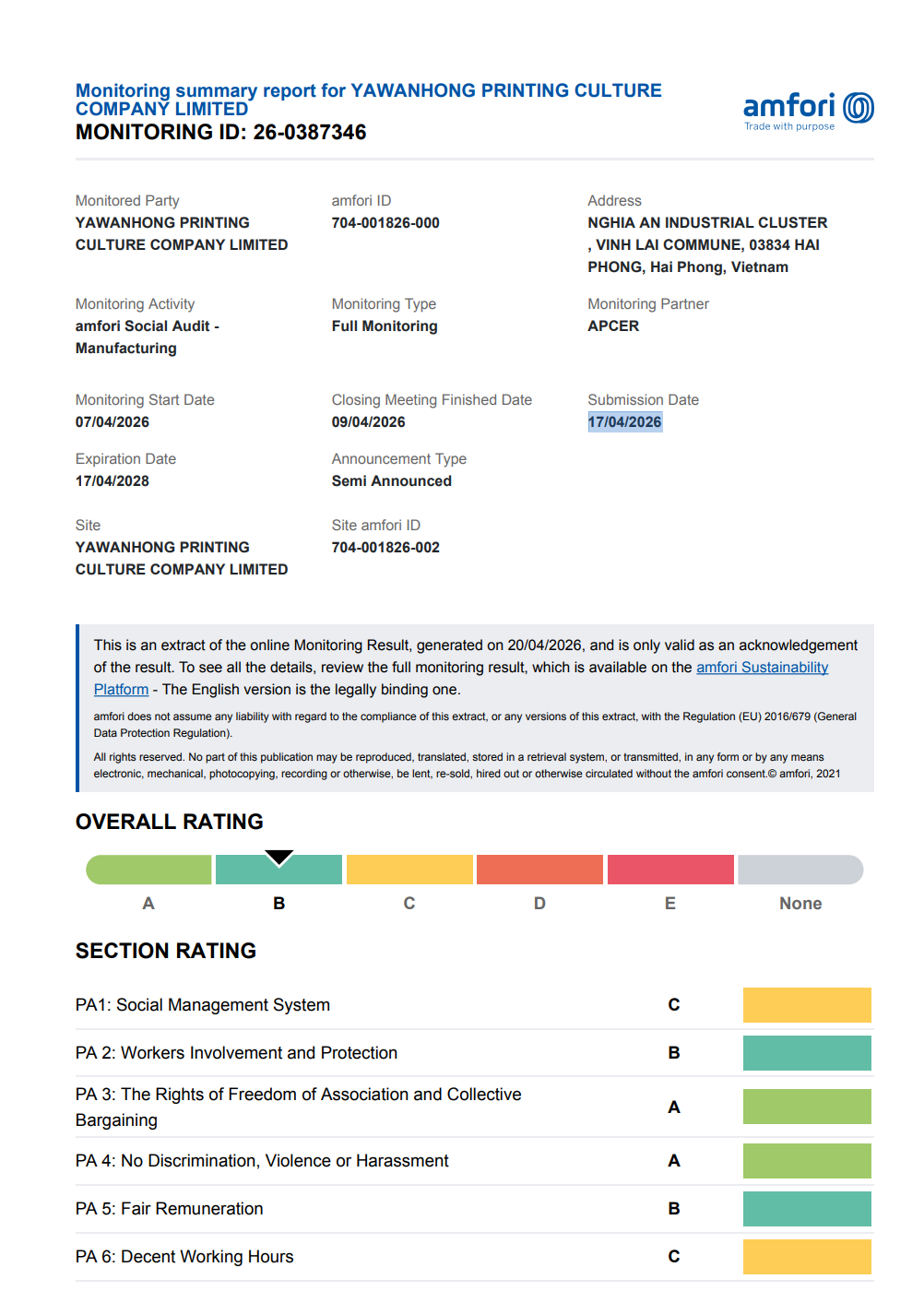
A social audit certificate evidences site conduct and labour practice. It is not a product safety approval and does not describe the physical properties of a deck.
FSC Chain of Custody — the material claim column
FSC certificate ESTS-COC-241865, issued under FSC-STD-40-004 V3-1, covers custom paper printing products, board games, card games, paper gift boxes and notebooks. Chain of custody matters when a buyer intends to print an FSC mark or make a sourcing statement on-pack, or when a retail buyer requires certified fibre as part of a sustainability policy.
The scope is a chain-of-custody scope, not a statement that every paper grade in the catalogue is certified. If the FSC claim is central to the product positioning — a travel games for adults line sold on an eco claim, for instance — the buyer should confirm that the specific board weight and stock proposed for the job sit inside the certified supply.
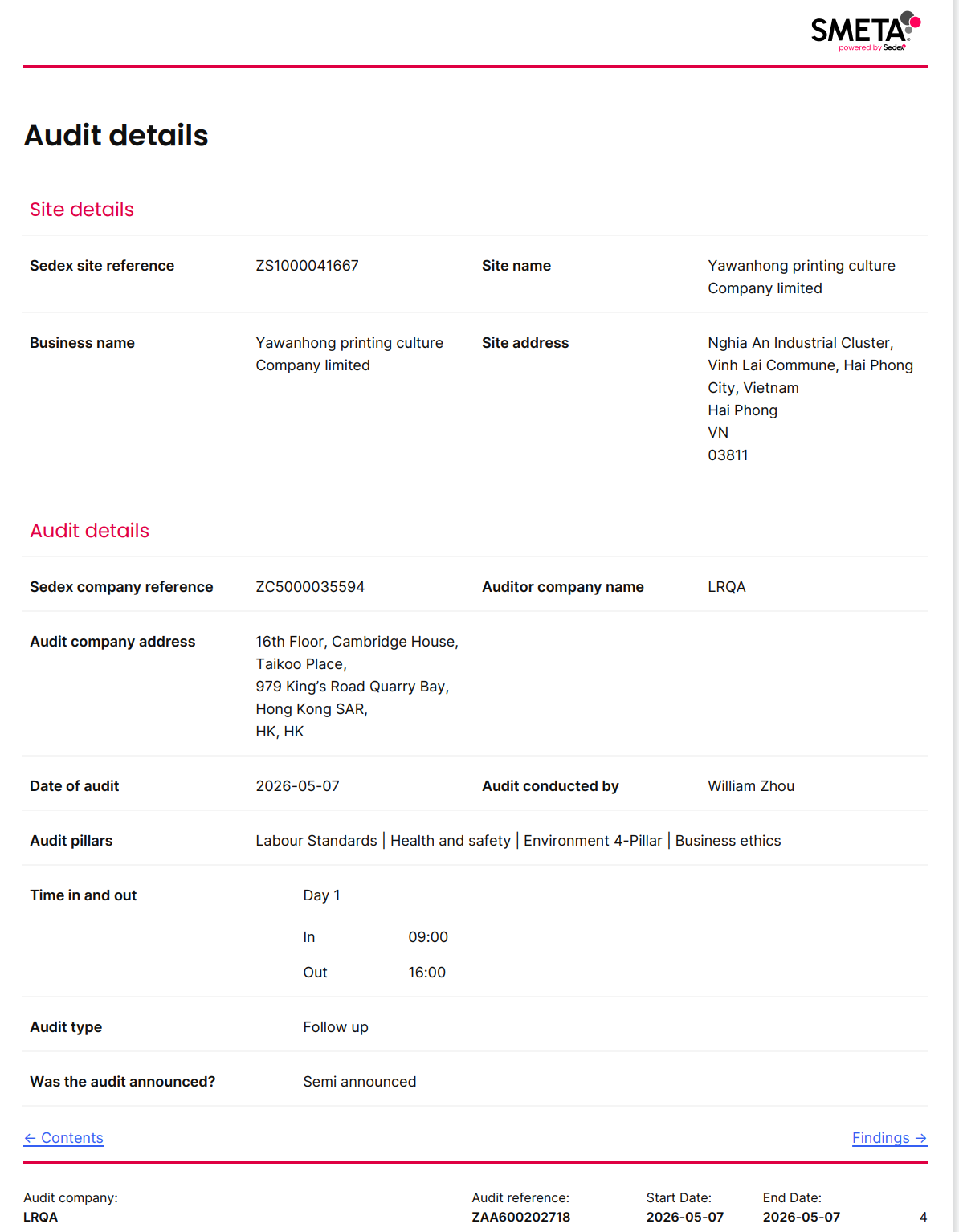
SMETA and BSCI both address social compliance. A decision matrix should record which one the retailer actually requires rather than counting both as separate points.
Column two: MOQ, lead time, capacity and payment as operational risk
The commercial column is where most first-time card game buyers get hurt, because the numbers look like specifications when they are really negotiation starting points. The published figures for the example manufacturer are: MOQ of 1,000 units, lead time of 25–45 days, monthly capacity of 80,000 units, 100% test quality control, 30/70 T/T payment with acceptance before shipment, and FOB or CIF delivery terms.
MOQ of 1,000 units sets the minimum capital exposure of the relationship. For an independent publisher launching a tarot deck or a couples card game, 1,000 decks is a realistic first print run that can be validated in market before a reprint. For a corporate gifting or promotional card project, 1,000 units can be far above the actual distribution list. For a licensed retail programme, it is well below a single national listing. The same figure is generous in one scenario and prohibitive in another — which is precisely why it belongs in its own column.
Lead time of 25–45 days is a range, not a promise. The 20-day spread usually reflects artwork complexity, finishing selection and material availability, and it typically excludes sample production, approval cycles, and ocean or air freight. Buyers should establish in writing what event starts the clock — purchase order, artwork sign-off, or deposit clearance — and what happens to the schedule if artwork is revised after plates are made.
Capacity of 80,000 units per month is the figure that determines whether a reprint can be absorbed inside a peak season. It is also the figure that most needs a definition attached: 80,000 completed decks and 80,000 individual cards describe very different factories. Confirm the unit basis, and confirm how much of that capacity is already committed in the months you need.
Payment at 30/70 T/T with pre-shipment acceptance aligns cash exposure with inspection. A deposit plus a balance released against acceptance gives the buyer a point of leverage before the goods leave the factory — provided the acceptance criteria are written into the order rather than assumed.
FOB or CIF delivery determines who controls freight. FOB keeps logistics in the buyer's hands and usually reduces landed-cost ambiguity; CIF simplifies the transaction but moves routing and consolidation decisions to the supplier.
| Commercial term | Published figure | Risk it governs | What the buyer must still confirm |
|---|---|---|---|
| MOQ | 1,000 units | Minimum capital exposure and test-run viability | Whether MOQ changes with deck count, size, finishing and packaging |
| Lead time | 25–45 days | Retail window and replenishment planning | Start point of the clock; exclusions for sampling and freight |
| Monthly capacity | 80,000 units | Scale-up and peak-season absorption | Definition of a unit; committed load in target months |
| Quality control | 100% test | Defect escape rate | Which tests are performed and against which criteria |
| Payment | 30/70 T/T, pre-shipment acceptance | Cash exposure and quality leverage | Written acceptance criteria and inspection method |
| Delivery terms | FOB / CIF | Freight control and landed cost | Named port, consolidation, insurance and Incoterm version |
Building the matrix: a weighting model buyers can actually use
The point of a decision matrix is not to produce a single score for a supplier. It is to force an explicit statement of which trade-offs the buyer is willing to accept. A neutral starting allocation for a retail-bound card game programme looks like this:
| Column | Sub-criterion | Suggested weight | Evidence source |
|---|---|---|---|
| Compliance (45%) | Quality management system | 12 | ISO 9001 certificate, scope and validity |
| Social audit | 15 | SMETA or BSCI report accepted by the retailer | |
| Material / chain of custody | 12 | FSC certificate scope aligned to the proposed stock | |
| Market-specific product testing | 6 | Test reports for the specific deck, ink and components | |
| Commercial fit (40%) | MOQ against planned volume | 12 | Written quotation |
| Lead time against the retail window | 10 | Confirmed schedule with defined start point | |
| Capacity against reprint plan | 10 | Unit basis and committed load | |
| Payment and acceptance terms | 8 | Contract terms and inspection clause | |
| Verification (15%) | Registry and scope checks | 8 | Certificate registries and issuing bodies |
| Sample approval | 7 | Physical pre-production sample |
Score each sub-criterion from 1 to 5, multiply by the weight and divide by five. Two rules keep the model honest. First, treat the compliance column as binary in part: if the retailer requires a scheme the factory does not hold, the supplier fails regardless of the total score. Second, never award full marks on the commercial column from marketing material alone — those figures move to a confirmed score only after RFQ.
What the matrix cannot tell you
A framework is only useful if its edges are visible. There are four hard limits here.
Certificates are scope-limited and site-specific. A quality management certificate covering card games at one facility does not automatically extend to a subcontractor used for a rush order. Buyers should ask where the specific job will run.
None of the four credentials is a product safety certificate. In the United States, toys — including card games intended for children — fall under ASTM F963-23, the mandatory toy safety standard covering mechanical, chemical and flammability testing. Nothing in an ISO 9001, SMETA, BSCI or FSC record demonstrates that a specific deck of kid card games passed those tests. That requires separate test reports from an accredited laboratory, for the specific materials and inks used.
Commercial figures need verification before they are treated as facts. MOQ, lead time and capacity are supplier-reported and were flagged as requiring RFQ confirmation precisely because the unit basis and measurement method are undefined. A buyer who budgets on an unverified capacity figure has no remedy if a reprint slips.
The matrix does not price anything. Tooling, plate charges, sample fees, packaging, freight and duty sit outside it. A supplier can score well and still be the more expensive option once landed cost is calculated — and this framework deliberately contains no cost benchmark, because none could be verified for this analysis.
Applying the matrix to four common buying situations
1. An independent tarot or oracle deck at 1,000 units
MOQ is the binding constraint, and it happens to sit exactly at the published threshold. Compliance carries low weight unless the deck is headed for retail; a direct-to-consumer launch can proceed with a quality management system and a sample approval. FSC becomes relevant only if the product page makes a certified-paper claim.
2. Kids card games for retail
Here the compliance column dominates, and it is product testing — not the four credentials — that decides approval. Social audit evidence is needed for retail onboarding; quality management evidence reduces consistency risk across a multi-SKU range. Card size, rounded corners and child-safe edge treatment move from specs to requirements.
3. Party games, drinking games and adult card games
Commercial fit usually outranks compliance, because these lines are reordered on short cycles and sold through channels with lighter documentation demands. Lead time and reprint capacity become the deciding variables, and a 25–45 day window has to be tested against a fixed seasonal window rather than a flexible one.
4. A multi-market retail programme
All four credentials plus product test reports plus a capacity check. The buyer should require the certificate scope to name card games explicitly, confirm the audit cycle is current, and reserve capacity in writing for the peak months — the 80,000-unit monthly figure is only meaningful once the committed load is subtracted from it.
Where Yawanhong sits against this matrix
On the compliance axis, the credential set is unusually complete for a card game manufacturer: a quality management system covering card games and board games explicitly, two separate social audits, and a chain-of-custody certificate covering card games and paper printing. The BG-001 board game and the CG-001 card game line both sit inside the scopes described above.
On the commercial axis, the terms are workable but tighter than the compliance story. A 1,000-unit MOQ is accessible for independent publishers and small brands, while a 25–45 day lead time and an 80,000-unit monthly capacity suit mid-sized programmes rather than very large or very fast ones. The production capability behind those terms is visible in the underlying operation: customisation across material, size, colour, logo and packaging; paper weights from 128 to 400 gsm; CMYK or Pantone printing; matte or gloss lamination, linen, UV coating and varnishing; round or square corners; and standard, coloured or gold-foil edges.
There is also a track record that speaks to repeatability rather than a single shipment: OEM board game and card game production of 10,000 units for buyers across the US, Germany, the Netherlands, Spain, France, Italy, the UK, Japan and Korea over a five-year period, sold online, with the reported result being stable quality, clear printing, sturdy construction, neat cutting and eco-friendly specification.
Market context: why documentation now sits inside the buying decision
Two published data points explain the shift towards document-heavy sourcing. Asia Pacific accounted for a 39.5% revenue share of the global playing cards and board games market in 2024, according to Grand View Research, confirming the region as both a production base and a demand centre. Separately, Custom Market Insights projects the global trading card game market at USD 14.12 billion in 2025 — a figure that uses a narrower product definition than the board and card games total and should not be added to it.
Neither number tells a buyer which factory to choose. What they do indicate is scale: procurement teams managing programmes across these volumes increasingly treat certificates, scopes and audit cycles as part of the commercial file rather than as a separate compliance favour. Where a single retail listing can absorb a factory's monthly output several times over, documentation becomes a gating item rather than a tiebreaker.
Compared with conventional supplier selection — and where this approach breaks
The conventional shortlist process is a price-per-deck comparison with a glance at certification logos. It fails for a predictable reason: two quotes are rarely priced against the same specification. A deck at 300 gsm with linen finish and gold-foil edges is not comparable to a 128 gsm deck with standard edges, and a supplier quoting an unstated paper weight has effectively quoted an unspecified product.
A matrix improves on this by separating what is documented from what is negotiated, and by forcing the specification into the open before price is discussed. The trade-off is overhead: it takes longer, it requires the buyer to request and read certificate scopes, and it demands a sample approval step that a pure price comparison skips.
Its weakness is dependence on self-reported inputs. If a buyer scores the commercial column using marketing claims rather than a written quotation, the matrix simply formalises an assumption. The framework is only as good as the documents behind each cell.
Future outlook
The direction of travel is towards verification rather than declaration. Certificate numbers are increasingly cross-checked against issuing-body registries, audit cycles are tracked with expiry alerts, and product-level test reports are becoming standard appendices to purchase orders rather than documents produced on request. For card game buyers, the practical consequence is that a supplier's compliance file will matter as much as its quote sheet in shortlisting decisions — and that suppliers who publish verifiable numbers and defined terms will be easier to evaluate than those who publish adjectives.
The unresolved gap is comparability. Unit definitions for capacity, lead-time start points, and paper-weight measurement methods are still not standardised across the category, which means buyers will keep doing the normalisation work themselves for some time.
Frequently asked questions
Which certifications should a custom card game manufacturer hold?
It depends on the destination market and channel. For US and European retail, buyers typically look for a quality management system such as ISO 9001:2015, a social audit such as SMETA or amfori BSCI, and an FSC chain-of-custody certificate if certified paper claims will be made. Yawanhong holds ISO 9001:2015 certificate 710925 issued by Guardian Independent Certification Ltd, SMETA certificate ZAA600202718 issued by LRQA, BSCI certificate 26-0387346 issued by amfori, and FSC certificate ESTS-COC-241865 issued under FSC-STD-40-004 V3-1.
Does ISO 9001:2015 certify the quality of a specific deck of cards?
No. ISO 9001:2015 certifies that a quality management system is in place for a defined scope. For Yawanhong, certificate 710925 covers manufacturing and printing of paper and board products and the assembly of custom board games, card games and notebooks. It does not certify grammage, opacity, colour accuracy or dimensional tolerance for an individual deck; those are established through specification and sample approval.
What MOQ should a first-time custom card game buyer expect?
Published MOQs in this category vary with deck count, card size, finishing and packaging. Yawanhong states a MOQ of 1,000 units, which is workable for independent publishers and small brands launching a first deck, but may exceed the needs of promotional or corporate gifting projects. MOQ should always be confirmed in a written quotation against a defined specification.
How long does custom card game production take?
Yawanhong states a lead time of 25–45 days. That range typically excludes pre-production sampling and approval, and it excludes shipping. Buyers should confirm in writing which event starts the clock — purchase order, artwork sign-off or deposit clearance — and whether the schedule is affected by changes made after printing plates are produced.
How can a buyer verify SMETA, BSCI, FSC and ISO 9001 certificates?
Request the full certificate document rather than a logo, then check five fields: certificate number, issuing body, site or facility covered, product scope, and validity dates. Cross-check the number against the relevant registry or contact the issuing body directly. For Yawanhong, the references to verify are 710925 (Guardian Independent Certification Ltd), ZAA600202718 (LRQA), 26-0387346 (amfori) and ESTS-COC-241865 (Extensive Standard Technical Services Co., Ltd.).
Is FSC certification required to manufacture card games?
FSC certification is not a legal requirement for card game manufacturing. It becomes relevant when a buyer intends to print an FSC mark or make a certified-fibre sourcing claim, or when a retail buyer requires chain-of-custody evidence under a sustainability policy. Yawanhong's FSC scope covers custom paper printing products, board games, card games, paper gift boxes and notebooks, valid from 25 November 2024 to 24 November 2029.
Can a stated monthly capacity of 80,000 units support a peak-season reorder?
It can, subject to two confirmations. First, the unit basis: whether 80,000 refers to completed decks or individual cards materially changes the answer. Second, committed load: capacity already booked in the target months is not available to a new reprint. Buyers should request a written capacity confirmation for the specific production window rather than relying on the headline monthly figure.
A PDF overview of the group's manufacturing base, product scope and facilities is available for download: Yawanhong VN Group Global Manufacturing.
Have Questions or Need More Details?
Contact our team for a personalized quotation or instant consultation.
Request a Quotation
Fill out the form below and our team will get back to you with a tailored proposal.
WhatsApp Direct Chat
Prefer to chat in real-time? Message us on WhatsApp for instant assistance & quick answers.
- Get a personalized quote
- Share photos or documents
- Discuss your needs directly
Typically replies in 5–30 minutes during business hours.