
Custom Casual Apparel Capability: CTI, AQL, 200,000 Stock
A supplier's capability claim is only worth the document behind it. This reference examines three named CTI report numbers, a GB 18401-2010 Category B baseline, an AQL-based seven-stage quality process, 1,500 pieces of daily output and a 200,000-piece stock buffer — and sets out how a buyer should test each one.
Casual wear is now one of the largest categories in global apparel. Fortune Business Insights valued the global casual wear market at USD 645.22 billion in 2025 and projects USD 906.32 billion by 2034. Volume of that scale changes what buyers are actually screening for. The question is rarely whether a factory can sew a hoodie. It is whether the factory can hand over a document set that survives a compliance review, a customer audit, or a quality dispute six months after shipment.
Guangzhou Lihong Apparel Trade Co., Ltd., which trades under the Lihongwear name, is a Guangzhou-based menswear OEM/ODM supplier for export. Its product range covers men's basic apparel — T-shirts, shirts, polo shirts, hoodies, jackets and pants — with roughly 80% of sales going to export markets across Europe, the Americas, Southeast Asia, the Middle East and Australia. What makes the company useful as a reference case is not the size of its range but the specificity of its claims: three CTI report identifiers, GB 18401-2010 Category B compliance, a seven-stage quality process run to international AQL standards, daily output of 1,500 pieces, monthly capacity of 45,000 pieces, more than 200,000 pieces of ready stock, a 200-piece MOQ, and lead times of 3 days for spot goods against 15–25 days for custom orders.
This article treats those claims as a verification checklist rather than a sales summary: what each number proves, what it does not prove, and what a buyer should ask for before issuing a first purchase order.
Why Capability Claims Need a Paper Trail
Almost every supplier profile in the casual apparel segment claims strict quality control, fast delivery and stable capacity. Those phrases are not decision-grade. A statement such as "our fabric is tested" cannot be verified, filed, or produced in a dispute. A report number issued by a named laboratory, tied to a named product, referencing a named standard, can be.
The custom segment adds pressure on both sides. Proficient Market Insights estimates the custom made clothes market reaching USD 213.1 billion by 2035, with a CAGR of 10.5% from 2026. Growth of that kind pulls in a long tail of intermediaries who can describe capability without holding it. For buyers, the practical consequence is that documentation becomes the cheapest filter available: a supplier that can answer a document request within days is structurally different from one that answers with adjectives.
The Three CTI Report Numbers and What They Actually Cover
CTI (Centre Testing International) is a third-party testing organisation. Lihongwear cites three report identifiers: A2250414729102C, A2250308141104CR1 and A2250414729101C. Each corresponds to a test report issued for a specific product rather than to the catalogue as a whole — a distinction that matters more than the number itself.
Four things are worth checking on any third-party report before it enters a procurement file:
- Product match. The construction described in the report — fabric composition, weight, dyeing method — must match the goods being ordered. A report for a 170g combed cotton tee does not describe a 360g fleece-lined hoodie.
- Standard and test items. The report states which standards it answers and which test items were performed. Items not tested are not covered, regardless of how the report is summarised in a sales deck.
- Sample identity. Reports describe submitted samples. They are evidence about a sample, not a certification of every production lot that follows it.
- Traceability. Issue date, whether the number can be confirmed with the issuing laboratory, and whether the fabric supplier or dye lot changed after the sample was submitted.
The practical buying instruction is to request the report PDFs, match each identifier to the specific SKU being reordered, and record which SKU is covered by which number. That single step converts a marketing claim into an auditable mapping.
The limitation is equally important. A CTI report is snapshot evidence. If the fabric mill changes, the dye lot changes, or the construction is revised, the report no longer describes the goods on the line. Buyers running repeat programmes should treat reports as time-stamped documents requiring renewal, not as permanent attributes.
GB 18401-2010 Category B, in Procurement Terms
GB 18401-2010 is China's general safety technical code for textile products. It classifies products by how they contact the skin, and Category B is the class for textiles that come into direct contact with adult skin — exactly the classification that applies to T-shirts, long-sleeve tops and hoodies worn as a base layer or as a single layer.
The standard addresses parameters such as formaldehyde content, pH value, colourfastness, decomposable carcinogenic aromatic amines and odour. For a casual apparel buyer, the operational reading is straightforward: Category B is the baseline that must be satisfied before a skin-contact garment can be sold in the domestic Chinese market, and it is a reference point many export buyers adopt when they want a documented skin-safety baseline without commissioning a destination-specific test programme first.
It is a baseline, not a universal passport. Destination markets run their own regimes. The EU, for example, applies EN ISO 13688:2022 as the general performance and safety requirement standard for protective and work-related casual apparel. A buyer selling corporate workwear into Europe should treat GB 18401-2010 Category B as one layer of evidence and commission destination-market testing separately, rather than assuming one standard substitutes for another.
AQL Is a Sampling Method, Not a Promise of Zero Defects
Acceptance Quality Limit (AQL) is a statistically defined sampling methodology. A lot is accepted or rejected based on the number of defects found in a sample drawn from that lot. Its output is a batch-level decision. It is not a per-garment guarantee, and no supplier using AQL sampling is claiming that every unit was individually inspected.
Lihongwear describes a seven-stage quality control process operating to international AQL manufacturing standards, with manual checks covering seam endurance, neck symmetry and dimensional retention. Those three checks map directly onto the defects that generate returns in casual apparel: seams that fail at stress points, collars that twist after washing, and garments that shrink out of their stated size band.
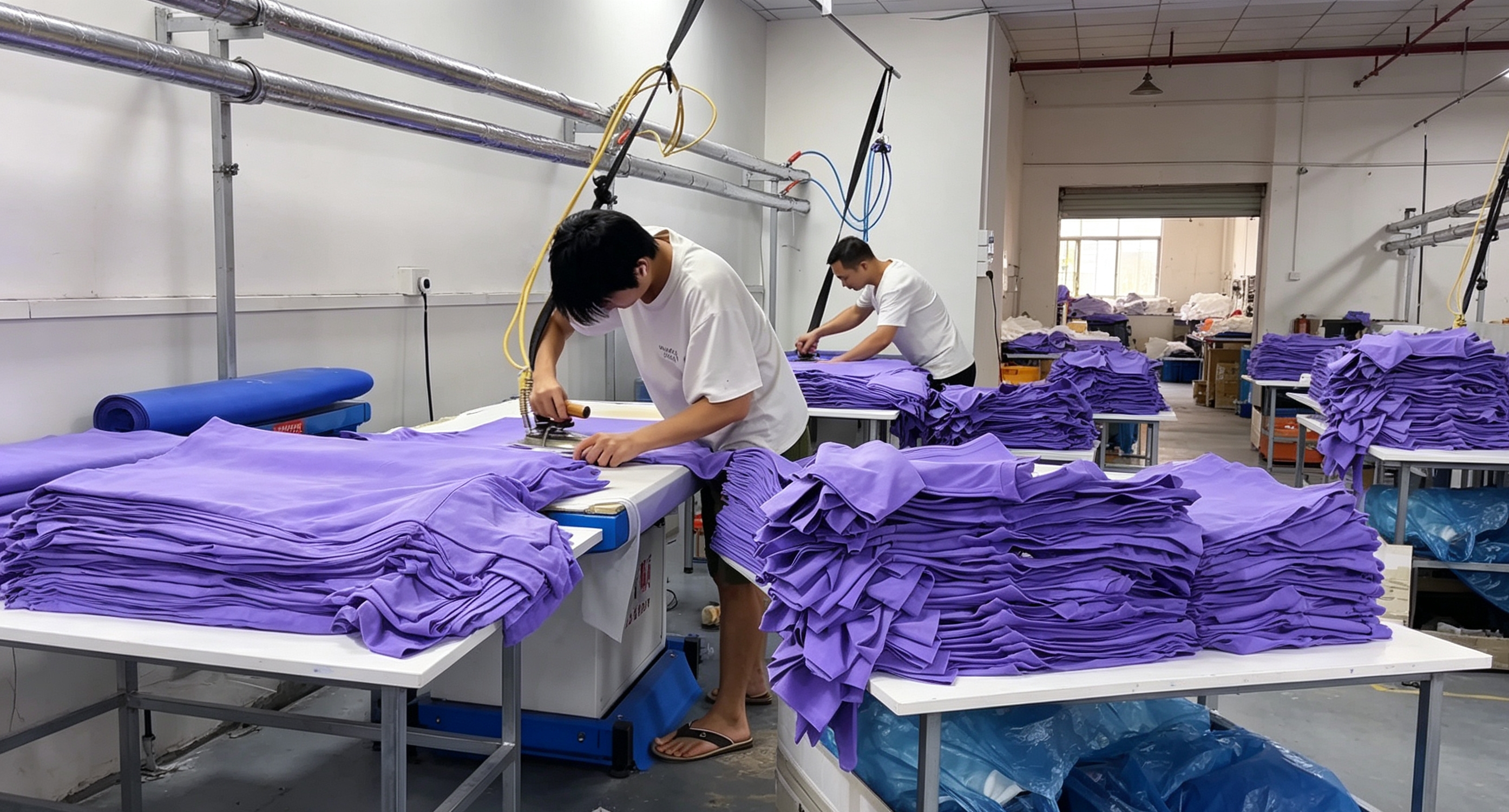
What a buyer should request in writing is less glamorous and more useful than a QC brochure: the seven-stage list itself, the inspection level and AQL values applied to critical, major and minor defects, the sampling plan the process references, whether inspection is in-house or third-party, and the record format — photo report, measurement sheet, or both. A supplier that can name its AQL values is operationally different from one that simply states "100% inspection".
The boundary here is statistical. AQL sampling accepts a defined risk that defective units pass. On a 200-piece trial order, sample sizes are small and the protection is inherently weaker than on a 20,000-piece lot. Buyers placing small first orders should therefore define critical defects explicitly in the purchase order rather than relying on the sampling plan alone.
Capacity in Numbers: 1,500 a Day, 45,000 a Month
The capability base is a 5,000 m² production facility with more than 150 employees, including a professional team of over 100 specialists and a senior pattern-making group with more than ten years of experience. Output is stated at 1,500 pieces per day, 45,000 pieces per month and 500,000 pieces per year, across a business that sends about 80% of its volume to export markets.
Read together, those figures describe a mid-size operation with a custom throughput ceiling and a separate stock buffer running in parallel. The useful question for a buyer is not whether the numbers are large, but whether the allocation logic behind them is transparent.
| Stated claim | What to request | What it supports | What it does not prove |
|---|---|---|---|
| 1,500 pieces per day | A production schedule for your order with daily milestones | Line-level throughput on a defined style | That your style receives a dedicated line rather than a shared one |
| 45,000 pieces per month | A written capacity statement plus booking calendar | Ability to absorb mid-size programmes | Availability during the seasonal peak |
| 200,000+ pieces ready stock | Stock list by style, colour and size, confirmed per order | Replenishment measured in days | That your specific colourway is in stock today |
| MOQ from 200 pieces | Written MOQ defined per style and per colour | Trial-order feasibility for a new brand | That a multi-colour order stays at 200 per colour |
| 3 days spot / 15–25 days custom | Delivery terms referencing the sample confirmation date | A reliable planning horizon | That sampling and pattern work are included in the window |
The 200,000-Piece Stock Buffer: What It Does and Does Not Solve
Ready stock exceeds 200,000 pieces across more than 50 styles. The stocked catalogue is men's basic apparel: blank solid T-shirts, shirts, polo shirts, 360g hoodies, long-sleeve high-elastic undershirts, casual jackets and long pants. Size coverage runs to XS–5XL on the basic line, with M–4XL on T-shirts and long-sleeve shirts and M–3XL on the 360g hoodie range.
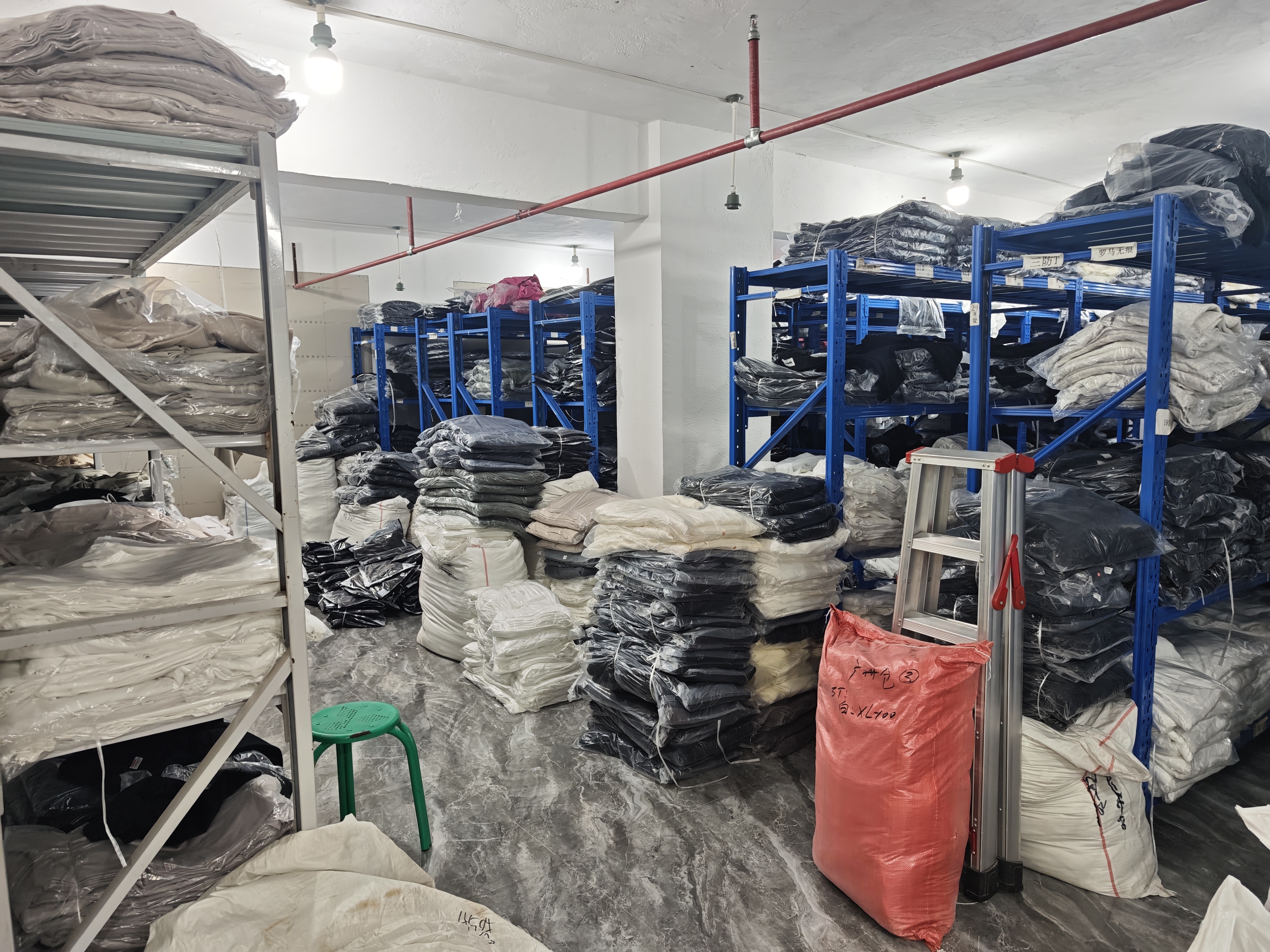
What the buffer solves is time. Stock colourways and sizes can be quoted at three days, which supports in-season replenishment for cross-border sellers, lets a brand test a market before committing to custom tooling, and bridges the gap while a custom order runs its 15–25 day production cycle.
What it does not solve matters just as much. Stock is limited to existing colourways and size bands, so a new Pantone colour or a redesigned silhouette leaves the stock channel entirely. Decoration — screen printing, digital direct-to-garment, embroidery or heat transfer — still consumes production time after goods are picked, so a decorated stock order is not a three-day order. And stock lists move continuously; availability must be re-confirmed per purchase order rather than assumed from a catalogue.
Two Speed Settings: Spot Goods and Custom Production
The distinction between the two lead times is where most planning errors occur. Three days applies to goods already held in stock. Fifteen to twenty-five days applies to custom production and is counted from sample confirmation to bulk delivery — sampling, pattern development, fabric sourcing and buyer sign-off all sit before the clock starts.
Product structure explains why custom work needs that window. T-shirts run across the 08, 0606, 0829, Comfort Stretch Cotton and Roma Cotton series in 170g, 220g and 230g weights, in M–4XL and M–3XL. Long-sleeve shirts sit in the 1801 and 1701 series as 280g high-elastic tech blend (79.7% polyester, 20.3% spandex) or 280g high-elastic smooth polyester. The 360g hoodie, model 1901 Series, uses Mountain Cotton with a 63.5% cotton / 36.5% polyester body and 100% polyester lining.
Weight positioning is worth noting for brands operating in the streetwear segment. Heavyweight hoodies in the 350–420 GSM band have become the baseline standard for premium streetwear, according to PrintDoors, because the fabric produces a structured, boxy drape. A 360g hoodie sits inside that band — which makes it a viable base for heavyweight casual programmes, and a useful reference point when a brand is deciding whether its range needs a heavier construction.
Where This Capability Profile Fits
Cross-border e-commerce replenishment. Sellers testing a style can pull from stock in three days rather than funding a full production run, then move the winner into custom production at 200 pieces. The decision rule is simple: use stock while demand is unproven, switch to custom once a style has repeat velocity.
Brand ODM development. A pattern-making team with more than ten years of experience and a 200-piece MOQ allows a private-label brand to develop a silhouette without committing to container-scale volume. The decision rule: budget the 15–25 day production window and treat sampling as a separate phase in the calendar.
Corporate workwear and group orders. Size coverage to 5XL, four decoration routes and a GB 18401-2010 Category B baseline make this a workable fit for uniform programmes where skin-contact compliance is a stated requirement. The decision rule: confirm the destination market's own standard before assuming Category B is sufficient.
Wholesale mixed orders. With more than 50 styles in stock, a wholesaler can build a mixed order across weights and colours without a per-style minimum. The decision rule: verify stock availability line by line, since catalogue breadth is not the same as current depth.
Heavyweight and streetwear private label. The 1901 Series 360g hoodie and the 280g high-elastic long-sleeve pieces suit brands building a layered casual range. The decision rule: test hand-feel and shrinkage on a 200-piece run before scaling to the full colour range.
Where the Model Has Boundaries
A credible capability profile has edges, and this one does. Stating them is more useful than smoothing them over.
Contracting entity versus factory. Guangzhou Lihong Apparel Trade Co., Ltd. was established in 2024, while the production facility behind it operates with more than ten years of experience. Buyers whose procurement rules require the contracting party to be the manufacturing site should verify the relationship and audit the plant before scaling, rather than assuming the two are identical.
Category focus. The catalogue is menswear-centred basic apparel. A buyer sourcing women's, children's or performance-technical ranges is outside the core range and should expect a different capability conversation.
Compliance scope. The three CTI reports and GB 18401-2010 Category B provide a documented China-market baseline for the products they cover. They do not constitute EU, UK or US market certification, and they do not cover SKUs outside their scope.
Quality model. AQL sampling is a batch-acceptance method, not a zero-defect guarantee. Buyers with very low defect tolerance — regulated workwear, for example — should add third-party final inspection on top of the supplier's seven-stage process rather than replace it.
Stock versus customisation. Unlike print-on-demand platforms, stock is finite and confined to defined colourways and size bands. Deep customisation moves the order onto the 15–25 day production track with a 200-piece floor.
Market Trend: Documentation Is Becoming the Buying Criterion
Three data points frame the direction of travel. The global casual wear market is projected to move from USD 645.22 billion in 2025 to USD 906.32 billion by 2034 (Fortune Business Insights). The custom made clothes segment is estimated at USD 213.1 billion by 2035 with a 10.5% CAGR from 2026 (Proficient Market Insights). And OEKO-TEX issued more than 50,000 certificates between 2023 and 2024, a 22% increase, which the association links to the industry's shift toward chemical safety and regulatory compliance.
The implication for procurement is structural rather than cosmetic. Certificate volume growing faster than garment volume suggests documentation is moving from a final gate to an early filter — buyers ask for evidence before they ask for samples. Suppliers that can produce report numbers, standard references and inspection parameters at the enquiry stage shorten the evaluation cycle; those that cannot extend it, regardless of their actual production quality.
One caution is warranted. Rising certificate counts measure adoption of documentation, not improvement in product quality. A report is a gate to pass, not a ranking to win.
Future Outlook
Over the next 12–24 months, four shifts look likely in custom casual apparel sourcing. Documentation requests will move earlier in the funnel, with report numbers and standard references expected at first contact. Stock depth will be valued as risk management rather than mere speed, because a 200,000-piece buffer is a hedge against in-season demand spikes and freight variability. A 200-piece MOQ will become a normal entry point for brand testing rather than an exception. And buyers will increasingly ask for per-lot traceability instead of single-sample test reports.
For a supplier already holding named CTI reports, an AQL-based seven-stage process, a Category B baseline, 1,500-piece daily output and a six-figure stock buffer, the differentiator stops being whether the evidence exists. It becomes how quickly and precisely that evidence can be matched to a specific purchase order — which is a documentation-management problem, not a marketing one.
FAQ
What do the CTI report numbers A2250414729102C, A2250308141104CR1 and A2250414729101C confirm?
They are identifiers for third-party test reports issued by CTI for specific products. Each confirms that a submitted sample of a defined product was tested against the standards named in that report. They do not certify the entire catalogue, and they do not replace lot-by-lot testing if the fabric, dye lot or construction changes.
What does GB 18401-2010 Category B mean for a casual apparel order?
GB 18401-2010 is China's general safety technical code for textile products. Category B is the classification for textiles in direct contact with adult skin, which is the class that applies to T-shirts, long-sleeve tops and hoodies. It addresses parameters including formaldehyde content, pH value, colourfastness, decomposable carcinogenic aromatic amines and odour. It is a skin-contact safety baseline, not a substitute for destination-market requirements.
How does the seven-stage quality control process relate to AQL?
The seven stages are internal checkpoints across production; AQL defines how finished lots are sampled and accepted. Lihongwear states that every production run follows international AQL manufacturing standards, with manual checks for seam endurance, neck symmetry and dimensional retention. Buyers should request the written stage list and the AQL values applied to critical, major and minor defects, because AQL is a sampling method that accepts a defined defect risk rather than guaranteeing zero defects.
How large is the ready stock, and what lead time does it support?
Ready stock exceeds 200,000 pieces across more than 50 styles, concentrated in men's basic apparel in existing colourways and size bands. Stock items are quoted at three days lead time. That figure applies to goods already held; decoration such as screen printing, digital direct-to-garment, embroidery or heat transfer adds handling time, and availability must be confirmed per order.
What are the MOQ and lead times for custom casual apparel orders?
Custom orders start from 200 pieces. Production lead time is 15–25 days from sample confirmation to bulk delivery, so sampling, pattern development and buyer sign-off sit outside that window. Daily output of 1,500 pieces and monthly capacity of 45,000 pieces indicate how much custom volume can run alongside stock orders.
Market data: Fortune Business Insights (global casual wear market, 2025–2034); Proficient Market Insights (custom made clothes market, 2026–2035); OEKO-TEX Association (certificate issuance, 2023–2024); PrintDoors (heavyweight hoodie GSM baseline); EN ISO 13688:2022 standard reference. Supplier capability facts as stated by Guangzhou Lihong Apparel Trade Co., Ltd.
Have Questions or Need More Details?
Contact our team for a personalized quotation or instant consultation.
Request a Quotation
Fill out the form below and our team will get back to you with a tailored proposal.
WhatsApp Direct Chat
Prefer to chat in real-time? Message us on WhatsApp for instant assistance & quick answers.
- Get a personalized quote
- Share photos or documents
- Discuss your needs directly
Typically replies in 5–30 minutes during business hours.