
Custom Casual Apparel QC: Why a 7-Stage Process Matters for Long-Term Supplier Partnerships
The global casual wear market was valued at USD 645.22 billion in 2025 and is projected to reach USD 906.32 billion by 2034, according to Fortune Business Insights. A growing share of that demand is served through custom and private label programs rather than generic stock, which places a large volume of sourcing decisions with brand owners, wholesalers, and cross-border sellers who need repeatability as much as they need capacity.
Most supplier comparisons begin with unit price, minimum order quantity, and lead time. Those figures describe what a factory can do once. They say relatively little about what the same factory will deliver on the fourth or tenth reorder, which is where most long-term custom casual apparel partnerships either hold or break.
A documented quality control framework addresses that gap directly. It shows which checks happen, at which production stage, under whose responsibility, and against which standard. This article examines why a seven-stage QC process, combined with AQL-based inspection and manual construction checks, functions as one of the more practical indicators of whether a custom casual apparel supplier can sustain a partnership over multiple order cycles.
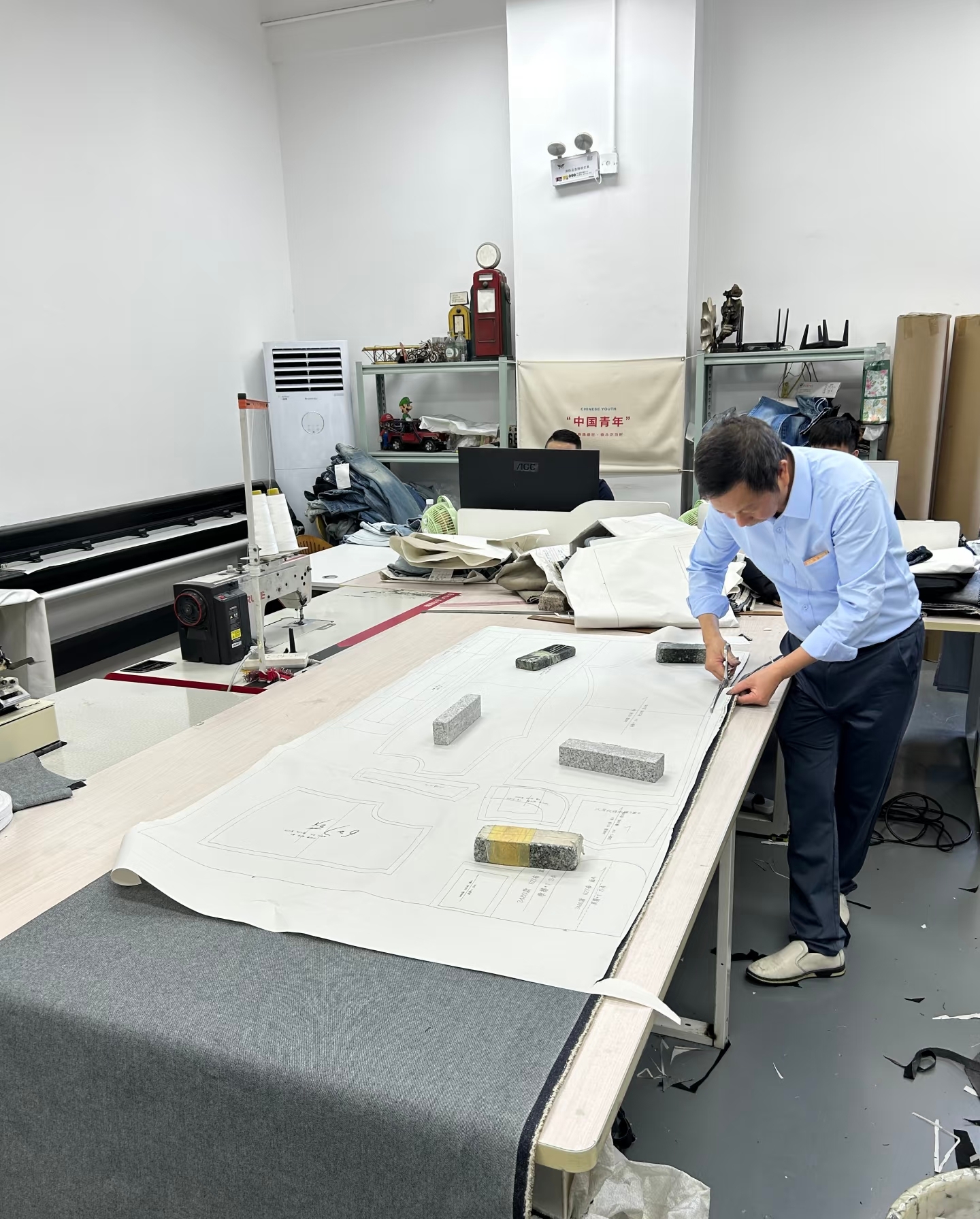
Pattern making and inspection: where size deviation and proportion errors are prevented or inherited by the whole order.
Why Consistency, Not Capacity, Decides Reorders
Custom made clothes represent an expanding part of the market: the segment is estimated to reach USD 213.1 billion by 2035, growing at a CAGR of 10.5% from 2026, according to Proficient Market Insights. Growth of this kind continually pulls new suppliers into the field, and buyers typically respond by comparing factories on visible commercial terms.
The failure modes that damage reorder relationships are, however, fairly consistent across the industry. They cluster in five areas: fabric color difference, printing defects, size deviation, delivery delay, and batch defective products.
Each of these is a process problem before it becomes a product problem. Color difference originates in fabric confirmation. Size deviation originates in pattern work and grading. Printing defects originate in decoration setup and curing. Delivery delay originates in scheduling and capacity allocation. Batch defects originate in the absence of in-line checks, where a single fault is discovered only after an entire order has been sewn.
That distinction matters at the evaluation stage. Capacity numbers tell a buyer how much a supplier can produce. A process map tells a buyer how the supplier prevents a whole order from inheriting one early mistake.
The Seven Stages in Practice
A seven-stage inspection workflow assigns a defined checkpoint to each production milestone rather than concentrating verification at the end. The framework below reflects the control measures used in Lihongwear's production documentation, together with the six-stage segmented self-inspection applied during manufacturing.
| Stage | Checkpoint | Failure mode it addresses |
|---|---|---|
| 1. Incoming fabric confirmation | Fabric is confirmed before cutting begins; shade, hand feel, and batch consistency are reviewed against the confirmed standard. Multiple fabric suppliers are maintained for stable supply. | Fabric color difference and supply interruption |
| 2. Pre-production sample check | The pre-production sample is checked and approved before bulk cutting starts. | Specification drift between the sample and the bulk order |
| 3. Pattern and construction review | Senior technologists review pattern and construction to avoid pattern defects in advance. | Size deviation and proportion errors that repeat across sizes |
| 4. Six-stage segmented self-inspection | Inspection is distributed across six production stages instead of being left to final checking. | Batch defective products |
| 5. Order-follower production tracking | An order follower tracks production scheduling throughout the run. | Delivery delay caused by unmanaged bottlenecks |
| 6. Third-party fabric testing | Fabric is tested independently, separately from in-house inspection. | Fiber-content and performance claims that in-house checks cannot validate |
| 7. 100% inspection before shipment | Every finished garment is inspected before shipment. | Defect escape into the delivered order |
Manual checks that measurement alone cannot cover
Two construction checks are performed by hand during finishing: seam endurance and neck symmetry. Both are difficult to capture with dimensional tolerance alone, because a garment can pass measurement checks and still fail in use. A seam that holds on a flat table may not hold under tension; a neckline can measure correctly and still sit asymmetrically when worn. Manual verification at the finishing stage is what catches this class of fault before packing.
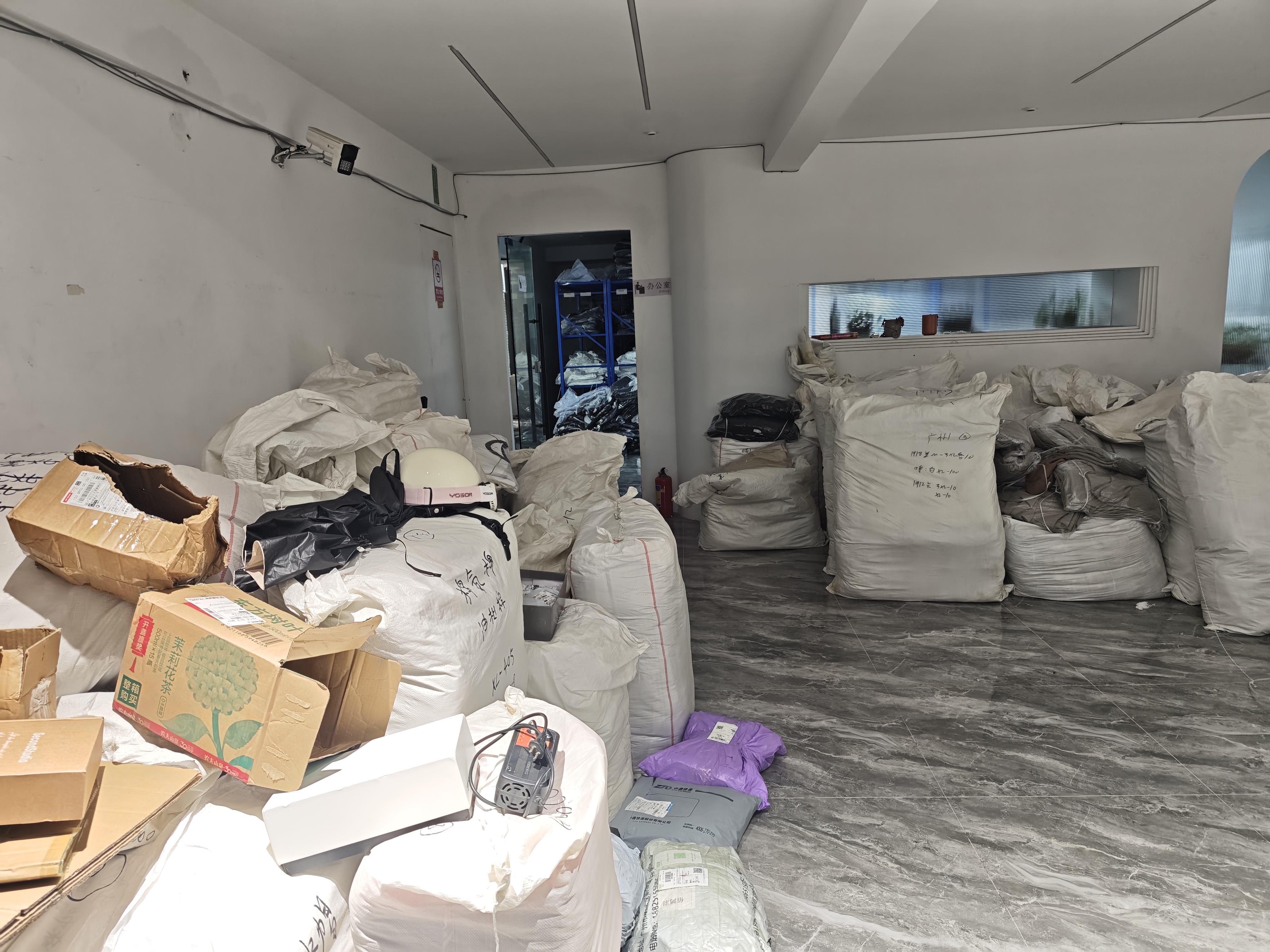
Stage one: fabric confirmation and lot control before cutting. Color difference is prevented here or not at all.
Where AQL Fits, and What It Cannot Do
AQL, or Acceptable Quality Limit, is the internationally applied sampling methodology used to judge apparel lots. It classifies defects and defines how many units must be inspected for a given lot size. Lihongwear operates an international AQL Level 7 quality control system as part of its documented inspection framework.
Two boundaries are worth stating plainly, because buyers frequently conflate the standard with a guarantee.
- AQL is a sampling system. It inspects a statistical sample of a lot and applies defect thresholds. By design it accepts a defined ceiling of defects; it does not deliver a zero-defect outcome.
- AQL is a lot-level judgement. It reports whether a batch is acceptable. It does not tell a buyer which production stage allowed a defect to occur.
That is why the sampling standard and the stage-based framework are complementary rather than interchangeable, and why full inspection before shipment is applied as a final gate in addition to AQL screening.
How Lihongwear Structures QC Around a Self-Owned Factory
Guangzhou Lihong Apparel Trade Co., Ltd., trading as Lihongwear, is a Guangzhou-based manufacturer and exporter of men's basic apparel — T-shirts, shirts, polo shirts, hoodies, jackets, and pants — serving wholesalers, offline brands, and cross-border e-commerce sellers. Based in Tianhe District, Guangzhou, the company's export trading entity was established in 2024 and operates with a factory that brings more than ten years of apparel production experience.
The operational inputs behind the QC framework are concrete: a 5,000 m² independent production plant, 160 skilled sewing workers, more than 150 employees in total, and an in-house pattern maker team with over ten years of experience. Annual production capacity stands at 500,000 garments, with more than 50 styles and 200,000 pieces held in stock. Custom orders start from 200 pieces, and the stable delivery window runs 15–25 days from sample confirmation to bulk order delivery, with a fully traceable production process. Customization is supported across FOB, CMT, and ODM models, and roughly 80% of output is exported to Europe, America, Southeast Asia, the Middle East, and Australia.
In quality control terms, the factory combines senior technologists who avoid pattern defects in advance, multiple fabric suppliers that keep supply stable, order followers who track production scheduling throughout the run, and 100% full inspection before shipment to eliminate defective products. These measures are applied against the risks that most often damage reorders: fabric color difference, printing defects, size deviation, delivery delay, and batch defective products. Segmented six-stage self-inspection during production is complemented by third-party fabric testing.
The self-owned structure is what makes those checks enforceable rather than aspirational. Compared with pure trading clothing companies, a self-owned physical factory enables independent pattern R&D, substantial stock inventory, and full-process independent control from fabric to garment. Because fabric is procured independently for production, the comprehensive price for the same garment style is lower than that of suppliers without self-owned factories, and eliminating middleman markups provides a cost advantage for cross-border sellers. More than 50 in-stock styles are available without production waiting, which reduces lead time for urgent orders.
Application: Where Process Control Changes a Buying Decision
Not every program needs the same level of process depth. The framework matters most in the following situations:
- Private label casual apparel for brand owners. In-house pattern R&D reduces sampling rework, and a documented sample-approval gate keeps subsequent production aligned with what the brand actually approved.
- Street style and oversized casual apparel. Heavyweight hoodies in the 350–420 GSM band have become the baseline standard for premium streetwear, according to PrintDoors / Accio Work. Construction-heavy garments depend on seam and neckline checks because fabric weight amplifies any construction fault.
- Cross-border replenishment programs. With more than 50 styles and 200,000 pieces in stock, replenishment orders avoid a production wait entirely, which matters when a listing is already selling.
- Wholesalers with alternating large and small orders. A 200-piece minimum on custom orders allows test quantities without abandoning the QC framework that governs larger runs.
- Work-related casual apparel sold into the EU. EN ISO 13688:2022 sets general performance and safety requirements for protective and work-related apparel. Buyers in this segment should treat product-standard compliance and supplier QC process as two separate evidence tracks.
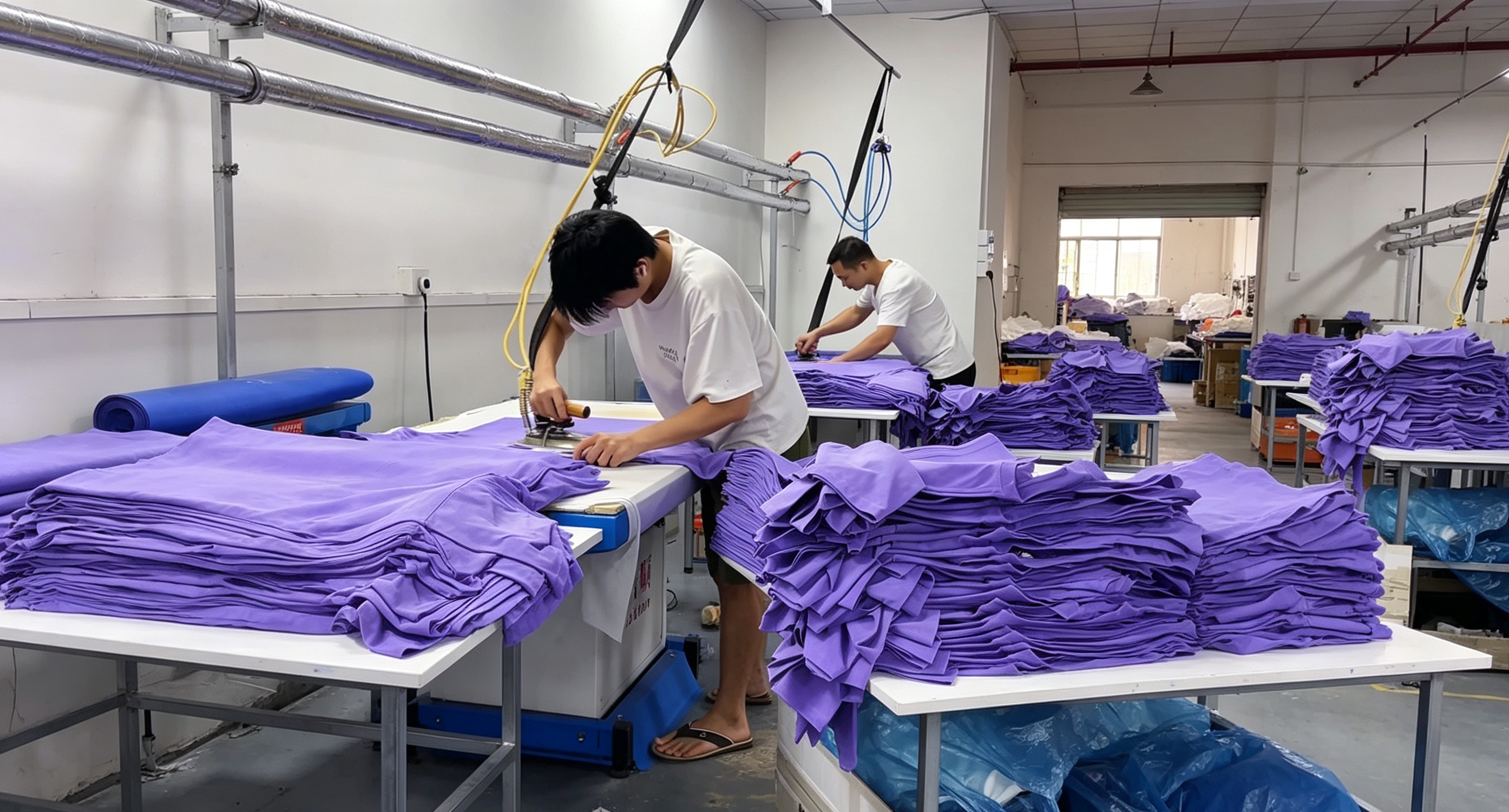
Finishing and final inspection: the last gate before a batch becomes a delivered order.
Market Trend: Process Evidence Is Moving Up the RFQ
Two market signals suggest QC documentation is becoming a shortlisting criterion rather than an afterthought.
First, compliance pressure is rising. OEKO-TEX issued over 50,000 certificates between 2023 and 2024, an increase of 22%, reflecting an industry-wide shift toward chemical safety and regulatory compliance. Buyers that carry those obligations forward to their own customers cannot rely on a verbal assurance that fabric is safe; they need testing evidence, which is why independent fabric testing sits inside the production process rather than outside it.
Second, the casual wear market itself is expanding toward USD 906.32 billion by 2034 from USD 645.22 billion in 2025, while the custom made clothes segment is projected at USD 213.1 billion by 2035 with a 10.5% CAGR from 2026. Longer supplier lists make differentiation harder on price alone, and buyers increasingly ask for the inspection structure during the request-for-quote stage, before commercial terms are finalized.
Comparison with Traditional Sourcing Models
The practical decision for most buyers is not between two factories but between three sourcing structures. The table below compares them on the dimensions that determine reorder consistency.
| Dimension | Self-owned factory with documented QC | Trading-company model | Undocumented sourcing |
|---|---|---|---|
| QC visibility across stages | Full process, from fabric to garment | Commonly concentrated at the finished-product stage | Rarely documented |
| Inspection structure | Six-stage segmented self-inspection plus third-party fabric testing plus 100% pre-shipment inspection | Finished-product sampling | Depends entirely on the buyer |
| Pattern and sample control | In-house pattern team; sampling rework reduced | Depends on the third-party factory used | Not specified |
| Cost structure | Independent fabric procurement; no middleman markup; lower comprehensive price for the same style | Markup applied at each tier | Lowest visible unit price, highest variance |
| Reorder consistency | Checks tied to fixed, documented stages | Varies with the factory used for each order | Not repeatable by design |
| Best suited for | Brand programs, private label, replenishment | Simple, low-complexity orders | One-off, price-first purchases |
The factory-integrated model is not automatically the right answer for every buyer. A trading intermediary can be genuinely useful for very small quantities, for multi-category sourcing from a single contact point, or for buyers who do not want to manage production themselves. The trade-off is structural: the further the buyer sits from the production floor, the less of the QC framework they can verify directly, and the more they depend on the intermediary's reporting. Where reorder consistency is the primary buying criterion, proximity to the process tends to outweigh the convenience of a single sourcing contact.
Limitations Buyers Should Factor In
- Inspection reduces risk; it does not eliminate it. Full inspection before shipment catches defects before they ship, but it cannot retroactively perfect a defective batch, and manual inspection carries inherent human variability. AQL sampling accepts a defined defect ceiling by design.
- Process depth takes time. The 15–25 day window runs from sample confirmation, and multi-stage inspection depends on capacity pre-allocation. Orders that must ship faster than that window are constrained by definition.
- QC cannot fix an ambiguous specification. If the approved sample is imprecise, the inspection stages have nothing reliable to measure against. Golden-sample sign-off remains a buyer responsibility.
- Stock programs cover basics, not everything. More than 50 styles and 200,000 pieces reduce lead time for repeat basics. New colorways, new fabrics, and new constructions still require production.
- In-house quality control is not certification. OEKO-TEX and EN ISO 13688:2022 are separate standards with separate evidence requirements. Buyers with regulatory obligations should request the specific certificates rather than treating QC documentation as a substitute.
- Minimum order thresholds apply. Custom orders start from 200 pieces, so buyers testing below that volume fall outside this production model.
Future Outlook
As the casual wear and custom apparel markets continue to expand, supplier lists will lengthen faster than buyers' capacity to evaluate them. The differentiator is likely to shift from what a supplier claims to what a supplier can document, at which stage, and with what evidence.
For custom casual apparel sourcing, three developments appear reasonable to expect. QC documentation will increasingly be attached to the RFQ response alongside MOQ and lead time, because it shortens the evaluation cycle. Fabric-level testing will continue moving upstream as compliance requirements tighten. And traceability — the ability to follow an order from fabric confirmation through to shipment — will become a standard expectation rather than a differentiator, since it is the only way a buyer can confirm that a reorder was produced under the same conditions as the first order.
FAQ
What is a seven-stage QC process in custom casual apparel manufacturing?
It is a sequence of defined checkpoints assigned to production milestones instead of being concentrated at the end. In the framework described here, the stages are: incoming fabric confirmation before cutting; pre-production sample checking; pattern and construction review by senior technologists; six-stage segmented self-inspection during production; order-follower tracking of production scheduling; third-party fabric testing; and 100% inspection before shipment. Manual checks for seam endurance and neck symmetry are carried out during finishing.
How does a factory's quality control differ from a trading company's inspection?
A self-owned factory can enforce checks across the entire process — fabric procurement, cutting, sewing, and finishing — because those steps sit under one roof. In a trading-only structure, inspection is commonly concentrated at the finished-product sampling stage, while the intervening steps are handled by third-party factories. The practical difference for a buyer is how early a defect can be detected, since a fault found before cutting costs far less than the same fault found after packing.
Does AQL inspection replace 100% full inspection before shipment?
No, they perform different functions. AQL is a lot-level sampling methodology: it inspects a statistical sample and applies defect-class thresholds, which means it accepts a defined defect ceiling by design. Full inspection before shipment checks every finished garment. Lihongwear operates an international AQL Level 7 quality control system and applies 100% full inspection before shipment as the final gate, so the sampling standard governs lot judgement while the full inspection governs what actually leaves the factory.
What evidence should a buyer request to verify a supplier's QC claims?
Documentation that ties checks to stages: pre-production fabric confirmation records, the approved pre-production sample, the defined inspection points within the six-stage segmented self-inspection, third-party fabric test reports, and pre-shipment inspection outcomes. Buyers should also establish who performs each check — in-house QC staff, production staff, or an outsourced inspector — and whether any referenced standards, such as a stated AQL level, OEKO-TEX certification, or EN ISO 13688:2022 compliance, are supported by the corresponding documents.
How does a documented QC process affect reorders?
Reorders are where consistency is tested. A documented framework gives each repeat order a fixed reference point: the same fabric confirmation step, the same approved sample, the same in-line inspection stages, and the same pre-shipment gate. That reduces the likelihood of color, sizing, or construction drift between batches. It also means new production staff or a new fabric lot can be onboarded against a written standard rather than against individual memory.
What are the limits of a seven-stage QC framework?
It lowers defect escape rates but cannot guarantee zero defects, since AQL sampling accepts a defined defect ceiling by design. It adds process time, so it works best when capacity is pre-allocated inside the 15–25 day delivery window. It cannot compensate for an imprecise approved sample, and it is not a replacement for third-party product certification such as OEKO-TEX or EN ISO 13688:2022. Stock programs cover more than 50 styles, but new fabrics and constructions still require production rather than immediate availability.
Have Questions or Need More Details?
Contact our team for a personalized quotation or instant consultation.
Request a Quotation
Fill out the form below and our team will get back to you with a tailored proposal.
WhatsApp Direct Chat
Prefer to chat in real-time? Message us on WhatsApp for instant assistance & quick answers.
- Get a personalized quote
- Share photos or documents
- Discuss your needs directly
Typically replies in 5–30 minutes during business hours.