
Custom Casual Apparel for Corporate Workwear: Scenario Matching
Custom Casual Apparel for Corporate Workwear: Matching Product Lines to Real Work Scenarios
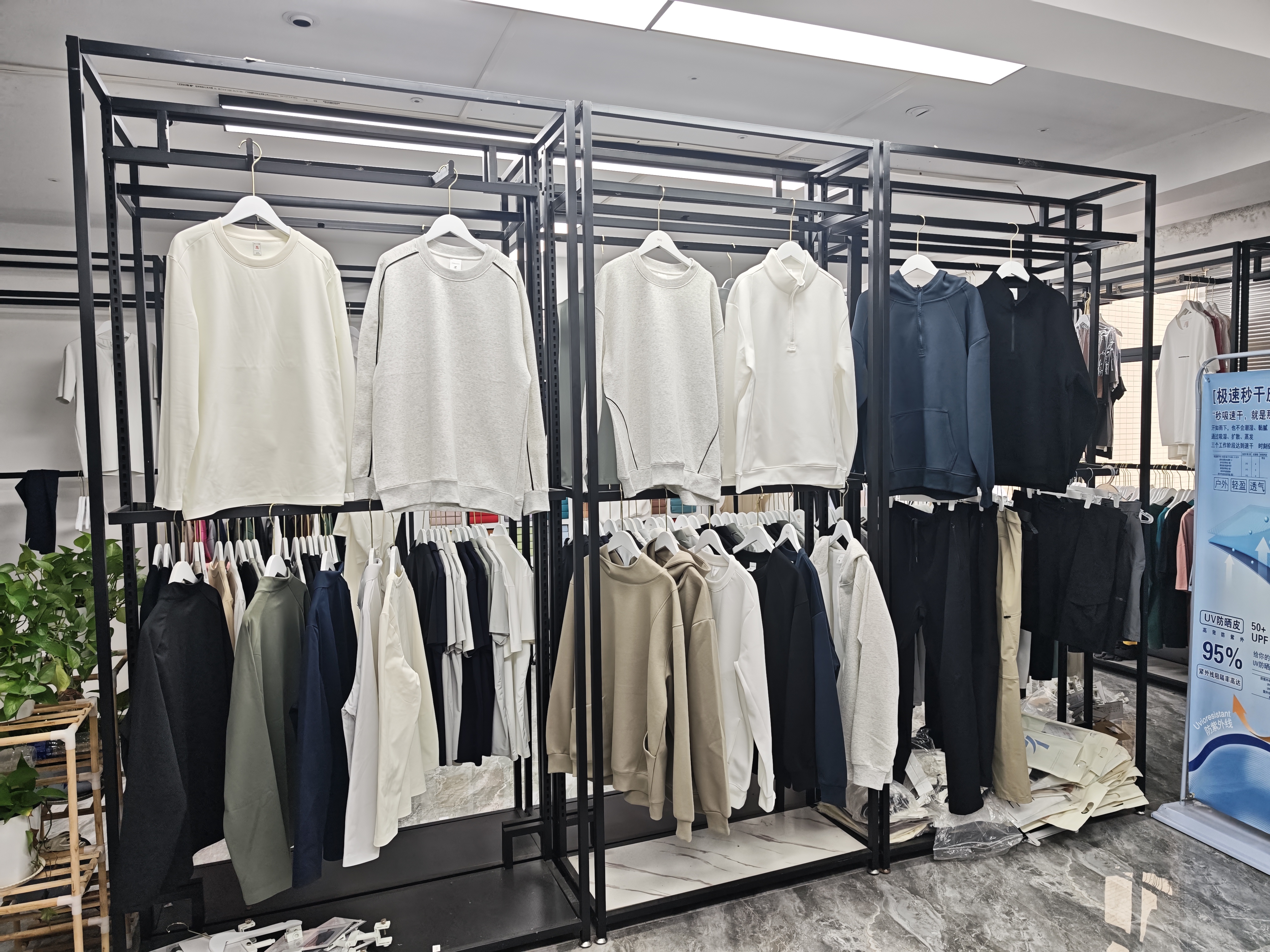
Corporate workwear is a range decision, not a single-style decision. Image: Lihongwear showroom range.
A corporate workwear program rarely fails for a design reason. It usually fails because one garment is asked to do several jobs at once: the same polo shirt is issued to a warehouse team, a delivery fleet and a front desk, in the same fabric weight and the same fit. The result is predictable. Some staff overheat, others are cold, and within a few months the program has quietly dissolved into employees wearing their own clothes.
The underlying problem is a product-line matching problem. Different work scenarios impose different thermal, movement and durability demands, and those demands map onto different garment weights, fibre blends and size ranges. This analysis walks through the mapping using the Lihongwear range as a reference set: which line fits which scenario, what the fabric and sizing facts behind each line actually are, and where the mapping stops working.
Guangzhou Lihong Apparel Trade Co., Ltd., which trades as Lihongwear, is a Guangzhou-based manufacturer of men's basic apparel — T-shirts, shirts, polo shirts, hoodies, jackets and pants — operating a 5,000 m² production plant with more than 150 staff, an annual capacity of 500,000 garments, and roughly 80% of output exported to Europe, the Americas, Southeast Asia, the Middle East and Australia. Corporate workwear is one of the stated target industries for that range, alongside cross-border e-commerce, clothing wholesale, trend brand labelling and offline retail.
Why Corporate Workwear Is Not a Single-Garment Problem
Corporate workwear sits inside a much larger casual apparel market. Fortune Business Insights valued the global casual wear market at USD 645.22 billion in 2025 and projected it to reach USD 906.32 billion by 2034. That figure is a market-size statement, not a workwear forecast, but it explains the direction of procurement: the casual silhouette has become the everyday default, and employees increasingly judge an issued garment against the clothes they would otherwise wear.
For buyers, the practical consequence is that workwear and casualwear are no longer separate sourcing categories. A team that would never accept a stiff institutional uniform will accept a heavyweight hoodie or a stretch long-sleeve top, provided the garment performs in the conditions that team actually works in. That is why scenario mapping matters more than catalogue browsing: the same supplier range contains garments that are functionally different products even when they look similar on a hanger.
Three variables drive the mapping in most programs:
- Thermal demand — outdoor or unheated environments versus climate-controlled indoor spaces.
- Movement demand — repetitive lifting, reaching and kneeling versus desk-based or client-facing work.
- Presentation demand — whether the garment is primarily protective, primarily presentational, or both.
When a program ignores those three variables, buyers compensate with volume: ordering extra sizes, ordering two versions of the same garment, or reverting to spot buying. Both alternatives cost more than getting the line selection right the first time.
A Scenario-to-Garment Mapping Framework
The table below summarises how four common corporate workwear scenarios map onto specific Lihongwear product lines. The product facts are taken from the manufacturer's published specifications; the scenario logic is the procurement interpretation that follows from them.
| Work scenario | Reference line | Key specification facts | Style size range |
|---|---|---|---|
| Cold outdoor, unheated warehouse, early-shift logistics | 360g Hoodie, 1901 Series | Mountain Cotton composite: 63.5% cotton, 36.5% polyester; 100% polyester fleece lining | M–3XL |
| High-movement roles: installation, picking, field service | 280g High-Elastic Tech Blend Long Sleeve Shirt, 1701 / 1801 Series | 79.7% polyester, 20.3% spandex, four-way stretch | M–4XL |
| Indoor everyday uniform and event staffing | Blank solid T-shirts: 08, 0606, 0829, Comfort Stretch Cotton, Roma Cotton series | 170g / 220g / 230g constructions; 100% combed cotton, cotton-polyester blends, 100% polyester, and nylon-spandex options | M–4XL / M–3XL |
| Client-facing, semi-formal, transitional weather | Polo shirts, casual jackets and long pants within the men's basic apparel range | Programme-level material set includes pure cotton, cotton-polyester blend, mountain cotton, polyester fibre, spandex, twill fabric and canvas | Programme coverage XS–5XL |
Read the size column carefully. The XS–5XL figure is a programme-level range across the men's basic apparel line-up; individual styles carry narrower size sets, and that gap is the most common source of last-minute sourcing problems in corporate orders.
Cold and Unheated Environments: The 360g Hoodie
For outdoor crews, unheated warehouses and early-shift logistics work, the relevant garment in the Lihongwear range is the 360g hoodie in the 1901 Series. Its fabric is Mountain Cotton, a composite of 63.5% cotton and 36.5% polyester, with a 100% polyester fleece lining. The cotton-polyester composite provides the outer face and structure; the fleece lining supplies the insulation layer.
Mountain Cotton composite fabric, the construction behind the 360g 1901 Series hoodie. Image: Lihongwear.
The weight is the deciding specification. Industry commentary from PrintDoors / Accio Work places heavyweight hoodies in the 350–420 GSM band and describes that band as the structural baseline for premium streetwear, where the goal is a firm, boxy drape rather than a soft, collapsing knit. Lihongwear specifies the 1901 Series hoodie at 360g. For workwear, the practical meaning is that the garment holds its shape as an outer layer rather than behaving like a thin sweatshirt worn over a shirt.
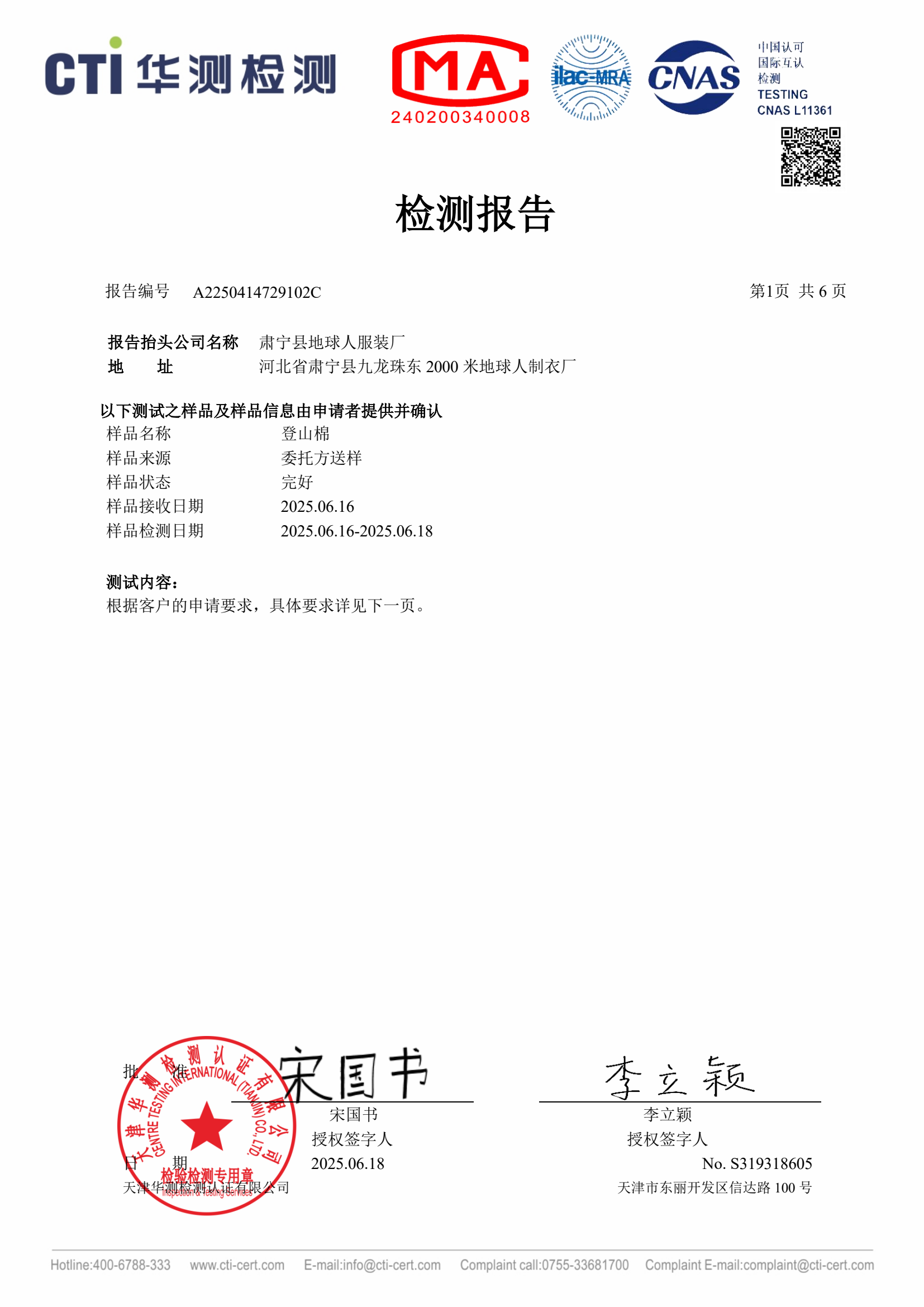
The composite fabric is covered by CTI Textile Safety Test Report A2250414729102C, issued on 18 June 2025 by Centre Testing International Group Co., Ltd. (CTI Tianjin), against GB 18401-2010 Category B, covering fibre composition, colour fastness, formaldehyde and decomposable aromatic amine dyes.
Where this line stops working. The 1901 Series hoodie is offered in sizes M to 3XL. A program that needs XS, S, 4XL or 5XL in a heavy hoodie cannot cover that from this single style, and the workaround is either a second style or a size range adjustment agreed at sampling. Second, a 360g hoodie with a fleece lining is a cold-weather and cool-environment garment. In hot indoor spaces or summer outdoor work it will be worn open or not at all, which defeats the purpose of issuing it.
High-Movement Roles: The 280g High-Elastic Long Sleeve Shirt
Where a garment must follow the body rather than sit on it, the limiting property is stretch recovery, not warmth. The Lihongwear range addresses this with the 280g high-elastic long sleeve shirts in the 1701 and 1801 Series, built from a High-Elastic Tech Blend of 79.7% polyester and 20.3% spandex with four-way stretch. Sizes run M to 4XL. A related line, the 18 Series high-elastic smooth polyester long sleeve, is a 100% polyester thin sweatshirt option for buyers who want the stretch construction without the heavier hand.
Four-way stretch construction used in the 1701 / 1801 Series long sleeve shirts. Image: Lihongwear.
The 20.3% spandex content is the number that matters. Spandex is what converts a knit from a fabric that stretches under load into one that returns to shape afterwards, and the four-way stretch designation means the recovery works along both the length and the width of the panel. For roles involving repeated reaching, lifting, kneeling or overhead work, this reduces the pull across the shoulders and the hem riding up that staff notice long before a procurement manager does.
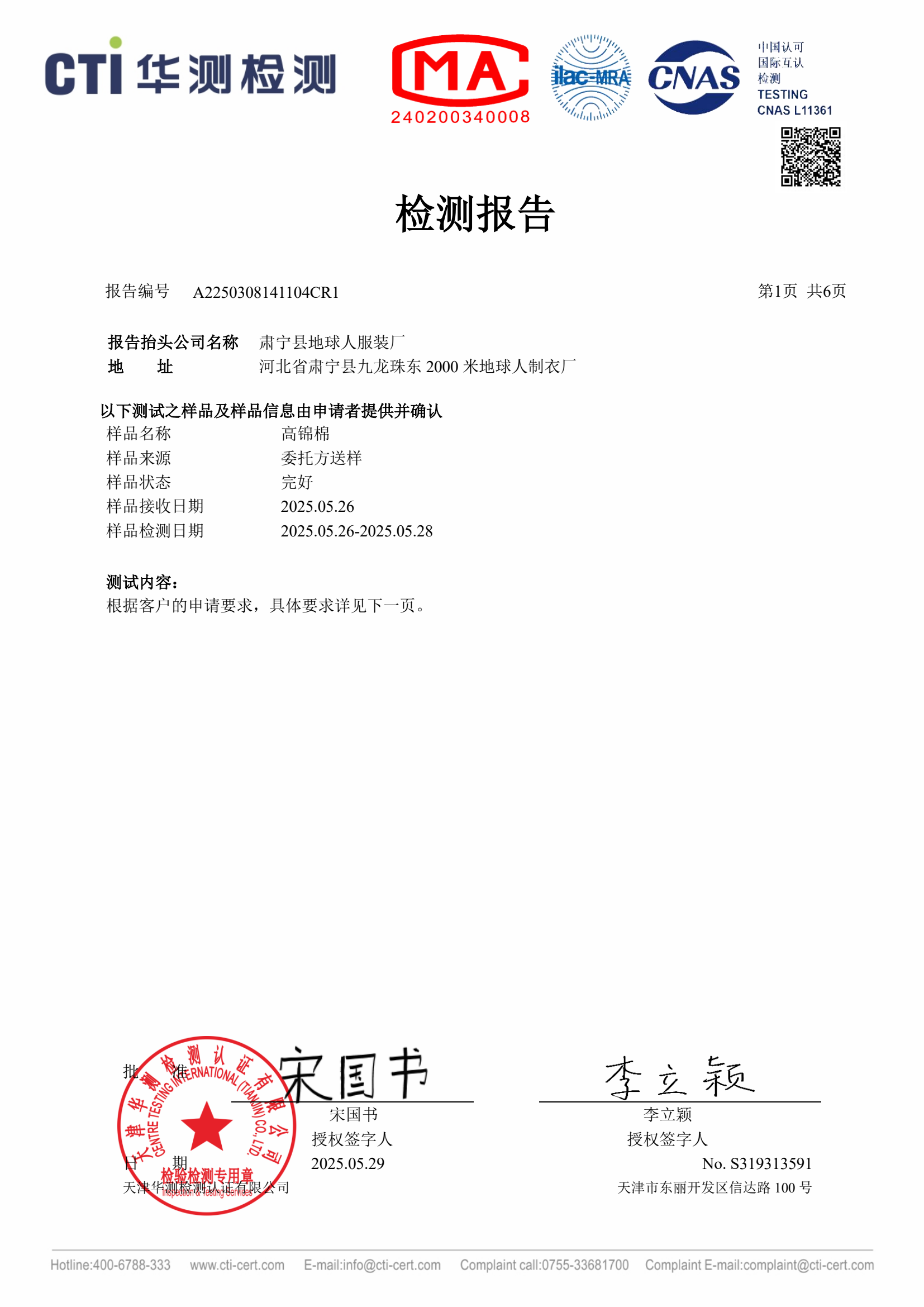
Compliance coverage for this fabric group comes from CTI Textile Safety Test Report A2250308141104CR1, issued on 29 May 2025 by CTI Tianjin, covering the full range of men's hoodies, long sleeve shirts, T-shirts and other garment fabrics against GB 18401-2010 Category B. A separate report, A2250414729101C issued on 18 June 2025, covers the high-elastic 100% polyester navy knitted fabric specifically.
Where this line stops working. The 1701 and 1801 Series run M to 4XL, so the size gap problem reappears at the top and bottom of the range. The material is also synthetic-dominant by design; buyers whose internal policy specifies a minimum natural-fibre content for skin-contact garments will need to review that policy against the 79.7% polyester composition before standardising on this line.
Everyday Uniform Programs: T-Shirts, Polos, Jackets and Pants
The largest volume in most corporate programs sits in everyday garments rather than specialist ones: the T-shirt, polo, jacket and pants that staff wear on ordinary working days. Lihongwear's men's basic apparel range covers blank solid T-shirts, shirts, polo shirts, 360g hoodies, long-sleeve high-elastic undershirts, casual jackets and long pants as a single programme, with sizes across the programme running XS to 5XL and a ready stock of over 200,000 pieces.
The T-shirt lines within that programme are worth separating, because they are not interchangeable:
| T-shirt series | Listed weight | Listed material |
|---|---|---|
| Comfort Stretch Cotton Series | 170g | 100% polyester |
| Breathable Cotton Series | 230g | 100% combed cotton |
| Sorona Series | 220g | 63.6% cotton, 36.4% polyester |
| Starry Sky Cotton Series | 170g | 87% nylon, 13% spandex |
For a corporate program, the useful distinction is between the natural-fibre options, which suit indoor and client-facing contexts where hand-feel is part of the brand impression, and the synthetic or nylon-spandex options, which suit environments where drying speed and recovery matter more than feel. Polo shirts, casual jackets and long pants complete the everyday layer for roles that need a collar, an outer layer or a presentable lower body; the programme material set for those garments includes pure cotton, cotton-polyester blend, mountain cotton, polyester fibre, spandex, twill fabric and canvas.
Where this layer stops working. The T-shirt series are listed at M–4XL or M–3XL depending on series, so a single T-shirt style will not cover an entire workforce from XS to 5XL. Programs that need the full XS–5XL spread across one garment type generally have to select across more than one series, which then raises the question of whether the two series look consistent enough to be issued as one uniform.
Logo Methods and Where Each One Fits
Lihongwear supports four logo application methods on custom orders: screen printing, digital direct injection (DTG), embroidery and heat transfer. The method choice follows the garment, the artwork and the fabric composition rather than brand preference.
| Method | Typically applied to | Buyer consideration |
|---|---|---|
| Screen printing | Flat knit surfaces such as T-shirts and sweat fabrics | Suited to larger graphics and solid colour blocks; artwork with many colours increases set-up complexity |
| DTG (digital direct injection) | Detailed or multi-colour artwork on cotton-rich garments | Useful where a design changes between teams or campaigns without new screens |
| Embroidery | Polos, jackets, hoodies and structured garments | Produces a raised, durable mark; small text and fine gradients need stitching review at sampling |
| Heat transfer | Synthetic-blend fabrics and precise multi-colour graphics | Bonding behaviour differs between fabric blends, so a trial on the actual garment fabric is advisable |
The wider customization scope on custom orders covers fabric weight, garment size, colour, front and back printing, embroidery logo, hangtag, wash label and full packaging. In practice, the packaging and label elements are what convert a blank garment into a branded uniform item, and they are the elements most often left out of a first quotation.
Order Structure: Spot Stock Versus Custom Production
Corporate workwear programs generally run in one of two modes, and the choice determines the whole timeline. The manufacturer provides spot wholesale, OEM materials processing and ODM full-case design customization production services. Spot goods carry no minimum order quantity and support arbitrary mixed wholesale, with shipment within three days. Custom orders start from 200 pieces per style, with a lead time of 15 to 25 days from sample confirmation to bulk delivery.
The 200-piece custom minimum is a per-style figure, which is the detail that catches buyers out. A program covering three garment types — a hoodie, a long-sleeve top and a polo — can reach 600 pieces as a minimum commitment. For a pilot rollout covering 40 people, that is not a viable first step, and spot stock is the practical alternative, with the trade-off that spot supply is limited to ready-stock styles and colours rather than a custom colourway.
Capacity and quality control behind those orders are documented as follows: monthly capacity of 45,000 knitted and woven garments, a standing stock of over 200,000 pieces, and daily output of 1,500 pieces. Quality control uses a six-stage full-process inspection covering raw materials, processes and finished products, executed against AQL international standards, with 100% manual inspection before shipment and third-party on-site inspection accepted. Fabrics are supported by CTI test reports.
Commercial terms follow conventional foreign trade practice: factory pickup EXW, FOB Guangzhou or Shenzhen, and CIF destination port, with a 30% deposit and the balance settled against a copy of the bill of lading. Acceptance can be handled through factory self-inspection, remote video inspection or third-party agency on-site sampling inspection. After-sales support includes a dedicated order follower, reply within two hours on business days, real-time production progress synchronisation by video or photo, and handling of defect returns and exchanges for quality problems reported within seven days of receipt.
A full product and specification overview is available in the Lihongwear product catalogue (PDF).
Market Trend Analysis: What the Numbers Say About Custom Workwear
Several published datasets point in the same direction, though their scopes differ enough that they should be read separately rather than combined.
- Casual wear demand. Fortune Business Insights recorded the global casual wear market at USD 645.22 billion in 2025, projected to USD 906.32 billion by 2034.
- Custom-made clothing. Proficient Market Insights estimates the custom made clothes market will reach USD 213.1 billion by 2035, with a CAGR of 10.5% from 2026.
- Private label apparel. HTF Market Intelligence reported the private label apparel market at USD 81.2 billion in 2024, growing to a projected USD 147.5 billion by 2033. This source carries medium reliability and its figure should be treated as directional rather than exact.
- Certification adoption. OEKO-TEX issued over 50,000 certificates between 2023 and 2024, an increase of 22%, reflecting a broader industry shift toward chemical safety and regulatory compliance in textiles.
- Custom T-shirt printing. Grand View Research valued the US custom T-shirt printing market at USD 857.5 million in 2023, with a projected CAGR of 11.8% to 2030.
One caveat matters for anyone building a business case on these figures. Published estimates for the custom apparel market diverge significantly depending on whether made-to-measure tailoring and simple printing services are counted in the same category. Proficient Market Insights, Dataintelo and Credence Research have each published custom apparel figures at very different scales — one as low as USD 2.3 billion for a printing-specific segment — so the number a buyer uses should match the scope of the decision being made. A corporate uniform program is closer to private label apparel and bulk custom production than to retail print-on-demand, and should be benchmarked accordingly.
Two regulatory reference points are also relevant to corporate workwear specifically. In the European Union, EN ISO 13688:2022 sets out general performance and safety requirements for protective and work-related casual apparel. In China, GB 18401-2010 Category B is the national standard covering fibre composition, colour fastness, formaldehyde and decomposable aromatic amine dyes — the standard against which Lihongwear's CTI reports are issued.
Comparison with Traditional Uniform Sourcing
The traditional approach to corporate workwear is a catalogue order: one or two styles, one fabric, one colour, ordered by headcount and size. The scenario-matched approach described above replaces that with a small garment matrix — usually two to four lines covering thermal, movement and presentation needs.
The advantages of the matrix approach are straightforward. Staff in cold environments receive a 360g hoodie instead of an underspecified sweatshirt; staff in high-movement roles receive a four-way stretch long-sleeve top rather than a rigid knit; and staff who never leave a climate-controlled space avoid being issued a heavy outer layer they will not wear. Because blank solid T-shirts, polos, jackets and pants sit in the same range and can carry the same logo treatment, the resulting garments still read as one program rather than a collection of unrelated workwear.
The limitations are equally concrete, and buyers should weigh them before committing:
- Minimum quantities rise with line count. Custom orders start at 200 pieces per style. A three-line program therefore carries a materially larger minimum commitment than a single-line order, which rules the approach out for small pilot groups unless spot stock is used instead.
- Style-level size ranges are narrower than the programme range. The overall men's basic apparel programme covers XS–5XL, but the 1901 Series hoodie runs M–3XL and the 1701 / 1801 Series long sleeve shirts run M–4XL. Programs needing extreme sizes in a specific garment type must either select a different style or accept mixed sourcing.
- Custom timelines are longer than spot timelines. Spot goods ship within three days, while custom production runs 15 to 25 days from sample confirmation. Programs with a fixed launch date need to account for the sampling stage before that clock starts.
- Heavier constructions are seasonal, not universal. A fleece-lined 360g hoodie is unsuitable for hot indoor environments or summer outdoor use, so a climate-diverse workforce may need a lighter companion style.
- The matrix approach requires more internal work up front. Someone has to survey teams, agree sizes, choose colourways and approve logo placement before sampling. A catalogue order can be placed without that survey; a matched program cannot.
None of these limitations makes the matched approach unworkable. They do mean it suits buyers with a stable workforce of a few hundred or more, a reasonably consistent set of work environments, and enough lead time to complete sampling — and it suits buyers with a small or highly mobile workforce less well.
Future Outlook
Three shifts are likely to shape corporate workwear sourcing over the next few years, based on the market and compliance signals above.
First, the boundary between workwear and casualwear will continue to blur. With the global casual wear market projected to grow from USD 645.22 billion in 2025 toward USD 906.32 billion by 2034, and the custom made clothes market carrying a projected 10.5% CAGR from 2026, buyers will increasingly source workwear from suppliers whose primary competence is casual apparel rather than institutional uniform manufacture. That favours manufacturers who can supply both a structured 360g outer layer and a lightweight 170g everyday top from the same production base.
Second, textile safety documentation will move from a differentiator to a baseline. The 22% increase in OEKO-TEX certificates issued between 2023 and 2024 is one indicator; the fact that corporate buyers now routinely request test reports by certificate number, issue date and scope is another. Suppliers who can produce CTI reports covering specific fabric groups — the Mountain Cotton composite, the high-elastic knitted fabric, the garment fabric range — will find procurement conversations shorter than suppliers who can only state compliance in general terms.
Third, and least certain, is how the growing private label segment reshapes minimum order expectations. If private label apparel continues to expand from USD 81.2 billion in 2024 toward a projected USD 147.5 billion by 2033, competitive pressure may push custom minimums downward. For now, the working assumption for a corporate program should remain the documented one: 200 pieces per style for custom production, with spot stock as the low-volume alternative.
Frequently Asked Questions
What fabric weight is appropriate for a corporate workwear hoodie?
For cold outdoor or unheated indoor work, the relevant reference point in the Lihongwear range is the 360g hoodie in the 1901 Series, made from a Mountain Cotton composite of 63.5% cotton and 36.5% polyester with a 100% polyester fleece lining, offered in sizes M to 3XL. As market context, PrintDoors / Accio Work describes heavyweight hoodies in the 350–420 GSM band as the structural baseline for premium streetwear, which is the same construction logic that makes a heavier hoodie suitable as a workwear outer layer rather than a thin sweatshirt. For milder conditions, the 18 Series 100% polyester thin sweatshirt offers a lighter alternative within the same range.
What is the minimum order quantity for custom corporate workwear?
The minimum order quantity for custom orders is 200 pieces per style. Spot goods carry no minimum order and support arbitrary mixed wholesale, with shipment within three days. Custom orders run 15 to 25 days from sample confirmation to bulk delivery. Because the 200-piece threshold applies per style rather than per order, a program spanning three garment styles carries a minimum commitment of 600 pieces in total.
Which logo application methods are available for corporate uniforms?
Four methods are supported on custom orders: screen printing, digital direct injection (DTG), embroidery and heat transfer. The customization scope on custom orders also covers fabric weight, garment size, colour, front and back printing, embroidery logo, hangtag, wash label and full packaging. As general practice, embroidery is commonly applied to structured garments such as polos, jackets and hoodies, screen printing to flat cotton-rich knits, DTG to detailed multi-colour artwork, and heat transfer to synthetic-blend fabrics where bonding behaviour differs by composition. Because bonding and stitching results vary with fabric, testing the chosen method on the actual garment fabric during sampling is advisable.
What size range can a corporate uniform program cover?
At programme level, the Lihongwear men's basic apparel range covers sizes XS to 5XL. Individual styles carry narrower ranges: the 1901 Series 360g hoodie runs M to 3XL, the 1701 and 1801 Series high-elastic long sleeve shirts run M to 4XL, and the T-shirt series are listed at M–4XL or M–3XL depending on series. Buyers whose workforce includes sizes outside those per-style ranges should confirm the size chart for each specific style before finalising an order, rather than assuming the programme range applies to every garment.
How is textile safety compliance verified for corporate workwear?
Compliance is verified through third-party test reports issued by Centre Testing International Group Co., Ltd. (CTI Tianjin). Three reports cover the relevant fabric groups: A2250308141104CR1, issued 29 May 2025, covering men's hoodies, long sleeve shirts, T-shirts and other garment fabrics; A2250414729101C, issued 18 June 2025, covering high-elastic 100% polyester navy knitted fabric; and A2250414729102C, issued 18 June 2025, covering the Mountain Cotton composite of 63.5% cotton and 36.5% polyester. All three are issued against GB 18401-2010 Category B, which addresses fibre composition, colour fastness, formaldehyde and decomposable aromatic amine dyes. For European procurement, EN ISO 13688:2022 sets out general performance and safety requirements for protective and work-related casual apparel; buyers whose application requires certification under that standard specifically should confirm applicability, since the reports listed above are issued against GB 18401-2010.