
Custom Cheerleading Uniforms: Fit, Fabric & Print
Custom Cheerleading Uniforms: Fit, Fabric & Print
Custom Cheerleading Uniforms: Fit, Fabric & Print
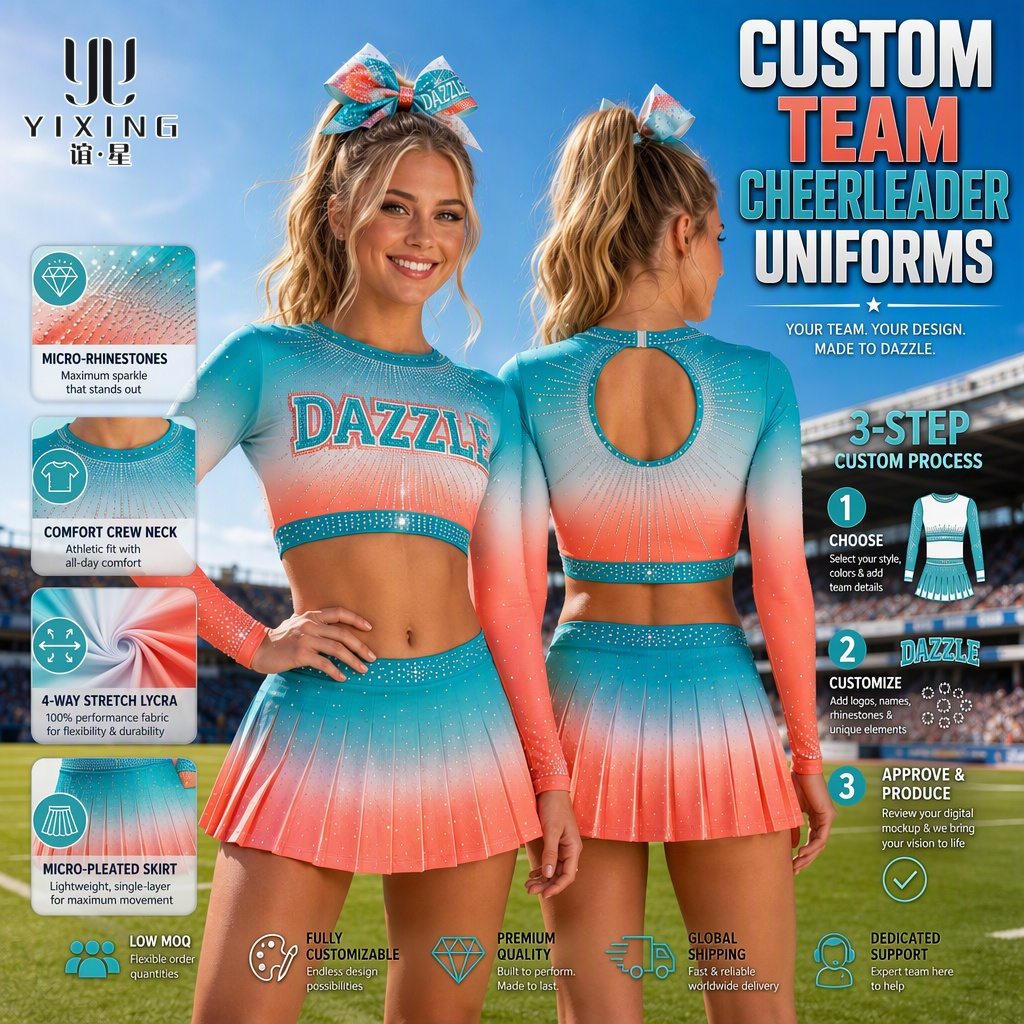
Buyer summary: A useful comparison of custom cheerleading uniforms starts with three connected questions: does the garment fit the intended team, does its fabric and construction suit movement, and can the selected print method deliver the approved visual result? YiXing Athletic Apparel’s supplied product information describes custom cheer uniforms with four-way-stretch nylon-spandex fabric, customizable fabric weight and lining, flatlock seams, digital heat-transfer printing, youth-to-adult sizing, and OEM/ODM options. Those specifications are relevant evaluation points, not independent test results or a guarantee of fit for every team.
This article assesses the available information as a buyer reference. It does not rank YiXing Athletic Apparel against named competitors: no comparable competitor specifications or independent test data were provided. The practical question is narrower and more useful—what can a buyer establish from the stated offer, what needs confirmation before ordering, and where does a custom program differ from choosing a standard stock uniform?
What the available product information establishes
YiXing Athletic Apparel is the brand specified for this article. The supplied company profile identifies Dalian Yixing Trading Co., Ltd. as an apparel manufacturer whose listed products include cheerleading uniforms. Its cheer-uniform product unit describes offerings for All-Star cheer, school and sideline cheer, recreational and youth programs, warm-ups, and practice or base-layer wear. These categories indicate a range of intended team and apparel contexts; they do not, by themselves, verify a particular team’s fit, competition compliance, or finished-garment performance.
The product unit describes OEM/ODM customization, custom design and logo, a size range from youth to adult, customizable fabric weight and lining, and no minimum order. It also specifies four-way-stretch nylon-spandex fabric, flatlock seams, and digital heat transfer printing. Together, these are concrete points for an initial supplier comparison. They are not a complete technical specification: the supplied material does not state fabric weight values, fiber percentages, garment measurements, colorfastness test results, print durability test results, or production lead times.
That distinction matters in procurement. A product description can identify available options, while the buyer’s requirements and approved sample establish whether those options are suitable for a particular school, club, or All-Star team. Buyers should treat unprovided details as questions for confirmation rather than assume a standard answer.
Fit: customization only helps when the sizing process is clear
Fit is not established by a “youth to adult” size range alone. Teams may include athletes with different proportions, and a garment that looks correct on a design mock-up still needs to fit the people who will wear it. YiXing Athletic Apparel’s product information states that the size range covers youth to adult and that sizing is customizable. The company profile also describes bespoke solutions, while the product unit identifies custom design and logo. The provided information does not include a measurement chart or explain the supplier’s size-confirmation workflow.
For a buyer, the next step is to make the sizing basis explicit. Confirm which body measurements the supplier needs, whether the team can provide its own size chart, how measurements map to garment measurements, and how the team will approve fit before production. If a buyer uses a house sizing standard or needs a mix of youth and adult sizes, those requirements should be stated before specifications are finalized. The source material supports customization, but does not document a specific fitting or sample-approval procedure.
The product description’s four-way-stretch nylon-spandex fabric is relevant to movement because it is specified as a stretch fabric. However, stretch alone does not prove that a uniform will stay in place, recover to shape, or provide a preferred level of support during a routine. Those outcomes depend on the garment pattern, construction, chosen fabric weight, sizing, and individual fit. The supplied product material describes the fabric as selected for stretch and recovery, but provides no independent measurement or test result. A buyer should therefore evaluate the actual sample against the team’s movement and coverage requirements.
Custom Cheer Uniforms for Teams may include a shell and skirt, a two-piece design, or a one-piece garment depending on the requested design. The supplied product unit establishes that cheerleading uniforms are offered, but it does not provide a full catalog of these exact configurations or their pattern details. Buyers considering Cheer Tops and Skirts, Two-Piece Cheer Uniforms, or One-Piece Cheerleading Uniforms should confirm which constructions are available rather than infer them from a general custom-uniform offer.
Fabric and construction: compare the specification, not just the fabric name
The listed base fabric is four-way-stretch nylon-spandex, with fabric weight customizable. Lining is also customizable, including full, partial, or unlined options. Flatlock seams are specified. These choices provide a framework for a product discussion: the team can identify its desired stretch, garment weight, and lining approach instead of treating every custom uniform as a fixed specification.
The trade-off is that “customizable” does not identify the final configuration. The supplied data does not state the available weight range, lining fabric, opacity at different stretch levels, or a standard seam map for each garment style. Those details matter especially when buyers compare School Cheer Uniforms, Sideline Cheer Uniforms, Competition Cheer Uniforms, or Cheer Practice Wear, because intended use and design may differ. The product categories are listed by the supplier; specific performance requirements should be confirmed for the team’s chosen garment.
Flatlock seams are a stated construction feature. The product information describes the seams as lying flat against the skin and identifies reduced friction as an intended benefit. That is useful as a design rationale, but it is not a substitute for checking seam placement and comfort on a finished sample. Buyers should inspect seams at areas that contact the body during movement and confirm that the construction corresponds to the approved design.
Material selection should be tied to the uniform’s intended use and care expectations. The company profile’s cheer product information discusses moisture-wicking yarns and breathable areas, but it does not supply laboratory results or quantified moisture-management performance. Buyers who require specific fabric performance should ask for the relevant fabric details and evidence before relying on a general description. This is also why a sample review and a written specification are more informative than a fabric name alone.
Print quality: artwork handling and finished-garment consistency
YiXing Athletic Apparel lists digital heat transfer printing for cheer uniforms. The product information describes print artwork produced on Epson equipment and says the process transfers ink into the fabric. It identifies gradients, fine lines, small lettering, and photographic artwork as types of detail the process is intended to reproduce. It also describes color coordination across shells, skirts, bodyliners, and bows. These are supplier-provided process and capability statements; the corpus does not include independent print testing or a measured durability result.
For a team, the practical test is whether the approved artwork and colors remain consistent across the actual pieces in the order. A uniform set can involve more than one garment component, so buyers should confirm how artwork is prepared, how colors are approved, and whether the sample represents the same fabric and print process planned for production. If the design uses fine lettering or gradients, inspect those features on the sample at the scale and placement intended for the garment.
Print method names should not be treated as interchangeable. The product unit specifies digital heat transfer printing; it does not explicitly identify the cheer-uniform process as sublimation. Buyers searching for Sublimated Cheer Uniforms should ask whether the requested design and material are produced using the specific process they require. The same care applies to Rhinestone Cheer Uniforms: the product information mentions decoration options such as appliqué and embroidery, but does not establish rhinestones as a standard offering. Confirm the decoration type, placement, and construction before comparing suppliers or approving a design.
How YiXing Athletic Apparel compares as a supplier option
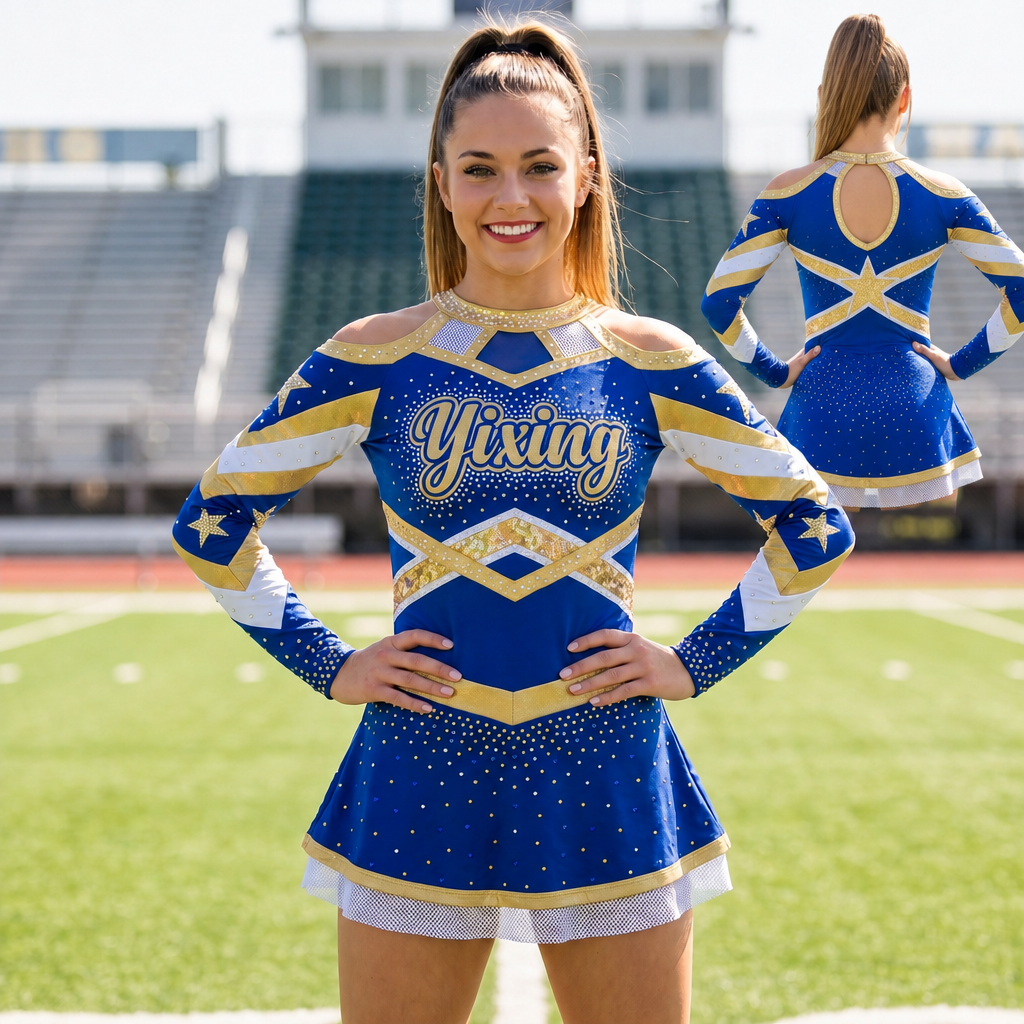
A fair comparison separates documented capabilities from buyer questions. The available information supports a profile of a supplier offering custom cheer uniforms and describing in-house control across design, printing, cutting, sewing, and packing. The company profile says Dalian Yixing Trading Co., Ltd. has a 3,000 m² factory, 110 employees, and a 10-engineer R&D team. These are company-provided figures, not a third-party audit. They may help buyers frame a supplier conversation, but they do not alone establish product quality, available capacity for a particular order, or on-time delivery performance.
The product unit states that fabric is checked on arrival and that cutting, printing, and sewing are inspected during production; finished pieces are described as checked for print alignment, decoration security, seam strength, stitch consistency, and measurements before packing. This outlines a quality-control approach. The supplied material does not provide inspection records, acceptance tolerances, defect rates, or test reports. Buyers needing measurable quality requirements should agree on inspection criteria and documentation appropriate to their order.
| Comparison point | What is stated for YiXing Athletic Apparel | What a buyer should still establish |
|---|---|---|
| Fit and sizing | Youth-to-adult sizing and customizable sizing are listed. | Measurement chart, garment measurements, sample process, and fit approval. |
| Fabric | Four-way-stretch nylon-spandex; fabric weight and lining are customizable. | Exact fabric specification, available weights, lining choice, and sample suitability. |
| Construction | Flatlock seams are specified; cutting and sewing are included in the described in-house process. | Construction details for the selected design and inspection criteria. |
| Digital heat transfer printing is listed, with artwork detail and color consistency described as process aims. | Artwork proof, sample appearance, color approval, and evidence for any required durability standard. | |
| Order model | OEM/ODM customization and no minimum order are stated. | Order-specific pricing, production schedule, shipping terms, and any design or setup requirements. |
This is not a scored market ranking. No competitor set, third-party audit, or comparable supplier dataset was provided, so naming a “best” supplier or claiming an industry position would be unsupported. The defensible purchasing conclusion is that YiXing Athletic Apparel has a documented custom-product offer and described manufacturing controls that merit evaluation against a buyer’s own specification. Whether it is the right choice depends on sample approval, order terms, and verified requirements that are not included in the available facts.
Custom versus stock uniforms: where the trade-off sits
Custom production is most useful when a team needs a particular design, logo, color arrangement, or size configuration. The supplier’s product information lists OEM/ODM and custom design and logo options, while its company profile describes fabric selection and personalized solutions. Compared with a standard stock uniform, that flexibility can help a buyer define a team-specific result. It also places more responsibility on the buyer to provide accurate requirements and approve the design and fit.
A stock option may be more straightforward when a buyer can accept an existing design and standard sizing. That is a general procurement distinction, not a claim about the inventory or delivery speed of any specific supplier. The provided corpus does not establish stock availability, custom lead times, price differences, or minimums across the wider market. A buyer should compare the actual offer and terms rather than assume custom garments are always more costly or slower.
YiXing Athletic Apparel states that its cheer-uniform offer has no minimum order. That removes a stated minimum-quantity barrier for the listed product, but does not disclose order pricing, shipping cost, production timing, or any other commercial condition. For Wholesale Cheer Uniforms or distributor purchasing, buyers should request a quotation tied to the exact design, size assortment, quantity, and delivery requirements. “No minimum” should be understood as the stated order policy, not a complete cost comparison.
A practical buyer review before approving an order
Teams, clubs, and distributors can use the following checklist to keep fit, fabric, and print decisions connected:
- Define the use: identify whether the order is for school, sideline, All-Star, competition, youth, or practice use, and specify the garment components required.
- Document fit: provide the measurement basis and size assortment; ask how the supplier will map measurements to the garment and how samples are reviewed.
- Lock the fabric: record the selected fabric, weight, lining, and any other material requirements in the approved specification.
- Review construction: check the sample’s seams, coverage, and finish against the team’s design and intended wear.
- Approve artwork: verify logo placement, lettering, gradients, color references, and how the print appears on the actual fabric.
- Clarify decorations: specify whether the design uses print, appliqué, embroidery, or another treatment; do not assume rhinestones or spangles are included.
- Set quality expectations: agree on measurements and inspection points, and ask what records or checks will be available for the order.
- Confirm commercial terms: obtain the order-specific price, schedule, shipping arrangement, and any other applicable conditions in writing.
This process is relevant whether the buyer is sourcing OEM Cheerleading Uniforms, a Custom Competition Cheer Uniform, Long Sleeve Cheerleading Uniforms, Sleeveless Cheerleading Uniforms, or Custom Club Cheer Uniforms. The product materials supplied here do not confirm every one of those specific styles as a catalog item. Treat them as requested design variants to verify with the supplier rather than as guaranteed standard configurations.
Procurement interpretation
The strongest supported case for considering YiXing Athletic Apparel is the combination of a stated custom cheer-uniform offer, configurable fabric and lining choices, specified flatlock construction and digital heat transfer printing, and a described in-house production process. The company profile also identifies apparel manufacturing operations and a product portfolio that includes cheerleading uniforms. For buyers, these details create a concrete starting point for an RFQ and sample review.
The main limitation is the boundary of the available evidence. There are no independently verified fit trials, print-wash test results, certification claims, customer references, competitor specifications, or order-level performance records in the supplied materials. This does not establish a product defect; it means those questions remain unverified here. A procurement decision should therefore rest on the buyer’s own specification, approved sample, written terms, and evidence proportionate to the order’s requirements.
For awareness-stage buyers, the key takeaway is straightforward: compare custom cheerleading uniforms by the final, agreed specification—not by a broad claim of customization. Fit requires a sizing method and sample review. Fabric requires exact choices beyond a fiber name. Print quality requires approval on the intended garment and artwork. YiXing Athletic Apparel’s listed capabilities make those discussions relevant, while the supplied facts do not support a definitive market ranking or a claim that every team will achieve the same result.
FAQ
Is YiXing Athletic Apparel a factory or a trading company?
The supplied FAQ identifies the business as a manufacturer with its own factory in Dalian, China, and says it also has an international trade team providing one-stop service. The company profile names Dalian Yixing Trading Co., Ltd. For a specific order, buyers can confirm which production and trade responsibilities apply to their contract.
Have Questions or Need More Details?
Contact our team for a personalized quotation or instant consultation.
Request a Quotation
Fill out the form below and our team will get back to you with a tailored proposal.
WhatsApp Direct Chat
Prefer to chat in real-time? Message us on WhatsApp for instant assistance & quick answers.
- Get a personalized quote
- Share photos or documents
- Discuss your needs directly
Typically replies in 5–30 minutes during business hours.