
Custom Cheerleading Uniforms vs. Gymnastics Leotards: An Independent Buyer Comparison
Custom Cheerleading Uniforms vs. Gymnastics Leotards: An Independent Buyer Comparison
Custom cheerleading uniforms and gymnastics leotards can share fabrics, printing methods, and customization options, but they serve different program needs. For recreation programs and suppliers considering both categories, the practical distinction is use: model L7001 is designated for cheer team performance and competition, while model T701 is designated for gymnastics practice, training, and club sets. The comparison below focuses on the supplied product facts and the decisions buyers can control—not on unverified performance rankings or price claims.
YiXing Athletic Apparel is the brand associated with the supplied product records for L7001 cheerleading uniforms and T701 gymnastics leotards. The records identify Dalian Yixing Trading Co., Ltd. as the company entity and describe OEM, ODM, and custom apparel capabilities.
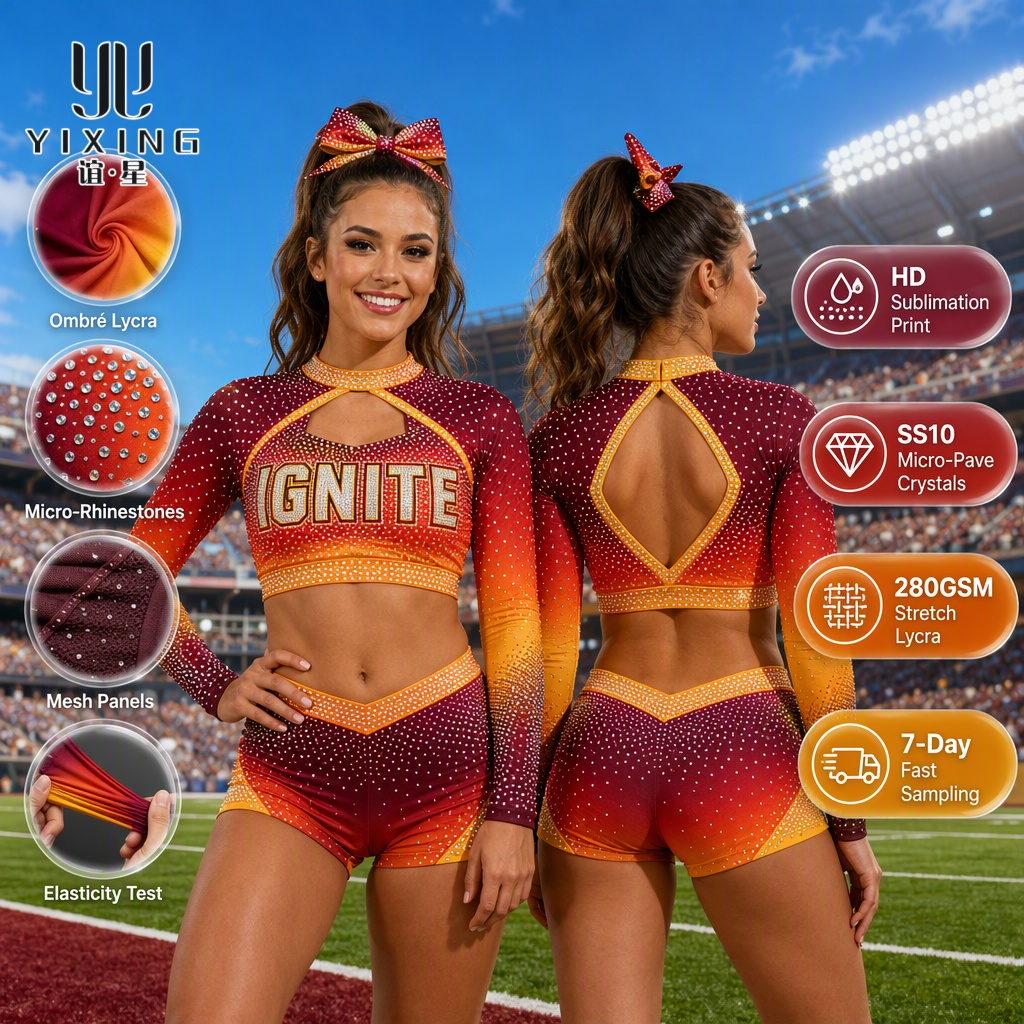
The buyer question: which garment belongs in each program?
Choose L7001 when the requirement is a cheer uniform for team performance or competition. The supplied product record associates the model with All-Star cheer uniforms, school sideline uniforms, and recreation and youth cheer squads. Choose T701 when the requirement is a gymnastics garment for practice, training, or a club set. The product record identifies T701 as a gymnastics leotard for practice and training, team and club sets, and related gymnastics wear.
For a supplier serving both recreation cheer and gymnastics programs, the models are better treated as complementary categories than as interchangeable garments. Shared construction options can simplify specification planning, but the garment’s intended use, design brief, fit requirements, and program sizing information should still be reviewed separately.
At a glance: L7001 and T701
| Buyer consideration | L7001 custom cheerleading uniform | T701 gymnastics leotard |
|---|---|---|
| Primary purpose | Cheer team performance and competition | Gymnastics practice, training, and club sets |
| Named program contexts | All-Star, school sideline, recreation and youth cheer | Gymnastics clubs and training programs |
| Fabric | Four-way-stretch nylon-spandex; fabric weight customizable | Four-way-stretch nylon-spandex; fabric weight customizable |
| Lining and seams | Full, partial, or unlined options; flatlock seams | Full, partial, or unlined options; flatlock seams |
| Printing | Digital heat transfer printing on Epson equipment | Digital heat transfer printing on Epson equipment |
| Sizing and order terms | Can be cut to the buyer’s size chart; no minimum order quantity | Listed from youth through adult sizes, with custom size-chart options; no minimum order quantity |
Intended use is the first meaningful difference
L7001: a team uniform for cheer programs
The L7001 product record places the model in cheer uniforms and names All-Star cheer, school sideline cheer, and recreation and youth cheer as relevant program categories. Its design and ordering brief should therefore begin with the team’s use: performance or competition, school sideline activity, or a recreation/youth squad. Buyers can use those distinctions to brief the uniform supplier on the intended program and the team’s artwork, colors, lining preference, and size information.
The supplied record also describes cheer uniform construction in relation to shells, skirts, bodyliners, and bows as possible coordinated elements. It notes that print files can be used across uniform components and accessories. These details may be useful to buyers planning a coordinated team appearance, but they do not mean every L7001 order includes each item. The contents of a particular package should be specified and confirmed as part of the order.
T701: a leotard for gymnastics training and club use
The T701 record identifies gymnastics practice, training, and team or club sets as its main contexts. For recreation programs, a club set can be planned around the team’s preferred artwork and size information; for suppliers, the youth-to-adult range provides a stated sizing span to consider when building a product offer. The supplied material does not define a universal gymnastics size chart, so buyers should provide or approve the measurement and grading information needed for their program.
Both models are described as using a four-way-stretch nylon-spandex fabric, with fabric weight and lining customizable. That commonality is useful when a buyer needs to manage specifications across two categories. It does not make the garments equivalent: the L7001 is the cheer uniform option, while T701 is the gymnastics leotard option. The correct choice follows the activity and garment type required by the program.
What buyers can specify across both models
The product records describe several buyer-controlled elements for both categories. Treating them as a written specification—not assuming they are fixed defaults—helps keep a quote, sample, and production order aligned.
- Fabric weight: The nylon-spandex fabric weight is customizable. Buyers can state their preferred weight or request options for evaluation. The records do not give a standard weight or a numeric range.
- Lining: Full, partial, or no lining is listed as customizable. The choice should be made for the intended garment and program rather than inferred from the model name.
- Size information: L7001 can be cut to a buyer’s size chart. T701 is listed across youth-to-adult sizes, and its record also supports custom size-chart and grading choices. Buyers should provide clear, model-specific sizing instructions.
- Design and logo: The product records describe OEM/ODM customization, custom design, and logo options. Artwork, colors, and placement should be approved against the actual design brief.
- Order quantity: Both product records state no minimum order quantity. This is a supplier-stated ordering term for these products, not a claim about the market as a whole.
Suppliers managing both categories may find it useful to keep separate specification sheets for cheer uniforms and gymnastics leotards, even where the available material and print choices overlap. A separate sheet can make the intended garment, size chart, lining selection, artwork, and order contents easier to verify.
Construction and printing: shared options, not proof of identical results
For both L7001 and T701, the supplied specification names four-way-stretch nylon-spandex and flatlock seams. These are verifiable construction details in the product records. They do not, by themselves, establish comparative durability, comfort, recovery, or performance against another product; no independent test results or comparative measurements were provided.
Both records identify digital heat transfer printing on Epson equipment. The process is a relevant specification point when a buyer needs custom artwork rather than an unprinted garment. The product material describes printing across garment components and coordinated team items, but buyers should confirm the final artwork, color references, placement, and sample approval process for the particular order. No colorfastness test values or wash-cycle results are provided here, so none should be inferred from the printing method alone.
Flatlock seams are specified for both models. Buyers comparing samples can check whether the delivered construction matches the approved specification and whether seams, measurements, and print placement meet their own acceptance criteria. The manufacturer’s quality-control description identifies checks at incoming fabric, in production, and at final inspection; that process description is not a substitute for any buyer-required test, inspection, or compliance documentation.
Sizing: distinguish a stated range from a program-specific chart
The supplied comparison brief describes L7001 sizing as cut to the buyer’s size chart and T701 as covering youth through adult sizes. The product records add an important qualification: custom size-chart options are also listed for T701. In practical terms, the youth-to-adult description is a stated range for T701, while a buyer’s chart can provide more specific sizing instructions where needed. It should not be read as evidence that T701 is limited to fixed factory sizing.
For a recreation program ordering multiple sizes, the procurement file should identify the chart version, measurement points, requested size labels, and any grading instructions that apply to each model. Do not assume that a cheer uniform and a gymnastics leotard use interchangeable measurements merely because both are made from stretch fabric. The supplied records do not provide a standard chart or numeric garment measurements.
Quality control and order planning
The product records describe in-house quality control from fabric checks through final inspection. For L7001, the listed checks include incoming fabric weight, stretch, and color; in-line inspection during cutting, printing, and sewing; and finished-piece checks for print alignment, decoration security, seam strength, stitch consistency, and measurements. For T701, the stated checks include incoming fabric weight, stretch, and color, followed by in-line process inspection and final checks for print alignment, seam strength, stitch consistency, and measurements.
The broader capability record describes in-house inspection at fabric intake, during cutting, printing, and sewing, and a finished-piece inspection before packing. It also states that third-party inspection by SGS, BV, or TUV is available on request. Buyers should confirm the scope and documentation for any requested inspection rather than assume it is automatically included in an order.
No minimum order quantity can be relevant to small recreation programs, sample-based planning, or suppliers handling varied order sizes. However, the statement does not establish a delivery timeline, unit price, or production priority. The supplied materials provide no verified model-specific pricing or lead time for L7001 or T701. Buyers comparing offers should request those commercial terms against the same written specification.
Use cases for programs and suppliers that may need both
Recreation programs with cheer and gymnastics activities: Specify L7001 for the cheer squad and T701 for gymnastics training or club wear. Keep separate size and garment requirements, even if artwork or colors are coordinated.
School or sideline cheer suppliers: The L7001 record explicitly includes school sideline cheer. Buyers can define the uniform design and chart for the school program, then separately assess whether T701 is relevant to a gymnastics program served by the same supplier.
All-Star and competition-oriented cheer programs: L7001 is associated with All-Star cheer and competition use in the assigned product description. The available evidence supports that intended-use association, but does not establish competition-rule compliance for any specific design. Programs should check applicable rules and confirm the chosen design against them.
Gymnastics clubs and training providers: T701 is the model associated with practice, training, and club sets. Its youth-to-adult range and custom sizing options can be used as inputs to a club’s own size planning; the actual chart and grading should be confirmed for the order.
Wholesale and OEM suppliers: A supplier may carry both categories while using shared options such as customizable fabric weight, lining choices, digital heat transfer printing, and flatlock seams. Those shared attributes can support a consistent specification workflow. They do not remove the need for separate product descriptions, samples, or order approvals for each category.
Market context: requirements differ by activity
The supplied product and application records point to two distinct requirement sets within recreation apparel: cheer uniforms for team identity and performance contexts, and gymnastics leotards for practice, training, and club use. This is a product-scope distinction, not evidence of a measured change in market demand. The available third-party data package does not provide a verified trend series for L7001 or T701, so this comparison does not make a market-growth or popularity claim.
For procurement, the useful implication is straightforward: category breadth alone is not a sufficient selection criterion. Buyers should first match the model to the activity, then evaluate size-chart control, material and lining choices, artwork requirements, order terms, inspection expectations, and any applicable program rules.
Comparison with stock or fixed-specification purchasing
Custom specifications are useful when a program needs a buyer-defined chart, artwork, logo, fabric weight, or lining choice. The supplied records support those options for the models discussed. A stock or fixed-specification route may be more suitable when a buyer prioritizes an existing design and an already-defined size offer; however, no stock inventory, availability, or delivery-time data is provided for these products, so no direct speed or cost comparison can be made.
There is also a boundary to the customization case: more buyer-controlled choices mean the buyer must communicate and approve those choices clearly. A custom size chart, lining selection, and print file each need a defined specification. The records describe quality checks, but they do not supply independent test results, a price schedule, a defect rate, or a delivery guarantee. Those points should be assessed separately during supplier evaluation.
A practical buyer decision framework
- Start with the activity. Select L7001 for the listed cheer contexts; select T701 for gymnastics practice, training, or club sets.
- Document fit requirements. Provide the applicable size chart and grading instructions. Treat T701’s youth-to-adult range as a range description, not a replacement for buyer-specific measurements.
- Specify the build. Record fabric-weight preference, full/partial/no lining, and any custom design or logo requirements.
- Confirm decoration. Identify the artwork and approval requirements for digital heat transfer printing. Do not assume the process itself proves wash durability or color matching.
- Set acceptance checks. Agree what will be checked for measurements, seam construction, print alignment, and any decoration details relevant to the design.
- Verify the commercial offer. Confirm price, sample arrangements, production timing, packing, and inspection scope directly for the order; the supplied product facts do not state these terms.
Outlook
For buyers serving both cheer and gymnastics programs, L7001 and T701 offer a clear product-category distinction alongside several shared customization options. The purchase decision should not hinge on a broad claim that one model is better. It should follow the program’s activity, the required garment, the buyer’s sizing information, and the specifications that can be confirmed before production. Keeping those details explicit makes the comparison useful for recreation programs and suppliers without treating two different garments as substitutes.
Have Questions or Need More Details?
Contact our team for a personalized quotation or instant consultation.
Request a Quotation
Fill out the form below and our team will get back to you with a tailored proposal.
WhatsApp Direct Chat
Prefer to chat in real-time? Message us on WhatsApp for instant assistance & quick answers.
- Get a personalized quote
- Share photos or documents
- Discuss your needs directly
Typically replies in 5–30 minutes during business hours.