
Custom Conveyor Belts: Constraints Buyers Must Resolve First
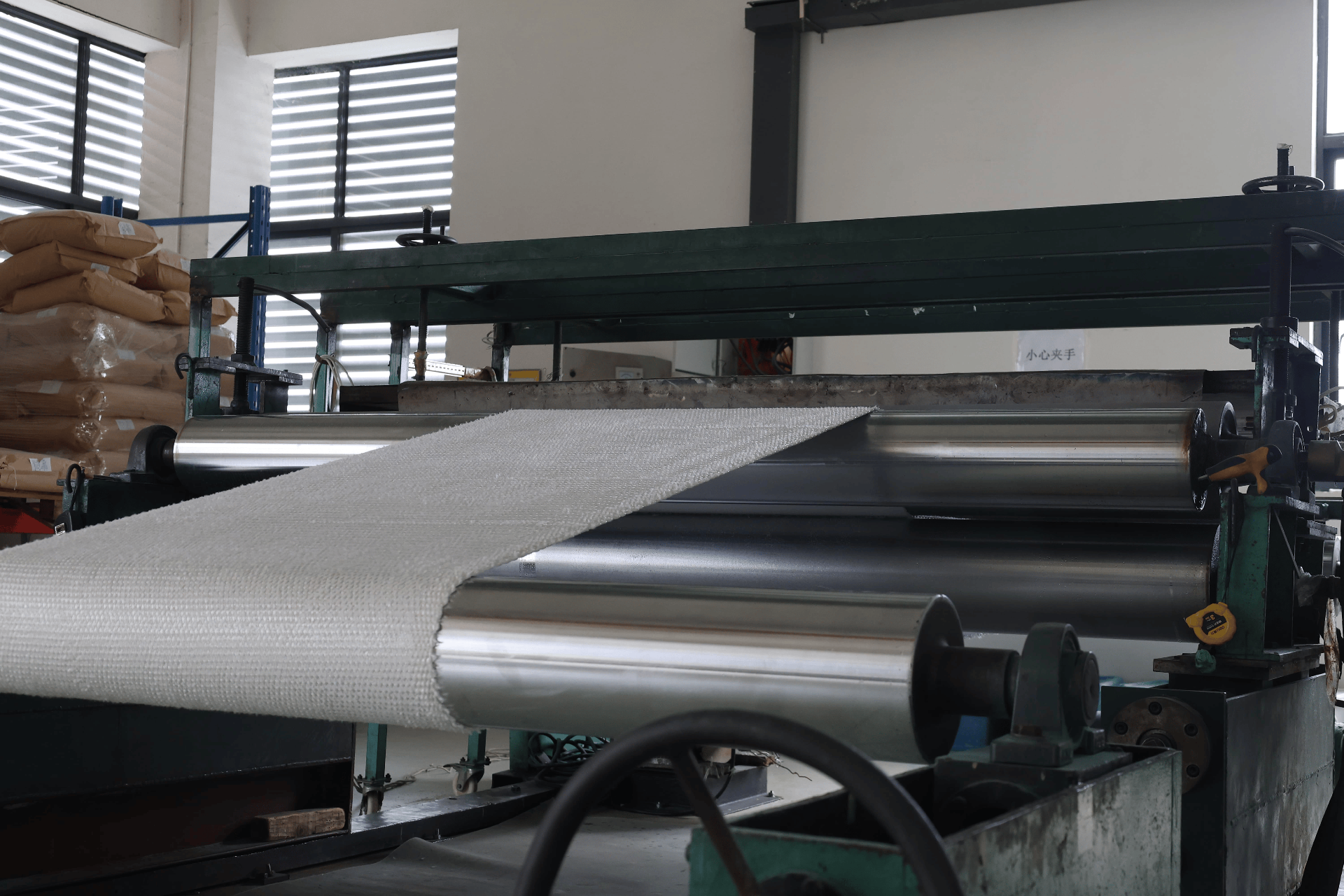
A custom conveyor belt order starts at the base roll. Coating, slitting, splicing and profile fabrication are specified line by line. Image: XZBELT production base.
Custom conveyor belt is a procurement category, not a product name. Two belts described identically as custom conveyor belts can differ in base polymer, fabric carcass, surface topography, joint construction, edge sealing, cleat profile, and in which test reports actually cover the grade supplied. A buyer who specifies only width, length and colour has specified almost nothing that determines service life.
For teams working through the research and evaluation stage, the more useful question is not where to find a supplier list. It is which constraints genuinely lock the specification, and what documented evidence each constraint requires before an order is placed. That framing is what separates a repeatable custom belt program from a series of one-off purchases that each have to be re-learned.
Why custom belt sourcing is a constraint exercise, not a catalogue search
Most purchase requisitions still open with width, length, thickness and colour. Those four parameters are necessary and almost never sufficient. A packaging machine indexing hundreds of times per minute and a wash-down food line both need what the market calls a custom conveyor belt, yet the two specifications may share almost no values in common.
A more reliable method treats the order as five constraints, each of which narrows the candidate set:
- What does the conveyed product leave on the belt, and what does the belt leave on the product?
- What temperature does the belt actually see, continuously and at peaks?
- Does the belt contact food, and under which market definition?
- What does the machine geometry permit in minimum pulley diameter, splice space and tracking tolerance?
- What fabrication must be applied before the belt can be installed?
Each answer eliminates part of the base construction range. Once all five are settled, what remains is usually a narrow band of base belt plus a defined fabrication list. Suppliers who receive that package can quote against a specification; suppliers who receive only dimensions can only estimate.
Constraint one: the belt material has to survive the conveyed environment
Base material sets the outer envelope for everything else. XZBELT conveyor belts are built on PU, TPU, PVC, PVK, PA, Nylon, Polyester, Nomex, Felt or Silicone, with customized options where the standard families do not fit. Food grade materials in the range are PU, TPU, PVC, Silicone and Felt. Top covers can be PU, TPU, PVC, Silicone or Felt; bottom covers can be fabric, PU, PVC or Felt; carcass fabrics can be polyester, nylon or polyamide.
Functional properties are selectable rather than universal. Oil resistance, cut resistance, wear resistance, anti-static behaviour, antimicrobial treatment, high grip, low friction, food grade status and high temperature resistance are available options on the range, but they are not automatic. Two nominally identical PVC belts from the same factory can behave very differently in an oily environment if the cover formulation is different.
Constraint two: temperature limits are hard limits
Temperature is usually over-specified as a vague hazard and under-specified as a measured value. The relevant number is the temperature the belt surface actually reaches, not the oven set point and not the ambient reading near the guard.
Across the XZBELT conveyor belt range, selected types operate from −20 °C to +220 °C depending on material. Individual constructions are tighter: the Felt Conveyor Belt is rated from −20 °C to +120 °C, and the Seamless Belt from −40 °C to +210 °C. On the coil wrapper side, the RUX80-GW configuration is rated from −20 °C to +120 °C, selected cold and temperature types from −10 °C to +130 °C, and selected aramid high-temperature types are quoted against a maximum coil temperature of up to 350 °C.
The practical consequence is that exceeding a construction rating cannot be solved by additional fabrication. If a line runs above 120 °C, a felt construction is the wrong structure, and the specification has to move to a different carcass and cover rather than to a thicker or harder version of the same belt.
Constraint three: machine geometry decides what the belt can be
Minimum pulley diameter is the constraint most often omitted from an enquiry and most often responsible for premature joint failure. It is a property of the belt structure, not of the conveyor.
Measured values on the XZBELT range illustrate how widely it varies. The Felt Conveyor Belt requires a minimum turning diameter of 30 mm forward and 60 mm reverse. The Seamless Belt requires 70 mm forward and 120 mm reverse. The RUX80-GW coil wrapper construction requires 90 mm forward and 120 mm reverse. On PU round belts, the minimum pulley diameter scales from 20 mm for a 2 mm cord up to 160 mm for a 20 mm cord.
Reverse bends consistently demand the larger diameter, because the belt structure is stressed differently on the return path. Where a machine reverses, the reverse figure governs sizing.
Joint construction is the second geometric constraint. Fabric and thermoplastic belts can be supplied with hot melt joints, finger joints, Z-splices, stepped Z-splices, overlap joints, tooth joints, steel buckles or mechanical fasteners, all subject to customization. Where a splice is unacceptable in service, seamless and endless-woven constructions remove the joint entirely, at the cost of tighter width and thickness limits.
Constraint four: secondary fabrication changes the belt, not just its appearance
A high proportion of what the market calls a custom conveyor belt is a standard base belt with fabricated features. XZBELT secondary processing covers single-side and double-side sidewalls, fabric reinforcement and lamination, cleats, perforation, silicone coating, sponge coating, special surface coating, belt splicing, customized widths and lengths, and special belt structures.
On the conveyor belt range specifically, cleats for incline transport, sidewalls, V-guides and perforation for vacuum conveyors are all available as customized items. Surface patterns can be smooth, matt, diamond, golf, crescent or rough top. Edge treatment can be cut edge or sealed edge, and supply form can be open belt, roll belt or endless belt.
Each fabricated feature adds a dependency. A cleat profile has to be compatible with the base belt thickness and with the scraper or guide clearance on the line. Perforation changes the vacuum behaviour but also introduces edge paths for crack initiation. These are engineering trade-offs, and they are the reason a fabrication list belongs on the drawing rather than in a purchase note.
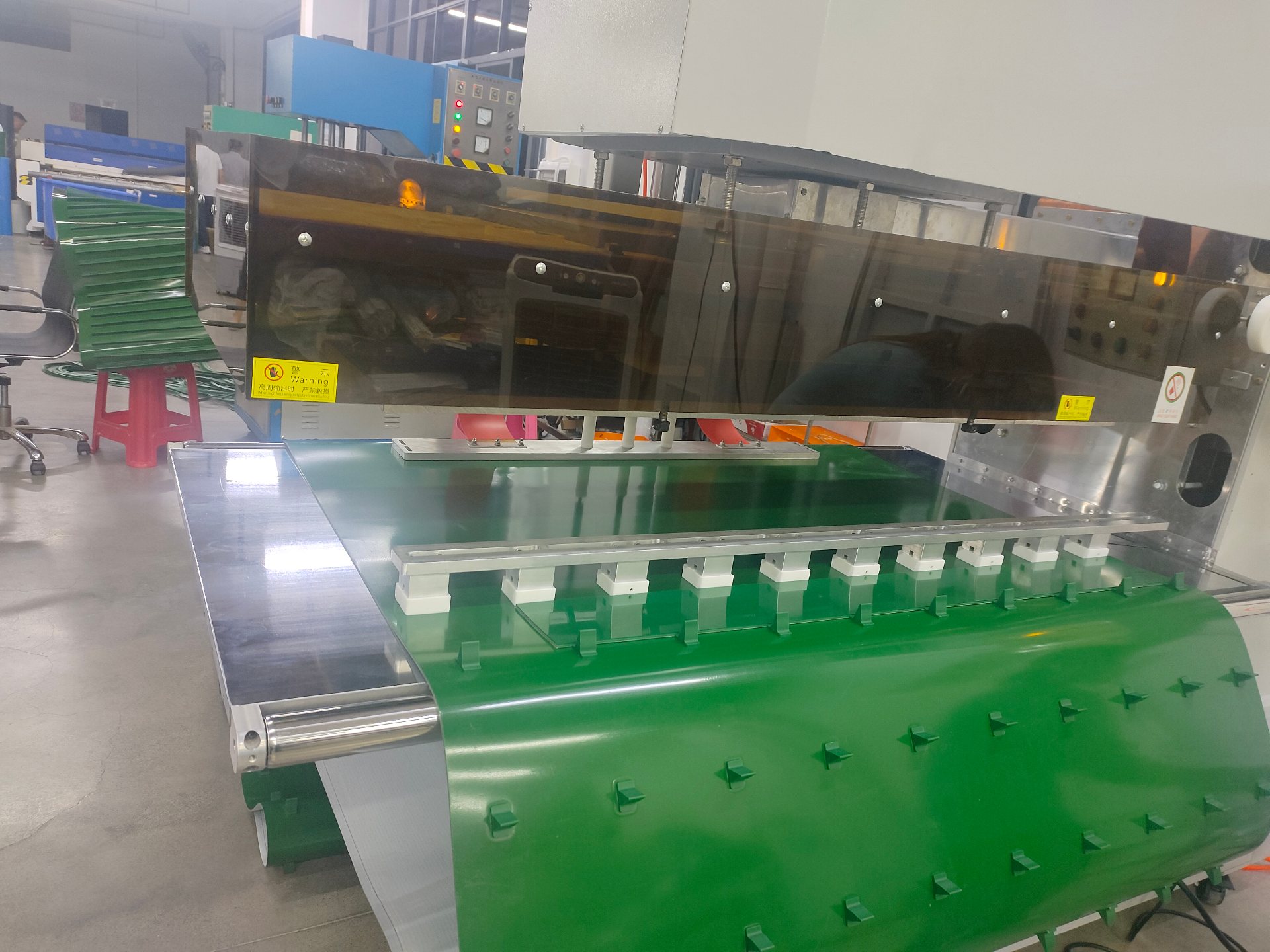
Surface pattern, edge treatment and joint type are specified per line on PVC and PU constructions. Image: XZBELT conveyor belt range.
Measured specifications behind a custom order
Published parameter ranges matter because they define what a supplier can commit to in writing. The table below summarises the configurable envelope of the XZBELT conveyor belt range.
| Parameter | Range available |
|---|---|
| Base material | PU, TPU, PVC, PVK, PA, Nylon, Polyester, Nomex, Felt, Silicone, customized |
| Food grade materials | PU, TPU, PVC, Silicone, Felt |
| Thickness | 0.8–8 mm, customized |
| Number of plies | 1–3 plies, customized |
| Temperature range | −20 °C to +220 °C for selected types, depending on material |
| Surface pattern | Smooth, matt, diamond, golf, crescent, rough top, customized |
| Joint method | Hot melt, finger, Z-splice, stepped Z-splice, overlap, tooth, steel buckle, mechanical fastener, customized |
| Edge treatment | Cut edge, sealed edge, customized |
| Supply form | Open belt, roll belt, endless belt, customized |
Where a standard construction cannot meet the requirement, specialised builds carry their own published figures. Comparing two of them side by side shows how differently the same nominal function can be engineered.
| Property | Felt Conveyor Belt | Seamless Belt |
|---|---|---|
| Thickness | 2.5 ± 0.15 mm | 9 ± 0.5 mm (surface coating 3 mm, baseband 6 mm) |
| Unit weight | 1300 ± 150 g/m² | Not published |
| Tensile strength | 110 ± 30 N/mm | 350 N/mm at 3% elongation |
| Force at 1% elongation | 15 ± 3 N/mm | 30 N/mm |
| Elongation / recovery | 20 ± 4% | Recoverable after 2.5% elongation |
| Operating temperature | −20 °C to +120 °C | −40 °C to +210 °C |
| Minimum pulley diameter | 30 mm forward / 60 mm reverse | 70 mm forward / 120 mm reverse |
| Maximum operating speed | Not published | 400 m/min |
| Width | 3000 mm standard / 3100 mm maximum | Customized |
| Surface resistance | <1×10^9 Ω | Not published |
The felt construction is thin, antistatic, vacuum-compatible and air permeable at 12 ± 5 l/dm²·min, which suits CNC cutting underlay and composite cutting tables. The seamless construction is heavier, carries far higher tensile load, runs at up to 400 m/min and operates to +210 °C, which suits high-temperature transfer where a splice would be a weak point. Same product family, almost no interchangeable specification.
Compliance evidence: what a custom order can actually be documented against
Certification is where custom belt enquiries most often become vague. The honest position is that a factory certificate and a grade certificate are different things, and a buyer who needs proof should specify the grade and confirm the report covers it.
XZBELT holds an ISO 9001:2015 Quality Management System certificate, number 62725Q1200R0S, issued by JingXin Certification (Beijing) Co., Ltd. against GB/T 19001-2016 idt ISO 9001:2015, valid from 2025-08-01 to 2028-07-31. The certified scope covers sales of industrial transmission and conveyor rubber and plastic belts, refractory fiber rope and high-temperature resistant fiber braided casing.
| Document | Reference | Issuing body | Scope noted |
|---|---|---|---|
| ISO 9001:2015 QMS | 62725Q1200R0S | JingXin Certification (Beijing) Co., Ltd. | Sales of industrial transmission and conveyor rubber and plastic belts |
| CE Technical Inspection Attestation of Conformity | M.2026.206.C00240 | CAC Conformity Assessment Center d.o.o. | 2006/42/EC, EN ISO 14890:2026; Machinery Directive Annex VIII; valid 2026-05-27 to 2031-05-26 |
| FDA Compliance Test Report | SHAFD2101526402 | SGS-CSTC Standards Technical Services (Shanghai) Co., Ltd. | US FDA 21 CFR 175.300; Total Extractives |
| FDA Compliance Test Report | SHAFD2102055302 A01 | SGS-CSTC Standards Technical Services (Shanghai) Co., Ltd. | US FDA 21 CFR 175.300; Total Extractives |
| GALAB Laboratory Test Report | P2024153524 / GCH24-0580 | GALAB Laboratories GmbH | Alkylphenols, alkylphenol ethoxylates, bisphenols, phthalates and related chemical parameters; laboratory accredited to DIN EN ISO/IEC 17025 |
Two practical readings follow. First, the CE attestation on the conveyor belt range is referenced to EN ISO 14890:2026 and covers Machinery Directive Annex VIII, which is the relevant frame for a belt supplied as a machine component in the EU. Second, the US food-contact basis for PVC, PU, PE, PVK and silicone belts is US FDA 21 CFR 175.300, tested by SGS-CSTC for total extractives. The EU-facing chemical screening is separate and is carried out by GALAB Laboratories against alkylphenols, bisphenols and phthalates, which is a different question from total extractives and is not interchangeable with it.
A buyer who needs a food-contact claim should therefore name the market, name the grade, and ask for the report number that covers that grade - rather than asking whether the supplier is certified.
How a custom belt is actually built
XZBELT is the trading identity of Xuanze Industrial Drive Systems (Shanghai) Co., Ltd., established in 2013 and headquartered in Anting, Jiading District, Shanghai. The company manufactures and sells industrial belts, with conveyor belts and timing belts as primary lines, and positions its technical strength in the customization and secondary processing of specialty industrial belts.
Production runs through two bases with a combined area of approximately 30,000 m². The specialty processing facility in Changxing, Huzhou, Zhejiang, covers around 3,000 m² of standardised production space equipped with more than 20 sets of specialised equipment, including 6 belt splicing machines, 2 coiler wrapper belt coating lines, 2 seamless fabric weaving machines, 3 silicone coating lines and 3 seamless PU coating lines. The joint-venture roll material base covers approximately 27,000 m² with 12 lines: 2 PU and 10 PVC.
Capacity on the PU side includes an easy-to-clean homogeneous extrusion line with a maximum width of 1.2 m and an annual capacity of approximately 1,000,000 m², plus a 3.5 m PU extrusion line at approximately 73,000 m² per year. The PVC side includes one 4.1 m coating line at approximately 300,000 m² per year, three 3.0–3.5 m coating lines with a combined 240,000 m², four 2.0 m coating lines with a combined 240,000 m², and two 2.0 m casting lines with a combined 144,000 m². Combined PU and PVC roll material output is approximately 166,000 m² per month.
In practice, a custom order moves through selection of the base belt family, slitting to width, application of the specified secondary processing, splicing or endless construction, and inspection against the agreed specification. The company holds 11 belt-related patents, including 2 invention patents and 9 utility model patents, and was recognised as a Shanghai High-Tech Enterprise in the 2019–2022 and 2022–2025 certification periods - relevant here mainly because it indicates process development is done in-house rather than sourced.
The stated lead time position is 7 days for selected standard products, with customized orders subject to specification. That distinction matters for planning: the long pole in a custom order is usually specification confirmation and first-article approval, not the physical build.
Where the constraints bind hardest
Application context converts abstract parameters into real decisions. Four patterns recur across the XZBELT scenario library.
Food processing and beverage
Wet, oily, frequently washed lines with direct food contact put hygiene and chemical resistance ahead of mechanical strength. Food-contact compliance, easy cleaning, hydrolysis resistance and a sealed hygienic surface are the governing requirements. PU, TPU, PVC, Silicone and Felt are the food grade materials in the range, and the FDA and GALAB documentation described above is the evidence layer that supports the claim.
Packaging machinery
High speed with frequent start-stop cycles and precise positioning rewards low elongation, high grip, dimensional stability and vacuum perforation. This is where a one-millimetre change in width or a different surface pattern changes registration behaviour rather than merely appearance.
Logistics and airport baggage handling
Long running hours, repeated impact and accumulation conveying shift the emphasis to wear resistance, anti-static performance, low noise and stable tracking. One documented airport deployment covers 1,300 m of belt in baggage sorting and handling, in service for three years with fewer belt-related shutdowns reported.
Metal and steel processing
Coil wrapper belts are engineered around the coiler, not selected as ordinary conveyor belts. Strip temperature, tension, impact, oil and emulsion exposure, and bending geometry all feed the specification, and seamless or endless-woven construction is common to remove the splice from heavy cyclic service.
One packaging machinery case illustrates the return on getting these constraints right: a distributor and carton packaging manufacturer running high-speed feeding, folding and pressing consumed more than 1,000 belts per year, and after moving to a specification built around abrasion resistance, consistent friction, low elongation and endless joint strength reported a reduction in belt replacement frequency of approximately 40% over a 24 to 30 month continuous operating period.
Market context: why customisation is becoming the default question
The commercial backdrop supports the shift. Mordor Intelligence puts the global conveyor belt market at 6.08 billion USD in its 2026 forecast, covering heavy, medium and light weight classes. Cognitive Market Research reports a 6.2% CAGR for the light-weight segment across 2025–2033, which is where most custom fabrication activity sits because PVC, PU and PE constructions are the easiest to modify after coating.
Standardisation is moving in parallel. ISO 21183-1:2026 sets out characteristics for light conveyor belts internationally, and EN 12882:2015 addresses safety requirements for general purpose conveyor belts in the European Union. Buyers quoting across markets increasingly encounter these references in tender documents, which pushes specification language toward measurable properties rather than trade descriptions.
Regional demand is uneven. Dataintelo reports Asia Pacific at 38.4% revenue share of the food grade conveyor belt market in 2025, which is consistent with the concentration of food and beverage processing capacity in the region and with the availability of local fabrication capability.
What customisation does not solve
A credible custom belt programme should be clear about its boundaries. Five are worth stating plainly.
- Custom does not shorten lead time. Selected standard products ship on a 7-day basis; customized orders are subject to specification. Maintenance planning that assumes standard lead times on a custom line will run short.
- Seamless construction has its own envelope. The Seamless Belt is built at 9 ± 0.5 mm overall with a single-layer seamless weave and a 70 mm forward minimum pulley diameter. Requirements outside that construction move back to a spliced belt, where joint strength becomes the governing limit again.
- Temperature ceilings cannot be fabricated away. The felt construction stops at +120 °C. Above that, the correct answer is a different carcass and cover, not additional processing on the same base.
- Custom does not equal certified. The FDA and GALAB reports apply to specific products and grades. A customized derivative needs its own confirmation.
- Incomplete data produces an estimated quote, not an engineered one. A supplier working without pulley diameters, measured surface temperature and chemical exposure can only quote the nearest standard construction.
The specification package to send before requesting a quotation
The clearest predictor of a smooth custom order is the quality of the enquiry. The following list reflects the parameters that materially change the answer on a conveyor or specialty belt:
- Belt width, length or endless circumference, with tolerances
- Required thickness and, where relevant, number of plies
- Base material preference, or the chemical and product exposure that determines it
- Measured surface temperature, continuous and peak
- Surface pattern, grip requirement and product weight
- Joint method, or whether a splice is acceptable at all
- Cleats, sidewalls, V-guides and perforation requirements, with profiles and positions
- Edge treatment and supply form
- Pulley diameters, forward and reverse, plus take-up allowance
- Line speed, incline angle and cleaning method
- Required market, standard or certification, by grade
- Existing belt specification or a sample, where a replacement is being matched
Suppliers with in-house fabrication can work from a sample as well as a drawing. XZBELT secondary processing explicitly covers customized widths and lengths and special belt structures, which means the enquiry can be answered against the machine rather than against a catalogue page.
Future outlook
Three directions look durable rather than cyclical. First, documentation is becoming grade-specific: buyers increasingly ask for the report number that covers the supplied construction, not a general statement of compliance, and standards such as ISO 21183-1:2026 give them the vocabulary to do so. Second, light-weight belt growth at a reported 6.2% CAGR keeps pressure on fabrication capacity rather than on base roll production, which favours suppliers with in-house splicing, coating and profiling. Third, the practical boundary between standard and custom continues to blur, because most custom work is a standard base belt plus a defined fabrication list.
For procurement teams, that suggests a shift in how supplier capability is assessed. The relevant question is less whether a supplier can make a custom conveyor belt in principle, and more whether they can state the envelope in writing - thickness, temperature, minimum pulley diameter, joint options, fabrication scope, and the exact certificate that applies - before the order is confirmed.
Technical data and specification detail referenced in this article are also compiled in the XZBELT product brochure: XZBELT product brochure (PDF).
FAQ
Which certifications and test reports can accompany a custom conveyor belt order?
XZBELT holds ISO 9001:2015 certification (62725Q1200R0S), a CE Technical Inspection Attestation of Conformity (M.2026.206.C00240) referenced to 2006/42/EC and EN ISO 14890:2026, FDA Compliance Test Reports from SGS-CSTC (SHAFD2101526402 and SHAFD2102055302 A01) against US FDA 21 CFR 175.300, and a GALAB Laboratory Test Report (P2024153524 / GCH24-0580) from a laboratory accredited to DIN EN ISO/IEC 17025. The applicable document depends on the market and on the specific grade ordered.
What thickness and temperature range is available on the conveyor belt range?
The conveyor belt range covers thickness from 0.8 mm to 8 mm with 1 to 3 plies, and selected types operate from −20 °C to +220 °C depending on material. Individual constructions are rated separately: the Felt Conveyor Belt from −20 °C to +120 °C, and the Seamless Belt from −40 °C to +210 °C.
How are MOQ and lead time determined for a customized order?
MOQ is set by product type and specification, and lead time is 7 days for selected standard products with customized orders subject to specification. Because fabrication steps and base belt availability vary, both figures depend on the confirmed construction rather than on a general category rule.
What information should be supplied before a custom belt can be quoted?
Width, length or endless circumference, thickness, base material or exposure conditions, measured surface temperature, surface pattern and grip requirement, joint method, cleat and perforation requirements, edge treatment, supply form, pulley diameters in both directions, line speed, incline angle, cleaning method and the required certification for the target market. Where a replacement is being matched, the existing belt specification or a physical sample shortens the process.
Is every PU conveyor belt food grade?
No. PU is listed among the food grade materials in the XZBELT range, but food-contact suitability has to be verified for the exact grade and model, together with the relevant market documentation. Material family alone does not establish a food-contact claim.
Can a custom conveyor belt be supplied with cleats, sidewalls and perforation?
Yes. The range supports customized cleats for incline transport, sidewalls, V-guides and perforation for vacuum conveyors, alongside customized surface patterns, edge treatment and supply form. Compatibility with the base belt construction and with the machine clearances has to be confirmed for each combination.
Have Questions or Need More Details?
Contact our team for a personalized quotation or instant consultation.
Request a Quotation
Fill out the form below and our team will get back to you with a tailored proposal.
WhatsApp Direct Chat
Prefer to chat in real-time? Message us on WhatsApp for instant assistance & quick answers.
- Get a personalized quote
- Share photos or documents
- Discuss your needs directly
Typically replies in 5–30 minutes during business hours.