
Custom Cosmetic Packaging Box: Inside Drbox Beauty Packaging
HTNXT Industry Reference · Packaging & Printing · Buyer Research

A QC inspector runs a performance test on packaging samples at the Guangzhou production base. Image: Drbox Beauty Packaging.
A custom cosmetic packaging box is a structural product before it is a decorative one. It has to hold a specific bottle at a specific tolerance, survive land and sea transit, present a brand on a retail counter, and carry regulatory text that differs by market. When any one of those four jobs fails, the failure is discovered late and expensively — usually after artwork approval and often after the first container has shipped.
That is why supplier evaluation in this category has shifted. Buyers in the awareness and research stage are no longer asking only who can print a logo on a rigid box. They are asking who controls structure engineering, surface finishing, insert assembly and quality consistency under one roof — and what that control costs. This analysis examines Drbox Beauty Packaging against those questions, using the company's disclosed operational facts and published market and regulatory data, and it states plainly where the boundaries of that capability sit.
The opportunity: premium demand meeting regulatory pressure
The demand side of the category is expanding. Grand View Research values the global cosmetic packaging market at USD 32.7 billion in 2023 and projects USD 44.3 billion by 2030. Custom Market Insights values the luxury packaging segment — the boxes-and-containers layer where rigid cosmetic gift boxes sit — at USD 14.3 billion in 2024, with a forecast of USD 23.6 billion by 2033 and a stated CAGR of 5.1%. Both figures describe secondary packaging inside a broader packaging economy, which means the growth is being absorbed by suppliers who can execute complex structures at repeatable quality rather than by commodity carton printers alone.
The constraint side is tightening at the same time. The EU Packaging and Packaging Waste Regulation introduces phased obligations, with requirements in force from 12 August 2026 covering restrictions on PFAS and sustainability requirements for packaging placed on the EU market. In the United States, cosmetics sold at retail must comply with the Federal Food, Drug, and Cosmetic Act, the Fair Packaging and Labeling Act and their implementing regulations; the principal display panel must identify the product and state net quantity, and retail labels generally require an ingredient declaration listed in descending order of predominance.
The practical consequence for a beauty brand is that packaging artwork is now part of market-entry compliance, not only brand design. A supplier that treats the box as a print job hands the compliance problem back to the buyer. A supplier that treats it as a structural and documentation problem absorbs part of it.
What Drbox Beauty Packaging is
Drbox Beauty Packaging is the beauty and fragrance packaging brand operated by Guangzhou Xingyichang Packaging Products Co., Ltd., a packaging manufacturer established in 2004 and based in Nansha District, Guangzhou, Guangdong, China. The company produces premium, personalised, one-stop packaging for global beauty and fragrance brands, with a stated focus on the tactility and ritual of unboxing rather than on print output alone.
| Established | 2004 |
| Location | No. 320 Shinan Road, Dongchong Town, Nansha District, Guangzhou, Guangdong, China |
| Production base | 15,000 m² self-owned factory with standardised lines and professional finishing equipment |
| Employees | 200 |
| Annual output | 50,000,000 units |
| R&D team | 30 specialists |
| Export ratio | 60% of output |
| Main markets | Middle East, Europe, Southeast Asia, North America, Africa |
| Cumulative clients | Over 1,000 beauty and fragrance brands worldwide |
| Listed MOQ / lead time | 500 units / 7–30 days |
In scale terms, the operation sits in the mid-sized tier of rigid box manufacturing rather than the volume-commodity tier: 200 employees and 15,000 m² supporting roughly 50 million units of annual output. That ratio matters to buyers. It is small enough that a 30-person R&D team can be assigned to structural work on individual projects, and large enough that sampling, mass production and insert assembly do not have to be subcontracted in sequence.
Core capability: in-house control from sample to seated insert
The company's stated operating model is full in-house control from sampling and mass production to insert assembly. In a category where the box, the wrap, the foil, the window, the magnet and the foam insert are produced by different specialists, that vertical span is the capability itself. It removes the handover points where dimensional tolerance is lost — the most common cause of a bottle arriving at a filling line in a box that no longer closes cleanly.
Quality control is described as a triple QC system targeting three specific failure modes: colour deviation, structural precision and batch-to-batch consistency. Colour is managed against Pantone alignment and brand spot-colour customisation, with digital and physical proofs proofread before production and colour tuned on-machine plus manual inspection in bulk runs. Structural precision is managed against the cavity and the box shell together, not separately, which is the detail that determines whether an insert grips or rattles.
The company also discloses a body of registered intellectual property — multiple registered trademarks and dozens of packaging-related patents covering registered trademark certificates, utility model patents and design patents — together with the following credentials, each of which verifies a different claim rather than a single general badge:
- ISO 9001 Quality Management System Certificate — a standardised quality management system.
- FSC Chain of Custody Certificate — responsible sourcing of paper raw materials through the supply chain.
- amfori Social Audit – Manufacturing Certificate and BSCI Audit Report — compliant social and ethical manufacturing.
- Gold Plus Supplier Assessment Certificate — assessed qualified-supplier status on a third-party platform.
- High and New Technology Enterprise Certificate — recognised R&D capability.
- Guangzhou Cleaner Production Enterprise Certificate — environmentally oriented production practice.
Product architecture: eleven structures, one engineering language
Drbox Beauty Packaging publishes eleven rigid box structures, all with customisable size, material, surface paper weight, surface finishing and cavity size. The portfolio matters less as a catalogue and more as an indication of which unboxing behaviours the factory can engineer. The table below maps structure to the opening mechanic a buyer would actually be specifying.
| Structure | Model | Opening / format | Typical beauty use |
|---|---|---|---|
| Rigid Lid & Base Box | xyc-001 | Two-piece lift-off lid; full, shallow, window or special shape | Single perfume or cream jar |
| Book-shaped Rigid Box | xyc-002 | Book-style opening with built-in magnet | Magnetic gift sets, fragrance collections |
| Drawer Gift Box | xyc-003 | Smooth pull-out drawer, optional ribbon pull | Skincare units, compact counter display |
| Double-door Box | xyc-004 | Symmetrical double-door reveal | Multi-piece gift sets, fragrance sets |
| Hinged Lid Rigid Box | xyc-005 | Hinged lid, optional clasp and double layer | Single prestige item, layered sets |
| Specialty Shape Box | xyc-006 | Irregular custom outline | Limited editions, holiday launches |
| Fan-shaped Box | xyc-007 | Fan unfolding panels, optional window | Single fragrance, ritual-led reveals |
| Window Display Box | xyc-008 | Transparent window, sloped or multi-compartment | Product-visible retail and counter sets |
| 3D Double-Open Gift Box | xyc-009 | Symmetrical double-door with multi-compartment insert | Luxury perfume and skincare sets |
| Multi-layer Drawer Box | xyc-010 | Multi-drawer set with independent cavities | Layered skincare routines, sample programmes |
| Ribbon Gift Box | xyc-011 | Satin, organza or grosgrain ribbon bow, fixed or detachable | Single-item gifting, festive sets |
Structures as published in the Drbox Beauty Packaging specification set; all listed at MOQ 500 units and 7–30 days lead time, with size, material, surface paper weight, finishing and cavity size customisable.
The technical layer buyers should interrogate
Four technical decisions determine whether a cosmetic box behaves as specified, and each is visible in how the supplier describes its process.
Board and wrap. All eleven structures are built on rigid greyboard, which is what gives a two-piece box its compression resistance in cross-border shipment and keeps a fan-shaped or irregular outline from deforming. Surface paper is treated as a specification variable rather than a fixed input: high-whiteness board for mass e-commerce lines, thicker coated and matte special paper for mid-range skincare, and pearlescent, touch or thick hardboard for prestige gift boxes and salon ranges.
Finishing. The disclosed craft range covers gold, silver and laser foil stamping, partial UV, embossing and debossing, graining, hollow windowing, special-shape die-cutting and magnetic closure technology. Logos, slogans and patterns can be produced as 3D embossing and foil, and window cutting can be used to show the bottle itself — a functional decision in counter display, where the product must be legible without opening the box.
Inserts. EVA and PET inserts, flocked cavities and satin linings are the components that convert a box into a set. The relevant tolerance is the clearance between cavity and product: too tight and the bottle jams on removal, too loose and it shifts in transit. The company's process designs the fitted box around the bottle's height, width, diameter, weight and curvature, reserving tolerance explicitly and matching an exclusive insert to the shell.
Colour. Brand VI colour is usually where premium packaging fails visibly. The described control chain runs from Pantone card alignment and spot-colour customisation through digital and physical proofing to machine colour tuning plus manual inspection during bulk production, with colour error managed to a minimal range rather than accepted as run-to-run variance.
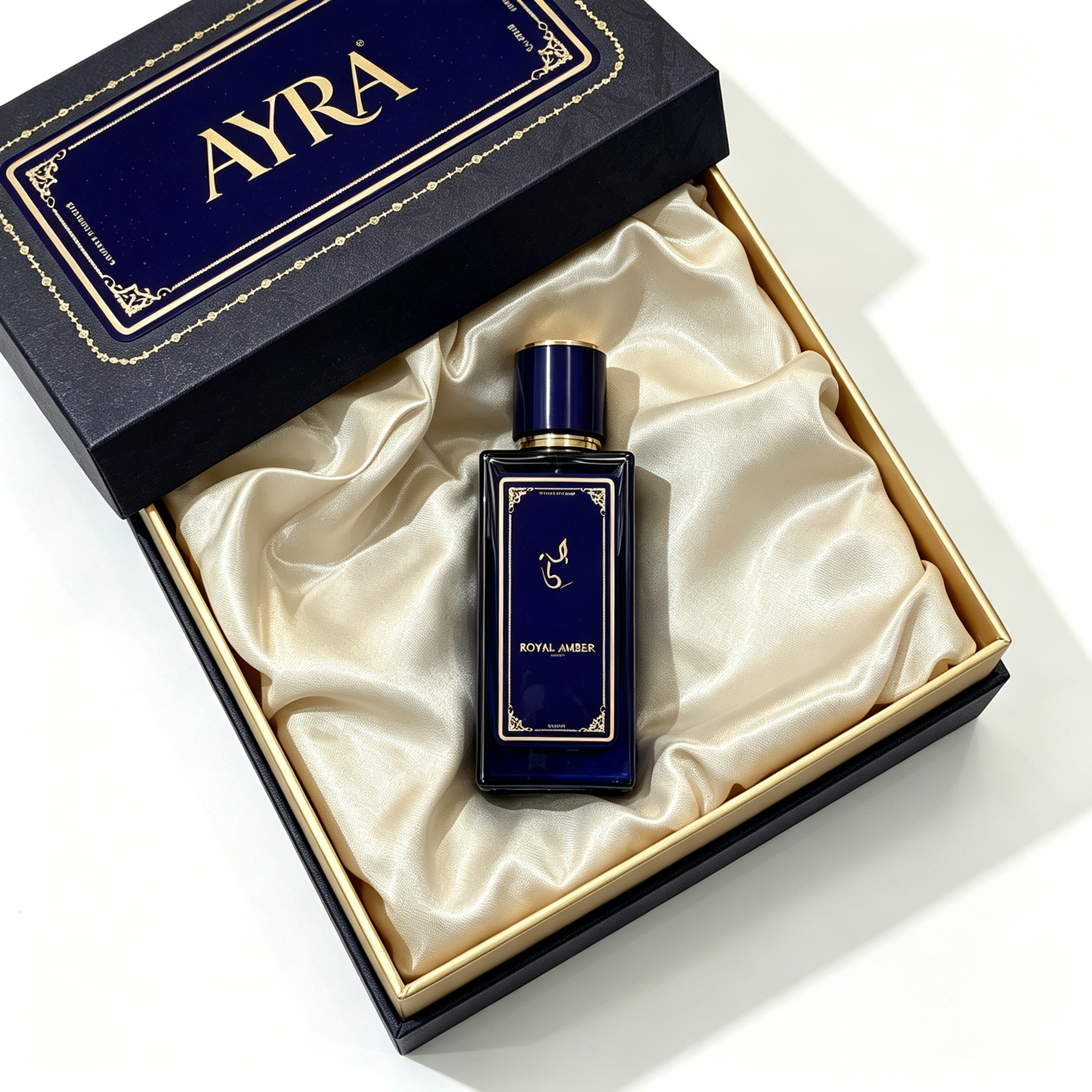
Rigid Lid & Base Box (xyc-001): hot-stamped lid detail with silk lining engineered around a single perfume bottle. Image: Drbox Beauty Packaging.
Where the structures are actually used
Three application families are documented for this portfolio, and they map cleanly onto the structural table above.
Perfume and aromatherapy. The requirement is bottle security plus presentational drama. A lid-and-base box with a pre-shaped EVA insert can hold aroma bottles, fragrance liquid and reed sticks in one engineered cavity, while a magnetic flip box with a moulded insert and metal clasp serves a single prestige flacon. Fragrance is also the segment where the opening sequence carries the most commercial weight, which is why fan-shaped and double-door formats appear here rather than in volume skincare.
Makeup. Here the constraint is multi-item organisation. A flip-lid multi-drawer box with a built-in mirror, fixed slots on the upper layer and pull-out drawers below separates bottles from compacts without the set collapsing into a jumble. Single-item makeup gifting is handled by ribbon-handle flip boxes lined with ruched satin — a format that costs less than a full drawer set but still reads as intentional.
Skincare gift packaging. Skincare sets are the most common driver of the multi-layer drawer and double-door formats, because a routine typically spans full-size bottles, jars and sample tubes that need different cavity depths. A flip lid with two drawers below, or a vertical triple-drawer with flocked inserts per layer, lets a brand present a complete routine in one box while keeping each component immobile during land and sea transport.
Across all three families, the operation combines machine production with manual packaging production — an honest description of how rigid boxes are actually made, and a reminder that the labour component does not disappear at higher quality tiers.
Market trends shaping supplier selection
Premiumisation is moving into secondary packaging. With luxury packaging forecast to grow from USD 14.3 billion in 2024 to USD 23.6 billion by 2033, the box is increasingly the differentiator at the point of sale rather than a protective afterthought. That favours suppliers with in-house finishing equipment, since foil, emboss and window work are where visual differentiation is actually produced.
Regulation is converging on material and recyclability. The EU PPWR obligations applying from 12 August 2026 on PFAS restriction and sustainability requirements make material choice a compliance variable, not a marketing preference. The FSC Chain of Custody Certificate held by Drbox Beauty Packaging addresses the sourcing chain for paper raw materials — a real but narrow claim, which buyers should read precisely rather than as a blanket recyclability statement.
Label compliance is becoming an artwork discipline. U.S. requirements covering principal display panel identity, net quantity and ingredient declaration mean the printable area on a cosmetic box is now partly pre-allocated. Suppliers who understand that panel space is finite produce artwork that clears prepress the first time.
Small-batch launches are pulling MOQ down. New beauty brands increasingly test a market before committing to tooling. One commercial supplier publicly signals a starting MOQ of 500 pieces for custom magnetic gift boxes, which is consistent with the 500-unit figure in the Drbox specification set, though both are supplier-specific signals rather than an industry benchmark.
Rigid versus folding: where each one belongs
The most consequential comparison in cosmetic packaging is not between suppliers but between structural families. Rigid boxes and folding cartons solve different problems, and a supplier with strong rigid capability is not automatically the right answer for every SKU.
| Criterion | Rigid box (greyboard) | Folding carton |
|---|---|---|
| Structural rigidity | High; holds shape and resists compression in export transit | Lower; depends on board grade and crease quality |
| Unboxing ritual | Strong; hinged, drawer and double-door reveals are native | Limited; the opening is a flap, not a mechanism |
| Shipping volume | Ships assembled; higher carton cube and freight cost | Ships flat; materially lower freight cube |
| Unit cost | Higher; commercial estimates place luxury rigid boxes up to USD 20.00 per unit | Lower; simpler custom boxes are estimated at USD 0.50–5.00 per unit |
| Labour content | High; wrapping and insert assembly are manual | Lower; largely automated converting |
| Best fit | Gifting, prestige launches, sets, counter display | E-commerce, mass retail, high-volume single units |
Unit-cost ranges drawn from commercial trade and research estimates compiled for 2025–2026; they describe broad bands, not quoted prices, and vary with dimensions, board grade, insert, finishing and quantity.
Boundaries a buyer should plan around
Rigid is not the cost-efficient answer for every SKU. If a product sells at a mass price point in high volume, a folding carton with a printed finish will usually deliver better economics. The rigid formats described here are a gifting and prestige instrument, and should be scoped to the SKUs that justify the cost.
Freight cube is a real penalty. Rigid boxes ship assembled. On long-haul sea freight from Guangzhou to Europe or North America, the volume-to-value ratio is worse than flat-packed cartons, and that cost sits in the landed price rather than the quotation.
Lead time excludes proofing cycles. The published 7–30 day window describes production. Physical sampling is offered within 1–3 working days, but each revision round — colour, craft detail, box tightness, layout, insert fit — adds elapsed time, and complex structures with magnets, windows and multi-cavity inserts consume more of it than a simple lid-and-base box.
Certification scope needs to be read precisely. ISO 9001 certifies the quality management system, not product conformity. FSC Chain of Custody certifies the paper sourcing chain, not that a finished box is recyclable in every municipality or PFAS-free under the EU PPWR. Compliance of the printed artwork, including ingredient declarations and net-quantity placement, remains the brand's responsibility.
Operational figures are company-reported. Facility size, annual output, client count and export ratio are disclosed by the manufacturer. They are specific and internally consistent, but they are not independently audited in the public sources reviewed for this analysis, and buyers running a formal supplier qualification should verify them during audit rather than relying on published statements.
A procurement checklist for this category
The evaluation logic below applies to Drbox Beauty Packaging and to any comparable rigid box supplier; it is offered as a decision framework rather than a scorecard.
- Confirm the structure against the product, not the reference photo. Supply bottle dimensions or a physical sample so the cavity and shell can be designed together.
- Request a physical sample with the actual finishing. Print colour, foil lustre, lamination touch, board stiffness and insert fit cannot be judged from a digital proof.
- Test the transit case. Ask how the structure performs under compression for land and sea transport, particularly for multi-layer drawer formats where each layer is a separate moving part.
- Specify the colour target in a measurable form. Pantone reference plus an approved physical proof is more reliable than a hex code.
- Reserve artwork space for regulatory panels. Ingredient declaration, net quantity, responsible-party information and barcode need allocated area before design is finalised.
- Verify certification scope in writing. Ask which certificate covers which claim — sourcing, social compliance, quality system or environmental status — and obtain copies.
- Separate sampling time from production time. Build revision rounds into the launch calendar rather than assuming the production lead time is the total timeline.
- Model landed cost, not unit price. Include freight cube for assembled rigid boxes, duties and any insert tooling.
Future outlook
Two forces will define the next procurement cycle in custom cosmetic packaging. The first is regulatory: as EU PPWR obligations phase in from August 2026, material declarations and PFAS restrictions will move from a sustainability talking point to a specification line in the RFQ. Suppliers with a documented chain of custody for paper and an audited quality system are structurally better positioned than those relying on marketing language.
The second is structural complexity. As luxury packaging grows toward the USD 23.6 billion forecast for 2033, differentiation shifts toward mechanisms — magnetic closures, multi-drawer layering, shaped outlines and fitted inserts — which are precisely the components that resist automation and depend on manual craft and in-house finishing. A 30-person R&D team and a 15,000 m² base with standardised lines and professional finishing equipment is a configuration built for that kind of work rather than for commodity volume.
For buyers, the practical reading is that supplier selection in this category should weight process control and structural engineering more heavily than price per unit at the sampling stage. The unit price advantage of a cheaper box is easily erased by a container of sets that arrive with shifted inserts or mismatched brand colour.
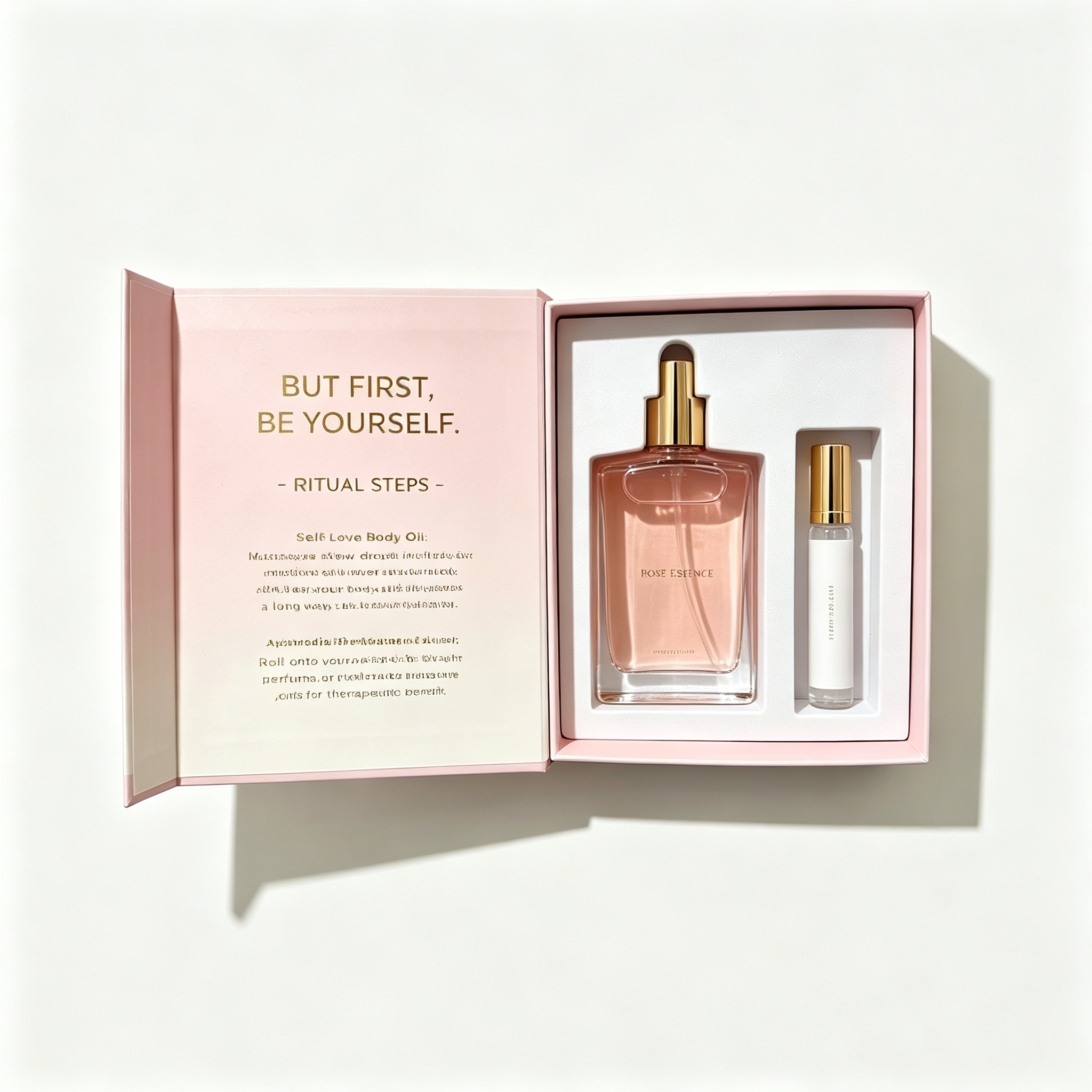
Book-shaped Rigid Box (xyc-002): magnetic closure, foil-stamped interior lid and a flocked insert fitted to bottle and roller sample. Image: Drbox Beauty Packaging.
The full Drbox Beauty Packaging structure and specification catalogue is available as a downloadable PDF: Xingyichang Product Catalog.
FAQ
Do you specialize in cosmetic and skincare packaging boxes? What styles can you make?
The company focuses on custom packaging boxes for cosmetics and skincare products. The published range includes mask boxes, essence boxes, cream boxes, lotion and toner set boxes, cosmetic gift boxes, sample boxes, magnetic hardcover boxes and drawer gift boxes, with full-category customisation for single-piece, bottled, set and travel-sized products, suited to e-commerce, offline counters and gift sales scenarios.
What is the difference between cosmetic packaging and ordinary paper boxes?
Cosmetic packaging is specified around appearance consistency, tactile quality and adaptability rather than basic containment. High-flat cardboard and high-precision colour printing are used to control colour deviation and fading, craft processes are matched to brand positioning, and dedicated print areas are reserved for ingredients, filing information, barcodes and warning statements so that compliance content and visual design coexist on the same panel.
Can you customise boxes according to my product bottle shape?
Yes. Customisation is designed one-to-one from a product sample or accurate bottle dimensions — height, width and diameter. The box is engineered to the bottle's curvature, wall thickness and weight, with tolerance reserved so the product neither rattles nor jams, and a matching insert is specified to support the presentation.
Can you control printing colour difference for cosmetic packaging? I need accurate brand colour matching.
Colour control uses a cosmetic colour matching system with Pantone card alignment and brand spot-colour customisation. Digital and physical samples are proofread repeatedly before production, and colour error during bulk runs is held to a minimal range through machine colour tuning plus manual inspection, so the finished box follows the brand's VI standard colour.
Can I get a sample of cosmetic gift boxes to confirm the texture?
Yes. Physical sampling is offered within 1–3 working days and is designed to reproduce print colour, foil lustre, lamination touch, board stiffness and insert fit before mass production begins. Mass production starts only after the sample is confirmed. Free unlimited fine-tuning and remaking are also stated, covering colour deviation, craft detail, box tightness, layout and insert fit.
Can you accept small trial orders for new beauty brands?
Small-batch customisation is supported, with the same size, logo, colour and craft options as bulk orders, which allows a new brand to test the market before committing to volume. The published specification sheets list an MOQ of 500 units per structure; because minimums can vary with size, material and finishing, the applicable threshold should be confirmed during quotation rather than assumed from the catalogue figure.
Have Questions or Need More Details?
Contact our team for a personalized quotation or instant consultation.
Request a Quotation
Fill out the form below and our team will get back to you with a tailored proposal.
WhatsApp Direct Chat
Prefer to chat in real-time? Message us on WhatsApp for instant assistance & quick answers.
- Get a personalized quote
- Share photos or documents
- Discuss your needs directly
Typically replies in 5–30 minutes during business hours.