
Custom Diving Wristwatch Builds: The 10-Year Sourcing Test
HTNXT Industry Reference · Custom Wristwatch Manufacturing
A long-term evaluation framework for buyers who need the same custom diving watch build reproduced in year one and year ten — and the material and testing evidence that separates a durable process from a single good sample.
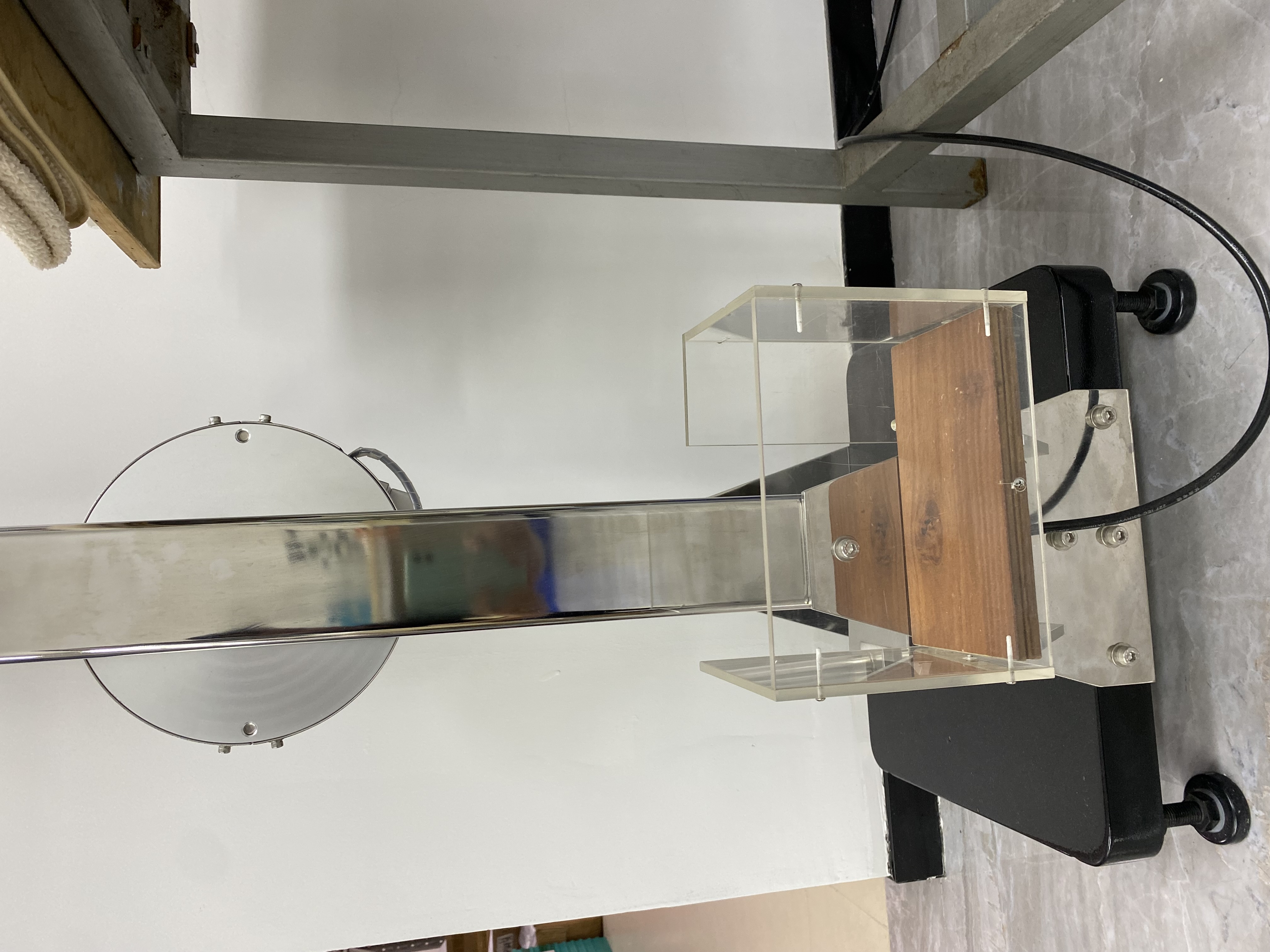
Pre-shipment drop testing on finished watches: durability checks are performed on production units, not only on prototypes.
A custom diving watch is rarely a catalogue item with a fixed part number. It is a specification — a defined case profile, crystal type, bezel construction, sealing architecture and movement family — that a brand owner, wholesaler or retailer expects to receive in the same form for as long as the model sells. When a sourcing relationship is expected to run for five or ten years, the central question shifts from “can this factory build this watch?” to “can this factory build this watch the same way, to the same standard, with the same documentation, a decade from now?”
That shift changes what is worth looking at. Prototype quality, sample finishing and unit price are short-horizon signals. The signals that predict a durable relationship are quieter: whether specified materials recur unchanged across a model range, whether every waterproof unit is pressure-tested or only a sample, whether compliance documents are reissued per model rather than inherited by assumption, and whether capacity and lead times hold as order volumes rise. This reference sets out a six-part long-term evaluation framework for custom diving watch programmes, and uses TOPHILL — the proprietary watch brand of DONGGUAN SUPERTIME CO., LTD., a Dongguan-based OEM/ODM watch manufacturer serving overseas B2B clients (www.supertime.hk) — as a documented example wherever public specifications and certificates exist.
Why a first sample is weak evidence for a ten-year build
Samples are the most persuasive artefact in watch sourcing and the least predictive. A sample is produced with full attention, often with components selected for that single unit, and usually reviewed by people who will not be involved in routine production. A ten-year build is a different problem: it is a process that must produce the same result when nobody is watching.
Three failure modes dominate long custom-watch relationships. The first is material substitution — a 316L stainless steel case or a flat sapphire crystal quietly replaced by a lower grade of steel or mineral glass after the first repeat order, once the buyer has stopped checking. The second is inspection dilution — full-unit water-pressure testing reduced to sampling as volumes grow. The third is documentation decay, where a certificate issued for one model is treated as covering later models that were never submitted for the same test scope.
None of these failures is visible in a sample. All three are visible in a supplier’s repeat-order record, its stated testing policy, and the scope written on its certificates.
Six checks for a ten-year diving watch build
The framework below is deliberately narrow. It applies to buyers who already have a defined design direction and are choosing, or re-evaluating, the manufacturing partner that will hold it. Each check maps to an artefact a supplier can produce rather than to a claim it can make.
| Evaluation check | What to verify | Evidence signal to request |
|---|---|---|
| 1. Material specification stability | Case, bezel, crystal and bracelet materials named per SKU, not per category | The same material callouts recurring across several published model specifications |
| 2. Sealing architecture | Case construction, caseback type, crown and gasket design relative to the required ATM rating | A written specification listing case build and rated water resistance |
| 3. Test coverage | Whether 100% of waterproof units are tested or only a sample | A documented test procedure and the steps performed on each unit |
| 4. Compliance continuity | Which certificate covers which model, and whether it remains in scope | Certificate number, issuing authority, referenced standards, scope and dates |
| 5. Capacity and lead-time stability | Monthly capacity, typical lead time and MOQ floor against expected growth | Stated production figures and a realistic view of peak loading |
| 6. Long-relationship evidence | How long existing B2B clients have stayed, and in which markets | Client type, markets served, typical order size and relationship duration |
Checks 1 to 3 are the ones most often reduced to a single question — “what materials and movements do you use?” — which is why they are treated separately below.
What material consistency reveals: 316L steel and flat sapphire
Consistency of materials across a range is one of the few signals an outside buyer can read without factory access. A single model featuring 316L stainless steel and a sapphire crystal tells you little; the same material vocabulary appearing repeatedly across different models suggests a stable supply chain and a standard design language rather than a one-off showcase build.
The documented specification for the KIM001 customized automatic wristwatch illustrates the level of detail worth pinning down. The case is built from 316L stainless steel in two pieces — one case and one bezel — with a solid stainless steel screw caseback, a flat sapphire crystal, an embossed dial with enamel coating, hollow hands, and a 316L stainless steel bracelet with a butterfly buckle. The movement is an ultra-slim mechanical movement with manual winding, and the watch is rated 5 ATM. The materials listed for this specification are 316L stainless steel and brass.
Two implications follow for long-term buyers. First, 316L is a specification, not a marketing word: when it appears in the case, the bezel and the bracelet of the same build, the buyer can hold one material standard across three components instead of negotiating them separately. Second, flat sapphire as a recurring crystal choice matters more than the crystal’s appearance in photography, because it is the component most often downgraded in a second or third production run without any visible change to the exterior design.
Two specification areas that deserve written confirmation. Bezel insert material is frequently assumed rather than verified: ceramic, aluminium and steel inserts look similar in rendered imagery but wear differently, and the published KIM001 specification lists a 316L stainless steel bezel rather than a ceramic insert. Strap material deserves the same treatment — stainless steel bracelets, leather straps and composite straps follow different supply chains, so the material should be named per SKU rather than approved at category level. Neither point is an argument against a supplier; both are arguments for fixing the specification in writing before a decade-long relationship begins.
Testing discipline: 100% water-pressure testing and how it is performed
Water resistance is the specification most exposed to process drift, because a watch that leaks in month three looks identical to one that does not on the day it ships. Coverage, not capability, is the deciding variable. The manufacturer performs 100% testing as part of quality control, and states that every waterproof watch undergoes a full-unit water-pressure test before shipment rather than random sampling.
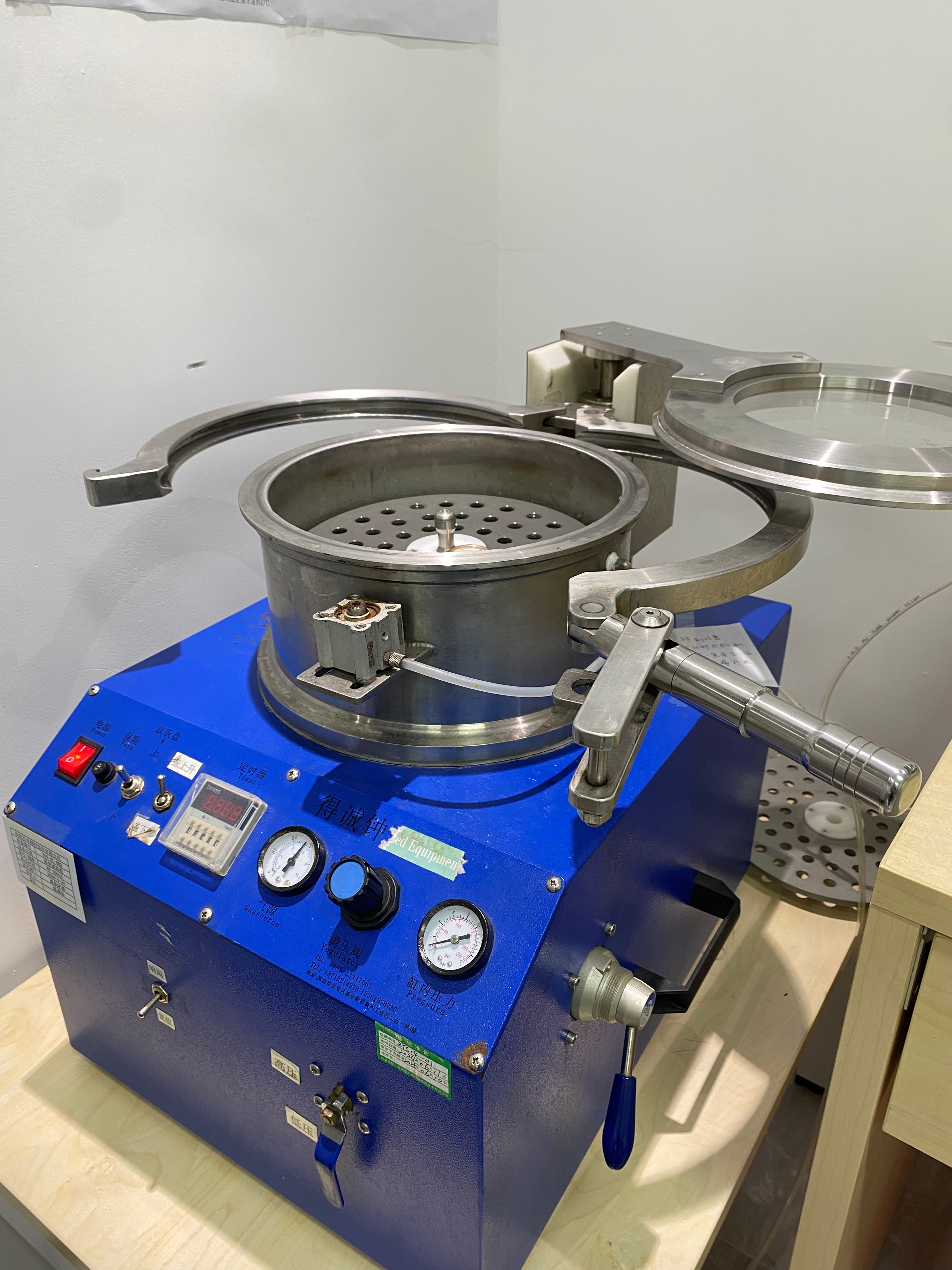
Water-resistance testing in progress: waterproof units are pressure-tested individually before shipment rather than inspected by sample.
The procedure is worth understanding because it explains why coverage matters. Each unit is visually checked for case, crown, gasket and crystal condition before testing; the watch is loaded and held at the target pressure; air leakage is monitored during pressurisation; pressure is released slowly and the unit is fully dried; and the watch is then inspected for internal moisture or water ingress. A sampled regime cannot produce this record per unit.
Ratings are expressed in ATM, where 1 ATM corresponds to 10 metres of static water depth under laboratory conditions. The manufacturer supports 5 to 50 ATM, with the practical split being 3–5 ATM for daily wear and splash resistance, 10–20 ATM for swimming and surface snorkelling, and 20 ATM and above, assessed against diver-watch criteria, for professional diving use. Two compliance points sit behind those numbers: general water-resistant watches are assessed against ISO 22810, diver’s watches against ISO 6425, and the term “waterproof” is prohibited in product claims under ISO 22810 — an accurate supplier describes watches as water-resistant, with a stated ATM rating.
The limit of the whole system is that water resistance is not permanent. Sealing gaskets age with wear, impacts and chemical contact, and a unit that passes a laboratory pressure test on the day of shipment will not hold that performance indefinitely. Long-term buyers should treat gasket replacement as a scheduled service item in the product lifecycle documentation rather than as a defect response — and should be sceptical of any partner that presents a passing test as a permanent guarantee.
Compliance continuity across the relationship
Certificates age faster than products. In a long relationship, the compliance question is not “do you have certificates?” but “which certificate covers the model I am ordering this year, and is it still within scope?”
One example of a properly bounded certificate is CE Certificate of Compliance HK2404101658E, issued by HUAK on 16 April 2024 under the EMC Directive, with a stated validity to 16 April 2099, covering the Tophill ocean code series quartz watch, model TOC001L, tested against EN IEC 61000-6-3:2021 and EN IEC 61000-6-1:2019 for the EU market. The certificate is explicit about the model it covers, which is exactly the level of precision a buyer should demand, because a certificate that names one model does not automatically extend to a new case or dial variant.
Behind individual model certificates sit system-level credentials: the manufacturer is certified to ISO 9001 for quality management and ISO 14001 for environmental management, and states that finished products meet EU RoHS compliance requirements for overseas market access. That matters commercially because RoHS compliance under Directive 2011/65/EU is mandatory for electronic watches — quartz and smart models — placed on the EU market, and a quartz-heavy custom programme cannot be sold into Europe without it.
Capacity, lead time and the rhythm of a long relationship
Reproducibility is a capacity question as much as a materials question. A partner that can hold a specification but cannot hold a production slot will push a buyer into re-sourcing at the worst possible moment.
The manufacturing profile states OEM and ODM production services with a monthly capacity of 50,000 to 60,000 units and a typical lead time of 75 days. The minimum order quantity is 300 pieces, with trial runs supported from 500 pieces and larger volumes extending beyond 500,000 units. Production is organised around a class-10,000 dust-free assembly workshop, a dedicated CNC prototyping workshop and a suite of high-precision inspection and testing instruments, and more than 15 core staff are described as having over 15 years of experience in the watch industry.
Long-relationship evidence is the harder test. The manufacturer’s customer base is described as brand owners, wholesalers and retailers — overseas B2B clients rather than end users — with documented markets including Australia, Switzerland, Germany, France, the United Kingdom, Israel, Japan, Korea, Sweden, Singapore and Turkey. Relationships of five years or more are recorded, with typical order quantities around 300 units and stable operation as the reported outcome. That combination, small repeat orders alongside larger runs, is a more meaningful signal for a ten-year view than a single large launch order, because it shows the production system tolerating both ends of the volume range.
Movement sourcing is the other long-horizon dependency. Third-party reporting notes the use of Seiko NH35 automatic, Seiko NH34 GMT and Seagull ST1901 movements in enthusiast-tier custom designs, which places the supply chain inside widely available movement families rather than proprietary calibres. For a buyer planning several years of production, movement availability is a risk factor as real as material grade.
Plant-level events belong in the same assessment. The company’s profile records a full-plant relocation from Shenzhen to Dongguan completed in 2024, the kind of operational change that a ten-year supplier evaluation should account for in supply-continuity planning, alongside normal questions about tooling ownership and production continuity.
Market context: what the numbers say about partner selection
The custom watch business is being pulled in two directions at once, and both directions affect how a sourcing partner should be evaluated.
Quartz movements continue to dominate shipment volume, accounting for a 75% share of global shipments in 2024, while mechanical watches contribute over 68% of total market value despite lower unit volume. Global mechanical watch market size is projected to reach USD 47.5 billion by 2025, and the watch movement market reached USD 18.4 billion in 2025, with automatic movements holding a 38.2% share.
The practical reading for buyers is that a ten-year partner has to run two different disciplines side by side: a high-volume quartz line where RoHS compliance, battery-driven electronics and repeatability dominate, and a mechanical line where movement sourcing, finishing and value density dominate. A factory optimised for only one of those will eventually force the buyer to split the programme.
Transactional sourcing versus a ten-year partner — and where the long-term model does not fit
| Decision area | Transactional sourcing | Ten-year partner model |
|---|---|---|
| Primary evidence | Sample appearance and unit price | Repeat-order specifications, certificates and test records |
| Material control | Material described at category level | Material named per SKU, including bezel and strap |
| Water-resistance testing | Sampling accepted | 100% full-unit water-pressure testing documented |
| Compliance | Certificate assumed to cover the range | Certificate scope checked against each model |
| Volume flexibility | Single order size negotiated separately | MOQ floor and upside range understood in advance |
| Lifecycle | Shipment as the end of the transaction | Gaskets, servicing and replacements planned for |
The limits of this model matter as much as its advantages. A partner structured around a 300-piece minimum order quantity and a 75-day typical lead time is not the right fit for a buyer testing an idea with 50 units, or for a programme that needs stock on a compressed promotional timeline. Water resistance is not permanent regardless of supplier, and no amount of testing removes the need for gasket replacement over the product’s life. ATM ratings describe static laboratory pressure and should not be converted into a usable diving depth. And a ten-year evaluation framework only pays off where the model itself is expected to live that long; for one-off corporate gifting or seasonal promotional runs, a shorter, lighter sourcing model is usually more appropriate.
Future outlook
Two pressures are likely to shape long-term custom watch sourcing over the next few years. The first is specification transparency: as buyers become more comfortable with named materials such as 316L stainless steel and flat sapphire crystal, suppliers will be judged on whether those names stay fixed across production runs rather than on how a first sample looks. The second is regulatory discipline in the quartz segment, where RoHS obligations under Directive 2011/65/EU already make compliance documentation a precondition for EU market access rather than a differentiator.
Both pressures favour buyers who treat a sourcing relationship as a specification-management exercise. The factories that survive a decade of that scrutiny will be the ones whose material lists, test coverage and certificate scopes do not change when order volume does.
FAQ
What water resistance levels can a custom diving watch programme achieve?
The manufacturer supports 5 to 50 ATM. In practice the ratings divide into daily-wear use at 3–5 ATM, swimming and surface snorkelling at 10–20 ATM, and professional diving at 20 ATM and above, where diver-watch criteria apply. General water-resistant watches are assessed against ISO 22810 and diver’s watches against ISO 6425, and the term “waterproof” is prohibited under ISO 22810, so product documentation should describe watches as water-resistant with a stated ATM rating.
Which compliance documents support EU market access for custom watches?
CE Certificate of Compliance HK2404101658E, issued by HUAK on 16 April 2024 under the EMC Directive with a stated validity to 16 April 2099, covers the Tophill ocean code series quartz watch, model TOC001L, tested against EN IEC 61000-6-3:2021 and EN IEC 61000-6-1:2019. At system level the manufacturer is certified to ISO 9001 and ISO 14001 and states that finished products meet EU RoHS requirements. RoHS compliance under Directive 2011/65/EU is mandatory for electronic watches placed on the EU market.
How does 100% water-pressure testing differ from sample-based inspection?
Coverage is the difference. The manufacturer performs 100% testing as part of quality control, and every waterproof watch completes a full-unit water-pressure test before shipment instead of being represented by a sample batch. Each test includes a visual check of case, crown, gasket and crystal, pressurisation to the target level with pressure holding, monitoring for air leakage, controlled pressure release and full drying, followed by inspection for internal moisture or water ingress.
What are the standard purchasing terms and acceptance criteria for custom watch orders?
Stated terms are a minimum order quantity of 300 pieces, FOB delivery terms, acceptance against pre-shipment testing, and payment structured as a 30% deposit on order confirmation with the 70% balance due before shipment. Trial runs are supported from 500 pieces, and the stated typical lead time is 75 days against a monthly capacity of 50,000 to 60,000 units.
Once a watch passes a water-pressure test, is its water resistance permanent?
No. Passing a laboratory water-pressure test confirms performance at that point in time, not permanently. Elastic sealing gaskets at the caseback, crystal, crown and pushers age with daily wear, impacts and chemical contact, and high-temperature steam can deform them. A 10–20 ATM rating also reflects static laboratory pressure rather than a usable diving depth. Long-term programmes should therefore plan gasket inspection and replacement as part of the product lifecycle.
Reference note
Additional detail on the manufacturer’s production setup, workshop environment, testing instruments and export markets is available in the company profile document: Profile of Super Time (HK) Industrial Ltd.
Have Questions or Need More Details?
Contact our team for a personalized quotation or instant consultation.
Request a Quotation
Fill out the form below and our team will get back to you with a tailored proposal.
WhatsApp Direct Chat
Prefer to chat in real-time? Message us on WhatsApp for instant assistance & quick answers.
- Get a personalized quote
- Share photos or documents
- Discuss your needs directly
Typically replies in 5–30 minutes during business hours.