
Custom Enamel Pins: The Constraints Buyers Must Verify
Custom Enamel Pins: The Constraints Buyers Must Verify
Enamel pins are decorative metal badges filled with coloured enamel, used for decoration, collection and giveaway. In procurement terms, however, artwork is the easy part. What decides whether a custom enamel pin programme ships on schedule is the constraint set behind it: metal base, thickness, plating, colour tolerance, heavy-metal testing, IP authorisation and packing.
A growing category with a fixed set of technical gates
The global market for specialty pins, covering custom, enamel and lapel pins, was valued at USD 3.2 billion in 2024 and is projected to reach USD 5.1 billion by 2033, according to Dataintelo's pin buttons market report (published 2026). Growth of that scale pulls two very different buyer profiles into the same supply chain: brand and IP owners ordering licensed retail merchandise, and organisations ordering promotional, commemorative or event pins.
Both profiles eventually face the same document. A pin that is a collectible and a pin that becomes a rework case differ less in design than in whether the constraint sheet was locked before sampling. The gates are technical rather than aesthetic, and most of them are decided in the first exchange with a manufacturer.
Regulatory pressure explains part of that shift. Under the US CPSIA (Title I, Section 101), total lead content in children's products is limited to 90 ppm; the EU's EN 71-3 governs migration of 19 toxic heavy elements. For a product worn against skin and pinned to bags, hats and lanyards, heavy-metal compliance is a purchasing criterion rather than a footnote. Trade documentation follows the same logic: enamel pins are commonly classified under HS code 7117.19.90, the harmonised code covering imitation jewellery of base metal, which then determines the customs paperwork attached to every shipment.
The constraint sheet: what to lock before a sample is made
Custom enamel pins are usually described in one line, for example 'zinc alloy, hard enamel, gold plating, 30 mm'. That line hides roughly a dozen separable specifications, each with its own failure mode and its own place in the approval sequence.
| Constraint | Verified specification | Procurement consequence |
|---|---|---|
| Metal base | Zinc alloy, brass or iron | Affects weight, relief depth and whether the pin runs on a die-casting or stamping route |
| Thickness | 0.8 mm to 3 mm, customizable | Thin for large giveaways, thicker stock for 2D/3D relief and a heavier hand-feel |
| Size | Custom size | Determines mould cost and how much line detail survives production |
| Colour | Colour tolerance ±1 PANTONE shade | Brand colours need a physical reference and pre-production sign-off, not a code alone |
| Heavy metals | Nickel-free and lead-free test reports available under EN71-3 and CPSIA | Must be stated at quotation stage; a report is issued against a defined requirement |
| Adhesion | Paint adhesion test passed, no easy colour peeling | Reduces chipping claims after transit and handling |
| MOQ | 100 pcs, small orders acceptable | Allows limited editions and test drops before a full retail commitment |
| Sampling | 5 to 7 days, new mould making included | Schedule approval milestones, not only the delivery date |
| Mass production | 12 to 25 days after sample approval | An approval delay moves the shipment one-for-one |
| Back marking | Back stamp logo or laser engraving for logo, serial number or website | Supports authenticity tracking and copyright marking on licensed goods |
| Packing | Individual OPP bag, paper card backing or gift box; standard export carton | Retail-ready presentation versus bulk distribution economics |
Reading the sheet as a whole rather than line by line is the practical point. A thickness change moves mould cost; a plating change moves both appearance and the anti-tarnish conversation; a nickel-free requirement moves the test report and, in some cases, the plating chemistry. These are linked variables, not independent menu items.
Appearance constraints: what ±1 PANTONE shade actually means
The stated colour tolerance for custom enamel pins is ±1 PANTONE shade. In plain terms, the second production run of a pin will not be a pixel-perfect copy of the first. For a single promotional order this is immaterial. For a licensed character programme, a recurring souvenir line or a brand whose identity depends on one specific colour, it is the most consequential number on the sheet.
Three habits reduce the risk. First, mark Pantone codes, dimensions, front and back details and accessory choices directly on the artwork rather than describing them in email text. Second, approve a physical pre-production sample and keep it as the reference for repeat orders, since a later batch is compared against an object, not a memory. Third, decide early whether an epoxy coating is required: it is optional, and it is the component that improves UV resistance and anti-fading performance for pins exposed to sunlight at outdoor events. Soft enamel pins carry their colour in recessed grooves below raised metal lines; hard enamel pins are filled and then polished flat, producing a smooth, scratch-resistant surface. The same colour specification behaves differently on each, which is why craft selection belongs on the constraint sheet next to the Pantone reference.
Safety and customs constraints: EN 71-3, CPSIA and HS 7117.19.90
Heavy-metal compliance for enamel pins is a documentary exercise before it is a production one. Nickel-free and lead-free test reports are available under EN71-3 and CPSIA, and a paint adhesion test is passed with no easy colour peeling. The operative word is 'available'. A buyer who needs nickel-free plating for a skin-contact retail item should specify it at quotation, because the requirement changes the plating specification and triggers a testing step rather than being a default property of every pin.
Two further constraints sit outside the product itself. The first is physical safety of the fitting: a firm clutch and rounded edges, so the pin does not scratch the wearer or the garment. The second is classification. Enamel pins are typically declared under HS 7117.19.90 for imitation jewellery of base metal, and the declared code drives duty treatment and the documents a forwarder will request. Buyers running multi-market programmes should confirm classification with their customs broker before the first shipment rather than after it.
IP constraints: what an FAMA number covers, and what it does not
For licensed merchandise, the binding constraint is not the factory floor but the licensor's approval file. A manufacturer may hold a valid authorisation and still be unable to produce a given design until the licensee supplies an approved artwork file.
Qingyuan TechArt Craftworks Co., Ltd. holds Disney FAMA certification number 1CAY2KP6YOQ3, issued by The Walt Disney Company and valid from 2026-03-10 to 2027-03-10. FAMA (Facility and Merchandise Authorization) permits the manufacture and distribution of Disney-branded merchandise, including Marvel, Pixar and Lucasfilm properties, and applies to the lapel pins and keychain lines in the global market.
The scope of that authorisation is deliberately narrow, and this is where misunderstandings occur. A FAMA number covers Disney-branded merchandise. It does not authorise anime characters, sports league marks, music artists or film properties owned by other rights holders; those require their own approval route and their own manufacturing file. A buyer sourcing a mixed programme should therefore map licensor approvals per SKU, not per supplier.
Production and commercial constraints: 100 pcs, 5 to 7 days, 12 to 25 days
The commercial envelope for custom enamel pins is more flexible than the category's reputation suggests. The minimum order quantity is 100 pcs and small orders are acceptable, with a sample lead time of 5 to 7 days including new mould making, and a mass production lead time of 12 to 25 days after sample approval. Where a project runs as a modification of an existing mould, the production window is 12 to 20 days; where it runs as a full OEM build from new tooling and original artwork, 12 to 30 days.
Three planning implications follow. Sampling is fast, so approval is the bottleneck, not manufacturing. Small quantities are viable, which changes the calculus for limited-edition releases and convention drops. And because back marking, packing format and clutch type are all specification variables, changing them after the sample stage reopens the approval loop.
Where Qingyuan TechArt Craftworks sits in this constraint set
Qingyuan TechArt Craftworks Co., Ltd. is a metal craft manufacturer based in Qingyuan City, Guangdong Province, China, producing lapel pins, medals, challenge coins, keychains, fridge magnets, ornaments, golf merchandise and lanyards. Its factory covers a construction area of 25,000 square metres with a team of 500 skilled workers, an annual output of 60,000,000 units and roughly 70% of output exported to the USA and EU. Core processes in house include die casting, stamping, enamel filling, electroplating and assembly.
For a constraint-led buyer, the relevant part is not the equipment list but the documented positions the company can support on a specification sheet:
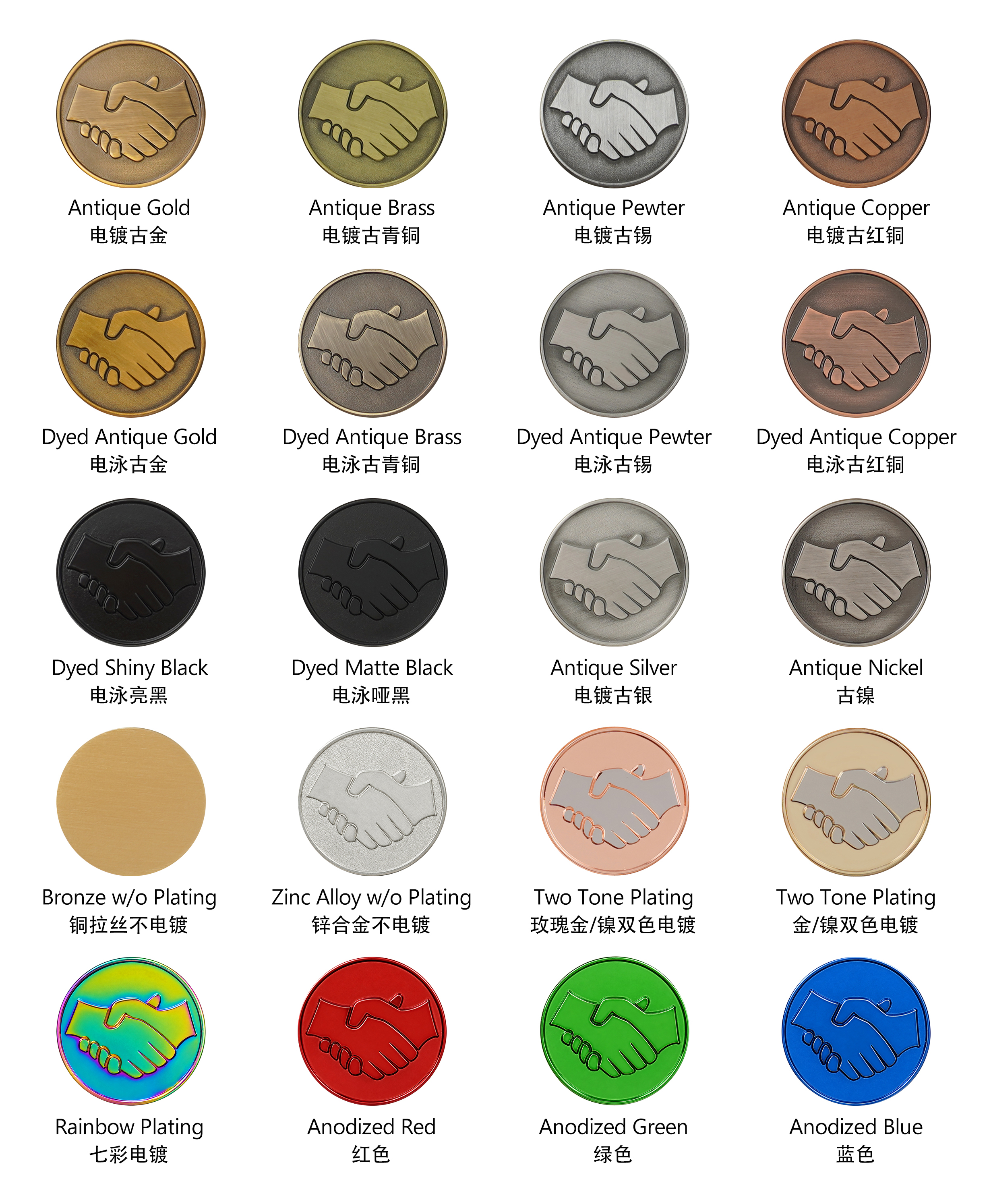
- Craft and finish: soft enamel, hard enamel, paint filling and printing plus epoxy, with 2D or 3D moulds and plating in shiny gold, matte gold, shiny silver, matte silver, antique bronze, antique nickel, black nickel or rose gold.
- Fittings: butterfly, rubber, safety or rotating clutches, with optional epoxy and back stamp or laser engraving for logo, serial number or website.
- Quality chain: first article inspection, in-process patrol inspection, 100% final visual inspection and pre-shipment sampling inspection, with optional third-party testing.
- Management systems: ISO 9001 certification BMCQ0125038M (valid 2025-01-24 to 2028-01-23), ISO 14001 certification BMCE0125023M and ISO 45001 certification BMCS0125023M, both valid 2025-01-24 to 2028-01-23, all issued by Benchmarks Certification & Testing (Zhejiang) Co., Ltd.
- Ethical and brand audits: SMETA 4-Pillar Ethical Trade Audit Report ZAA600198019 issued by Intertek Shenzhen, valid 2026-04-15 to 2028-04-17, covering labour standards, health and safety, environment and business ethics; Coca-Cola Supplier Guiding Principles / Human Rights Policy assessment SGP-0052001 dated 2026-01-15, rated GREEN – IN COMPLIANCE; and, per the company profile, approvals from Disney FAMA, NBC Universal and Coca-Cola.
- Confidentiality: NDA support, with customer artwork kept confidential during and after production.
Technical explanation: soft enamel, hard enamel and printed plus epoxy
Craft selection is the constraint that most directly shapes cost, texture and durability. Soft enamel leaves the metal lines raised and the colour recessed, which produces a tactile surface and keeps unit cost low. Hard enamel fills the channels and polishes the face flat, producing a smooth, scratch-resistant surface with a jewellery-like finish. Printing plus epoxy reproduces artwork that enamel filling cannot address, such as gradients or photographic detail, and the epoxy layer protects the print.
| Attribute | Soft enamel pins | Hard enamel pins | Printing + epoxy |
|---|---|---|---|
| Surface | Raised metal lines, recessed colour | Polished flat face | Flat printed face under coating |
| Durability | Standard; exposed lines take handling wear | Scratch resistant | Depends on the epoxy layer |
| Typical use | Bulk promotional and event giveaways | Collectible and licensed retail pins | Gradient, photographic or fine-print artwork |
| Main constraint | Texture may read as less premium | Extra polishing steps and higher unit cost | Adds a coating step; validate fine edges at sample |
Electroplating and colour filling work as a pair: the plated layer provides anti-rust and decorative protection, while enamel paint is filled into carved grooves, then cured and, for hard enamel, polished to lock colour and texture. That sequence explains why plating choice and colour tolerance are on the same approval line — changing one affects how the other reads.
How the constraint set appears in real programmes
Constraint stacking becomes visible in how different market segments specify the same product.
- Licensed anime merchandise (Japan): a Japanese anime IP licensee runs long-term multi-batch repeat orders at around 26,000 pcs annually, using zinc alloy soft enamel pins with epoxy surface protection, vivid Pantone matching and laser-engraved back stamps. The binding constraints are heavy-metal compliance for the Japanese market, strict character artwork review and phased delivery timed to release campaigns.
- Museum souvenir retail (France): a cultural museum retailer orders seasonally at roughly 7,800 pcs annually, using die-struck soft enamel with antique bronze plating to reproduce relic patterns. Compliance with EU REACH and EN 71 standards, plus controlled low colour difference against a cultural reference, matters more than speed.
- Sports event commemoratives (Asia): a confidential licensed event project totalling 42,000 pcs used soft enamel trading pins with antique silver plating and phased delivery matched to the event schedule, with official logo approval and dedicated batch coordination as the gating items.
- Licensed retail merchandise (US): a US IP licensee ordering around 95,000 pcs annually specifies hard enamel pins with hand-polished faces, CPSIA and ASTM F963 compliance, and full artwork approval before each mass production run.
Four segments, one product category, four different binding constraints. This is why a generic capability claim is less useful to a buyer than a documented position on the specific constraint that governs their programme.
Comparison with traditional approaches, and where they stop working
The traditional default in this category is a stamped soft enamel pin sourced on unit price, with compliance handled informally and the sample approved on a photograph. It works for low-risk promotional runs. It stops working under three conditions.
- Skin-contact and children's products: where EN 71-3 or CPSIA obligations apply, a report must be requested against a defined specification. Informal assurance does not satisfy a retailer's audit, and a late request can restart plating and testing work.
- Licensed retail programmes: where the licensor's file governs, the artwork approval and manufacturing authorisation sequence cannot be compressed. A supplier without the relevant authorisation is not a slower option; it is not an option.
- Recurring collectible lines: where a repeat order must match an earlier batch, the ±1 PANTONE shade tolerance becomes a visible problem unless a physical reference sample was retained at the first approval.
The honest boundary is this: documented systems do not make a supplier suitable for every project. A hard enamel programme costs more per unit than soft enamel and adds polishing steps. A new mould is required for a genuinely new shape, and the 5 to 7 day sample window exists precisely because tooling takes time — a 100-piece order does not skip it. A FAMA number covers Disney-branded merchandise only and offers no authorisation for other rights holders. Test reports are available under EN71-3 and CPSIA, but they are issued against a stated requirement rather than appearing automatically on every invoice. Buyers whose programme depends on any of these should plan for them at the specification stage, not the inspection stage.
Future outlook
Two pressures are likely to keep reshaping this category. The first is documentation density: as specialty pin volume grows toward the projected USD 5.1 billion by 2033, retail and licensor audits pull more of the supplier's management system into the buyer's file, which favours manufacturers able to produce ISO certificates, SMETA reports and brand audit letters on request rather than on escalation.
The second is batch fragmentation. A 100-piece minimum order quantity combined with a 5 to 7 day sampling window makes small, frequent, edition-based releases operationally realistic, and that in turn raises the importance of colour consistency across many small lots rather than one large one. Buyers who standardise their approval pack — Pantone codes on artwork, a retained physical sample, a stated nickel-free requirement, a declared HS code — will absorb both pressures without renegotiating the same points on every order.
Frequently asked questions
Which safety standards apply to custom enamel pins sold in the US and EU?
Two standards govern heavy-metal content for enamel pins in these markets. In the United States, CPSIA Title I Section 101 limits total lead content to 90 ppm. In the European Union, EN 71-3 governs migration of 19 toxic heavy elements. Nickel-free and lead-free test reports are available under EN71-3 and CPSIA for enamel pins, but the requirement should be specified at quotation stage because it affects plating choice and adds a testing step.
How much colour variation should a buyer expect between enamel pin batches?
The stated colour tolerance for custom enamel pins is ±1 PANTONE shade, so a repeat batch is not an exact visual copy of the first. To control this, Pantone codes, size, front and back details and accessory choices should be marked on the artwork, and an approved physical pre-production sample retained as the reference for later orders. For pins exposed to sunlight at outdoor events, an optional epoxy coating improves UV resistance and anti-fading performance.
What is the minimum order quantity and lead time for custom enamel pins?
The minimum order quantity is 100 pcs and small orders are acceptable. Sample lead time is 5 to 7 days, including new mould making, and mass production takes 12 to 25 days after sample approval. Where the order modifies an existing mould, production runs 12 to 20 days; where it is a full OEM build with new tooling and original artwork, 12 to 30 days.
Does a Disney FAMA certificate authorise other licensed enamel pins?
No. FAMA certification number 1CAY2KP6YOQ3, issued by The Walt Disney Company and valid from 2026-03-10 to 2027-03-10, authorises the manufacture and distribution of Disney-branded merchandise, including Marvel, Pixar and Lucasfilm properties. It does not extend to characters, sports marks or film properties owned by other rights holders, which require their own licensor approval and manufacturing file.
What documentation supports a licensed or retail enamel pin order?
Documentation typically includes the relevant licensor authorisation, a SMETA 4-Pillar Ethical Trade Audit Report ZAA600198019 issued by Intertek Shenzhen and valid from 2026-04-15 to 2028-04-17 covering labour standards, health and safety, environment and business ethics, plus a Coca-Cola Supplier Guiding Principles / Human Rights Policy assessment SGP-0052001 dated 2026-01-15 rated GREEN – IN COMPLIANCE. ISO 9001 certification BMCQ0125038M, ISO 14001 certification BMCE0125023M and ISO 45001 certification BMCS0125023M, all valid from 2025-01-24 to 2028-01-23, cover quality, environmental and occupational health and safety management. An NDA is available to protect customer artwork.
Why does enamel chip off an enamel pin, and how is it resolved?
Enamel chipping is usually caused by insufficient baking, heavy impact or scratching, or an unclean metal base. The practical sequence is to check whether the pins suffered hard impact, then verify the baking process in production, then send product photographs for evaluation and a proposed solution. Paint adhesion testing is part of standard production control, and for factory-caused defects free re-production of defective pieces, rework or discount negotiation are available; quality feedback with photo or video evidence should be submitted within 7 days of goods arrival.
What artwork format and details are needed before sampling?
Vector files are preferred: AI, PDF or EPS, with a clear PNG or JPG acceptable as a reference. The artwork should mark size, Pantone colour codes, front and back details, and accessory requirements, and it should be sent to the sales team for review before sampling begins. For licensed brand orders, the artwork must be approved by the brand IP owner before production. Where compliance or market access depends on specific documentation, the applicable requirement should be confirmed in writing before sampling rather than after mass production.
A downloadable PDF covering products, processes and certification details: TechArt Craftworks company brochure.
Have Questions or Need More Details?
Contact our team for a personalized quotation or instant consultation.
Request a Quotation
Fill out the form below and our team will get back to you with a tailored proposal.
WhatsApp Direct Chat
Prefer to chat in real-time? Message us on WhatsApp for instant assistance & quick answers.
- Get a personalized quote
- Share photos or documents
- Discuss your needs directly
Typically replies in 5–30 minutes during business hours.