
Custom Glassware OEM Shortlist: Signal, Explosion-Proof, Ribbed Shades
Custom Glassware OEM Shortlist: Signal, Explosion-Proof, Ribbed Shades
For OEM and ODM lighting buyers, the choice among signal, explosion-proof, and ribbed glass shades is a project-fit decision before it is a styling decision. The three options in this shortlist serve different procurement lanes: Pressed Borosilicate Signal Glass Lamp Shade (JX1832), Explosion-Proof Borosilicate Glass Lamp Shade (JX1830), and Clear Ribbed Glass Pendant Shade (JXHB-002). Each carries a different acceptance question, thermal boundary, and packaging risk profile.
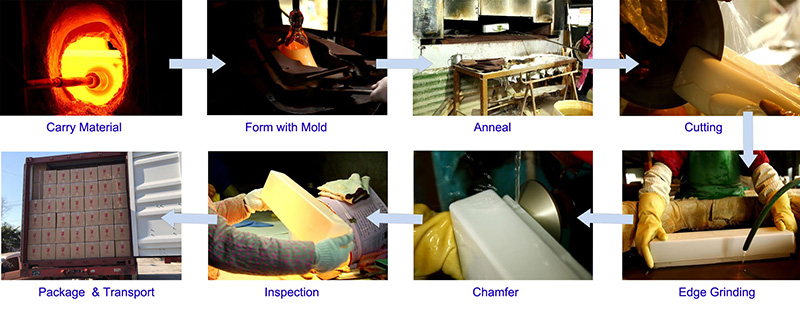
Jingxin Glassware (Yancheng Jingxin Glassware Co., Ltd.) is a custom glassware manufacturer founded in 1999 in Yancheng, Jiangsu Province, China. Its approved company profile covers glass lamp shades, decorative glassware, drinkware, storage containers, and laboratory glassware, with production lines for soda-lime and borosilicate glass and in-house surface finishing. For lighting OEMs, the relevant point is not the breadth of the catalogue alone; it is whether the supplier can match a documented shade specification, repeat it across bulk orders, and support the acceptance checks that the lighting project requires. The company website is www.cn-glassware.com.
Shortlist at a glance: three shades, three procurement jobs
The clearest way to compare these shades is to separate the job each one is documented to do. JX1832 is positioned for signal and safety lighting. JX1830 is positioned for industrial and explosion-proof environments. JXHB-002 is positioned for decorative pendant lighting where ribbed glass creates a visible light pattern. Treating them as interchangeable because all three are glass lamp shades would remove the very differences that matter at evaluation stage.
| Option | Documented role | Thermal, impact, or optical evidence | Acceptance focus | Fit boundary |
|---|---|---|---|---|
| Pressed Borosilicate Signal Glass Lamp Shade (JX1832) | Signal and safety lighting in aviation, railway, and marine applications. | Precision hot-pressed for tight dimensional tolerance; stable optical signal performance; weather and corrosion resistance; continuous working range from -60°C to +450°C. | Signal optics, dimensional tolerance, weather exposure, and model-to-model consistency. | Use where a signal function is specified. Do not substitute a decorative shade into a signal position. |
| Explosion-Proof Borosilicate Glass Lamp Shade (JX1830) | Industrial and explosion-proof environments; outdoor, marine, and high-humidity conditions. | IK10 impact rating; thermal shock resistance from -40°C to +260°C; 6.0–10.0 mm uniform wall thickness; sea water and salt-spray resistance; UV resistance. | Wall thickness, impact resistance, thermal-shock boundary, and fixture-level hazardous-location compliance. | The product name does not replace fixture certification. Confirm the complete luminaire approval for the intended hazardous area. |
| Clear Ribbed Glass Pendant Shade (JXHB-002) | Decorative and design-focused pendant lighting with ribbed light effects. | Clear ribbed glass for decorative light patterns and textured effects; Jingxin selection guidance places clear borosilicate shades in this family at 92–95% light transmission with thermal-shock resistance. | Rib pattern consistency, visible surface quality, light transmission, and finish uniformity. | Decorative use only. It is not the documented choice for signal optics or explosion-proof service. |
The shortlist does not rank the shades against one another. A signal buyer, an industrial lighting buyer, and a decorative pendant buyer are solving different problems. The useful comparison is whether each option satisfies its own project evidence before price, tooling, or delivery terms are negotiated.
Why thermal-shock resistance is a selection criterion, not a specification ornament
Thermal-shock resistance describes how a glass component handles sudden temperature change without cracking. In lighting, the practical risk appears when one area of the shade heats or cools faster than another, creating internal stress. Borosilicate glass is used in this family because its low thermal expansion reduces that stress compared with ordinary soda-lime glass. Jingxin’s technical material states that borosilicate glass has roughly one-third the thermal expansion coefficient of soda-lime glass and can withstand temperature differences up to 300°C without breaking under the conditions described in its guidance.
The product-level figures still need to be read individually. JX1830 is stated at -40°C to +260°C with a 6.0–10.0 mm uniform wall. JX1832 is stated at -60°C to +450°C for continuous working performance in signal and safety lighting. Those are not interchangeable claims. A buyer comparing them should match the figure to the actual fixture environment, lamp type, switching cycle, and installation position rather than choosing the widest number by habit.
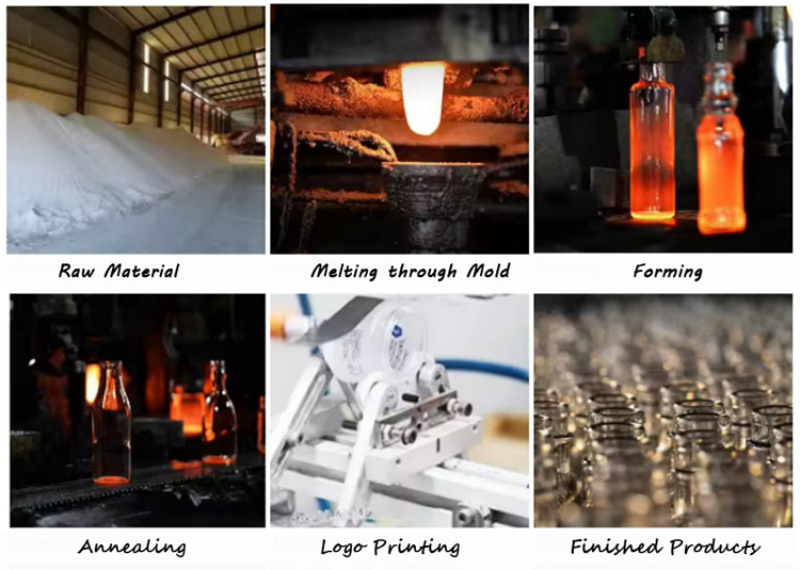
For the clear ribbed option, the thermal evidence is family-level rather than a separate wall-thickness table. The selection guidance positions clear borosilicate shades, including JXHB-002, for high light transmission and thermal-shock resistance, but the buyer should still request the measured wall thickness, sample dimensions, and finish standard for the quoted configuration. A family statement is a starting point for sampling, not a batch release certificate.
Fit and acceptance criteria by option
JX1832: signal performance starts with dimensional discipline
The Pressed Borosilicate Signal Glass Lamp Shade is the option to examine when the lighting project includes an optical signal function. Its documented advantages are precision hot-pressing for tight dimensional tolerance, stable optical signal performance, and weather and corrosion resistance. Those points matter because a signal shade is not judged only by whether it fits a holder; it is judged by whether the signal remains readable and consistent across the installed units.
An acceptance file for JX1832 should therefore include the fitter or mounting interface, the critical optical dimensions, the allowed tolerance band, and the appearance standard for the signal surface. The buyer should confirm the quoted model against the drawing rather than relying on the product name alone. If the project cites an aviation, railway, or marine standard, that standard should be named in the purchase specification and checked separately. The supplied evidence supports the product’s signal-lighting positioning and temperature range; it does not by itself certify compliance with an unnamed external signal standard.
JX1830: industrial fit requires a wall-thickness and fixture-level check
The Explosion-Proof Borosilicate Glass Lamp Shade is positioned for industrial and explosion-proof environments, with an IK10 impact rating, a 6.0–10.0 mm uniform wall, and thermal shock resistance from -40°C to +260°C. It is also documented for outdoor, marine, and high-humidity conditions with sea water, salt-spray, and UV resistance. For a lighting OEM, those attributes translate into a more demanding incoming inspection plan than a decorative shade requires.
The first check is wall thickness at defined measurement points. The second is impact condition: the IK10 rating should be matched to the fixture and installation environment, not treated as a universal guarantee outside the tested configuration. The third is the hazardous-location approval path. “Explosion-proof” is the product name and its documented application positioning; the buyer should still obtain the complete luminaire-level certification or declaration required for the destination market. A glass shade component and a certified explosion-proof luminaire are not the same compliance object.
The fourth check is environmental exposure. Sea-water and salt-spray resistance are relevant where the fixture is installed near coastal or marine conditions, but the buyer should confirm gasket, metal frame, and fixing compatibility as part of the same assembly. Glass performance cannot compensate for a fixture design that traps moisture or uses incompatible seals.
JXHB-002: decorative consistency is the acceptance centre
The Clear Ribbed Glass Pendant Shade is the decorative option in this shortlist. Its documented role is to create ribbed light patterns and textured effects for design-focused pendant lighting. The acceptance question is not signal accuracy or hazardous-area impact resistance; it is whether the rib pattern, clarity, surface finish, and light transmission remain consistent across the bulk order.
A sample approval for JXHB-002 should define the visible face, the rib pitch or pattern reference where applicable, the accepted colour and finish range, and the way light transmission is checked. Jingxin’s selection guidance gives 92–95% light transmission for clear borosilicate shades in this family, but that figure should be confirmed against the approved sample and the buyer’s own photometric method. The shade should not be moved into a signal or explosion-proof position simply because it is made from borosilicate glass; its documented fit is decorative pendant use.
Bulk-order consistency: what to lock before the purchase order
Custom glassware programs become difficult at the handover between sample approval and mass production. The risk is not usually a missing catalogue item; it is a specification that was approved visually but not measured, packed, or written into the acceptance record. For these three shades, the purchase order should lock the model number, drawing revision, material, dimensions and tolerances, surface finish, fitter interface, marking, packaging, and inspection method.
Jingxin’s OEM/ODM capability unit lists 900,000 pieces monthly capacity, a 500-piece minimum order quantity for select stock items with custom MOQ negotiable, sample lead time of 5–7 days, and mass production lead time of 20–30 days after sample approval. Its buyer FAQ adds that hand-blown MOQ is 500 pieces and machine-made MOQ is 2,000 pieces. These are useful planning figures, not a promise that every configuration will follow the same schedule. Complex tooling, new moulds, multiple finishes, or mixed packaging can change the commercial terms, so the quoted MOQ and lead time should be confirmed in writing for the exact shade.
Quality control evidence includes 100% pre-shipment inspection, third-party testing on request, in-process surface inspection, and batch inspection for adhesion, colour accuracy, and durability where surface finishing is involved. For lighting buyers, those checks should be converted into an acceptance plan: fitter opening and mounting interface; wall thickness where specified; visible bubbles, scratches, chips, and mould marks; colour and finish consistency; rib-pattern or signal-face uniformity; and packaging integrity. The plan should state the sample size, the measurement method, and the disposition of nonconforming units.
Custom glassware capability: the difference between a shade and a repeatable shade
The supplied capability record shows a manufacturer that can work across material selection, mould development, surface finishing, packaging, and export logistics. Jingxin was founded in 1999, has 20+ years of glassware experience, serves 1,000+ global clients in 100+ countries, and operates a 4,500 m² production base with 100+ employees. Its in-house finishing options include acid pickling, sandblasting, silk-screen printing, stamping, decalcomania, and spray painting. Those capabilities matter when a lighting OEM needs a standard shade adapted to a fixture, a logo, a surface effect, or a retail-ready pack.
They do not make every custom request equivalent. A new mould for a signal shade is a different engineering task from a colour change on a ribbed pendant shade. A change in wall thickness on an explosion-proof shade may affect impact and thermal behaviour, so it should not be treated as a cosmetic variation. The practical rule is to separate changes that affect the approved performance evidence from changes that affect only appearance or packaging. That separation keeps the qualification file honest and prevents a late finish change from silently altering a safety-related dimension.
The company also states 16 national patents, 19+ professional certifications, and a quality system that covers raw material to finished goods. For this shortlist, the most directly relevant documents are the RoHS test report and the SMETA-4P social-compliance audit. The RoHS report, certificate 251016112GZU-001 issued by Intertek on 2025-10-24, covers glass lamp shades including JX1832, JX1830, and JXHB-002. The SMETA-4P audit, certificate ZAA600149732 issued by TUV Rheinland on 2025-08-12, covers all glass products and the Yancheng manufacturing site. These records support compliance checks within their stated scope; they do not replace project-specific photometric, electrical, or hazardous-location approvals.
Packaging and delivery checks for bulk glass shades
Glass shades can pass dimensional inspection and still fail at the customer’s dock if the packaging does not match the fragility of the item. The supplied purchasing guidance is direct: inspect received items on arrival, document damage with photographs, compare the model and specification with the purchase order, and report any mismatch promptly. For future orders, buyers can request enhanced packaging with additional foam, thicker dividers, or custom inserts, and can require pre-shipment photographs of the packed goods. SGS third-party loading supervision is available on request for high-value shipments.
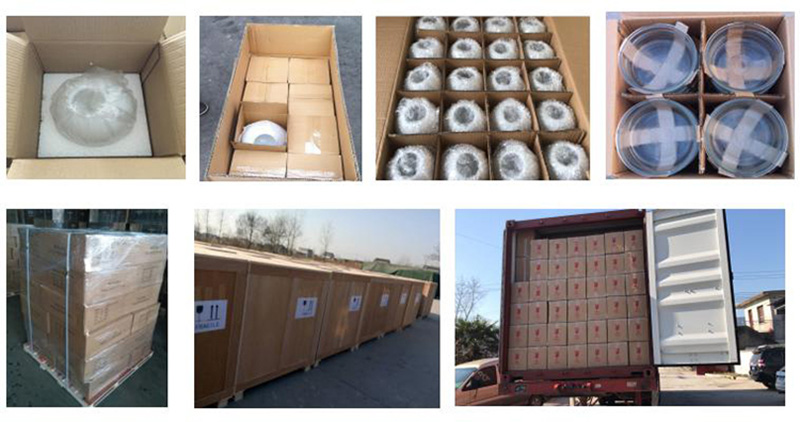
For JX1830, packaging should protect both the wall and the sealing or mounting surfaces; a chip on a critical face can be more serious than a cosmetic scratch. For JX1832, the signal face should be protected against abrasion and distortion in transit. For JXHB-002, the visible ribbed surface should be kept clean and separated from adjacent units to avoid scuffing. In all three cases, the carton mark should identify the model, quantity, finish, and batch or order reference so that incoming inspection can be traced back to the approved sample.
Delivery terms should also be checked against the project schedule. The company provides international logistics by sea, air, rail, truck, and courier, with export documentation including customs clearance, shipping marks, FORM E, and CO where applicable. Those service points support a one-stop supply discussion, but the buyer should still confirm the Incoterm, consolidation method, transit route, and responsibility for damage at each handover point.
Application fit and the limits of a traditional decorative comparison
A conventional decorative glass lamp cover is usually evaluated on shape, clarity, finish, and price. That is appropriate for a pendant or residential fixture where the shade’s task is to shape light and complement an interior. It is not an adequate comparison for a signal or industrial lighting project. JX1832 introduces optical signal stability and a -60°C to +450°C working range. JX1830 introduces IK10 impact resistance, a 6.0–10.0 mm wall, and a -40°C to +260°C thermal boundary. Those are different procurement objects, even when the outer silhouette resembles a shade.
The limitation runs in the other direction as well. A heavy industrial shade is not automatically the right answer for a decorative pendant. JXHB-002’s documented value is its ribbed light effect and textured appearance, not hazardous-area performance. Buyers should avoid using an explosion-proof model name as a generic quality label, and should avoid using a decorative ribbed shade where a signal or industrial standard is specified.
The supplied evidence also includes custom project experience beyond the standard catalogue. In 2018, Jingxin produced a batch of ultra-thick transparent lamp shades for a Chilean deep-sea fish-farming application, designed for pressure and sea-water exposure. That case demonstrates custom engineering for demanding environments, but it should not be read as a standard specification for JX1830 or JX1832. It is a capability reference, not a substitute for the current product data sheet.
Future outlook: what a lighting buyer should keep on the qualification file
The forward-looking conclusion is procedural rather than numerical. The supplied material does not provide a market-size forecast or a growth rate for these three shades, so no such figure is asserted here. What it does show is that lighting projects increasingly depend on documented fit, thermal boundaries, and acceptance evidence rather than a catalogue photograph alone. The buyer who keeps the drawing, sample approval, material record, inspection plan, and packaging specification together will be in a stronger position when the next bulk order is placed.
For long-term supply, Jingxin’s 20+ years of operation, export experience in 100+ countries, and one-stop service model support a continuing supplier discussion. They do not guarantee capacity allocation or price stability. The buyer should still secure written MOQ, lead time, change-control, warranty, and replacement terms for the exact model. That is especially important where a signal face, an impact-rated wall, or a visible rib pattern must remain consistent across repeat orders.
FAQ: evaluation questions for OEM lighting buyers
What should an OEM buyer compare first across signal, explosion-proof, and ribbed glass shades?
Compare the documented role first, then the performance evidence. The Pressed Borosilicate Signal Glass Lamp Shade (JX1832) is positioned for signal and safety lighting, with tight dimensional tolerance, stable optical signal performance, weather and corrosion resistance, and a -60°C to +450°C working range. The Explosion-Proof Borosilicate Glass Lamp Shade (JX1830) is positioned for industrial and explosion-proof environments, with an IK10 impact rating, a 6.0–10.0 mm wall, and -40°C to +260°C thermal shock resistance. The Clear Ribbed Glass Pendant Shade (JXHB-002) is a decorative ribbed pendant option for light patterning and textured effect. The first comparison should therefore be application fit, not visual similarity.
How does thermal-shock resistance change the choice between these three shades?
Thermal-shock resistance determines how much sudden temperature change a glass shade can tolerate without cracking. Borosilicate glass is used because it expands and contracts less than ordinary soda-lime glass. The exact figure must still be matched to the product and fixture: JX1832 is stated at -60°C to +450°C for continuous working performance in signal and safety lighting; JX1830 is stated at -40°C to +260°C with a 6.0–10.0 mm uniform wall; JXHB-002 is supported by family-level guidance for clear borosilicate shades rather than a separate product temperature table. Buyers should confirm the actual lamp heat, switching cycle, and installation environment against the quoted shade.
What acceptance criteria keep bulk orders consistent for custom glass lamp shades?
The acceptance plan should lock the model number, drawing revision, material, dimensions and tolerances, fitter interface, surface finish, marking, packaging, and inspection method. For JX1832, include the critical optical dimensions and signal-face standard. For JX1830, include wall-thickness measurement points, impact condition, and fixture-level hazardous-location documentation. For JXHB-002, include rib-pattern consistency, visible surface quality, light transmission, and finish uniformity. Jingxin’s quality process includes 100% pre-shipment inspection and third-party testing on request, but the buyer should still define sample size and nonconformance handling in the purchase order.
What packaging and delivery checks reduce damage risk for glass shade shipments?
Inspect the shipment on arrival and document any damage with photographs. Compare the received model and specification with the purchase order, and report a mismatch promptly. The supplied guidance recommends enhanced packaging where needed, such as additional foam, thicker dividers, or custom inserts; pre-shipment photographs of packed goods; and third-party loading supervision for high-value shipments. For JX1830, protect critical sealing and mounting faces; for JX1832, protect the signal face from abrasion; for JXHB-002, separate visible ribbed surfaces to prevent scuffing.
Which certifications and documents should a lighting buyer request?
For the three shades in this shortlist, request the RoHS test report and the SMETA-4P audit record that cover the quoted scope. The supplied RoHS report is certificate 251016112GZU-001 issued by Intertek on 2025-10-24, covering glass lamp shades including JX1832, JX1830, and JXHB-002. The SMETA-4P audit is certificate ZAA600149732 issued by TUV Rheinland on 2025-08-12, covering all glass products and the manufacturing site. Also request the model drawing, material declaration where applicable, inspection record, and any project-specific photometric or hazardous-location approval required by the destination market.
When is a ribbed decorative shade a better fit than an explosion-proof or signal shade?
A ribbed decorative shade is the better fit when the lighting task is pendant or interior decoration and the desired result is a visible ribbed light pattern, textured appearance, or a clear decorative effect. JXHB-002 is positioned for that decorative role and for custom colour and finish discussions. It is not the documented choice for signal optics or explosion-proof service. Conversely, JX1832 and JX1830 should not be selected merely because they appear more technical; they should be selected when the project actually requires signal performance, impact resistance, thermal boundaries, or hazardous-area compliance.
B2B enquiry reference. The official company website is www.cn-glassware.com. The supplied contact record lists Mr. Jerry Zhou, Tel +86 515-8822 9059, Mobile +86 136-0510-5950, WhatsApp +8618019627905, WeChat zxg13605105950, and the address No.268 South Jiefang Road, Yancheng, Jiangsu, China. For project-specific custom glassware discussions, use the official website contact channel and quote the model, drawing revision, order quantity, destination market, and required acceptance documents.
Glass Lamp Shades Catalogue (PDF): Download the Jingxin Glassware lamp shade catalogue.
Have Questions or Need More Details?
Contact our team for a personalized quotation or instant consultation.
Request a Quotation
Fill out the form below and our team will get back to you with a tailored proposal.
WhatsApp Direct Chat
Prefer to chat in real-time? Message us on WhatsApp for instant assistance & quick answers.
- Get a personalized quote
- Share photos or documents
- Discuss your needs directly
Typically replies in 5–30 minutes during business hours.