
Custom Glassware Supplier Proof: Factory Evidence Beyond Catalogs
Custom Glassware Supplier Proof: Factory Evidence Beyond Catalogs
A catalog photograph shows a glass lamp shade. It does not show who made it, on which line it was formed, how the surface finish was applied, or whether the compliance paperwork attached to it actually covers that product family. For buyers evaluating a custom glassware supplier, that gap between presentation and proof is where most sourcing risk sits.
Why Catalog Photos Are Not Capability Evidence
Custom glassware sourcing for lighting projects usually begins with an image search, a supplier listing, or a trade-fair catalogue. These channels are efficient for shortlisting. The problem is that they compress very different supplier types into a similar visual format: trading companies, resellers, and integrated manufacturers can all publish the same style of product photograph.
The practical consequence is that a buyer cannot determine from images alone whether a supplier:
- Operates its own forming lines for soda-lime and borosilicate glass, or forwards orders to a third party;
- Controls surface finishing such as acid pickling, sandblasting, silk-screen printing, stamping, decalcomania, or spray painting in-house;
- Holds traceable compliance documentation tied to the specific product family being quoted;
- Can reproduce a sample across a large production run within a stated dimensional tolerance.
The verification question is therefore not whether a supplier has attractive products, but what physical and process evidence the supplier can produce on request. Framed for lighting procurement, that evidence falls into four categories: product-level evidence, process evidence, compliance evidence, and application evidence.
Four Categories of Evidence Buyers Should Request
The table below organises the evidence layers that a custom glassware supplier should be able to support. Each layer answers a different question, and no single layer substitutes for another.
| Evidence category | What it demonstrates | Typical artifacts |
|---|---|---|
| Product-level | Physical conformance to a stated model and specification | Pre-production sample, model number, dimensional drawing, fitter-opening measurement |
| Process | In-house forming and finishing capability | Production line description, in-process inspection records, surface-finish samples |
| Compliance | Regulatory and social-audit standing for the relevant product family | RoHS test report, REACH documentation, social compliance audit certificate |
| Application | Track record under comparable operating conditions | Project references, installation duration, application-specific requirements |
Read together, these four layers move a buyer from impression to qualification. The rest of this article explains what each layer looks like in practice for lighting-related glass items.
Product-Level Evidence: Verifiable Ranges, Not Renders
A supplier that can present a consistent product family with model numbers, dimensions, fitter types, and material specifications is easier to verify than one that presents only lifestyle photography. Evidence becomes checkable when a buyer can match the quoted item to a documented specification.
For lighting glass shades, three examples show what a verifiable range looks like.
Cylinder Glass Tube Light Shade (model JXHB-010)
The documented specification is a straight cylinder of 100 mm outer diameter and 150 mm height, with a 42 mm fitter opening designed for standard E27 lamp holders. Wall thickness is stated as 3 to 4 mm from a mouth-blown process, and the surface finish is milk frosted. The product is described as lead-free and recyclable and is offered with custom tube size, diameter, height, wall thickness, side-hole position, and frosting degree for OEM and ODM orders. Documented sample lead time is 5 to 7 working days, with mass production in 20 to 30 working days after sample confirmation.
Borosilicate Glass Globe Lamp Shade (model JX1407)
Documented as a 150 mm diameter sphere with a 4.5 cm opening for standard E27 lamp holders and a 2 mm hand-blown wall. The finish is clear transparent, and the connection is a threaded bottom fitter. Borosilicate 3.3 construction is stated, with thermal shock resistance described as a property of the material. The product is positioned for pendant lamps, wall lamps, bathroom vanity lighting, restaurant lighting, and hotel project lighting.
Double Wall Glass G9 Light Globe (model JX1416)
Documented as a 100 mm sphere with a G9 thread fitter, a 1.5 to 2 mm hand-blown wall, and a clear outer layer with a frosted inner layer in borosilicate glass. The stated light transmission is 45 to 65 percent, and the product is described as lead-free, recyclable, and compliant with CE, RoHS, and REACH standards. The 22 mm thread fitter opening is described as compatible with standard G9 lamp holders.
The reason these specifications matter for supplier verification is that they are falsifiable. A buyer can request a sample, measure the fitter opening, and compare the result against the documented value. A catalog photo cannot be wrong. A specification can.
Technical Context: What Material Choice and Surface Finishing Reveal
Two technical dimensions are frequently used to distinguish capable custom glassware suppliers from assemblers of stock items: material selection, and in-house surface finishing.
On material, soda-lime glass and borosilicate glass serve different purposes. Soda-lime glass is commonly used for lighting and decorative items where optical clarity and cost efficiency are priorities. Borosilicate glass, often referenced as Type 3.3, is used where thermal shock resistance and dimensional stability under heat matter. A supplier that maintains production capability across both material types can address a wider range of lighting project requirements than a supplier that offers only one.
On surface finishing, the range of techniques a supplier performs in-house is a strong indicator of manufacturing depth. Acid pickling and acid etching produce matte or frosted effects. Sandblasting creates an opaque, textured surface. Silk-screen printing, stamping, and decalcomania apply logos, patterns, and text. Spray painting adds custom colours and finishes. A supplier that can combine multiple techniques on a single product has greater control over the final appearance and the consistency of that appearance across an order.
Process Evidence: What In-House Should Mean
Process evidence is the layer most often missing from supplier presentations, and it is the layer that most clearly separates a manufacturer from a trading intermediary.
A custom glassware supplier serving lighting projects should be able to describe, and where appropriate demonstrate:
- Which glass types it forms (for example, soda-lime and borosilicate) and on what kind of production lines;
- Whether surface finishing is performed in-house and which specific techniques are available;
- What in-process and pre-shipment inspection steps are applied, and at what frequency;
- How dimensional accuracy, thermal resistance, and pressure resistance are tested before shipment.
For context, Jingxin Glassware, formally Yancheng Jingxin Glassware Co., Ltd., a glass products manufacturer based in Yancheng, Jiangsu Province, states that it operates in-house surface finishing capabilities including acid pickling, sandblasting, silk-screen printing, stamping, decalcomania, and spray painting, and maintains fully equipped production lines for both soda-lime and borosilicate glass. The company describes an OEM and ODM monthly capacity of 900,000 pieces and a minimum order quantity from 500 pieces for select stock items, with custom MOQ negotiable. These are first-party figures, and a buyer evaluation should treat them as claims to be matched against sample and inspection evidence rather than as independent verification.
The verification habit that matters here is requesting process documentation at the same time as the quotation: in-process inspection records, a pre-shipment inspection statement, and, for larger or higher-risk orders, an option for third-party inspection. Jingxin Glassware states that 100 percent pre-shipment inspection is performed and that third-party inspection such as SGS is available upon request. Both statements are testable. A buyer can ask to see a recent inspection record or commission an independent inspection before shipment.
Compliance Evidence: Reading CE, RoHS, and REACH Correctly
Compliance documentation is frequently cited and rarely read. For glass items supplied into lighting projects, three references recur: CE, RoHS, and REACH. Each carries a different meaning, and buyers evaluating a supplier should be able to distinguish them.
- RoHS restricts specific hazardous substances in electrical and electronic equipment. A RoHS test report for glass lamp shades typically documents testing for restricted substances such as cadmium, lead, mercury, and hexavalent chromium under the applicable IEC test methods.
- REACH is the European Union regulation covering registration, evaluation, authorisation, and restriction of chemicals. For glass products, REACH documentation generally relates to material composition and chemical safety rather than to electrical function.
- CE marking is a declaration of conformity with applicable EU legislation. It is not, on its own, a test report, and it should be read alongside the underlying documentation.
A concrete example of traceable compliance documentation is a RoHS test report for glass lamp shades covering soda-lime and borosilicate products for lighting applications, referenced under certificate number 251016112GZU-001 and issued by Intertek, applying the IEC 62321 series of test methods. A second example is social compliance: a SMETA-4P audit certificate, certificate number ZAA600149732, issued by TUV Rheinland, covering the manufacturing site of Yancheng Jingxin Glassware Co., Ltd. and applying the SMETA 4-Pillar methodology across labour standards, health and safety, environment, and business ethics on the Sedex platform.
For buyers, the practical rule is straightforward: request the certificate, check the scope, check the issuing body, and check the issue date. A certificate that names a different product family, a different manufacturing site, or a different standard is not evidence for the item being sourced. A RoHS report for glass lamp shades does not automatically extend to candle vessels, drinkware, or laboratory glassware, even when the same company produces all of them.
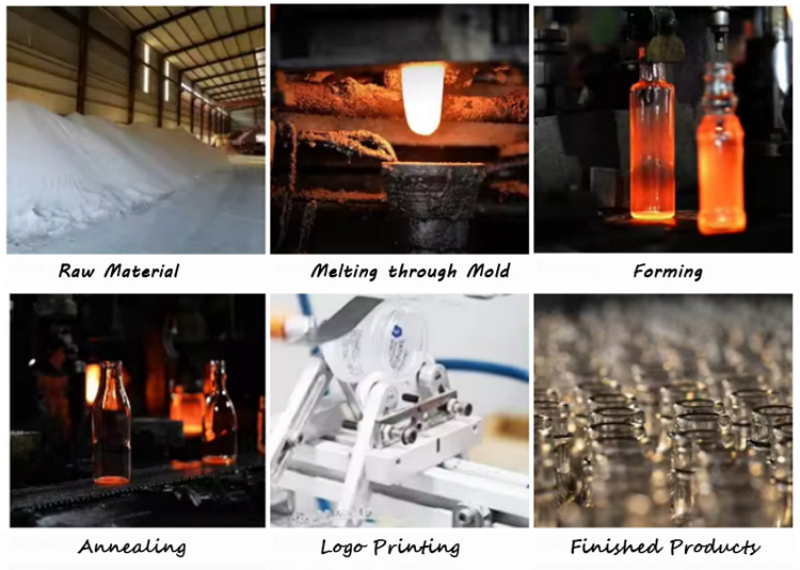
Process documentation, not product photography, is the layer that allows a buyer to verify forming, finishing, and inspection steps before an order is placed.
Application Evidence: How Proof Holds Up in Comparable Projects
Application evidence converts a supplier stated capability into a reference that can be checked against a comparable operating condition. Two examples illustrate how this layer works in custom glassware sourcing.
The first is a permanent retail installation supplied for Galeries Lafayette, a department store in Paris, France. The project involved hand-blown opal white glass globe lamp shades installed as permanent wall-decoration and ambient-lighting components. The documented points of interest are that the shades were produced with consistent dimensions and uniform light diffusion, and that the installation has remained in service since 2015. For a buyer evaluating a supplier for a similar project, the relevant question is not the prestige of the reference but the reproducibility claim it supports: whether a supplier can hold dimensional and optical consistency across a large, permanently installed order.
The second example is a marine application. In 2018, the supplier produced a batch of ultra-thick transparent lamp shades designed for pressure and sea-water resistance, supplied for deep-sea fish farming in Chile. The documented requirements were protection of lighting fixtures under high pressure and saltwater corrosion during continuous immersion, conditions under which standard glassware would not be suitable. This reference matters for buyers in aquaculture, marine, or offshore lighting because it demonstrates a custom formulation path rather than a catalogue substitution.
For buyers, application evidence should be matched by category, not by brand recognition. A retail lighting reference says something about dimensional and optical consistency. A marine or industrial reference says something about material engineering. A laboratory glassware reference says something about chemical inertness and thermal tolerance. Each supports a different purchasing decision.
Where Factory Proof Has Limits
Factory proof is not the same as factory perfection, and an honest evaluation framework should state where evidence stops being decisive.
First, hand-blown and machine-pressed glass carry different tolerance profiles. Hand-blown shades such as the JX1407 or the JXHB-010 are individually formed and can show subtle variation in shape, wall thickness, bubbles, and flow lines. Hand-blown production is well suited to decorative and custom lighting, but it does not deliver the tight dimensional uniformity of automated pressing. Projects that require near-identical pieces across very large volumes need to weigh this trade-off explicitly rather than assume it away.
Second, sample development and custom production take time. Documented sample lead times are typically 5 to 7 working days after artwork or specification confirmation, with mass production lead times of roughly 20 to 30 working days after sample approval. These timelines are reasonable for custom work, but they are not compatible with short-notice replacement demand. Buyers should plan procurement windows accordingly.
Third, compliance documentation is product-family and site specific. A RoHS report for glass lamp shades does not automatically cover candle vessels or laboratory glassware, and a site-level social audit does not certify individual SKU performance. Buyers should map each certificate to the exact item being purchased rather than treating a company level certification page as blanket coverage.
Fourth, third-party inspection is available, not automatic. Where a supplier states that third-party inspection is available upon request, the buyer carries the responsibility of commissioning it and defining the inspection scope before shipment. The availability of the option is not the same as its use.
Fifth, physical handling remains a real constraint. Glass shades should be inspected for cracks or chips before installation, and a cracked shade should be replaced rather than repaired, since its structural integrity is compromised. Safe installation also requires the fixture to be switched off and the glass to be at room temperature before handling, and the fitter opening should be confirmed against the lamp holder rather than forced into place.
Market Trend: Why Buyers Are Asking for Factory Proof
Several converging developments in glassware sourcing are pushing buyers toward direct factory evidence.
The first is the shift from catalogue selection to specification-based sourcing. As more lighting projects move toward custom fitter openings, custom diameters, and brand-specific finishes, for example custom frosting degrees, side-hole positions, and surface treatments on the JXHB-010 range, the ability to verify production capability becomes a procurement requirement rather than a courtesy.
The second is compliance scrutiny. RoHS and REACH documentation has moved from an optional attachment to a supply-condition requirement in many European and North American lighting programmes. Buyers who cannot map a certificate to a product family face downstream risk, and suppliers that present certificates without scope alignment create avoidable friction during qualification.
The third is documentation as a differentiator among manufacturers. Suppliers that maintain traceable certification, offer third-party inspection, and publish transparent process descriptions make it easier for buyers to complete supplier qualification. That same transparency makes it harder for trading intermediaries to compete purely on presentation.
These trends do not mean photographs have become irrelevant. They mean photographs are no longer sufficient on their own.
A Practical Evidence Checklist for Supplier Evaluation
Buyers can consolidate the above into a checklist to be used before order placement.
- A model number and full specification for each quoted glass item, including material, dimensions, fitter type, wall thickness, and surface finish.
- A pre-production sample for physical verification of fitter opening, wall uniformity, and surface finish.
- In-process and pre-shipment inspection documentation, with third-party inspection available as an option.
- Compliance certificates, including RoHS, REACH, and where relevant social compliance audits, mapped to the specific product family and manufacturing site.
- At least one application reference under comparable operating conditions, ideally within the same category such as retail lighting, industrial lighting, marine, or hospitality.
- A written statement of lead times for sample development and mass production.
- A clear explanation of the tolerance expectations for the chosen forming process, whether hand-blown or pressed.
Future Outlook
The direction of travel in custom glassware sourcing is toward evidence-rich supplier relationships. Buyers who evaluate suppliers against physical samples, traceable certificates, and process documentation will be better positioned to absorb shifts in compliance requirements and end-customer expectations. Suppliers that can answer verification questions with reproducible evidence, rather than with another photograph, are likely to remain the more durable sourcing partners for lighting-driven glass projects.
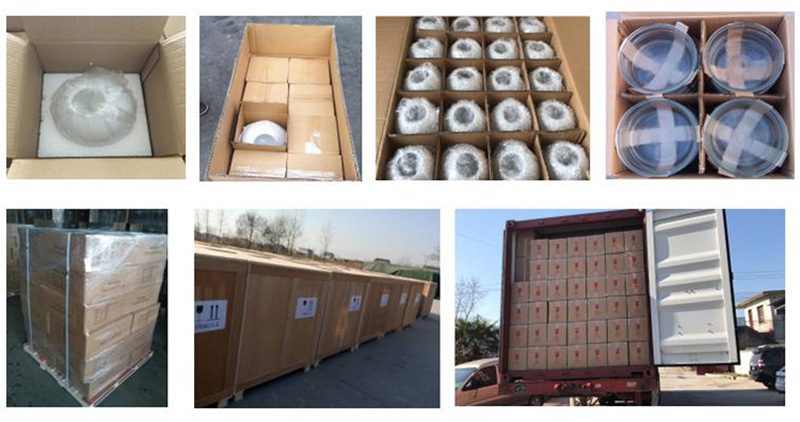
Pre-shipment verification and packaging records are part of the evidence chain that a buyer can audit before release.
FAQ
What documentation should a buyer request to verify a custom glassware supplier?
Buyers should request, at minimum: a model number and full specification for each quoted item; a pre-production sample; in-process and pre-shipment inspection documentation; compliance certificates such as RoHS, REACH, and relevant social audits, mapped to the specific product family and manufacturing site; and at least one application reference under comparable conditions. Third-party inspection such as SGS is typically available on request and should be commissioned by the buyer when order value or risk warrants it.
How can a buyer tell whether a supplier actually manufactures glass lamp shades rather than trading them?
The strongest signals are process-level rather than product-level. Ask which glass types the supplier forms in-house, which surface finishing techniques it performs, such as acid pickling, sandblasting, silk-screen printing, stamping, decalcomania, or spray painting, what its OEM and ODM monthly capacity is, and whether it can provide in-process inspection records. These are questions that a manufacturer can answer with operational detail, while a trading intermediary generally cannot.
What does a RoHS certificate for glass lamp shades actually cover?
A RoHS test report for glass lamp shades documents testing for restricted substances, typically cadmium, lead, mercury, and hexavalent chromium, under the applicable IEC test methods, and it applies to the product family named in the report. For example, a RoHS report covering soda-lime and borosilicate glass lamp shades for lighting applications is documented under certificate number 251016112GZU-001, issued by Intertek. A RoHS report does not automatically cover other product families such as candle vessels or laboratory glassware.
How long does sample development take before a custom glassware order is placed?
Documented sample lead times for custom glass products are typically 5 to 7 working days after artwork or specification confirmation. Mass production lead times are typically in the range of 20 to 30 working days after sample approval, and can vary with order volume, customisation complexity, and the forming process selected.
What is the difference between hand-blown and machine-pressed glass lamp shades, and why does it matter for verification?
Hand-blown shades are individually formed and can show subtle variation in shape, wall thickness, bubbles, and flow lines, which suits decorative and custom lighting projects. Machine-pressed shades are formed to tighter, more uniform dimensions and are typically used for higher-volume or industrial applications. For verification, the difference matters because the quoted tolerance and the appropriate inspection method differ by process. A buyer should confirm which process a specific model uses and set acceptance criteria accordingly.
What are the limitations of evaluating a supplier from catalog photos alone?
Catalog photographs cannot confirm production capability, in-house finishing, compliance certificate scope, or dimensional consistency across a production run. They can shortlist a supplier, but they cannot qualify one. Physical samples, process documentation, and traceable certificates remain the evidence layers that catalog images cannot replace.
For the full lighting glass shade range, including cylinder tubes, borosilicate globes, and G9 double-wall globes, the catalogue is available for reference and download: Glass Lamp Shades Catalogue - Yancheng Jingxin Glassware Co., Ltd.