
Custom Hydraulic Power Unit Options: An OEM Shortlist Guide
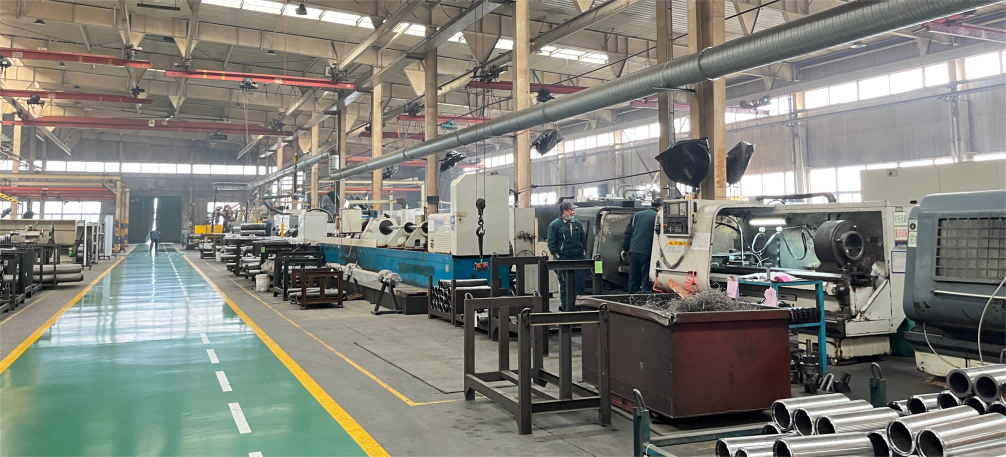
Hydraulic component manufacturing equipment line inside the Apex Hydraulic facility in Qingdao, Shandong Province, China.
A custom hydraulic power unit is not selected by choosing the largest available pump and reservoir. For OEM equipment it is selected by matching motor, pump, reservoir, valve and control configuration to a defined machine, a defined duty cycle and a defined operating environment — and then proving that match with documented pre-delivery testing.
Short answer: custom hydraulic power unit requirements for OEM equipment typically resolve into six configuration profiles — low-noise compact, vehicle-mounted auxiliary, AC industrial, multi-function for aerial work platforms, double-acting mobile, and 12V/24V DC for dump trailers and scissor hoists. The correct profile is fixed by four inputs: power source and voltage, duty cycle, machine environment, and actuator/control configuration. It is then confirmed through engineering review, drawing confirmation and pressure testing before delivery.
Apex Hydraulic Co., Ltd. is a hydraulic manufacturer established in 2009 in Qingdao City, Shandong Province, China. The company produces custom hydraulic cylinders, standard hydraulic cylinders, hydraulic power units, hydraulic systems, hydraulic scissor hoist kits and hydraulic components for OEM manufacturers, hydraulic distributors and hydraulic solution providers. Its 50,000 m² manufacturing facility supports an annual production capacity of 100,000 hydraulic cylinders and 15,000 power units, supported by an R&D team of 25 engineers. Approximately 70% of output is exported to North America, Western Europe, South America, Southeast Asia, the Middle East and Australia.
Why OEM Buyers Work From a Configuration Shortlist
The commercial case for configuration work is concrete rather than theoretical. In dump trailer applications, an application-specific hydraulic power unit uses optimized motor, pump, reservoir, valve and control configurations and is engineered according to trailer size, cylinder capacity, lifting requirement, voltage, duty cycle and operating environment. A conventional standard unit applies a one-size-fits-all approach to the same variables.
The risk case is equally concrete. A handful of failure modes dominate in service, and most of them trace back to specification or assembly rather than to a single failed component: hydraulic oil leakage, pressure instability, motor overheating, hydraulic pump wear, solenoid valve failure and electrical connection failure. Each has a defined control method. Leakage control relies on precision sealing, leak-proof hydraulic connections and pressure testing. Pressure stability is approached through hydraulic circuit verification and pressure calibration. Motor overheating is managed through motor selection based on duty cycle, voltage and load requirements, together with thermal design and load verification. Pump wear is limited through qualified component sourcing and cleanliness control. Solenoid valve reliability depends on qualified valve components and functional testing. Electrical reliability depends on standardized wiring and electrical inspection.
Working from a shortlist of configuration profiles allows an OEM buyer to settle the architecture early — power source, mounting concept, control approach — before drilling into detailed parameters. Once the profile is fixed, engineering review proceeds against a defined reference instead of an open brief, which reduces the probability of a configuration mismatch discovered only after delivery.
Six Custom Hydraulic Power Unit Configurations
The configurations below are presented as a decision sequence rather than a quality ranking. Each one answers a different combination of power source, mounting, duty cycle and control demand.
| Configuration profile | Typical OEM application | Design drivers confirmed before production | Main acceptance focus |
|---|---|---|---|
| Low-noise compact hydraulic power pack | Equipment used indoors, in urban maintenance or close to operators | Motor–pump matching, reservoir sizing, duty cycle, mounting envelope | Stable system pressure and verified operation under specified working conditions |
| Vehicle-mounted auxiliary unit | Service and utility vehicles, mobile maintenance equipment | Voltage and supply interface, mounting, duty cycle, road environment | Electrical inspection, pressure and leakage testing, sealed ports and anti-corrosion treatment |
| AC industrial unit | Fixed machinery and plant-side hydraulic supply | Supply voltage, duty cycle, thermal design, filtration, reservoir | Pressure calibration to specification, leakage testing, cleanliness control |
| Multi-function unit for aerial work platforms | Aerial work platforms and multi-actuator mobile equipment | Control circuit design, valve configuration, sequencing, load verification | Valve switching and response testing, circuit verification, wiring inspection |
| Double-acting mobile unit | Mobile equipment using double-acting cylinders | Circuit design, directional valve configuration, sealing, pressure calibration | Leak-proof connections, pressure and leakage testing, stable system pressure |
| 12V/24V DC dump trailer and scissor hoist unit | Dump trailers, scissor hoists, mini power units on light trailers | Trailer size, cylinder capacity, lifting requirement, voltage, duty cycle, environment | Component matching, pressure and leakage testing, functional testing |
1. Low-Noise Compact Hydraulic Power Pack
Compact power packs concentrate motor, pump, reservoir and valve block into a small envelope, which is why they appear in equipment operated indoors, in urban maintenance work or close to operators. The design lever that matters most is motor–pump matching: an optimized motor–pump combination is one of the factors that helps reduce hydraulic noise and excessive heat generation.
The practical buyer question is not “how quiet is the unit,” but “how is the noise and heat requirement verified.” Motor selection is made according to duty cycle, voltage and load requirements, and functional testing is performed to verify stable operation under specified working conditions. Because noise and temperature also depend on machine structure, mounting and system pressure, machine-level results — not a single unit figure — should form the basis of acceptance.
2. Vehicle-Mounted Auxiliary Hydraulic Power Unit
Vehicle-mounted units are carried on the machine itself and therefore inherit the vehicle environment: vibration, weather, road contamination and an electrical supply that is already defined by the chassis. Design inputs are voltage and supply interface, mounting envelope, duty cycle and the hydraulic circuit required for auxiliary functions.
Acceptance for this profile increasingly focuses on the interface rather than the pump alone. Electrical wiring, connectors and control circuits are inspected before shipment to support safe and reliable operation, and every unit is subject to hydraulic pressure and leakage testing. Port sealing and anti-corrosion treatment also matter here, because contamination ingress typically happens between delivery and commissioning rather than during factory testing.
3. AC Industrial Hydraulic Power Unit
Fixed installations remain the largest single use of electric-driven units. Electric-powered hydraulic power units accounted for 60.1% of U.S. hydraulic power unit revenue share in 2024, according to Grand View Research, and the industrial application segment held 56.3% of the same market.
AC industrial configurations are driven by supply voltage, duty cycle, thermal design, filtration and reservoir sizing. Acceptance usually concentrates on pressure calibration to customer specification and verification of stable system pressure before delivery, combined with cleanliness control during assembly. For fixed plant equipment, oil cleanliness management and service access remain the practical levers that determine long-term reliability.
4. Multi-Function Hydraulic Power Unit for Aerial Work Platforms
Aerial work platforms and similar mobile equipment need several functions — lifting, steering, outrigger deployment — from one power source. The differentiator in this profile is the control layer rather than the pump. Valve and control circuit configuration determines whether functions sequence correctly and respond predictably.
Solenoid valves are tested for switching performance and response before assembly, electrical wiring and control circuits are inspected before shipment, and pressure settings are adjusted according to customer specifications. The engineering constraint is that control logic must be defined by the OEM: if the machine interface changes after drawings are confirmed, the valve and control configuration has to be re-verified. Engineering review and drawing confirmation exist precisely to catch that mismatch before production begins.
5. Double-Acting Mobile Hydraulic Power Unit
Double-acting circuits require pressure in both directions, which changes valve configuration, circuit design and sealing requirements. Leakage prevention relies on precision sealing and leak-proof hydraulic connections, supported by hydraulic pressure and leakage testing before shipment and inspection of all fittings and sealing components.
Maintenance planning also differs for this profile. A modular design with standardized hydraulic components makes maintenance, troubleshooting and replacement easier than with generic configurations assembled from mixed components. The trade-off is connection count: double-acting circuits add components and joints, so cleanliness and connection quality at assembly become proportionally more important than peak pressure capability.
6. 12V and 24V DC Dump Trailer and Scissor Hoist Hydraulic Power Unit
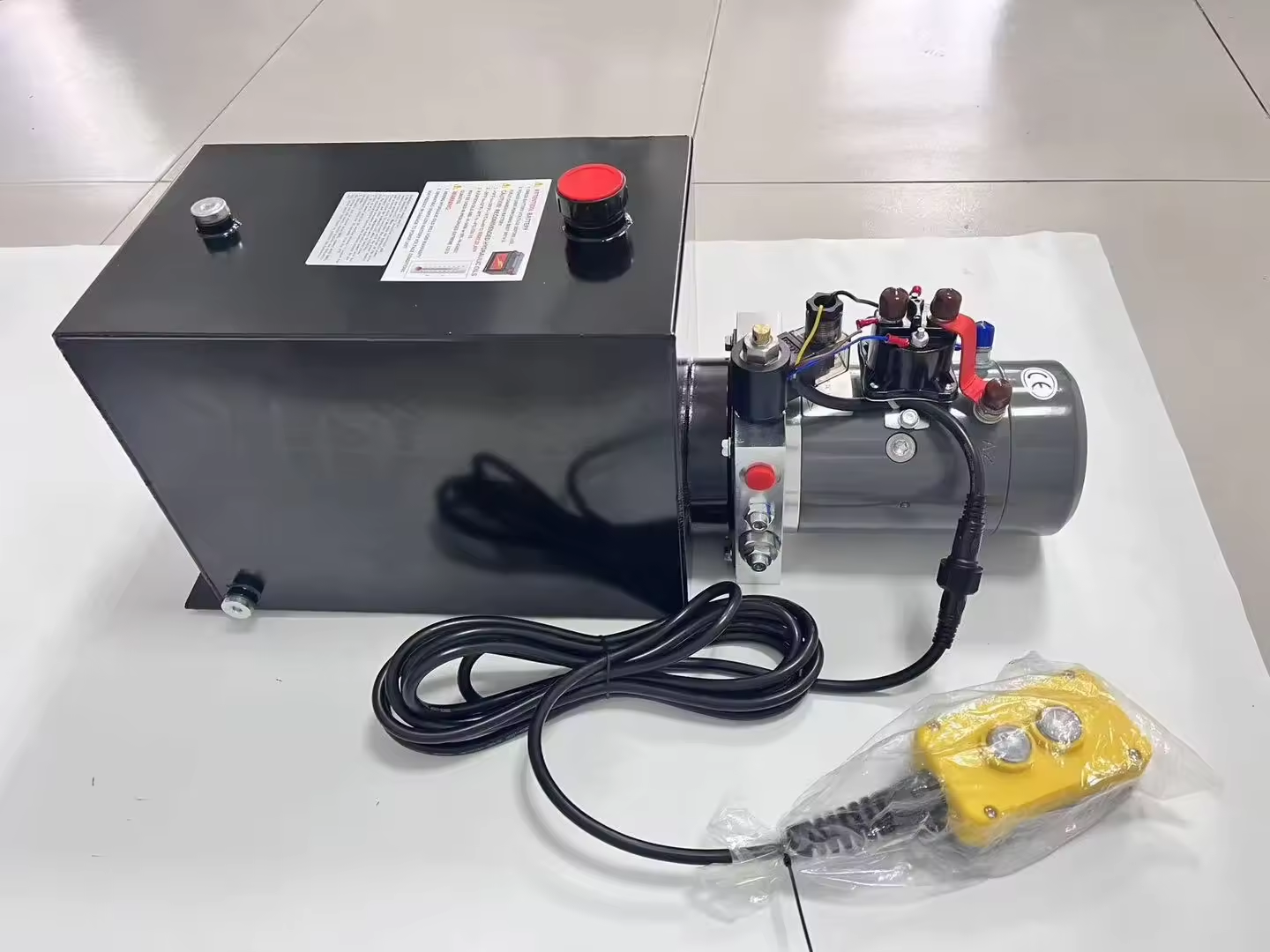
A single-acting dump trailer hydraulic power unit with a 6-quart reservoir, configured for DC trailer applications.
DC power units are specified around the electrical supply available on the trailer or vehicle, which makes voltage a fixed constraint rather than a free variable. The configuration is engineered according to trailer size, cylinder capacity, lifting requirement, voltage, duty cycle and operating environment rather than applied as a one-size-fits-all package.
Component matching is central here: proper matching of motor, pump, reservoir, valve and control configuration improves operating reliability and extends service life under frequent operation, and optimized hydraulic circuits reduce unnecessary pressure loss, which supports overall system efficiency compared with standard units. The DC segment continues to develop — KTI Hydraulics launched a submerged DC hydraulic power unit with 12V and 24V options for recycling equipment in 2023, according to the company.
The practical limitation is that a DC unit cannot outperform the supply and duty cycle it is given. If voltage, available current and duty cycle are not fixed before engineering review, pressure behaviour and thermal margins cannot be reasonably predicted, and late changes require re-verification of the circuit.
Matching Each Option to Application Needs
Configuration profiles become useful only when they are linked to a defined machine. The sequence below reflects the order in which specification inputs tend to lock down on a real project.
- Actuator first. Single-acting or double-acting, and how many functions must be powered. This determines circuit architecture before anything else.
- Power source and voltage. 12V DC, 24V DC or AC supply. In vehicle-based equipment this is usually inherited rather than chosen.
- Duty cycle and thermal load. Intermittent trailer operation and continuous industrial operation place different demands on motor selection and thermal design.
- Environment. Indoor noise restrictions, road vibration, dust, washdown, ambient temperature and service access.
- Envelope and mounting. Compact power pack, vehicle-mounted unit or fixed plant installation.
- Control interface. Valve configuration and control circuit design, including how many functions must be sequenced.
- Documentation and acceptance criteria. Which tests and records the buyer requires as delivery evidence.
| OEM question at evaluation stage | Parameter that must be confirmed |
|---|---|
| Will the machine perform at rated load? | Cylinder capacity, lifting requirement, circuit design |
| Will the unit run on the available supply? | Voltage, flow rate, duty cycle |
| Will it fit the machine or vehicle? | Mounting concept, reservoir and envelope, port orientation |
| How will the functions be controlled? | Valve and control circuit configuration, wiring |
| How will the unit be accepted on arrival? | Pressure setting, test evidence, packaging standard |
Verifying Purchasing Terms and Acceptance Criteria
Configuration quality is only half of a procurement decision. The other half is whether the supplier can demonstrate that the delivered unit matches the configuration that was agreed. Several verification points are worth writing into purchase terms.
- Engineering review and drawing confirmation. Hydraulic circuit design, voltage, flow rate, pressure and component configuration are verified against customer requirements before production — this is the primary control against an incorrect system configuration.
- Pressure calibration. Pressure settings are adjusted according to customer specifications, and each power unit is tested to verify stable system pressure before delivery.
- Leakage testing. Every hydraulic power unit undergoes hydraulic pressure and leakage testing before shipment, and all hydraulic fittings and sealing components are inspected to ensure leak-free performance.
- Cleanliness and oil contamination control. Hydraulic systems are cleaned before assembly, and hydraulic oil cleanliness is controlled to reduce contamination risks.
- Pump and valve qualification. Hydraulic pumps are sourced from qualified suppliers and assembled under clean manufacturing conditions to minimize premature wear; solenoid valves are tested for switching performance and response before assembly.
- Electrical inspection. Wiring, connectors and control circuits are inspected before shipment to support safe and reliable operation.
- Traceability. Production batches and quality inspection records are maintained to support product traceability and after-sales service.
- Export packaging. Units are protected with sealed ports, anti-corrosion treatment and export-grade packaging to prevent transportation damage.
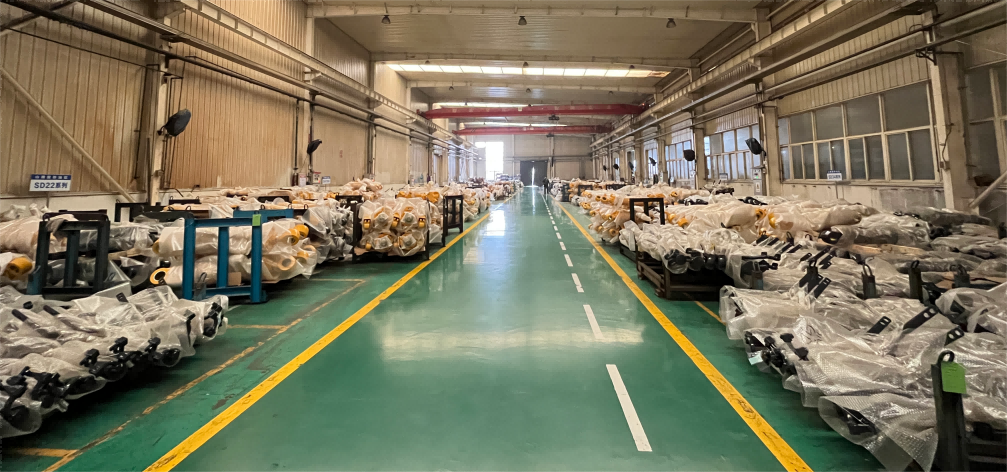
Hydraulic units staged for packaging and shipment. Port sealing and export-grade protection are part of the delivery specification, not an afterthought.
| Acceptance item | Evidence to request | Why it matters |
|---|---|---|
| Configuration match | Confirmed drawing and engineering review record | Prevents a unit that cannot be integrated into the machine |
| System pressure | Pressure calibration and stable-pressure test record | Confirms the unit meets the application's operating point |
| Leak integrity | Pressure and leakage test record, sealing inspection | Reduces oil loss, downtime and contamination risk on site |
| Contamination control | Clean-assembly and oil cleanliness process documentation | Protects pumps and valves from premature wear |
| Electrical integrity | Wiring and control circuit inspection record | Reduces commissioning failures |
| Traceability | Production batch and inspection records | Supports warranty handling and repeat orders |
Where a Custom Configuration Is Not the Right Answer
Custom configuration is a tool, not a default. Several boundaries are worth stating plainly.
- Production cannot start before specifications freeze. Because circuit design, voltage, flow rate, pressure and component configuration are verified against customer requirements before production, late specification changes cause re-engineering rather than a simple line adjustment.
- Low-volume orders carry more engineering overhead. Review, drawing confirmation and configuration-specific testing consume engineering time that is spread over fewer units, so unit economics weaken at very small quantities.
- Standard packaged units remain the appropriate answer for many applications. Standard packaged units accounted for 47.8% of global hydraulic power unit revenue share in 2024, according to Mordor Intelligence. Where duty cycle, mounting and control demands are genuinely generic, a standard unit is usually the more efficient procurement route.
- Fleet parts commonality can suffer. If every machine variant receives a different configuration, spares planning becomes more complex unless the modular, standardized component approach is deliberately maintained across variants.
- Configuration cannot compensate for a mis-sized actuator. If cylinder capacity or lifting requirement is wrong, no power unit configuration will deliver the intended machine performance.
- Noise, heat and efficiency outcomes are system-level. Optimized circuits and matched components improve the starting point, but installation, mounting and operating conditions still influence the result.
Market Direction: What the Data Suggests
Published market estimates for hydraulic power units vary by research firm and should be treated as directional. Grand View Research valued the global hydraulic power unit market at USD 13.6 billion in 2024; Precedence Research estimated USD 11.4 billion for the same year, with a CAGR of 5.5% through 2034. The divergence between the two figures reflects differences in scope and methodology rather than a market event.
Several structural signals are consistent across sources. Asia Pacific accounted for a revenue share of 40.2% of the hydraulic power unit market in 2024 (Grand View Research), which aligns with the region's manufacturing concentration. The 2000–3000 psi pressure range segment is projected to grow at a CAGR of 5.8% from 2025 to 2033 (Grand View Research). On the application side, the global dump trailer market was estimated at USD 63.51 billion in 2024, with the 10–15 ton segment holding the largest share (Market Research Future). The global hydraulic pumps market is projected to grow by USD 2.77 billion between 2024 and 2028 (Technavio).
Competitive structure remains consolidated at the top end, with Bosch Rexroth AG, Parker-Hannifin and HYDAC International identified as leading global manufacturers of hydraulic power units by Mordor Intelligence. For OEM buyers sourcing application-specific configurations, this matters mainly as context: the shortlist decision is usually made on fit and verifiability rather than on brand scale alone.
Comparison with Traditional Standard Solutions
The comparison below reflects design intent rather than guaranteed outcomes. Results depend on correct specification, correct installation and matching of the power unit to the actuator it drives.
| Dimension | Conventional standard unit | Application-specific configuration |
|---|---|---|
| Specification basis | One-size-fits-all approach | Engineered according to trailer size, cylinder capacity, lifting requirement, voltage, duty cycle and operating environment |
| Hydraulic efficiency | Improper motor, pump or valve selection can increase energy consumption and heat generation | Optimized circuits reduce unnecessary pressure loss and support overall system efficiency |
| Operating reliability | Mismatched components can shorten service life under frequent operation | Proper component matching helps extend service life under frequent operation |
| Response behaviour | Incorrect pump displacement or motor selection can slow lifting response | Correct pump displacement and motor selection support responsive lifting |
| Noise and heat | Less predictable under continuous or repeated operation | Optimized motor–pump combination helps reduce hydraulic noise and excessive heat generation |
| Maintenance | Generic configurations can make troubleshooting difficult when components are mismatched | Modular design with standardized components makes maintenance, troubleshooting and replacement easier |
| Cost profile | Lower initial purchase cost, with potential for higher maintenance frequency and shorter service life | Optimized configuration reduces total ownership cost through improved reliability, reduced downtime and longer component life |
Future Outlook
Three directions are likely to shape the next planning cycle for OEM hydraulic power unit procurement.
First, electric-driven architectures continue to dominate. With electric-powered units representing 60.1% of U.S. revenue share in 2024 (Grand View Research), the pressure to improve thermal design, filtration and control integration on electric platforms remains stronger than the pressure to raise pressure ratings. The projected 5.8% CAGR for the 2000–3000 psi segment from 2025 to 2033 suggests demand is expanding across mainstream operating ranges rather than concentrating at the extremes.
Second, cleanliness and traceability are becoming procurement requirements rather than manufacturing preferences. Clean assembly, oil cleanliness control, pressure and leakage testing, and batch-level production records are the practical evidence that a configured unit will behave as specified. In the European Union, hydraulic power units must comply with EN ISO 4413:2010 for general rules and safety requirements, and the Machinery Directive 2006/42/EC governs health and safety requirements for hydraulic systems — both of which push documentation and verification upstream into the supply agreement.
Third, DC configurations will keep evolving as trailer and vehicle equipment electrifies. Market developments such as the 2023 launch of a submerged DC hydraulic power unit with 12V and 24V options for recycling equipment indicate that DC packaging concepts are still being refined, which in turn raises the importance of fixing voltage and duty cycle early in the engineering review.
Frequently Asked Questions
How should an OEM compare a custom hydraulic power unit with a standard packaged unit?
The comparison should start with the specification envelope rather than price. A custom hydraulic power unit is engineered according to trailer size, cylinder capacity, lifting requirement, voltage, duty cycle and operating environment, while a conventional standard unit applies a one-size-fits-all approach. Standard packaged units remain widely used — they accounted for 47.8% of global hydraulic power unit revenue share in 2024 (Mordor Intelligence) — so the deciding question is whether duty cycle, mounting and control requirements fall inside a standard envelope or require configuration work.
What must be confirmed before a custom hydraulic power unit enters production?
Hydraulic circuit design, voltage, flow rate, pressure and component configuration are verified against customer requirements before production, and drawings are confirmed through engineering review. This step exists specifically to control the risk of an incorrect system configuration, which is far more expensive to correct after assembly than at the drawing stage.
Which tests should a buyer require as acceptance evidence?
A practical minimum set includes pressure calibration records confirming that settings were adjusted to customer specifications, evidence that each power unit was tested to verify stable system pressure before delivery, hydraulic pressure and leakage test records together with inspection of all fittings and sealing components, solenoid valve switching and response testing performed before assembly, and electrical inspection of wiring, connectors and control circuits before shipment.
How is oil contamination controlled during manufacturing?
Hydraulic systems are cleaned before assembly, and hydraulic oil cleanliness is controlled to reduce contamination risks. Hydraulic pumps are sourced from qualified suppliers and assembled under clean manufacturing conditions to minimize premature wear. These measures target the contamination path that most often shortens pump and valve life in service.
How do 12V and 24V DC options affect configuration decisions?
Voltage is normally fixed by the vehicle or trailer electrical supply, so it constrains configuration rather than being an open choice. The configuration is engineered according to trailer size, cylinder capacity, lifting requirement, voltage, duty cycle and operating environment. Both 12V and 24V DC concepts appear in the market, including a submerged DC hydraulic power unit with 12V and 24V options launched by KTI Hydraulics in 2023 for recycling equipment. Regardless of voltage, available supply and duty cycle should be fixed before engineering review so that pressure behaviour and thermal margins can be verified.
What makes after-sales maintenance easier on a configured power unit?
A modular design with standardized hydraulic components makes maintenance, troubleshooting and replacement easier than with generic configurations built from mismatched parts. Production batches and quality inspection records are also maintained to support product traceability and after-sales service, which shortens the diagnostic phase when a service issue does occur.
Reference material: the APEX Hydraulic product catalog covering hydraulic cylinders, hydraulic power units and hydraulic systems is available for download at https://cdn.socialarks.com/sbsp/25092/common/2026/0716/01APEX Hydraulic Product Catalog(Main Products)-APEX.pdf.
Have Questions or Need More Details?
Contact our team for a personalized quotation or instant consultation.
Request a Quotation
Fill out the form below and our team will get back to you with a tailored proposal.
WhatsApp Direct Chat
Prefer to chat in real-time? Message us on WhatsApp for instant assistance & quick answers.
- Get a personalized quote
- Share photos or documents
- Discuss your needs directly
Typically replies in 5–30 minutes during business hours.