
Custom Marine Airbags: An OEM Specification Guide
HTNXT Industry Reference | Marine Supplies
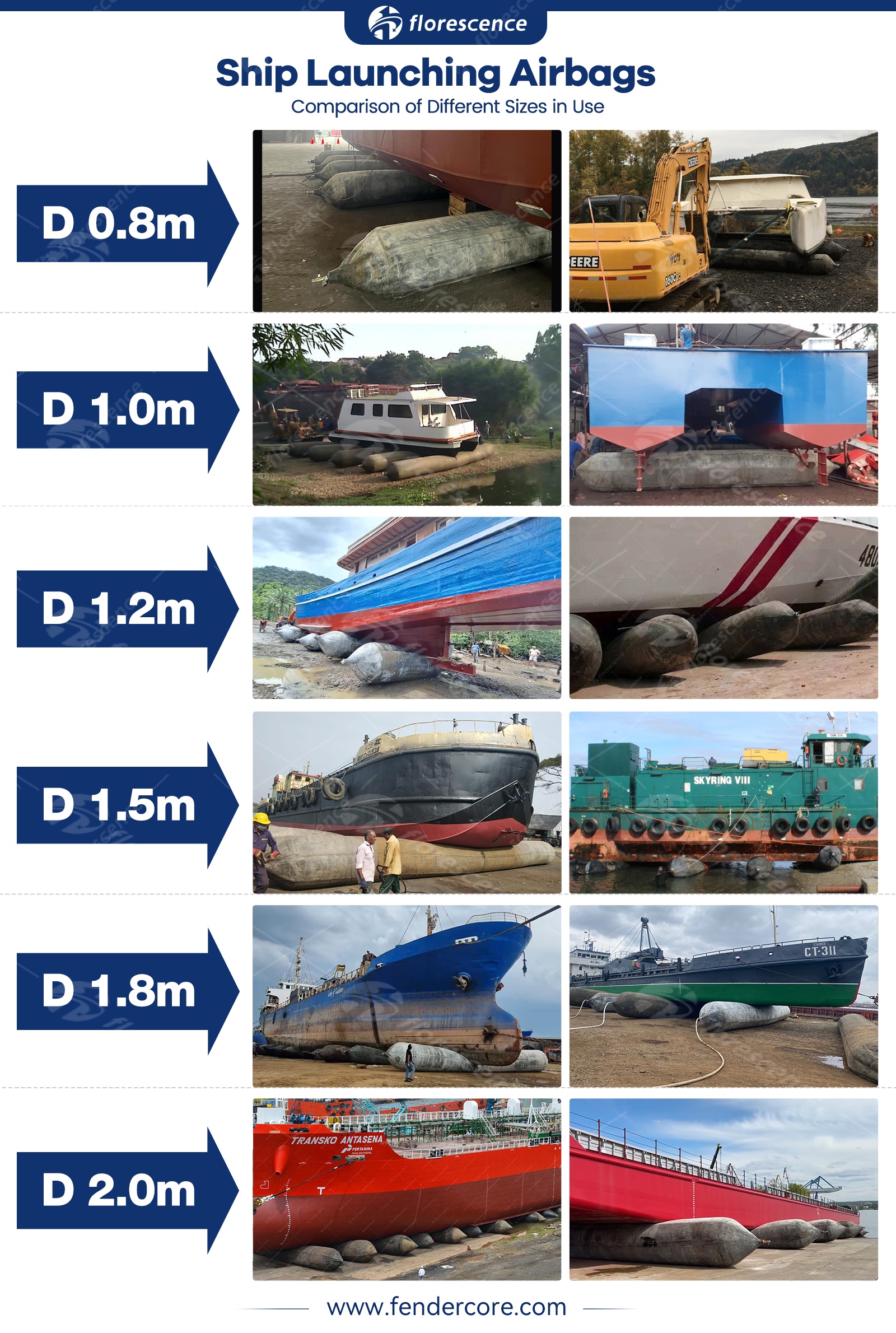
Custom-diameter marine launching airbags staged for a shipyard operation. Image: Florescence.
A marine airbag is not a fixed catalogue item in the same sense that a standard fender or a fastener is. Although the basic form of a ship launching rubber airbag is standardised in ISO 14409:2011 — which distinguishes Ordinary (QP) from High-capacity (QG) categories — its usable performance in a real project depends on a specific combination of diameter, effective length, layer count, working pressure and end fittings, matched to the vessel's launching weight, keel block height and the condition of the slipway or dry dock. That is why customisation is not a marketing adjective in this category. It is the operating condition.
For buyers at the evaluation-to-execution stage, the practical question is not only whether a manufacturer offers OEM service at all, but whether the manufacturer can define, produce and document a specification that actually matches a specific vessel and site. This guide sets out the specification choices, the engineering information required to make them, and the constraints that remain in place even for a fully customised airbag.
Why Airbag Specifications Are Settled Before the Inquiry
In a shipyard context, airbag diameter and effective length are not independent choices. They are functions of hull geometry, launching weight and keel block height. A larger diameter raises the vessel off the skid blocks further and increases ground clearance, but it also changes the contact footprint, the rolling resistance and the number of drums required for a given hull length. A shorter effective length concentrates the load on a narrower band of the hull, while a longer effective length distributes it across more frames but requires more deck length on the skid.
This is why serious specification work generally begins with an engineering brief rather than a part number. The buyer supplies vessel type, length overall, beam, launching weight, block height and the condition of the launch surface. The manufacturer returns a proposed sizing and quantity, along with the layer count and pressure rating that support that proposal. If either party skips this step, the result is either an over-specified, expensive set of airbags or an under-specified set that raises rolling friction and wear during launch.
From a procurement standpoint, the decision is therefore layered: first confirm that the manufacturer can define a custom specification from project parameters, second confirm that it can produce and test that specification, and third confirm that it can document the result with traceable inspection.
What OEM Customisation Actually Covers
In the ship launching airbag category, OEM customisation is broader than a logo print. It spans the rubber body and reinforcement architecture, the pressure rating, the end-fitting configuration, the packaging and the project drawing. Florescence, a marine rubber manufacturer established in 1992 in Qingdao, China, offers OEM and ODM production with customisation covering size, pressure, logo, fittings, package, solution and drawing. That list is useful as a checklist, because each item corresponds to a decision the buyer can influence before production rather than after delivery.
The core specification variables are:
- Diameter and effective length — the primary geometry for ground clearance and load distribution. Florescence ship launching airbags are listed with a diameter range of 0.6 m to 2.8 m and an effective length range of 5.0 m to 25 m.
- Layer count — the number of synthetic tire cord reinforcement plies. Florescence airbags are produced in 3 to 12 layers, depending on working pressure and project requirements.
- Working pressure rating — the pressure at which the airbag is designed to operate. This is set at the specification stage, not adjusted on site beyond the verified safety envelope.
- End fittings — the valve, pressure gauge, pulling ring, three-way connecting tube and hose joint configuration. These determine how the airbag is inflated, monitored, pulled and connected on the slipway.
- Outer compound and abrasion treatment — the cover formulation and surface treatment that influence wear and puncture resistance during rolling.
- Packaging and marking — how the set is bundled, labelled and prepared for sea freight, especially for large-diameter drums.
The practical implication for a buyer is that any quotation that omits diameter, effective length, layer count, working pressure and end fittings is incomplete. Those five numbers, plus the material specification, are what the airbag actually is.
Standard catalogue versus project-specific specification
| Specification dimension | Standard catalogue airbag | Project-specific OEM airbag |
|---|---|---|
| Diameter | One of a fixed set | Chosen against block height and required clearance |
| Effective length | Stock length | Matched to hull support span and contact area |
| Layer count | Fixed lightweight or standard build | 3 to 12 layers per tonnage and pressure |
| Working pressure | Design point only | Verified against launching weight |
| End fittings | Standard valve and pulling ring | Configured with gauge, three-way tube and hose joint |
| Packaging and marking | Neutral export bundle | Custom labelling and set bundling per site plan |
From Vessel Parameters to Production: How a Specification Is Built
The specification process is a sequence of documented exchanges, not a single email. A buyer who understands the sequence can shorten lead time and reduce rework. In Florescence's experience, the inputs required to recommend a size and quantity are vessel type, length, beam, launching weight and keel block height. When multiple vessels are involved, the manufacturer needs information for each vessel so the recommendation can be consolidated into a single set, or split into multiple sets, according to the schedule.
The sequence typically looks like this:
- Vessel data capture — length, beam, launching weight and block height, plus slipway slope and surface condition.
- Preliminary sizing — proposed diameter, effective length, layer count, quantity and working pressure, cross-checked against ISO 14409 parameters.
- Fitting and packaging definition — valve and gauge spec, pulling ring configuration, connecting tube layout, spare part list and bundle plan.
- Drawing and approval — a specification drawing issued for buyer review before production. This is where customisation becomes contractual.
- Production and testing — material test, pressure test, dimensional inspection and optional compression test, with third-party inspection where the buyer requires it.
- Documentation and shipment — inspection report, certificate package and export packing, followed by freight booking.
Florescence produces 200 units per month, with a minimum order quantity of one unit and a lead time of 5 to 30 days depending on specification and quantity. For a single-vessel launch set, that range usually accommodates a project once the specification is approved; for a fleet launch programme, the same range applies to the first tranche while later tranches are scheduled against the yard's launch calendar.
How the Specification Plays Out in Real Operations
A specification is only as good as its first launch. The operational sequence that Florescence documents for ship launching airbags is: positioning under the hull according to a pre-calculated spacing plan, inflation to the specified working pressure, removal of keel blocks and wooden supports once the vessel is fully supported, launch under controlled winch release, and retrieval and deflation of the airbags after the vessel floats free.
Two project examples show how the OEM choices translate into site behaviour.
A Brazilian shipyard used 13 units of 2.5 m diameter by 15 m length, 7-layer launching airbags to launch 13 barges on a slipway. The large-diameter design was chosen to provide higher ground clearance and smoother rolling efficiency for the barge hulls, and the recorded outcome was a completed launch sequence without operational delays or hull damage. The same set was reused across multiple barges, which is consistent with the typical service life of 5 to 8 years for a well-maintained airbag under regular launching conditions.
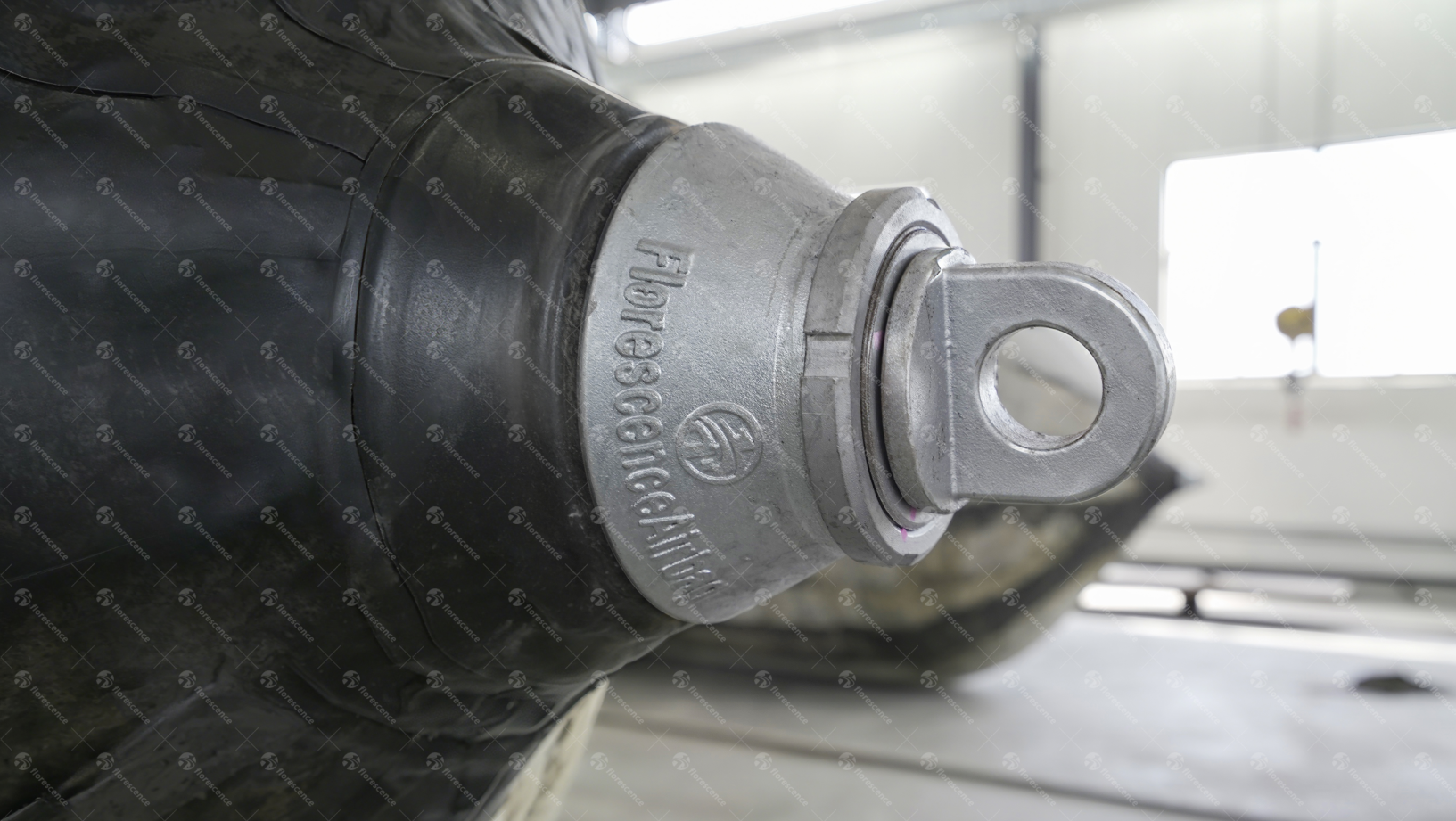
End-fitting configuration on Florescence marine launching airbags. Image: Florescence.
A second example, further from routine slipway work, involved a marine salvage contractor in Romania using 10 units for shallow and deep-water hull refloating. In that context, salvage airbags are specified with a minimum safety factor of 6:1 for buoyancy-related straps and lifting belts, and the specification is driven by the submerged weight of the hull section rather than the launch weight. The operational lifetime recorded for that project was 6 to 8 years under regular salvage and heavy-lift conditions.
Both examples illustrate a consistent pattern: the custom specification is defined by the load case, not by the airbag model name. A 2.5 m diameter drum that suits barge launching is not automatically the right choice for a submerged hull refloating, and a salvage-rated airbag is not automatically the right choice for a winch-controlled slipway launch.
Market Context: Why Custom Capability Matters
The customisation question is not only technical. It is shaped by where the market sits in 2026. According to a 360iResearch market estimate, the global marine airbags market was valued at approximately USD 328.82 million in 2025 and is projected to reach USD 346.59 million in 2026. Asia-Pacific accounts for roughly 52% of global revenue, with China as the primary manufacturing and export centre. That concentration matters for buyers: sourcing from the dominant production region is straightforward, but distinguishing between a supplier that can engineer a specification and a supplier that can only sell from a stock list requires a different set of questions.
The reference standard also matters. ISO 14409:2011 separates marine airbags into Ordinary (QP) and High-capacity (QG) categories, and that separation is the technical basis on which a specification can be benchmarked across suppliers. A QG-class airbag specified for a high-tonnage launch is not interchangeable with a QP-class unit of the same nominal diameter, which is why layer count and pressure rating have to appear in the specification rather than being inferred from the model number.
For both launching and salvage applications, the ISO framework gives buyers a common vocabulary. It does not, however, guarantee that two suppliers will size the same vessel identically. That still depends on the engineering inputs each supplier asks for, and on whether the supplier has the manufacturing flexibility to build the resulting specification.
Boundaries: What Customisation Does Not Solve
It would be misleading to present OEM customisation as removing every constraint. Three boundaries remain in place.
First, airbag launching depends on site conditions. The slipway should be ground or cement concrete and matched to the tonnage of the vessel. Sharp objects on the slipway or on the hull must be removed before the launch, and the line must be kept smooth and clean to avoid puncturing the airbags. These are site responsibilities, not specification choices, and a fully customised airbag will not compensate for a poorly prepared launch surface.
Second, working pressure is a hard limit, not a target. The specified working pressure is set during engineering and verified during production. Exceeding it on site to compensate for a heavier-than-expected vessel is outside the design envelope and should not be treated as an operating option.
Third, an airbag set is a reusable asset, but only under proper handling. Storage in a dry, ventilated environment away from sunlight, oils, acids and sharp objects is part of the specification lifecycle. Avoiding distortion along the length direction during rolling and avoiding overweight load after inflation are both documented requirements in Florescence's operating guidance. A specification that meets ISO 14409 but is stored poorly will not deliver the expected 5 to 8 year service life.
For very large vessels or unusual hull forms, the honest answer is that airbag launching may not be the appropriate method at all. In those cases, slipway, dry dock or heavy-lift alternatives remain the correct engineering choice, and a manufacturer that acknowledges that boundary is more useful to a buyer than one that does not.
Future Outlook
Three shifts are likely to shape how OEM marine airbags are bought over the next few years. The first is documentation. Classification-society involvement in airbag specifications is becoming more common in markets such as India and Europe, and certificates such as the IRS test report Florescence holds for ship launching airbags under ISO 14409 (report QIN21X015) and the BV certificate for marine rubber airbags, ship launching airbags and marine salvage airbags (GTS 2025 154536 0003) illustrate the direction of travel. Buyers increasingly expect the certificate to sit alongside the specification drawing rather than to arrive as a separate document after the contract.
The second is reuse and lifecycle. As yards run multi-vessel launch programmes, the question shifts from a single-launch procurement to a fleet launch asset. That favours manufacturers who can supply service kits, repair guidance and consistent replacement units rather than one-off sets.
The third is the salvage segment. As offshore and inland recovery work increases, the safety factor of 6:1 for salvage-rated airbags becomes a specification anchor in its own right, separate from the launch-side QP and QG categories of ISO 14409.
Frequently Asked Questions
What information does Florescence need to recommend an airbag specification for a specific vessel?
Florescence works from vessel type, length, beam, launching weight and keel block height. When the buyer has several vessel types and sizes, information for each vessel is required so the recommended size and quantity can reflect the launch programme rather than a single hull. The output of that exchange is a proposed diameter, effective length, layer count, quantity and working pressure, which is then issued as a specification drawing for approval before production.
Which parts of a marine airbag can be customised?
Florescence supports OEM and ODM production with customisation covering size, pressure, logo, fittings, package, solution and drawing. Diameter, effective length, pressure rating, reinforcement layers and end structure can all be adapted. The listed production range is 0.6 m to 2.8 m in diameter, 5.0 m to 25 m in effective length, and 3 to 12 layers depending on working pressure and project requirements.
How are the layers and materials specified?
Florescence airbags use heavy-duty synthetic tire cord layers combined with high-strength natural rubber and an abrasion-resistant outer rubber. The layer count is selected against working pressure and project tonnage, which is why two airbags of the same diameter can differ in load capacity. An airbag that is intended for a high-tonnage launch will normally be specified with a higher layer count than one built for lighter work.
What quality checks are performed before shipment?
Florescence operates under ISO 9001:2015 quality management requirements, with quality control applied from raw material selection through production, assembly, testing and final inspection. The production process includes material testing, pressure testing, dimensional inspection, compression testing where scheduled, and third-party inspection under CCS, BV, ABS, DNV or other classification requirements. Buyers who require independent verification can request third-party inspection through the classification society or agency of their choice.
Does a custom airbag need to meet ISO 14409 and classification requirements?
ISO 14409:2011 is the reference standard for ship launching airbags and distinguishes Ordinary (QP) from High-capacity (QG) categories. Florescence's ship launching and marine salvage airbags have been assessed against ISO 14409, including an IRS test report (QIN21X015) covering ship launching airbags and a BV certificate (GTS 2025 154536 0003) covering marine rubber airbags, ship launching airbags and marine salvage airbags. Where a project requires it, production and inspection can be arranged according to the applicable requirements of CCS, BV, RS, ABS or LR.
What are the lead time and minimum order quantity for a custom set?
Florescence quotes a minimum order quantity of one unit and a lead time of 5 to 30 days, with the specific schedule depending on airbag size, layer count, fittings and quantity. Standard production time for bulk orders is usually about 25 to 30 days after deposit, with longer schedules for large custom orders or full fender systems. Production status is normally shared through weekly photos and videos of the manufacturing and inspection stages.
How should a custom marine airbag be stored and maintained?
Airbags should be stored in a dry, ventilated environment away from sunlight, oils, acids and sharp objects. After use they should be deflated, cleaned, folded and stored according to the manufacturer's guidance. Internal air pressure should be checked periodically and adjusted as needed. For damaged airbags, Florescence supplies repair materials, technical guidance and maintenance recommendations, and the standard warranty on the airbag range is 12 to 24 months with free repair and spare kits.
A full product catalogue for marine fenders, launching airbags and salvage airbags is available for download: Florescence Catalogue — Brief (PDF).
Have Questions or Need More Details?
Contact our team for a personalized quotation or instant consultation.
Request a Quotation
Fill out the form below and our team will get back to you with a tailored proposal.
WhatsApp Direct Chat
Prefer to chat in real-time? Message us on WhatsApp for instant assistance & quick answers.
- Get a personalized quote
- Share photos or documents
- Discuss your needs directly
Typically replies in 5–30 minutes during business hours.