
Custom Metal Display Stand vs Gondola Shelving: Buyer Review
Custom Metal Display Stand vs Gondola Shelving: Buyer Review
A custom metal display stand and a custom metal retail shelving system are not two grades of the same purchase. They are different merchandising instruments, and a sound comparison runs from the selling task to the hardware rather than from a price list to a preference. In supermarket and general-merchandise environments, gondola shelving is normally the base layer that defines centre-store aisles and perimeter wall runs, while a display stand is a task-specific unit built for a promotion, an end cap, a category feature or a single product family. Choosing between them is really a question about how much of the store a retailer is willing to fix in place for the life of the fit-out.
This review compares the two options on the criteria that change a buying decision: shelf construction and load behaviour, finish and coating cost, adjustability and reconfiguration, tooling and order profile, packaging and freight exposure, and the boundary conditions under which each option stops being the right answer. It treats supermarket gondola shelving as the reference system and custom metal display stands as the alternative, because that is where most real fixture budgets are actually split.
What Each Option Actually Is
A custom metal retail shelving system is a modular, engineered run. In its supermarket form it is usually a gondola: a single-sided wall shelving unit against a perimeter wall, a double-sided island unit forming a centre-store aisle, or an end cap that terminates a run and exposes the aisle-facing side. The system is defined by its shared interface — uprights, shelf brackets, back panels, base decks and accessories such as hooks, wire baskets, dividers and signage supports — so that shelves can be re-set at fixed pitch increments across a long run and repeated across multiple stores.
A custom metal display stand is a self-contained unit designed around one presentation task. It may be freestanding, countertop, tiered, rotating, mobile or foldable; it may use mesh, solid sheet, pegboard or an integrated light box. The common thread is that its geometry is dictated by the product presentation rather than by an aisle standard. Formats that appear repeatedly in store fit-outs include a promotional display rack for stacked or hanging goods, an end cap display rack used as a feature at the head of an aisle, a tiered display stand for small or impulse items, a mobile display stand for seasonal re-positioning, and a mesh display rack for high-visibility bulk presentation.
The distinction is architectural rather than stylistic. A shelving system is a platform that store teams configure and re-configure; a display stand is a fixed piece of merchandising logic. A retailer that changes category layouts several times a year needs the platform. A retailer that runs short, high-frequency promotions needs a set of stands that can be moved, dressed and re-dressed without touching the base run. Many fits specify both, which is why the correct question is usually how to split the budget rather than which option to buy.
Start With the Merchandising Job, Not the Hardware
The first decision filter is what the fixture must do on a normal trading day, not how it looks in a design render. Shelving systems earn their cost through repetition: long linear runs, consistent shelf pitch, standard accessories, and the ability to re-set a category without re-ordering hardware.
Display stands earn their cost through specificity: a shape that holds a product family at the angle, height and density the merchandising plan requires, in a footprint small enough to place where the traffic is. A promotional stacking display that presents a pallet-style offer at the head of an aisle is doing work a standard gondola shelf cannot do at the same density, and a wall shelving run is doing work no single stand can do across twelve metres of perimeter.
A decision rule that holds up in most supermarket projects is simple: if the requirement repeats in a line, specify a system; if the requirement is a point of interruption, specify a stand. Then test that split against three constraints — the floor plan's fixed versus flexible zones, the replenishment workflow between backroom and shelf, and the store's re-set calendar.
Load Path and Shelf Construction Decide More Than Frame Style
Two custom fixtures finished in the same colour can behave very differently once loaded, because the shelf is usually the weak link rather than the frame. The comparison that matters is the material and the forming method of the shelf itself.
A 1.2 mm bent sheet metal shelf with stiffeners and hemmed edges carries load through a folded section that behaves like an I-beam. Folding raises bending stiffness without adding mass, and hemmed edges stiffen the free edges where thin sheet would otherwise deflect first. In the supplier's comparison data for a one-metre span, this construction supports roughly 80–100 kg with no risk of sagging. A 25 mm thickened MDF shelf over the same span is stated at an ultimate load of about 30 kg, and thick boards are described as prone to physical creep — permanent sagging under long-term compression.
For a supermarket buyer, that gap translates directly into category decisions. Boxed beverages, hardware, building materials and auto parts are the applications where the folded steel shelf is the first choice in the same comparison. MDF remains a reasonable alternative where a wood-grain texture is wanted and the per-shelf load stays below 20 kg, as in folded apparel and soft furnishings. Specifying wood grain in a heavy category, or steel in a light decorative bay, produces either sagging shelves or unnecessary cost rather than an immediate failure.
Two qualifications belong beside those figures. A load number is only meaningful when the span, fixing method and load distribution are stated; a one-metre span figure does not transfer automatically to a 1.3-metre bay. And in custom work, load requirements should be defined for each design rather than inferred from a catalogue. A buyer who asks for a declared load basis, rather than a load claim, gets a fixture that can actually be checked on delivery.
Finish, Coating and the Cost of a Flawless Surface
Finish is where display fixtures most often exceed budget without improving the shopping experience. High-gloss baked enamel delivers a rich, reflective surface and suits decorative, brand-led presentations. Matte powder coating delivers a lower-sheen texture that resists scratching and is easier to keep clean, and it is more forgiving in a working store.
The cost difference is not marginal. In the supplier's comparison, high-gloss surfaces require repeated manual sanding and polishing, making them approximately 30–40% more expensive than standard spraying. The visual risk is also asymmetric: under the intense lighting typical of shopping centres, surface imperfections on high-gloss finishes are described as magnified by up to 90%, whereas a matte surface absorbs the same imperfection visually. That is why high gloss is best reserved for decorative applications where colour vibrancy and a premium look carry brand value, and matte is the better default for functional environments where fingerprints and minor scratches would otherwise dominate maintenance.
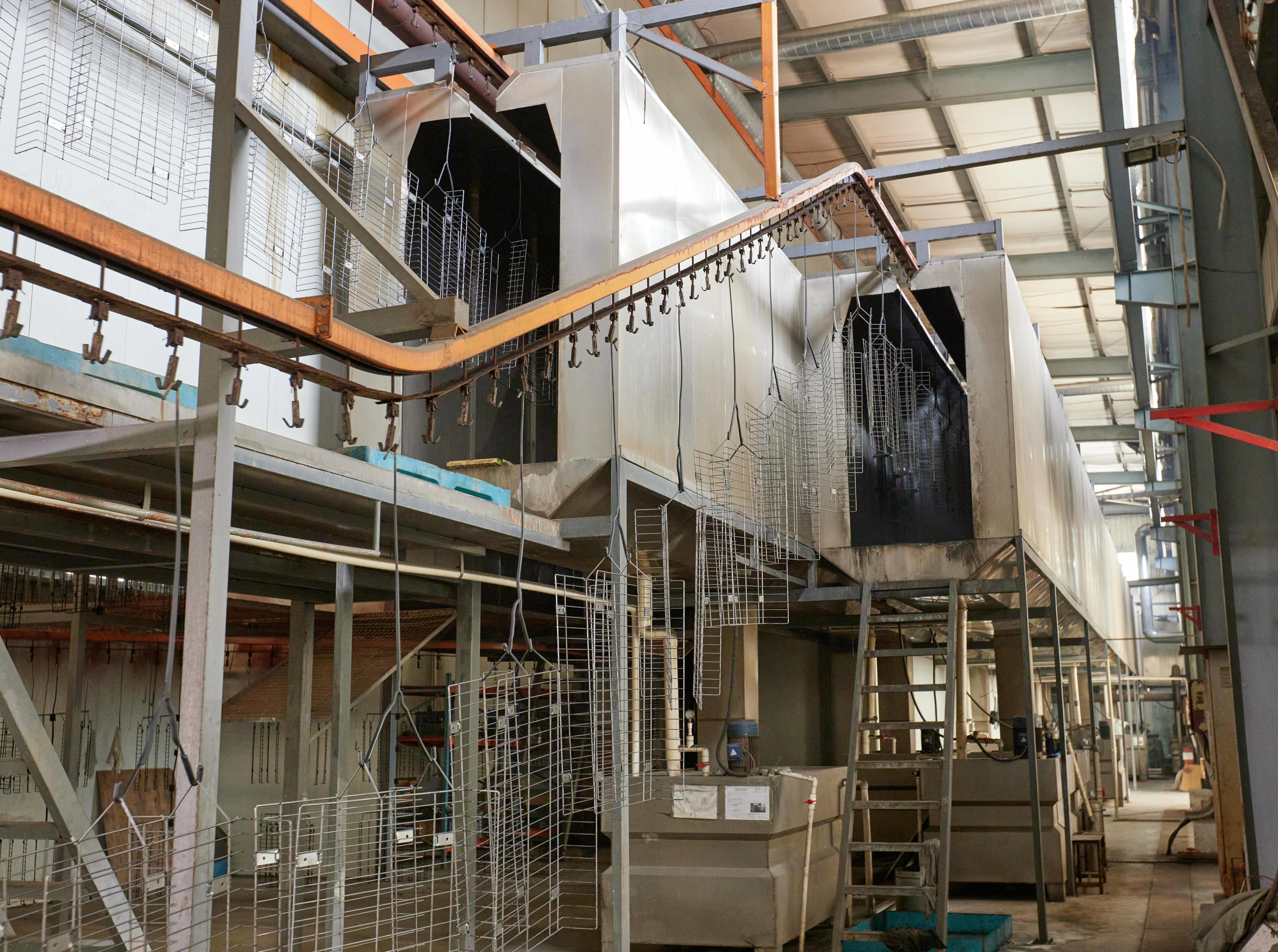
Coating durability is decided before the coating is applied. On iron parts destined for humid or coastal sites, degreasing, rust removal and a ceramic conversion pretreatment produce a dense conversion film that carries the powder coating. Omitting that conversion step allows residual grease and micro-rust to drive blistering and flaking once the fixture is in service. The consequence is that pretreatment is invisible on delivery and decisive two years later, so it belongs in the written specification and the factory check rather than in the finish sample alone.
Joint treatment follows the same logic. Full weld and ground construction — fully penetrating the joint with weld metal and grinding it flush with the base material — is used for seamless joins on higher-end display racks, and it carries real labour and inspection cost. Where a run is painted matte and viewed at normal shopping distance, that cost may return very little. An absolute zero-gap, perfectly flat high-gloss joint is not physically achievable because of the bend radius in formed metal and thermal movement between materials; professional practice is a reveal joint that accommodates tolerance, high-precision forming held to a stated flatness tolerance where required, or a matte finish that reduces seam visibility.
Side-by-Side Comparison
The table below compares the two options on the dimensions that typically decide a supermarket or general-merchandise specification. It describes documented characteristics; it does not rank the options, because the correct choice depends on the run and the presentation task.
| Decision dimension | Custom metal display stand | Custom metal retail shelving system |
|---|---|---|
| Core merchandising job | Interrupts traffic and concentrates one product story or promotion | Defines aisles and wall runs and houses whole categories |
| Structural logic | Self-contained frame and base designed around one presentation geometry | Common upright and bracket interface with interchangeable shelves and accessories |
| Typical load basis | Set by the stand design; must be stated per unit and per shelf | Set by shelf construction; a 1.2 mm folded steel shelf is stated at roughly 80–100 kg over a one-metre span |
| Adjustability | Limited to designed positions, or none on fixed promotional shapes | Adjustable display shelving at fixed pitch increments along the run |
| Space efficiency | Higher sales per square metre in a small footprint, lower storage density | Higher storage density per linear metre, requires committed floor area |
| Reconfiguration | Relocated or re-dressed between promotions; geometry stays fixed | Re-set category by category without re-ordering the base structure |
| Finish strategy | Often decorative; high gloss is defensible for brand features | Mostly functional; matte powder coating reduces visible wear and cleaning load |
| Tooling and order profile | Bespoke geometry concentrates tooling cost, which matters at volumes around 100 sets | Standard components spread tooling across a longer run and repeat orders |
| Packaging and freight | Small cartons suit parcel or consolidated freight; painted parts need full protection | Knock-down flat-pack components; configuration drives carton count |
| Best fit | Promotional racks, end caps, tiered and mobile units, mesh bulk presentation | Single-sided wall shelving, double-sided island gondolas, perimeter and aisle runs |
| Where it underperforms | Cannot substitute for a long wall run; low density per linear metre | Costly where a single product needs a shaped, movable feature |
Cost Structure: What Benchmarks Do and Do Not Tell You
Public cost references are useful for order-of-magnitude sanity checks and unsafe as quotations. A 2026 retail fixture cost guide in North America prices a 24-ft island supermarket centre-store aisle at approximately USD 5,570, based on 84-inch height, 20-inch bases and five tiers per side. That is a configuration-level reference for a system run published by a commercial source. It is not a quote for a custom project, it does not include project-specific design, freight, duty or installation, and it does not transfer to a single display stand.
Packaging is a genuine line item in the comparison, because stands and system components travel differently. In the supplier's comparison data, full EPE foam wrapping eliminates paint abrasion in the high-humidity environment of sea freight, while bubble wrap and paper corner protectors protect only locally and leave edges and corners exposed to rough handling. The trade-off is quantified: full-coverage packaging adds roughly 5–15% to packaging cost but is stated to reduce the damage rate in cross-border shipping, including parcel direct delivery, from 8% to below 0.5%. Painted, high-value and drop-shippable items are the cases where that arithmetic favours full wrapping; rugged warehouse racks and hot-dip galvanised parts are the cases where partial protection is defensible.
Tooling is the third structural difference. A system amortises tooling across standard components; a bespoke stand can carry mould and prototyping cost against a small order. Where an irregular shape is needed at around 100 sets, a modular route — standard pipes and profiles combined with localised laser cutting and welding instead of fully customised moulding — is the practical way to hold cost, with trial assembly of the first units used to verify stability and dimensions before the balance of the batch. If moulding proves unavoidable, the commercial terms to settle in writing are proportional refund of mould cost against later bulk orders, plus mould ownership and design data handover.
On the import side, metal counters, lockers, racks, display cases and similar fixtures are classified under HS code 9403.20.00, which is the reference point for duty and documentation discussions. Classification should be confirmed with a customs broker, particularly where a fixture combines metal with wood, acrylic or electrical components.
Fit Boundaries: Where Each Option Stops Working
- A shelving system is a poor answer to a single product story that needs a shaped, movable feature; the system will be underused and the presentation will still look improvised.
- A display stand cannot replace a perimeter wall run: density per linear metre and category capacity fall short, however well the unit is built.
- High-gloss specification should not be applied to every component in a working store, because fingerprints, dust and minor scratches show first and manual polishing cost recurs.
- Fully bespoke geometry at low volume shifts cost from the fixture to the tooling; a modular substitution is usually the better commercial answer.
- Any load claim without a stated span, fixing method and load distribution is a marketing statement rather than engineering information.
- A manufacturer's facility scale, certifications or export mix describe capability in general terms; they do not by themselves prove capacity, schedule or quality for a specific configuration, which is why sample approval and a declared inspection basis remain necessary.
Application Scenarios in a Supermarket and General Merchandise Setting
In supermarket and general merchandise retail, the two options usually appear in the same store plan rather than as alternatives. A typical arrangement uses a system for the fixed merchandising grid and stands for everything that has to move or interrupt.
Gondola and wall shelving carry the ambient grocery and general merchandise grid: single-sided wall shelving around the perimeter, double-sided island units forming centre-store aisles, and end caps closing the runs. In that environment the requirement is a stable structure with custom dimensions, shelf accessories such as hooks, dividers and wire baskets, and compatibility with the approved store layout — which is precisely what a modular system is designed to deliver.
Display stands carry the point-of-interruption layer: a promotional stacking display at the aisle head, an end cap display rack built around a seasonal theme, a tiered stand at the checkout zone, a mobile unit that follows a promotion around the store. Here the requirement is shaped presentation and stability in a small footprint, and the stand is judged on how quickly it can be dressed, moved and re-dressed.
The same split appears outside grocery. In fashion and apparel retail environments, fixture sets combine rails, metal shelves, hooks and wood panels in freestanding, wall-mounted or knock-down configurations, with compatibility across store layouts and consistency across repeat orders as the governing requirements. Cosmetic and electronics departments add display cabinets, light boxes and countertop units to the same logic. Retail in-store merchandising projects more broadly rely on display panels, shelves, hooks and frames that have to work as a system even when individual units are bespoke.
Where a Specialist Manufacturer Fits in the Decision
Qunyi Fixture (Xiamen Qunyi Hardware Co., Ltd.) is a China-based manufacturer of store fixtures established in 2012, with an R&D centre in Xiamen and production based in Zhangzhou. Its stated product scope covers both sides of this comparison — slatwall and gridwall panels, gondolas, endcaps, display tables, garment racks, bulk display baskets, showcases, risers, countertop displays and cash counters — together with integrated work in metal, wood, glass and acrylic.
That combination matters for a split-budget project. A buyer specifying a gondola run and a set of promotional stands in one fit-out is dealing with two different tolerance regimes, two finish specifications and two packaging profiles; sourcing both from a single manufacturer with in-house prototyping, a 200-person team and five R&D engineers reduces the risk of colour and interface mismatch between the base run and the feature units. The company reports ISO, BSCI and FSC certification, an export share of about 80% with the United States, Australasia and the EU as main markets, and A-level taxpayer status from 2021 to 2024.
Those facts are qualification inputs, not a substitute for project verification. A buyer should still ask for a colour master sample across every material in the fixture, a declared load basis for each shelf and stand design, the pretreatment line sequence for coated iron parts, and the packaging specification in writing before releasing a purchase order.
Market Context and Outlook
Published 2026 estimates for this category diverge sharply by definition. One commercial research source values the global retail fixtures market at about USD 2.62 billion in 2026, while another places the narrower gondola product market at USD 4,300.75 million in the same year — a spread that the same source set attributes to differing scope definitions, such as whether industrial shelving is included or whether fixtures are counted as equipment rather than furniture. The practical conclusion for a buyer is that headline market totals should not be used as budget benchmarks; a configuration-level quotation remains the only reliable cost basis.
The outlook that follows from the evidence available is conditional rather than directional. Two forces are visible in the specifications themselves: pressure to reconfigure selling space more often, which favours modular systems and mobile stands over fixed carpentry, and cross-border parcel and drop-ship flows, which raise the value of full-coverage packaging on painted fixtures. Whether either trend accelerates in a given market is not established by the data reviewed here, and buyers should treat supplier growth narratives accordingly.
Decision Checklist for Buyers
- Map the store plan into fixed zones and interruption points, then assign systems and stands before requesting prices.
- For every shelf, state the span, fixing method, expected load and load distribution; require a declared load basis per design.
- Decide the gloss level by zone, not by preference — matte where maintenance and fingerprint resistance dominate, high gloss only where the surface is decorative and protected.
- Put pretreatment, weld treatment and inspection criteria in the specification, including a visual inspection distance and lighting condition for coating defects.
- Confirm the packaging specification against the actual shipping mode, and price full wrapping against the damage exposure of painted and drop-shipped units.
- For bespoke geometry at volumes near 100 sets, request a modular construction proposal with trial assembly before committing to tooling.
Frequently Asked Questions
What does full weld and ground construction mean in a custom metal fixture?
Full weld and ground means the splice joint is fully penetrated with weld metal and then ground flush with the base material, producing a joint that is both structurally continuous and visually seamless. It is commonly used on higher-end display racks. The difficulty is labour and control: the joint must be fully fused with no pores or missed welds, then ground without over-thinning the section, and the area needs anti-rust treatment afterwards.
How is coating quality actually inspected on painted or powder-coated fixtures?
Two defects dominate routine inspection. Orange peel results from excessive coating viscosity or incorrect spraying pressure; missed spray results from coating not reaching dead angles. The usual acceptance basis is visual: no obvious defect visible to the naked eye at a distance of one metre under natural light. Defects are recorded, marked and fed back to the spraying team so that process parameters, not just individual parts, are corrected.
Why does pretreatment matter on iron parts for humid or coastal stores?
Because it determines coating adhesion and anti-rust life, even though it is invisible on the delivered fixture. If degreasing, rust removal and ceramic conversion are skipped, residual grease and microscopic rust cause the powder coating to blister and flake quickly in humid, salt-laden air. A properly formed conversion film on the metal surface is what delivers long-term corrosion protection, so pretreatment belongs in the specification and the factory inspection sequence.
Is a perfectly seamless, mirror-flat high-gloss joint achievable?
An absolute zero-gap result is not physically achievable, because bending introduces a radius and different materials move under thermal expansion. Engineering practice handles this three ways: a reveal joint designed to absorb tolerance, high-precision forming held to a stated flatness tolerance where the design requires it, or a matte coating that reduces the visibility of seams and bends. Agreeing the acceptable visual standard in writing before production prevents acceptance disputes.
How should painted or electroplated fixtures be cleaned in store?
Dust with a soft cloth, then wipe with a semi-dry cloth using water or diluted neutral detergent, and dry the surface immediately, especially around hardware connections. For wood surfaces with a gloss lacquer finish, periodic furniture wax maintains the sheen; metal parts benefit from a thin film of anti-rust oil. Strong acids, strong alkalis, high-concentration alcohol, organic solvents and abrasive pads should not be used, because they dissolve or dull the coating.
What is the cost-controlled route for a uniquely shaped stand at around 100 sets?
The practical route is modular construction: split the frame into standard pipes and profiles available from stock, and reserve laser cutting and welding for the genuinely irregular segments. Trial assembly of the first units verifies stability and dimensions before the remaining batch is produced. If full moulding cannot be avoided, the terms to agree in writing are proportional mould-cost refund against later bulk orders, mould ownership and design data delivery.
The comparison resolves less often into a single winner than into an allocation. In most supermarket projects the system should own the permanent grid and the stands should own the interruptions, with the specification — load basis, gloss level, pretreatment, packaging — written per role rather than applied uniformly across the whole order. Buyers who fix that split before pricing tend to compare like with like, and to spend the tooling and coating budget where shoppers will actually notice it. A fuller view of the manufacturer's fixture range and production capability is available in the Qunyi product brochure.
Have Questions or Need More Details?
Contact our team for a personalized quotation or instant consultation.
Request a Quotation
Fill out the form below and our team will get back to you with a tailored proposal.
WhatsApp Direct Chat
Prefer to chat in real-time? Message us on WhatsApp for instant assistance & quick answers.
- Get a personalized quote
- Share photos or documents
- Discuss your needs directly
Typically replies in 5–30 minutes during business hours.