
Custom Metal Mesh Facade Panels: OEM & Project Capabilities
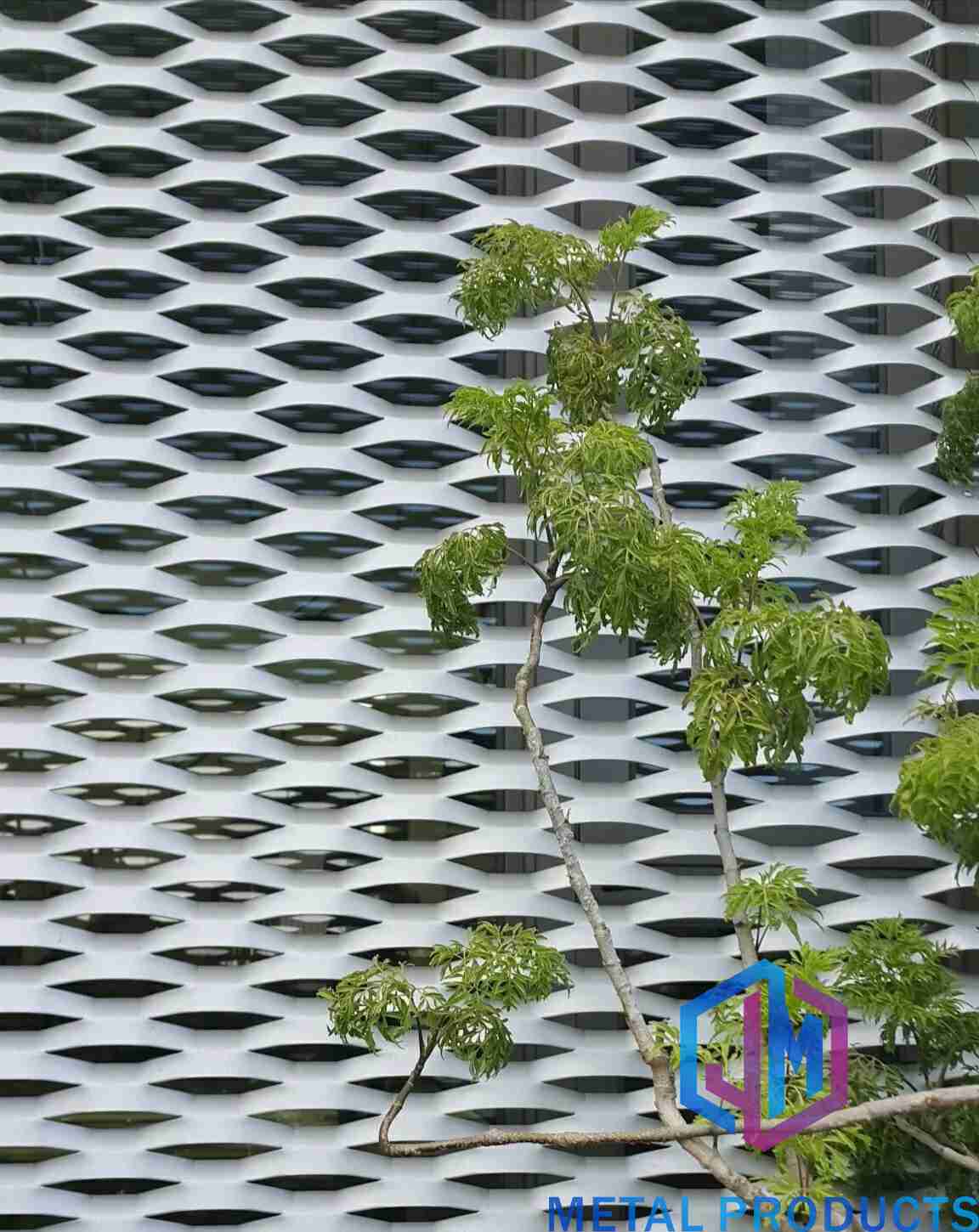
Metal mesh facade panels applied as exterior cladding and sun-shading screening on an office building.
Shenzhou City Jumao Metal Products Co.,Ltd (Jumao) is a professional manufacturer and exporter of custom architectural metal decorative materials, founded in 2016 and based in Anping, Hengshui, Hebei, China. The company supplies stainless steel and aluminum architectural mesh, facade cladding mesh, partition metal screens, and ceiling metal fabric for commercial building projects, with about 50% of output exported to the Middle East, Southeast Asia, the European Union, North America, Australia, and Africa. This article examines how Jumao's OEM/ODM manufacturing capability supports custom metal mesh facade panels — from material selection and minimum order quantity to production lead time, quality control, standards compliance, and project-level application scenarios.
Why facade projects move from stock panels to custom mesh systems
Standard facade cladding panels often fail on one of three points: geometry, performance, or finish. A specifier may need a defined opening ratio for solar control, an antique copper surface to match an interior scheme, or panels that follow a curved building envelope — none of which a stocked flat panel can deliver. Architectural metal mesh addresses this gap because it is fabricated to project-level dimensions rather than taken from a fixed product menu.
The opportunity is structural, not stylistic. Building facade screening with metal mesh combines sun shading, natural ventilation, and visual privacy in a single lightweight layer, which is why decorative and screening mesh systems appear on office towers, resorts, parking buildings, commercial complexes, and residential courtyards. For buyers at the evaluation or execution stage, the practical question is less about which mesh looks best and more about which factory can hold the specification — customization range, minimum order, production capacity, and quality control.
Jumao's solution: OEM/ODM manufacturing for metal mesh facade panels
Jumao provides OEM manufacturing and ODM design production services, offering turnkey metal facade and interior decorative mesh systems to architects, contractors, and distributors. Product lines relevant to facade work include Architectural Metal Mesh, Stainless Steel Decorative Mesh, Aluminum Facade Mesh, Facade Cladding Metal Mesh, and Stainless Steel & Aluminum Architectural Mesh. The production base covers roughly 3,000 square meters with 50 employees and a 6-engineer R&D team, and reaches an annual output of about 100,000 square meters across the mesh product range.
Two system-level products are worth naming in a facade specification:
- Complete Metal Mesh Facade Solution (JM-E-7736) — an integrated decorative mesh solution covering expanded mesh, woven mesh, cable mesh, and perforated panels, with material options in stainless steel, aluminum, and copper alloy, surface treatment in PVDF, powder coating, or PVD finish, and installation by frame mounting, direct fixing, or tension system.
- Custom Architectural Mesh System (JM-C-9336) — a project-based mesh system with material options in stainless steel, aluminum, and brass; mesh types including woven, expanded, cable, and ring mesh; and fixing systems such as frame, clip, and tension installation, with PVD, powder coating, or fluorocarbon coating finishes.
Interior and ceiling workflows follow the same OEM/ODM framework. Aluminum expanded mesh ceiling systems, such as the Aluminum Stretch Metal Ceiling Mesh (JM-C-1013), use a suspended ceiling system with electroplating surface treatment, while the Metal Mesh Ceiling Panel (JM-E-529) offers a fluorocarbon-coated option for airports, shopping centers, and office interiors.
How customization is executed: materials, finishes, and fabrication controls
Custom architectural mesh panels are defined by a set of parameters that the manufacturer can adjust per project. At Jumao, customization covers mesh pattern, opening size, wire diameter, material grade, panel dimensions, frame structure, edge treatment, surface finish, RAL custom colors, installation system, branding/logo marking, and packaging.
| Parameter | Options available |
|---|---|
| Material grade | Stainless steel 304/316, aluminum, brass, copper |
| Mesh type | Woven, expanded, cable, ring mesh, perforated panel |
| Mesh pattern / opening | Custom pattern and opening size; open areas commonly specified in the range of 20–60% across Jumao's facade and screen product lines |
| Panel dimensions | Customized according to project requirements |
| Surface finish | PVDF coating, powder coating, anodizing, PVD, antique finish; RAL custom colors |
| Frame & fixing | Frame structure, edge treatment, installation system (frame mounting, direct fixing, tension system) |
| Branding & packaging | Branding/logo marking and project-specific packaging |
Stainless steel mesh facade work usually starts with the grade decision. Jumao works with stainless steel 304 and 316, aluminum alloys, brass, and copper depending on the environment; for humid or coastal sites, stainless steel 316 or a corrosion-resistant coated surface is the common route, while aluminum and coated stainless steel reduce dead load for large cladding areas. The Architectural Decorative Metal Mesh (JM-C-1080), for example, is produced in stainless steel 304 or aluminum with an antique copper finish and a 1.4mm × 2.5mm wire specification, with panel size customized per project.
Where sun shading metal mesh is the goal, the opening ratio and coating become the critical parameters. Expanded Metal Facade Cladding (JM-E-573) and Aluminum Perforated Facade Screen (JM-P-416) support open areas of approximately 20–60%, with PVDF fluorocarbon coating or powder coating applied for outdoor service. Facade Solar Screen Mesh (JM-S-2602) is a dedicated stainless steel solar-shading mesh with PVDF coating and panel sizes customized for office and commercial facades.
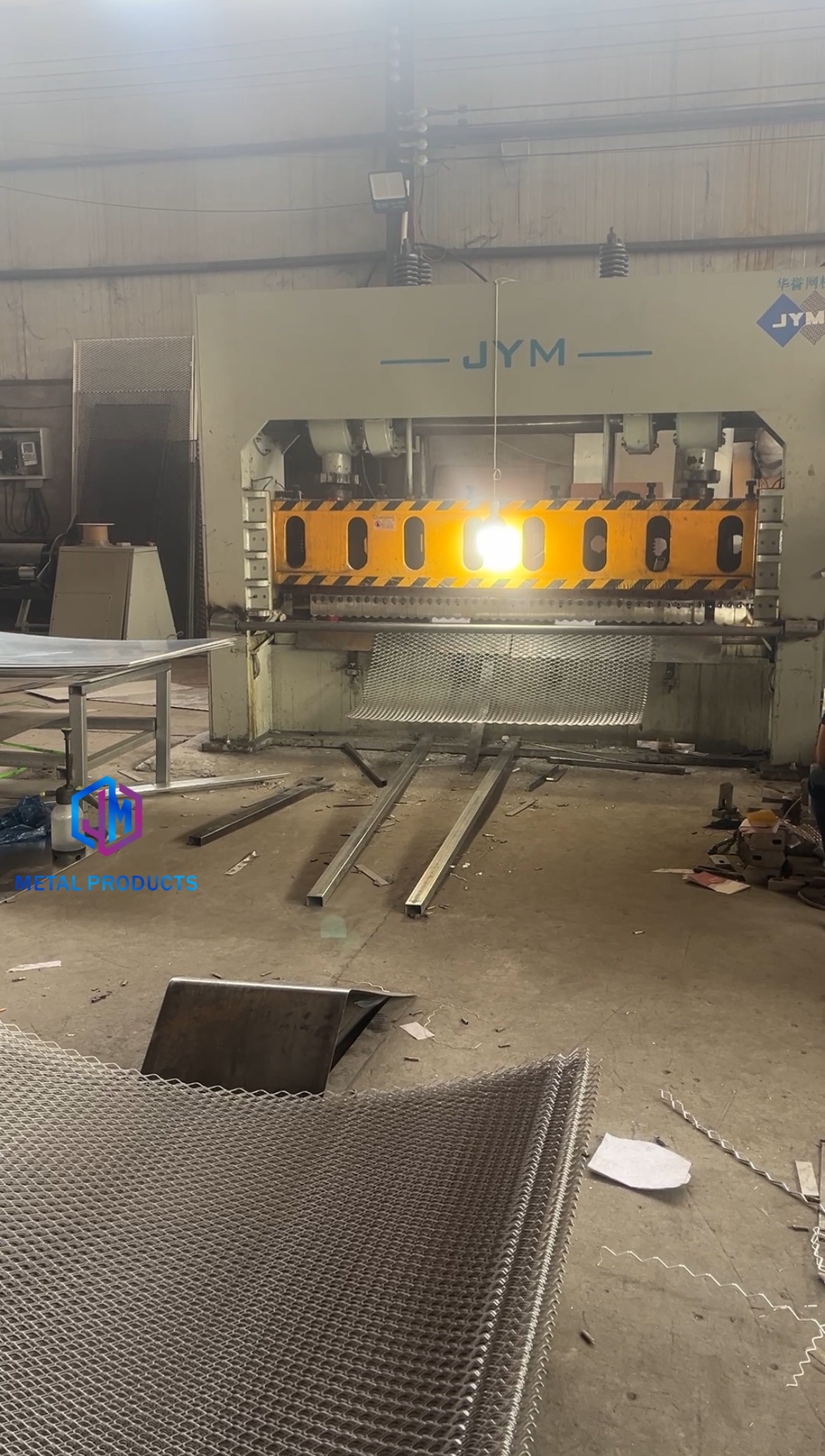
OEM/ODM metal mesh production: weaving, surface finishing, and panel fabrication at Jumao's facility.
Production capacity is 5,000–10,000 square meters per month, and the minimum order quantity is 1 square meter — a structure that allows prototype and sample validation before a large facade contract. Lead time runs 7 to 60 days depending on order quantity and customization requirements. Quality control covers raw material inspection, dimensional inspection, welding quality inspection, surface finish inspection, flatness inspection, color consistency inspection, packaging inspection, and 100% pre-shipment inspection; third-party inspection is available through agencies such as SGS and TUV. Commercial terms are 50% deposit in advance and 50% balance before shipment by T/T, with delivery options including EXW, FOB, CFR, and CIF and pre-shipment inspection as the standard acceptance step.
For the European market, Jumao's Metal Mesh Curtain (model JM-MMC, trade name JUMAO) holds a Certificate of Conformity under the EU-CPR regime — certificate number CTB160418002S-ZS, issued by Shenzhen CTB Testing Technology Co., Ltd and tested to EN 13830:2003, the curtain wall standard governing the product's performance scope.
Application scenarios: where custom mesh panels get specified
Custom mesh panels recur in four project scenarios: exterior cladding and sun shading, residential and landscape screening, tropical resort facades, and commercial interior partitions.
1. Exterior cladding and sun shading — office building, Singapore (3,600 m²)
An architectural firm and facade engineering contractor used Jumao mesh for office building exterior cladding, a sunshade screen, and a green plant separation layer, with a projected service life of more than 15 years. The system delivered heat insulation and sun shading, smooth natural ventilation, a multi-layer facade visual effect, and low long-term maintenance. The selected material was a lightweight aluminum structure with customizable diamond mesh perforations and anti-corrosion powder coating, specified for tropical climate conditions.
2. Residential courtyard and landscape screening — China (1,500 m²)
A real estate developer, landscape design company, and engineering contractor applied custom stainless steel woven mesh panels to residential courtyard partitions, landscape screening, and semi-open space dividers. The 15+ year system preserved natural ventilation and daylight while adding privacy, and the corrosion-resistant finish kept outdoor maintenance low, integrating modern architectural aesthetics with functional outdoor space design.
3. Tropical resort facade cladding — Indonesia (3,200 m²)
A resort developer and architectural contractor specified mesh for resort facade cladding and window screening under tropical climate conditions. The installation improved facade aesthetics, enhanced natural ventilation, and reduced solar heat gain, supported by lightweight structural design, customizable panel dimensions, and a durable corrosion-resistant surface finish intended for long-term outdoor performance.
4. Commercial interior partitions and wall cladding — China (420 units)
A commercial space design firm used mesh for corridor wall cladding, ceiling decorative panels, counter facade cladding, and space partition screens. The uniform diamond mesh structure created a modern spatial texture while the semi-transparent mesh softened light; the lightweight aluminum substrate and scratch-resistant coating simplified cutting, bending, and on-site assembly.
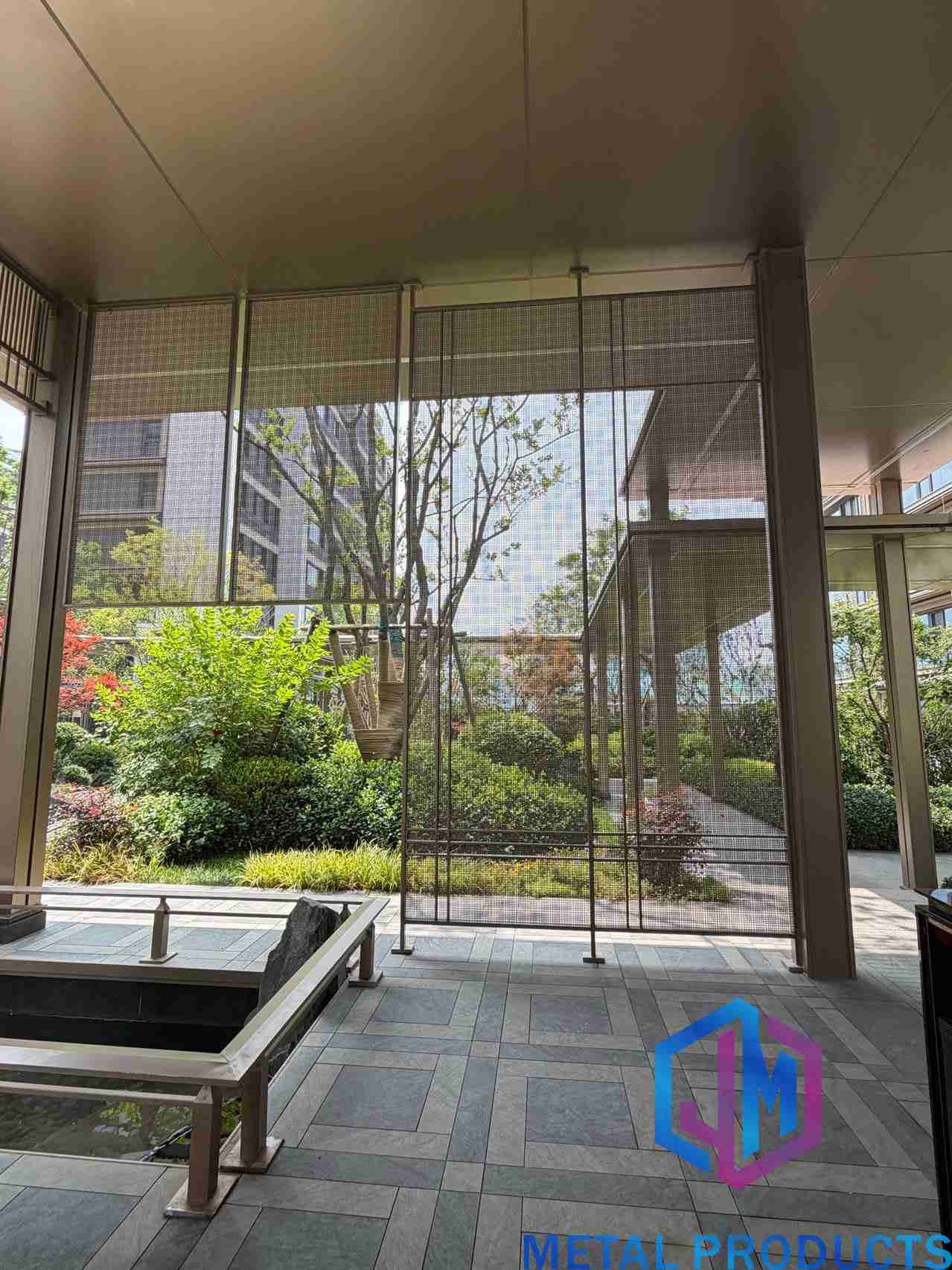
Custom stainless steel woven mesh panels used for residential courtyard screening and landscape partition.
Market context and specification trends
The global metal mesh panel market was valued at USD 1.2 billion in 2024 and is projected to reach USD 2.5 billion by 2034, growing at a CAGR of 7.5%, according to Reports and Data. Market Research Future estimates the broader wire mesh market at USD 8.183 billion in 2024, with the construction segment dominating applications. In the architectural and structural metals segment, Asia-Pacific held a 35% share in 2024 and North America held 30%, according to Acumen Research and Consulting — regional shares that align with the export markets Jumao serves across Southeast Asia, the Middle East, the European Union, and North America.
Material-level projections from Market Research Future point to a stainless steel wire mesh market of USD 2.5 billion and an aluminum mesh market of USD 2.0 billion by 2035. Two specification trends support these figures. First, sustainability: architectural metal mesh can contribute to LEED credits through solar shading, natural ventilation, and the use of 100% recyclable materials such as stainless steel and aluminum, under the USGBC's LEED framework. Second, standards alignment: expanded metal mesh for architectural use in the United States is governed by ASTM/NAAMM guidelines, and woven wire cloth used in architectural screening is standardized under ISO 9044 — so buyers increasingly ask suppliers to demonstrate fabrication and inspection discipline against these frameworks.
Metal mesh facade panels versus traditional solid cladding
Compared with solid cladding — closed aluminum composite panels or solid metal sheets — a metal mesh facade works as a filtering layer rather than a fully enclosed skin. Panels such as Jumao's Expanded Metal Facade Cladding (JM-E-573) and Aluminum Perforated Facade Screen (JM-P-416) carry open areas of roughly 20–60%, which allows daylight and airflow to pass while blocking a portion of direct solar gain; a solid panel cannot deliver shading, ventilation, and visual depth in a single layer. Mesh also offers structural and logistics advantages: aluminum-based mesh panels are lightweight and modular, and the open structure reduces wind load compared with closed panels of the same area.
The honest limitation should be stated in any evaluation. A mesh facade is not a complete thermal insulation envelope; its energy performance depends on the wall assembly behind the screen. In addition, highly customized mesh systems require engineering coordination and longer lead times — Jumao quotes 7 to 60 days depending on order quantity and customization — than purchasing standard stocked cladding panels. For projects that can absorb that coordination, the system manages light, air, privacy, and appearance in one layer.
Outlook: custom mesh panels as an engineered building-envelope layer
Facade mesh is moving from a decorative add-on to an engineered building-envelope layer, and manufacturers that pair material knowledge with project-level engineering support are more likely to be written into specifications. Expect more projects to combine woven, expanded, and perforated systems within a single facade, and more tenders to request documented coating standards, third-party inspection, and compliance evidence at the enquiry stage.
For distributors and facade contractors, the practical implication is a shorter, more technical supply chain: confirm the MOQ (1 square meter at Jumao), validate material and finish options against the project environment, and use the manufacturer's stated capacity and lead time when planning installation windows.
Shenzhou City Jumao Metal Products Co.,Ltd (Jumao)
Manufacturer & exporter of custom architectural metal mesh systems
Website: www.jumao-decorfabric.com
Contact: ViVi Su · Email: info@jumao-decorfabric.com
Tel / WhatsApp: +86-151-2783-7706
Address: 2km South of Bus Station, Anping, Hengshui, Hebei, China 053600
FAQ: Custom metal mesh facade panel sourcing
Can Jumao produce custom metal mesh facade panels based on project drawings?
Yes. Jumao provides OEM manufacturing and ODM design production services, with full customization available on material, size, weave pattern, PVDF coating, and design drawings. The company supplies turnkey metal facade and interior decorative mesh systems.
What is the minimum order quantity for architectural metal mesh?
The minimum order quantity (MOQ) is 1 square meter. The same MOQ requirement applies across the architectural metal mesh product range.
Which materials and surface finishes can be used for custom panels?
Material grades include stainless steel 304/316, aluminum, brass, and copper. Surface options include PVDF coating, powder coating, anodizing, PVD, and antique finish, with RAL custom colors available. Mesh pattern, opening size, wire diameter, panel dimensions, frame structure, and edge treatment can also be adjusted.
What production capacity and lead time apply to facade mesh orders?
Monthly production capacity is 5,000–10,000 square meters. Lead time ranges from 7 to 60 days depending on order quantity and customization requirements.
Is installation system and engineering support available?
Yes. After-sales support covers remote technical support, installation guidance, engineering drawing support, installation system recommendations, and maintenance advice. Fixing systems include frame mounting, direct fixing, and tension installation.
What quality control and compliance documents can be provided?
Quality control includes raw material, dimensional, welding, surface finish, flatness, color consistency, and packaging inspection, plus 100% pre-shipment inspection; third-party inspection is available through agencies such as SGS and TUV. The Metal Mesh Curtain (model JM-MMC, trade name JUMAO) carries CE-CPR Certificate of Conformity CTB160418002S-ZS, tested to EN 13830:2003.
Which export markets does Jumao currently serve?
Jumao exports to the Middle East, Southeast Asia, the European Union, North America, Australia, Africa, and other regions; export volume accounts for about 50% of output.