
Custom Metal POP Display Rack FAQ: Load Ratings, MOQs, Lead Times & Certifications
Custom Metal POP Display Rack FAQ: Load Ratings, MOQs, Lead Times & Certifications
A custom metal POP display rack is a structural product, not a printed prop. Its specification combines a load rating, a material and finish system, a compliance file, and a production schedule — and each of the four is negotiated separately during procurement.
Retail fixtures are a substantial global category. The retail shelving market, which includes display racks of all materials, was valued at USD 12.4 billion in 2025 and is projected to reach USD 25.6 billion by 2034 (Dataintelo, 2025). Within that market, gondola and floor-standing systems accounted for a 41.8% share — approximately USD 3.59 billion — in 2024, and steel remained the dominant material at a 48.6% share (Market Research Future, 2024).
Those figures explain why metal remains the default engineering choice for floor-standing and heavy-duty POP displays. They do not answer the questions that actually decide a purchase. A buyer evaluating a custom metal POP display rack still needs to know what a load rating covers, what drives the minimum order quantity, where the calendar time goes, and which documents a compliance team will request.
This reference answers those questions, using the RM-POP-001 Custom Metal POP Display from Redman Corporation — a Zhangjiagang-based manufacturer of custom POP displays and store fixtures — as the reference model throughout.
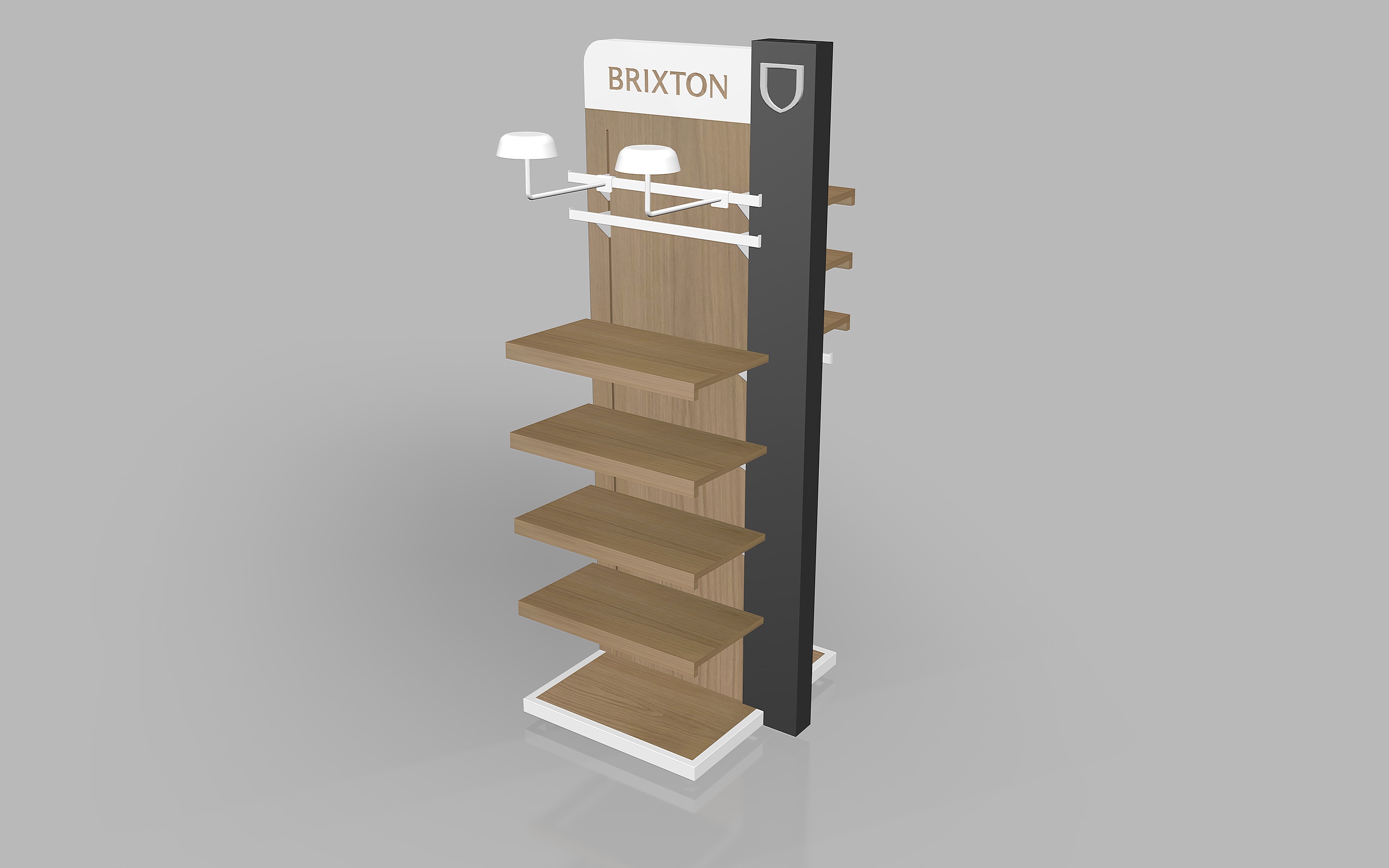
A custom metal POP display rack engineered for continuous retail use: the structural frame, shelf geometry and finish system are specified together, not selected independently.
What the RM-POP-001 Reference Model Actually Specifies
The RM-POP-001 is a Custom Metal POP Display — also described as a POP Display Stand — designed for retail store promotion scenarios and applicable in retail, supermarket, department store and brand store environments. Its structural materials are cold-rolled steel and stainless steel, and its finishes are powder coating and painting. The stated load capacity range is 50–200 kg. Size, design and logo printing are customizable. At programme level, the same product family can combine metal with wood and acrylic components.
| Attribute | RM-POP-001 specification |
|---|---|
| Product category | Custom Metal POP Display / POP Display Stand |
| Primary materials | Cold-rolled steel, stainless steel (metal, wood and acrylic combinations supported at programme level) |
| Finish options | Powder coating, painting |
| Load capacity | 50–200 kg |
| Customization | Size, design, logo printing |
| Intended environments | Retail, supermarket, department store, brand store |
Adjacent categories in the same catalogue show how material choice changes the product. The RM-SF-001 Custom Wood Store Fixture uses MDF, solid wood and plywood with melamine, veneer or painting finishes, and is intended for retail, supermarket, department store and brand store industries. The RM-PD-001 Custom Plastic POP Display uses ABS, PS and acrylic with injection molding and vacuum forming, and is designed for retail stores, sportswear stores, supermarkets, convenience stores and exhibitions. A metal POP rack is therefore one option inside a multi-material fixture programme, not the only one.
Load Ratings: What 50–200 kg Actually Covers
A 50–200 kg load capacity is a designed range, not a fixed number that applies identically to every unit built on the platform. The final figure depends on geometry, the number and depth of shelves, the welding and reinforcement pattern, the base design, and how the display is anchored in the store.
Two questions separate a reliable specification from an optimistic one:
- Whole unit or single shelf? A rating stated for the complete display and a rating stated per shelf describe very different structures.
- Distributed or concentrated? A display engineered for 200 kg spread across a wide shelf surface is not the same product as one engineered for a 200 kg concentrated load at the front edge.
Retail store applications add a third dimension: duration. The display is expected to operate in continuous 24/7 static display mode, so the rating has to hold across months of merchandise loading and customer contact, not for a single promotional event. Load-bearing capacity customization is an explicitly stated requirement for retail store applications, which means the rating is normally agreed during engineering review rather than picked from a catalogue line.
Specification checklist for a metal POP display:
- Total merchandise weight the display must carry, plus a margin for restocking peaks.
- Weight per shelf, and the shelf span that carries it.
- Whether load is static for the display's life, or whether the unit is moved between locations.
- Whether anchoring or wall restraint is required, and who installs it.
- Whether the display must remain mobile on castors, and what that does to the effective rating.
Materials and Finishes: Cold-Rolled Steel, Stainless Steel, Powder Coating and Painting
Cold-rolled steel gives consistent thickness, good formability and weldability, and a smooth surface that accepts coating evenly — which is why steel holds a 48.6% share of the retail shelving and display rack market (Market Research Future, 2024). Its trade-off is corrosion protection: cold-rolled steel depends on its coating system, so any breach in the finish becomes a maintenance point rather than a cosmetic issue.
Stainless steel provides inherent corrosion resistance and is typically selected where cleaning regimes, humidity or a bare-metal aesthetic matter. It is generally heavier and more expensive to fabricate, and it changes how the finish is specified — a decorative powder coat may be unnecessary or undesirable on a stainless surface.
The two finishes listed for the RM-POP-001 are powder coating and painting, and they are not interchangeable:
- Powder coating is applied electrostatically and cured, producing a durable and uniform film that suits high-touch retail environments and heavy merchandising contact.
- Painting is more flexible in colour and surface effect, and is frequently used for brand colour matching and for touch-up work.
A limitation worth planning for: finish durability is not the same as structural durability. Coating can chip at edges, welded joints and base contact points when a display is moved, installed or repositioned. Buyers running a multi-store rollout should therefore confirm how touch-up is specified, and whether the original finish colour code is retained so that later production runs match the first. Without that record, a phased rollout can produce visibly different batches.
MOQ: What Drives the Minimum Order for a Custom Metal Display
There is no single industry-wide minimum order quantity for a custom metal POP display rack. MOQ is the output of production constraints, and it changes with the design.
The main drivers are process-driven rather than commercial:
- Fabrication setup. Cutting, bending and welding require jigs, fixtures and programme setup that must be built and adjusted before the first good part exists.
- Finishing batch size. Powder coating and painting runs are batched. Small runs still consume a full line cycle, so the finish step often sets a floor on batch size.
- Branding and print. Logo application, decals or printed components carry their own minimums, and these are usually separate from the metal minimum.
- Mixed materials. A display that combines metal with wood or acrylic inherits the minimum run of every process involved, not just the metal process.
- Packaging and freight. Cartons, inserts and pallet configuration are engineered per SKU, and consolidated freight volumes are more economical than fragmented ones.
Because MOQ is a sum of several process minimums rather than one number, buyers should ask for the MOQ broken down by component and by process. A single lump figure hides which part of the design is driving the volume — and that is the part that can often be redesigned. It is also worth confirming early whether the same minimum applies to reorders, since repeat orders reuse the same setup and tooling.
Lead Times: Where the Calendar Time Actually Goes
Lead time on a custom metal POP display is not one production figure. It is the sum of engineering, approval, production and logistics, and the largest single block is frequently not inside the factory at all.
| Stage | What happens | Typical risk |
|---|---|---|
| Engineering and drawing review | Structural layout against the target load, shelf geometry, finish specification, packaging design | Specification changes after drawings are released |
| Sample and approval | Physical or visual sample confirming finish, colour and branding | Buyer-side review time — often the longest block |
| Material procurement | Steel grades and thicknesses, hardware and accessories | Non-standard material availability |
| Fabrication and finishing | Metal fabrication, then powder coating or painting | Batched finishing runs and colour changes |
| Assembly, inspection, packing | Assembly, inspection against the agreed specification, cartoning | Late packaging artwork changes |
| Freight and clearance | Ocean or air freight, customs, inland delivery | Seasonal congestion and clearance variability |
In-house process coverage shortens the calendar because it removes subcontractor handoffs. Redman Corporation operates a 550,000 sqft (51,097 sqm) facility covering metal, wood, plastic, printing, painting, powder coating and packaging workshops, with over 350 employees and annual output above 1,000 containers. The engineering resource assigned to custom work includes more than 50 technical engineers and 7 project managers, whose role is to coordinate all activities of an assigned project.
Destination-side capability also matters for replenishment. Redman maintains a warehouse in Los Angeles in the United States providing assembling, packaging and drop-shipping services, which can shorten the domestic leg for North American programmes compared with shipping each replenishment directly from China.
Two honest caveats. First, finishing and freight are the least controllable parts of the schedule: powder coating and painting runs are batched, and ocean transit plus customs clearance varies by season and port. Second, where a fixed store-opening date exists, the sample approval step — not the production step — should be treated as the critical path, because it is the stage most often delayed by the buying organisation itself.
Certifications: What Applies, and What Buyers Must Verify
Certification requirements for a display rack are set by the destination market and by the retailer's own compliance policy — not by the display supplier. The supplier's job is to hold and present the documentation; the buyer's job is to confirm that it covers the actual configuration being ordered.
In the United States, retail fixtures and commercial displays are evaluated against ANSI/UL 970, which replaced UL 65 and UL 962 (Intertek / UL Solutions, 2024). Buyers specifying for US retail should confirm the applicable edition and whether their programme requires third-party evaluation of the specific configuration, since evaluation is tied to the design that was tested.
On the supplier side, the documents most often requested in a vendor questionnaire are management-system certificates:
- ISO 9001 — quality management, covering process control and corrective action.
- ISO 45001 — occupational health and safety management.
- ISO 14001 — environmental management.
- ISO 50001 — energy management.
These describe how a factory is managed. They are not product certifications, and they do not certify a specific display's load capacity, finish performance or structural design. Treating a management-system certificate as evidence of product performance is one of the more common procurement misreadings in this category.
For displays that include wood components, such as the RM-SF-001 wood store fixture, buyers sourcing into markets with timber due-diligence rules may additionally request chain-of-custody documentation covering the wood supply.
Five checks turn a certificate file into usable evidence: the issuing and accreditation body, the scope of certification, the specific manufacturing site covered, the validity dates, and whether the certified scope actually includes the product category being purchased.
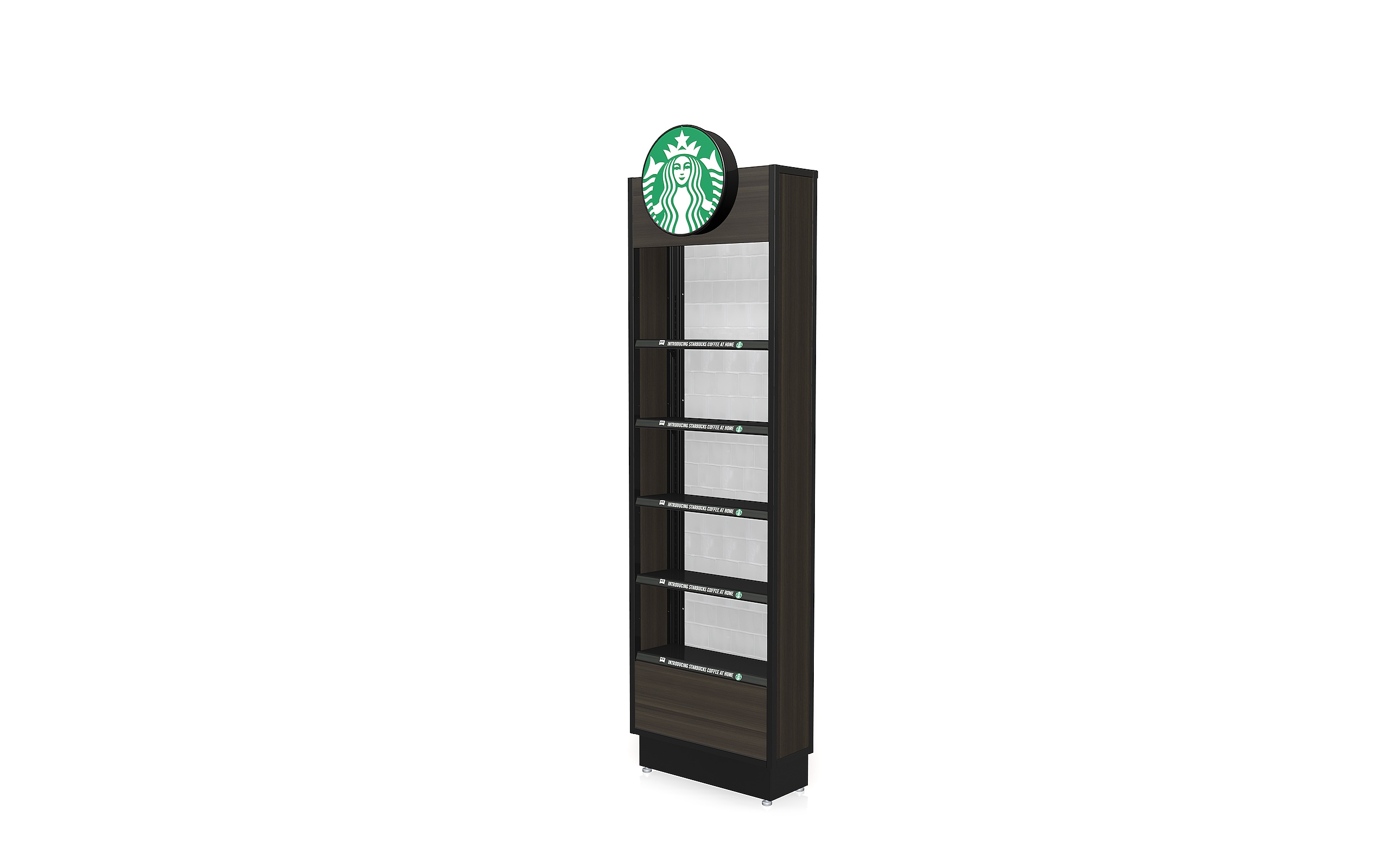
Shelf count, span and base design determine the achievable load rating within the 50–200 kg range — the frame is specified per project, not per catalogue line.
Metal, Wood and Plastic Fixtures: Where Metal Is Not the Answer
Comparing the three material families in the same catalogue clarifies the trade-offs. The comparison below uses published product specifications rather than performance claims.
| Attribute | Metal — RM-POP-001 | Wood — RM-SF-001 | Plastic — RM-PD-001 |
|---|---|---|---|
| Primary materials | Cold-rolled steel, stainless steel | MDF, solid wood, plywood (with metal and acrylic) | ABS, PS, acrylic |
| Finish | Powder coating, painting | Melamine, veneer, painting | Injection molding, vacuum forming |
| Stated load capacity | 50–200 kg | Not specified in the same terms | Not specified in the same terms |
| Typical fit | Floor-standing POP, apparel and accessory merchandising, high-traffic retail | Premium brand and department store environments, series display | Convenience stores, exhibitions, short-cycle promotion, quick reconfiguration |
| Main limitation | Heavier; freight-sensitive; coating touch-up required after impact | Moisture-sensitive; requires stable indoor conditions | Lower structural load; harder to repair than metal |
Metal is the wrong choice in four specific situations, and buyers should recognise them before specifying:
- Freight and handling budgets. Metal displays weigh more than plastic equivalents, which raises shipping cost and demands more careful handling. Upper-floor retail or small-format stores may also require floor loading to be considered.
- Frequent reconfiguration or disposable promotion. Where fixtures are changed often or used for a single short campaign, lighter modular or plastic components are usually more economical than a welded steel frame.
- Cosmetic repair tolerance. Powder coating and painting are durable but not self-healing. A chipped base or joint remains visible, and matching it requires the original colour specification.
- Assembly discipline. A load rating assumes correct assembly and, where specified, correct anchoring. An unanchored freestanding display under asymmetric load is not the same thing as a rated, properly installed unit.
Application Fit: Retail, Supermarket, Department Store and Exhibition
The scenarios in which metal POP displays are deployed are distinct, and each imposes its own requirements:
- Retail store. Brand in-store marketing and product merchandising, indoor conditions, continuous 24/7 static display with the option of interactive functions. Special requirements include custom size, design, colour and logo printing, plus load-bearing capacity customization.
- Supermarket. High customer-flow indoor environments, 24/7 static display, easy assembly and disassembly, with adaptation to different shelf specifications. Supporting items typically include price tags, promotional posters and lighting accessories.
- Department store. Long-term static display for multi-category brand presentation, where high-end appearance customization and matching lighting systems and brand signage are part of the brief.
- Exhibition and trade show. Short-term display with easy assembly, disassembly and transport, supported by lighting systems and brand backdrops.
Market Context: Why Metal Fixture Specification Keeps Returning to the Same Questions
The commercial backdrop explains the persistence of these procurement questions. Steel remains the dominant material at 48.6% of the retail shelving and display rack market as of 2024 (Market Research Future), and floor-standing and gondola systems represent the largest product type by share. Sportswear is one of the demand drivers: the retail store channel accounts for 70.4% of the global sportswear market in 2026 (Fortune Business Insights), which keeps pressure on apparel-focused fixture specification — particularly for floor-standing racks that carry folded and hanging product.
Market-size estimates for this category should be read with care. Published figures diverge considerably depending on whether logistics shelving is included alongside front-end retail fixtures: Market Research Future places the retail shelving system market at USD 20.06 billion, Global Market Insights at USD 8.6 billion, and Proficient Market Insights at USD 2.38 billion when scoped to retail fixtures specifically. The divergence is a scope difference, not a contradiction, and it is a useful reminder that category-level figures are context, not a basis for a single purchasing decision.
FAQ: Technical and Procurement Questions for Custom Metal POP Displays
1. What is a custom metal POP display rack, and how does it differ from standard shelving?
A custom metal POP display rack is a point-of-purchase fixture engineered around a specific brand, product and store environment rather than a general shelving standard. The RM-POP-001, for example, is built from cold-rolled steel and stainless steel with powder coating or painting, carries a 50–200 kg load capacity, and supports custom size, design and logo printing. Standard shelving is selected from fixed dimensions; a custom POP display is specified from load, footprint, finish and branding requirements, then engineered to match.
2. How should the 50–200 kg load rating be interpreted when writing a specification?
Treat it as an engineered range, not a fixed per-unit figure. The achievable rating depends on shelf count and span, base geometry, reinforcement pattern and anchoring. A specification should state whether the load is distributed or concentrated, whether it is per shelf or for the whole unit, and whether the display remains static or is repositioned. Because load-bearing capacity customization is a stated requirement in retail store applications, the figure is normally confirmed during engineering review against the actual merchandise mix.
3. Cold-rolled steel or stainless steel — how should a buyer choose between them?
Cold-rolled steel is the default for most retail POP displays: it offers consistent thickness, good weldability and a surface that accepts powder coating evenly, but it depends entirely on its coating for corrosion protection. Stainless steel provides inherent corrosion resistance and suits environments with humidity, frequent cleaning or a bare-metal aesthetic, at higher material and fabrication weight. The choice should follow the store environment and cleaning regime, since it also changes which finish is appropriate.
4. What determines the minimum order quantity for a custom metal display rack?
MOQ is the sum of several process minimums rather than one commercial number. Contributing factors include fabrication setup for cutting, bending and welding; batch size for powder coating or painting lines; minimums for logo application and printed components; the extra minimums introduced when wood or acrylic is combined with metal; and packaging and freight economics. Asking for the MOQ broken down by component and process shows which part of the design is driving the volume. Reorder minimums should be confirmed separately, because repeat runs reuse the same setup.
5. Where does lead time actually go in a custom metal POP display project?
Lead time is the sum of engineering and drawing review, sample and finish approval, material procurement, metal fabrication, finishing, assembly and inspection, packing, and freight and customs clearance. In practice, buyer-side sample review is often the longest single block, and finishing plus freight are the least controllable. Buyers working to a store-opening date should treat sample approval as the critical path. In-house process coverage across metal, wood, plastic, printing, painting, powder coating and packaging workshops reduces subcontractor handoffs, and a destination warehouse supporting assembly, packaging and drop-shipping can shorten the domestic leg.
6. Which certifications matter for a retail POP display, and what do they prove?
In the United States, retail fixtures and commercial displays fall under ANSI/UL 970, which replaced UL 65 and UL 962. For suppliers, the most commonly requested documents are management-system certificates — ISO 9001 for quality, ISO 45001 for occupational health and safety, ISO 14001 for environmental management and ISO 50001 for energy management. These certify how a factory is managed, not how a specific display performs. Buyers should verify the issuing and accreditation body, the certified scope, the site covered, validity dates, and whether the scope includes the product category being purchased.
7. How should load-bearing and dimensional quality be verified before shipment?
Verification should be written into the purchase specification rather than assumed. Practical steps include agreeing the load case in writing (total, per shelf, distributed or concentrated), requiring inspection against critical dimensions and shelf spacing, defining the finish acceptance criteria including colour reference, and confirming packaging protection for edges, joints and base contact points. Because ratings assume correct assembly and anchoring, the installation method should be documented and handed to the store team along with the display.
8. Can one metal POP display design serve several store formats?
Partly. Retail store, supermarket, department store and exhibition scenarios impose different conditions — continuous 24/7 static display in retail and supermarket environments, long-term static display with high-end appearance customization in department stores, and short-term, easily transported display in exhibition settings. A single platform can be adapted through shelf count, base design, finish and branding, but the load rating and anchoring requirements must be re-confirmed for each configuration rather than carried over from the original design.
Future Outlook
Two directions are already visible from the specification side. First, fixture programmes are becoming multi-material by default: a single store rollout may combine a metal POP display for heavy or hanging product with wood fixtures for premium presentation and plastic components for promotional or short-cycle display. That shift pushes procurement toward suppliers who can engineer across processes rather than source each material separately.
Second, compliance documentation is moving from a one-time check to an ongoing requirement. As retailers formalise vendor questionnaires covering quality, safety, environmental and energy management systems, buyers increasingly need documentation that is current, scoped to the correct site, and matched to the specific configuration ordered. For suppliers, the practical implication is that engineering records, finish specifications and certificate files have to be maintained as an operational asset — not assembled retrospectively when a customer asks.
Redman Corporation designs, engineers and manufactures custom POP displays and store fixtures in Zhangjiagang, Jiangsu, China, serving retail and brand customers across the USA, Canada, Europe, the Middle East and Australia. The 2026 product and capability catalogue is available for reference and download: Redman 2026 Catalogue (PDF).