
Custom One-Piece Swimsuit: What Buyers Should Verify
Category reference · Custom swimwear · One-piece construction · Buyer stage: discovery and research
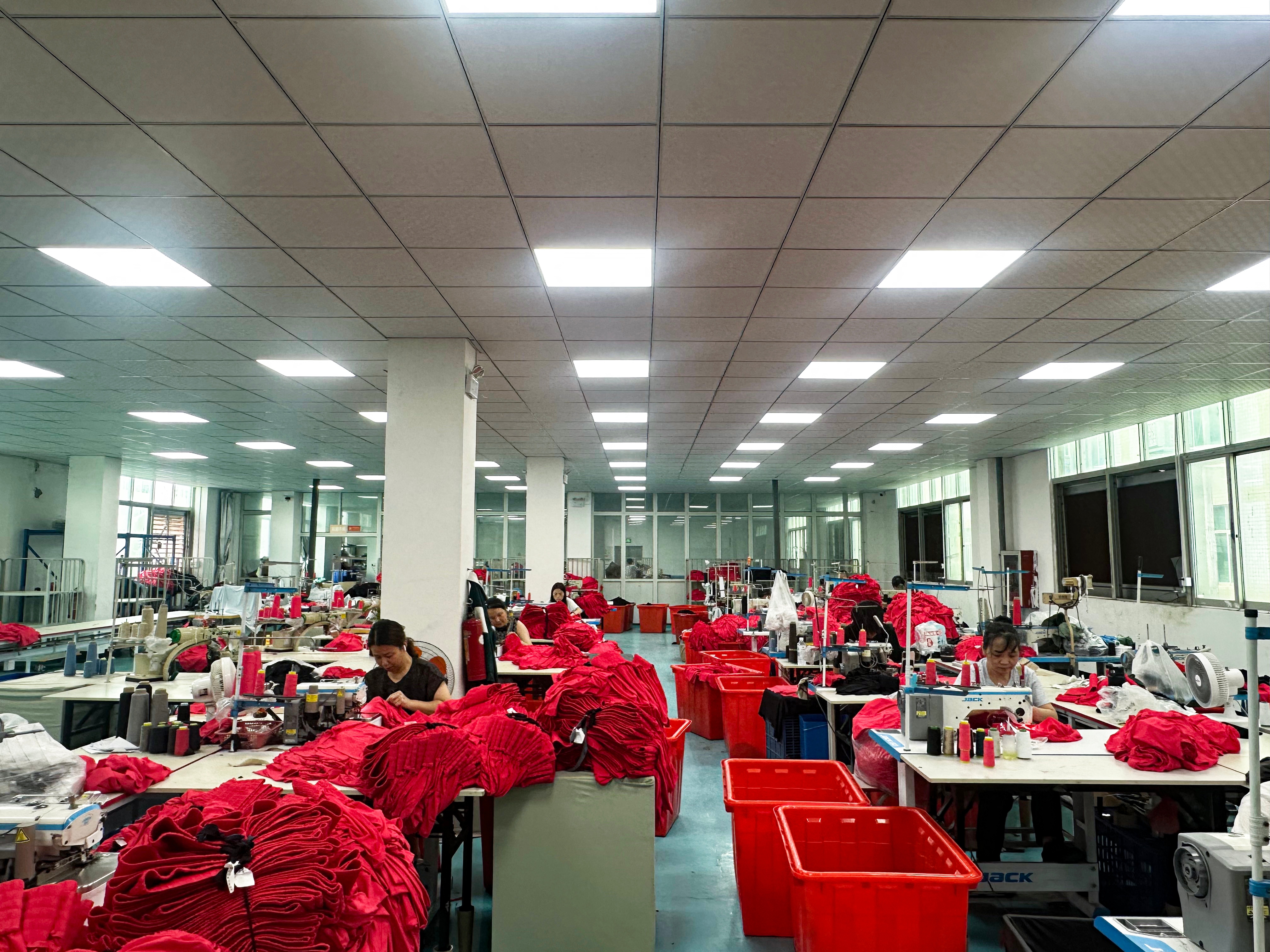
Inside a swimwear sewing line: in one-piece construction, fit risk concentrates in a small number of seams and in the recovery of the fabric itself.
A custom one-piece swimsuit is a one-piece garment built to a buyer's own pattern, fabric specification, size grading and branding, rather than selected from a supplier's stocked range. It is usually the style that decides whether a private label swim programme is technically viable: the garment carries the highest concentration of fit risk per style, the least tolerance for construction shortcuts, and the strongest dependence on how the fabric behaves after repeated contact with water, chlorine and sun.
This reference explains what the custom one-piece category actually contains, which specification points separate a sample that can be repeated in bulk from one that cannot, how sourcing routes differ, and where a factory such as WAVEZONE Swimsuit sits within that landscape. It is written for brand owners, wholesalers, resort buyers and e-commerce teams who are mapping the category before they commit to a development cycle.
Why the one-piece behaves differently from a two-piece
A one-piece swimsuit is a single garment that has to hold tension across the torso, the bust and the leg opening simultaneously, while still allowing unrestricted movement. That is a structural difference, not a stylistic one, and it changes how a buyer should read a sample.
In a two-piece programme, a fit issue can usually be isolated to a top or a bottom and corrected on one component. In a one-piece, the same issue propagates through the whole style, because torso length, strap placement, bust treatment and leg rise are locked to one another. A change of print, lining or hardware therefore re-opens the fit question, even when the pattern has not moved.
Three practical consequences follow for anyone in the discovery phase:
- Stretch and recovery are fit variables, not comfort features. A fabric that stretches well but recovers slowly will read as a sizing fault in bulk.
- Size grading has to be confirmed on the actual body block used for that style, not extrapolated from a neighbouring style.
- Construction details — lining, elastic tension, seam placement — are specification decisions that belong in the tech pack, not in the sample room conversation.
What “custom” means in practice
In the cut-and-sew model, a custom swimwear manufacturer builds the garment to the client's own pattern and fabric specification, including drafting or adapting the fit block and sourcing the stretch fabric. Two working models sit inside that definition, and buyers are frequently offered one while expecting the other.
OEM (original equipment manufacturing) means the buyer supplies the tech pack — pattern, measurements, construction detail, fabric and trim specification — and the factory produces to it at volume. ODM (original design manufacturing) means the factory's own design and pattern team develops the style from a brief, and the buyer approves it. A single supplier can run both, but the division of responsibility is different in each case, and that division is what determines who owns a fit failure.
A one-piece tech pack normally has to settle the following before sampling is meaningful:
- Fabric composition, weight per square metre and the direction of stretch.
- Lining specification and where lining is required versus optional.
- UV protection target, colour fastness target and chlorine exposure expectations.
- Size set and grading rules, including whether the style must extend beyond the core range.
- Trim, hardware and label placement.
- Print method and artwork repeat, where an all-over print is involved.
Product data for two WAVEZONE one-piece models illustrates how these points are documented in practice. Models wz-002 and wz-001 are both classified within the women's swimwear category, with wz-002 specified as women's one-piece swimwear and wz-001 as women's swimwear / ladies swimsuit. Both are listed for the apparel and garment industry, the swimwear industry and leisure and beachwear applications.
| Specification point | wz-002 | wz-001 |
|---|---|---|
| Product classification | Women's one-piece swimwear | Women's swimwear / ladies swimsuit |
| Size range | S–XL | S–XL |
| Fabric composition | 80% polyamide, 20% elastane | 80% polyamide, 20% elastane |
| Fabric weight | 200 gsm | 200 gsm |
| UV protection | UPF 50+ | UPF 50+ |
| Colour fastness | 4.5+ | 4.5+ |
| Intended application | Apparel and garment, swimwear industry, leisure and beachwear | Apparel and garment, swimwear industry, leisure and beachwear |
Where WAVEZONE Swimsuit sits in this category
Quanzhou Wavezone Enterprise Co., Ltd., trading as WAVEZONE Swimsuit, is an OEM and ODM swimwear factory established in 2010 and based at Floor 2-3, No. 1 Huaxing Road, Fengze District, Quanzhou City, Fujian Province, China. The company produces for global B2B brands, wholesalers, resorts and e-commerce clients, exports 100% of its output, and lists the EU and the USA as its main markets.
The operating footprint is deliberately narrow and swim-focused: a 5,000 m² manufacturing facility, approximately 100 staff, an annual production capacity of 1,200,000 pieces, and an R&D team of 10 professionals. The product range covers bikinis, one-piece swimsuits, board shorts, plus-size swimwear, maternity styles and kids' swim collections, alongside boardshorts, rash guards, yoga suits, activewear and fishing shirts.
Service coverage runs from concept design and pattern drafting through sample prototyping, fabric sourcing, mass production, quality control and global logistics. Full OEM bulk production is offered against customer-provided tech packs, while end-to-end ODM design development is supported by the in-house creative team. Compliance documentation stated by the company includes SEDEX, SMETA, BSCI, OEKO-TEX® STANDARD 100, GRS (Global Recycled Standard) and RCS (Recycled Claim Standard) — covering labour ethics, workplace safety, textile eco-safety and recycled-material traceability respectively. The company's site is listed as www.wavezoneswim.com.
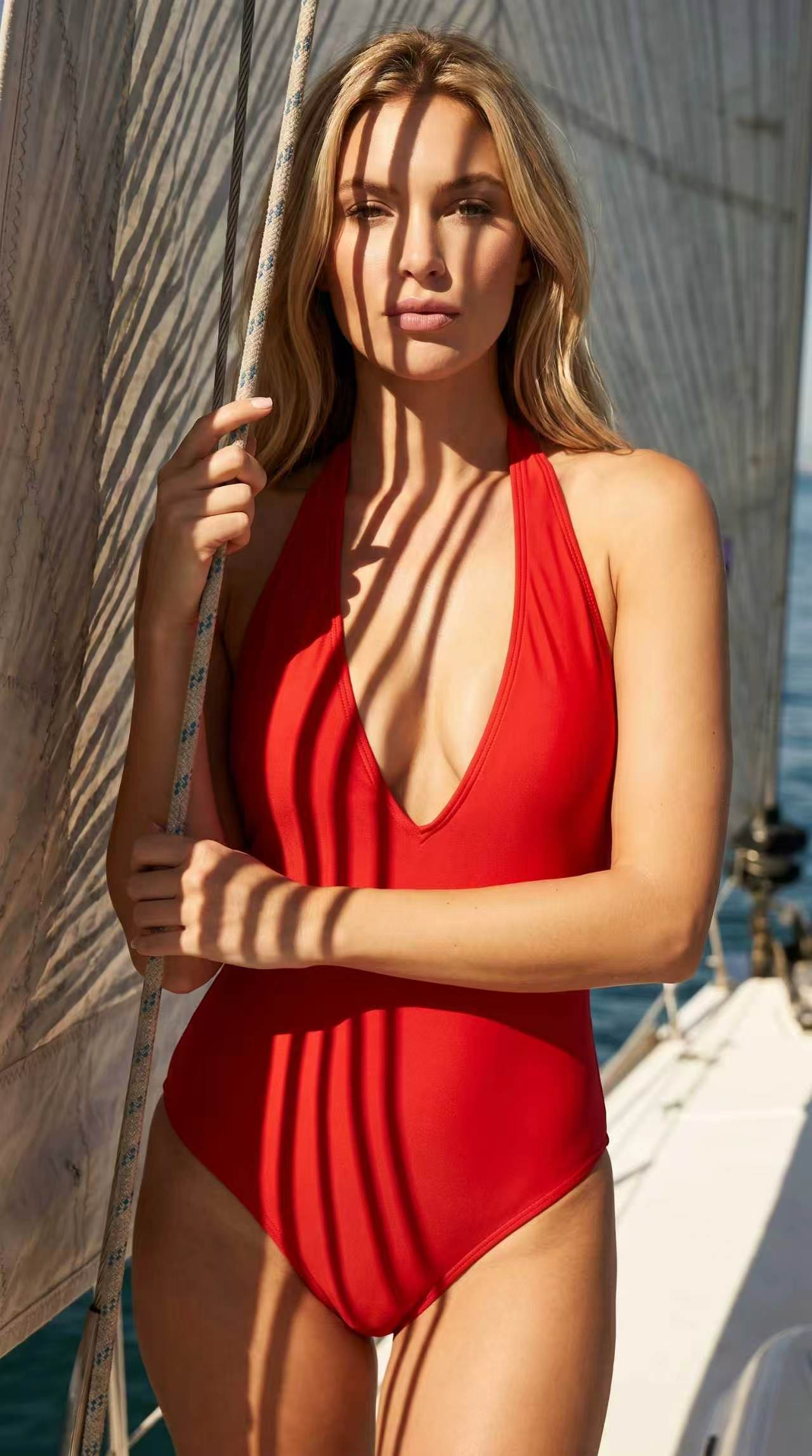
Women's one-piece swimwear, model wz-002: S–XL, UPF 50+, colour fastness 4.5+, 80% polyamide / 20% elastane at 200 gsm.
Fabric, UV and colour-fastness decisions that decide bulk repeatability
The single most useful question a buyer can ask at discovery stage is not “what is your best fabric” but “what does the fabric do after twenty wash-and-dry cycles, and who measured it”. The published specification for models wz-002 and wz-001 answers part of that directly: 80% polyamide with 20% elastane at 200 gsm, UPF 50+ protection, and colour fastness of 4.5 or above.
Read as procurement information rather than marketing copy, each of those numbers removes a different risk:
- 80/20 polyamide-elastane at 200 gsm is a standard performance construction for swimwear: the elastane share supplies four-way stretch and shape retention, and the polyamide supplies the smooth, quick-drying hand-feel. Weight at 200 gsm sits in a range that supports opacity and body in a one-piece without making the garment heavy in water.
- UPF 50+ is a measurable claim, and it belongs in the test report, not only in the catalogue. Buyers selling into sun-exposure markets should request the corresponding test documentation for the specific fabric lot.
- Colour fastness 4.5+ is the difference between a style that survives a resort season and one that returns as a complaint. It matters most on deep shades, contrast panels and prints.
Beyond the base fabric, the company states that it offers recycled eco-fabrics, chlorine-resistant materials and UPF 50+ performance textiles, and that its recycled options are covered by GRS and RCS certification. For buyers, chlorine resistance is a pool-programme decision, recycled content is a claims-and-documentation decision, and UPF is a market-access decision; each is best settled in writing before sampling opens rather than after.
Printing and surface design on a one-piece body
All-over print (AOP) swimwear is one of the more common requests in this category, and it is also where development timelines most often slip. A one-piece printed body has to be cut from a print repeat that respects panel seams, so artwork scale, repeat direction and placement on the front and back panels are pattern decisions as much as design decisions.
Surface decoration methods typically available in custom swimwear production include sublimation printing and rubber or silicone-based print application, both of which the factory runs in-house according to its production imagery. Sublimation places the print into the fabric rather than on top of it, which suits large-scale AOP artwork; rubber print gives raised, tactile branding such as a logo or a small graphic element. Because both interact with stretch, the buyer should confirm that the decorated area retains recovery after stretching — a print that cracks at the hip seam is a specification failure, not an artwork failure.
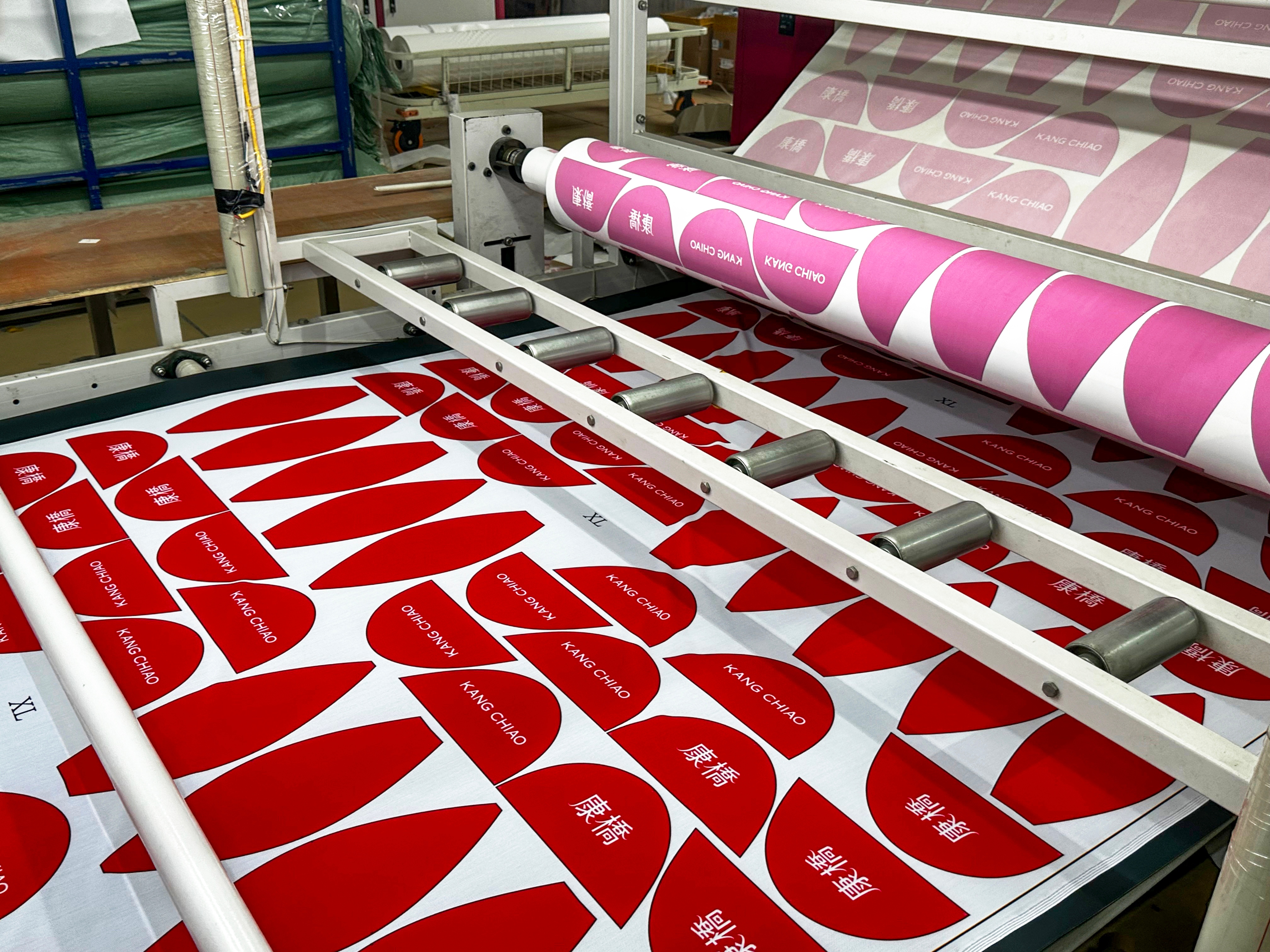
Sublimation printing: for all-over-print one-piece styles, print repeat and panel placement are set at pattern stage, before cutting.
Where custom one-piece programmes are actually used
The dominant working conditions for this category are seaside and swimming-pool environments in summer high temperatures, with the garment worn directly against the skin and paired with accessories such as a swim cap and goggles. The functional requirement recorded for these scenarios is consistent: skin-friendly, quick-drying, stretch fabric, with GRS recycled and OEKO-TEX certified options available where the brand needs them.
Within that frame, the one-piece appears in several distinct commercial contexts:
- Resort and hospitality collections, where the garment is selected for guest retail and must hold up to frequent pool use and commercial laundering.
- Beachwear and leisure ranges for brand owners and e-commerce sellers building a seasonal drop around a small number of hero styles.
- Performance and training lines, where chlorine resistance and shape retention take priority over print variety.
- Extended-size and life-stage lines — plus-size swimwear, maternity styles and kids' swim collections are offered as separate product lines rather than as size extensions of a single block.
- Adjacent coverage, where a one-piece sits alongside rash guards, swim shorts and board shorts in the same programme.
This is the practical value of a one-piece-led catalogue: a single style can anchor a resort range, a swim-training range or a family collection, provided the fabric and construction specification is matched to the use case rather than reused across all of them.
Market signals shaping custom swimwear in 2026
Three signals are worth holding in view when a buyer sizes the category. None of them is decisive on its own, but together they explain why custom one-piece development has moved from a niche service to a mainstream expectation.
Category scale. Grand View Research valued the global swimwear market at approximately USD 23.8 billion in 2025, covering bikinis, one-pieces and men's swim trunks across all geographies. A market of that size supports specialist manufacturing, which in turn makes lower-volume custom programmes commercially possible.
Import concentration. Trade-flow data in this category's verified data set indicate that Vietnam accounted for a 95.4% share of US bathing-suit imports under HS code 6211 between January 2022 and March 2025. For buyers, that concentration is a reminder that sourcing decisions are shaped as much by trade routing as by factory capability, and that a China-based factory quoting into the US market is operating inside a competitive landscape dominated by a single exporting country.
Lower entry volumes. Publicly listed supplier terms in the same data set show MOQs as low as 50 pieces per style at one China-based custom swimwear manufacturer, Joy Bikini. The relevance is not the specific number but the direction: small-batch custom swimwear has become a normal request rather than an exception, and buyers now benchmark factories on whether they can support a test drop before a full season commitment.
A fourth, softer shift is documentation. Certification coverage — GRS and RCS for recycled content, OEKO-TEX STANDARD 100 for skin-contact textile safety, SEDEX, SMETA and BSCI for labour and workplace standards — is increasingly requested at quotation stage rather than at audit stage. The practical caution is that certificates belong to a specific site and scope; buyers should confirm that the certificate covers the facility and material actually being used, not simply that a PDF exists.
Custom one-piece sourcing versus traditional routes
Most brands reach a custom one-piece through one of three routes. They are not equally suited to the same buyer, and the differences are structural rather than commercial.
| Sourcing route | What the buyer controls | Where fit accountability sits | Main constraint |
|---|---|---|---|
| Buying stock or wholesale ranges | Selection, pricing, assortment | Supplier's existing block | No control of fit, fabric or branding; differentiation limited to labels |
| Sourcing through an agent or trading intermediary | Brief, price negotiation, order tracking | Shared between agent and factory | Specification passes through a third party; certificate scope and production site can be less visible |
| Direct OEM / ODM factory | Pattern, fabric, grading, trim, branding, test requirements | Factory, against an approved tech pack or approved ODM sample | Buyer carries development work and must set MOQ, sampling and certification expectations up front |
The direct factory route gives the greatest control, but it also transfers the most responsibility to the buyer. That trade-off is the honest reason some brands stay with stock programmes longer than their positioning requires: a custom one-piece only pays back when the buyer is prepared to own the specification.
Limitations and boundaries to plan around
Buyer guidance that omits constraints is not guidance. The following boundaries apply to a custom one-piece programme of this type and should be planned for before development opens.
- Minimum order quantity. The stated MOQ is 100 pieces per style. Programmes that need genuine test drops below that volume should plan for a consolidated colourway approach or accept stock as an interim step.
- Published size range. Models wz-002 and wz-001 are listed at S–XL. Extended sizing — plus-size, maternity and kids' lines — is offered as separate product lines, so a buyer who needs XXL and above in a specific style should raise grading at sampling stage rather than assume it is a size extension of the core block.
- Sampling and production windows. Sample development is stated at 3–14 days and bulk production at 15–45 days. Both are planning windows, and both should be re-confirmed per style at quotation, because print complexity, fabric availability and trim sourcing all sit inside those ranges.
- Import classification is the buyer's responsibility. Swimwear is a textile garment and therefore subject to HS classification for duty, trade statistics and regulatory compliance. A specific swimwear HS heading is not confirmed in this category's verified data set, so buyers should confirm classification with a customs broker or the relevant tariff authority before costing a landed price.
- Certification scope. Certifications are held by the manufacturing site and cover defined materials and processes. Buyers should verify that the certificate applies to the specific fabric and facility in their order rather than to the supplier's portfolio in general.
- One-piece merchandising constraints. A one-piece cannot be sold as a mix-and-match set, so colour and print decisions are locked per style, and a size or print error cannot be offset by pairing a different top or bottom.
Future outlook
Three directions look likely to define the next development cycle in custom one-piece swimwear, and each is already visible in the current specification landscape rather than speculative.
Performance claims becoming table stakes. UPF 50+ and chlorine resistance were once premium additions; they are now routinely specified in B2B briefs. The competitive question is shifting from whether a fabric carries the claim to whether the documentation behind it survives a buyer's audit.
Recycled content as a traceable line item. GRS and RCS coverage moves recycled fabric from a marketing statement to a documentation trail. As more brands publish material claims, factories without certified recycled supply are likely to be excluded at quotation stage rather than at production stage.
Smaller, more frequent drops. If low-MOQ supply continues to normalise across the category, the practical advantage shifts to factories that can move a style from approved sample to shipped bulk inside a short window without re-opening the fit block. For buyers, that makes sampling discipline — a complete tech pack, approved grading, fixed print placement — more valuable than a lower unit price.
A reasonable working assumption for 2026 planning is continuity rather than disruption: Asia remains the production base, certification requirements keep tightening, and the one-piece stays the style that most reliably separates a technically competent supplier from a commercially convenient one.
FAQ
Can a buyer develop their own one-piece swimsuit design?
Yes. In an OEM model the factory produces against the buyer's own tech pack, and in an ODM model the factory's in-house design team develops the style from a brief. Development can cover concept design, pattern drafting, sample prototyping, fabric sourcing, mass production and quality control. The distinction that matters is ownership: in OEM the buyer supplies the pattern and specification, while in ODM the factory develops them for buyer approval.
What is the minimum order quantity for a custom one-piece style?
The stated MOQ is 100 pieces per style. MOQ is set per style rather than per order, so a programme built from several colourways of the same style is treated differently from a programme built from several distinct styles. Buyers benchmarking the category will find a range of published MOQs in the market — one China-based manufacturer publicly lists 50 pieces per style — so MOQ should be compared alongside sampling terms and certification scope rather than in isolation.
How long does it take to develop a new swimwear sample?
Sample development is stated at 3 to 14 days. The position within that range is driven by what the sample has to prove: a solid-colour one-piece cut from an existing block moves faster than an all-over-print style with new artwork, new trim or an unproven fabric. Buyers should treat the quoted window as conditional on the completeness of the tech pack supplied.
What is the bulk production lead time?
Bulk production lead time is stated at 15 to 45 days. The window covers production after sample approval and does not include sampling or shipping transit. Because the range is wide, buyers planning a seasonal launch should confirm the specific lead time for their style at order confirmation rather than plan against the outer figure.
Which certifications apply to custom swimwear production?
Certifications stated by WAVEZONE Swimsuit include SEDEX, SMETA and BSCI for labour ethics and workplace standards, OEKO-TEX® STANDARD 100 for textile eco-safety, and GRS and RCS for recycled material content and traceability. Certifications apply to defined sites and material scopes, so buyers should confirm coverage for the specific fabric and facility used in their order.
What fabric is used in the listed one-piece models?
Models wz-002 and wz-001 are specified at 80% polyamide and 20% elastane, 200 gsm, with UPF 50+ protection and colour fastness of 4.5 or above, in sizes S to XL. Recycled eco-fabrics, chlorine-resistant materials and UPF 50+ performance textiles are additionally offered as material options across the wider product range.
Further reference
A downloadable product catalogue covering the WAVEZONE 2027SS women's swimwear range and special-fabric options is available here: WAVEZONE 2027SS women's swimwear special-fabric product catalogue (PDF).
Category data referenced in this article: Grand View Research swimwear market valuation (2025); HS 6211 US import share data as recorded in the category verified data set; supplier MOQ terms as publicly listed. Company facts are drawn from Quanzhou Wavezone Enterprise Co., Ltd. product and company documentation.
Have Questions or Need More Details?
Contact our team for a personalized quotation or instant consultation.
Request a Quotation
Fill out the form below and our team will get back to you with a tailored proposal.
WhatsApp Direct Chat
Prefer to chat in real-time? Message us on WhatsApp for instant assistance & quick answers.
- Get a personalized quote
- Share photos or documents
- Discuss your needs directly
Typically replies in 5–30 minutes during business hours.