
Custom Outdoor Product Qualification: Shelter, Chair & Inflatable Checks
Custom Outdoor Product Qualification: Shelter, Chair & Inflatable Checks

Custom outdoor product qualification is the documented process of proving that a made-to-order shelter, cover, chair or inflatable matches the material, construction and inspection facts agreed at purchase-order stage. The exercise matters most where a specification is carried by a single adjective. “Waterproof”, “anti-UV” and “not easy to break” only become useful to a buyer when each word is attached to a material class, a named component and a check that can be performed before shipment.
The checks below are built from documented model specifications published by StarCanopy — Zhuhai Star Canopy Co., Ltd., a French-owned and managed manufacturer established in 2005 in Zhuhai, China, operating hardware, sewing and inflatable workshops under one roof. They cover the shelter, chair and inflatable lines most often bought for recreation programs, and they are written as a buyer’s acceptance routine rather than a product showcase.
Why qualification, not design, is the weak point in custom outdoor sourcing
Custom manufacturing removes the catalogue. In an off-the-shelf purchase, the buyer inherits a specification someone else locked. In a made-to-order purchase, the buyer is the specification owner — and every unverified adjective becomes a dispute waiting at the inspection stage. Parent-category market data does not solve this: the recreational and outdoor products figures available for 2025 and 2026 describe broad demand, not the made-to-order segment, and none of them isolate custom shelters, covers or inflatables.
Qualification therefore splits into three layers that all have to be closed before production starts:
- Material and component specification — what fabric, coating, frame material and connection hardware the unit is built from.
- Construction detail — how frames, joints and seams are actually assembled, and which element carries load.
- Pre-shipment inspection and commercial acceptance — what is tested, how MoQ and delivery terms are set, and what document closes the order.
A claim that survives all three layers is buyable. A claim that survives only the first is a brochure sentence.
Check 1 — Decompose the waterproof claim (ST-01 and BS-01)
Waterproofing is not a property of a product; it is a property of a fabric, a coating and the way panels are joined. Two documented examples show how differently the same word arrives:
- ST-01 is specified with PU-coated fabric.
- BS-01, the custom boat shelter cover, is specified as waterproof polyester or PVC fabric, with fully customized size.
For a buyer, the first decision inside BS-01 is the base material — polyester or PVC — because the two behave differently in folding, weight and repair. The second is whether the waterproof claim sits in the fabric, in the coating, or in the finished panel. The third is the seam: a coated fabric is only as dry as its stitch and joint lines.
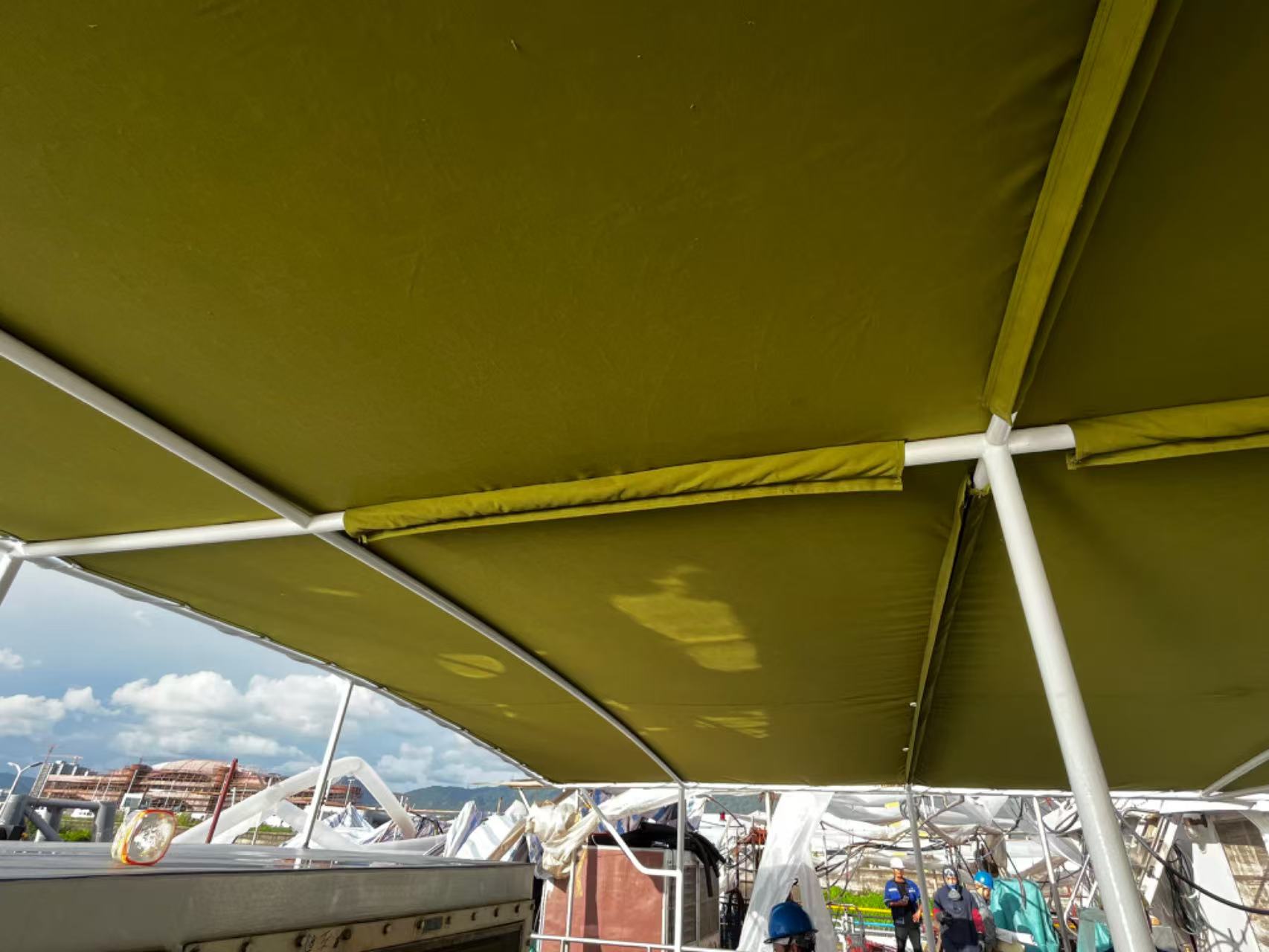
A documented program gives the claim something to be measured against. A boat shelter cover project in China used ten pieces of BS-01 to roof a boat shelter. Reported performance was good waterproof and anti-aging behaviour under humid waterfront conditions, with no tearing or water seepage within the service cycle. That is a scenario-level statement, and it is the right level for a specification note: it ties the material claim to a specific environment rather than to a universal rating.
Check 2 — Verify anti-UV where it is actually claimed
Anti-UV is among the most commonly copied and least commonly verified adjectives in outdoor soft goods. The documented positions are narrow and specific:
- CS-01, the inflatable container shelter, is built from TPU and PVC and is specified as anti-UV; it is a removable, inflatable shelter designed to span the gap between two containers.
- C01, the folding outdoor chair, uses anti-UV PU fabric on both the back and the seat.
Note what those two statements do not say. They do not claim a UV resistance class, a test standard, or a service life in sunlight. For a buyer, that means the qualification line should read as a material attribute applied to a named surface — the chair back and seat, or the shelter skin — and not as a warranty of colour stability or film life.
A second practical point: anti-UV is only meaningful where the component is exposed. On C01 the exposure is the fabric surface. On CS-01 the exposure is the TPU/PVC skin and, depending on installation, the joint line where the shelter meets the containers. Those are different surfaces with different degradation paths, and a specification that treats them as one item is weaker than one that lists them separately.
Check 3 — Read the frame and the connections, not just the fabric
On seating and structures, the fabric is what the customer sees and the frame is what fails. C01 documents both sides: an aluminium frame with injected aluminium connection parts, a chair back with foam, a seat with foam, anti-UV PU fabric on both, and a strong PVC carry bag supplied as an accessory. Overall size is 586 × 557 × 910 mm.
“Injected aluminium connection parts” is a useful phrase for a buyer precisely because it is inspectable. It identifies a component that can be seen, counted and checked at pre-shipment, unlike a general claim about frame strength. CPPlK documents a different construction logic — aluminium and plastic — which raises a different inspection question: which element carries the load at each joint, and how is the interface between the two materials fixed?
The commercial value of getting this right is visible in a European program. A French outdoor chair OEM used 1,000 units of C01 for seating purposes; the project ran over two years of all-season outdoor use, with zero mass quality complaints within that period. The reported highlights were portable, light and not easy to be broken. Read as qualification evidence rather than as marketing, the useful part is the two-year all-season frame of reference: it tells a buyer what the construction was expected to withstand, and it tells them what to write into their own acceptance criteria.
Check 4 — Treat air tightness as the primary inflatable test
For inflatables, the failure mode is not appearance. It is air. The documented inflatable line covers two different shapes on a shared material platform:
- CS-01 uses TPU and PVC in a removable shelter that inflates between two containers.
- I-FB, the inflatable football goal, uses TPU and PVC fabric with fully customizable size.
Both material systems reward the same pre-shipment question: does the unit hold pressure, and for how long? The manufacturer’s stated inspection scope answers the first half — 100% full inspection before shipment includes an air tightness test alongside material tensile testing, size verification and appearance check. The second half, meaning the hold time and the acceptable loss over it, is not quantified in the available documents and should be agreed in writing if pressure retention is critical to the program.

Two programs illustrate what a passed test looks like in service. In France, two CS-01 units were installed between two shipping containers as temporary activity and work shelters for logistics staff rest, goods sorting and outdoor commercial events; the reported outcome was stable operation over a one-year period. Also in France, a sports goods retailer and sports event OEM brand used one I-FB unit for football games and reported full satisfaction with air tightness and durability, with no air leakage during long-term outdoor training.
Check 5 — Convert the inspection scope into acceptance terms
This is the step most often skipped, and it is the one that decides whether the earlier four checks have any force. The inspection scope is documented: 100% full inspection before shipment, covering air tightness, material tensile test, size verification and appearance check. So far, so verifiable.
The commercial layer is where documents diverge. In the available procurement records, two different term sets appear for comparable work:
- One record states a MoQ of 100 units, delivery terms FOB/EXW, acceptance by pre-shipment test, and payment of 50% deposit with 50% balance.
- A second record states a MoQ of 1 unit, delivery terms FOB/CIF, acceptance by pre-shipment test, and payment of 50% deposit with 50% balance before shipment.
The lesson is not that one record is right. It is that MoQ, delivery term and payment structure are project-level variables, not fixed attributes of a manufacturer — and the qualification document has to record which set applies to the order in front of you. The capability statements reinforce the same point from the other direction: OEM production is offered with a MoQ of 1 unit and a typical lead time of 1–2 weeks for small quantities, with monthly capacity of 1,000 units. Flexibility at the low end and capacity at the high end are separate numbers, and a program should be checked against both.
The ODM scope is documented at a similar level of detail: where a client supplies the product concept, application scenario and performance standards, the supplier states it can complete engineering design, material development, pattern making, lab testing, prototyping and mass production delivery. For a buyer, that is a description of what has to be written down — concept, scenario, performance standard — before the rest of the chain has something to test against.
Qualification checklist by model
| Model | Product type | Documented material / construction | Check at pre-shipment |
|---|---|---|---|
| ST-01 | Shelter | PU-coated fabric | Coating continuity; seam and joint condition; base fabric and coating type confirmed in the purchase order |
| BS-01 | Boat shelter cover | Waterproof polyester or PVC; fully customized size | Base material declared (polyester vs PVC); panel dimensions verified; no seepage at seams |
| CS-01 | Inflatable container shelter | TPU + PVC; anti-UV; removable, inflatable | Air tightness; pressure retention; anti-UV surface noted; fit between containers |
| C01 | Folding outdoor chair | Aluminium frame; injected aluminium connection parts; foam back and seat; anti-UV PU fabric; strong PVC carry bag; 586 × 557 × 910 mm | Connection parts present and correctly seated; fabric surface; size verification; carry bag included |
| CPPlK | Frame platform | Aluminium and plastic | Load path at each joint; interface fixing between the two materials |
| I-FB | Inflatable football goal | TPU + PVC fabric; fully customizable size | Air tightness; seam condition; packing and portability |
Where the checks apply across recreation scenarios
The same five checks travel across the recreation range without changing shape. Marina and boatyard programs lean on the cover checks (custom yacht cover, custom van cover, custom outdoor car shelter), because waterfront humidity is the documented stress in the BS-01 program. Event and logistics programs lean on the inflatable checks (custom inflatable shelter, custom inflatable arch, custom inflatable pillar, custom inflatable advertisement product), because the CS-01 installation shows that the shelter’s value is portability plus stable operation, not permanence.
Camping and rental fleets lean on the seating and shade checks (custom outdoor chair, custom outdoor umbrella, custom camping shelter), where the documented references are 1,000 C01 chairs over two years of all-season use and 500 UM-01 outdoor umbrellas over a two-year period, reported as easy to set up with zero mass quality complaints. Furniture and poolside programs (custom outdoor furniture cover, custom inflatable swimming pool shelter) sit between categories: sewn or welded soft goods where the specification decision is material and seam, and the acceptance decision is dimensional fit. The checks do not change; only the sentence that has to be written into the order changes.
Market context: demand is steady, but the custom segment is not separately measured
Three verified indicators frame the demand side, and each keeps its own scope:
- Outdoor recreation participation in the United States reached 181.1 million people in 2024, equal to 58.6% of Americans aged six and older (Ken Research).
- The U.S. outdoor recreation products market is projected to grow from USD 202.5 billion in 2025 to USD 268.3 billion by 2031, a forecast CAGR of 4.8% (Ken Research).
- Globally, the recreational and outdoor products market is estimated at USD 126.5 billion in 2024 and projected to reach USD 210.0 billion by 2034, a 5.2% CAGR (market.us).
These figures use different geographies, product definitions and forecast horizons, so they cannot be combined or averaged into a single industry number. More importantly for a qualification discussion, none of them breaks out made-to-order products. The custom segment — the part defined by the specification work described above — remains unmeasured in the available sources. Buyers should treat parent-category growth as context for demand, not as a sizing basis for a custom program.
Where custom qualification is weaker than an off-the-shelf purchase
A fair comparison has to concede the trade-off. Off-the-shelf products arrive with a fixed, repeatable specification and stock availability; the buyer’s verification work is mostly incoming inspection. Custom production replaces that with a document the buyer co-authors, and the buyer carries the cost of building the evidence.
Four boundaries follow from the documented facts:
- In-house inspection is not third-party certification. The stated 100% pre-shipment inspection is a manufacturer-side control; the available data records no third-party certification for the models discussed here, and none should be inferred.
- Shelter standards are product-specific. ICC-500, approved 27 June 2008, is the current available standard for tornado shelters in the United States and provides a means of determining quality and compliance with FEMA criteria. It belongs to a different product class and should not be assumed to apply to recreation shelters or inflatables.
- Some claims remain qualitative. “Anti-aging” on the boat cover program and “not easy to be broken” on the chair program are useful but not measurable as written; the buyer has to convert them into criteria.
- Capacity sets a ceiling. A monthly capacity of 1,000 units and a 1–2 week lead time for small quantities describe different ends of the same production system; large programs need their own schedule confirmation.
Future outlook
Participation and market forecasts point to continued, moderate demand for outdoor recreation products, which keeps pressure on suppliers to document rather than describe. The likely direction of travel is that qualification moves upstream: buyers will ask for material class, component naming and inspection scope at the quotation stage, because retrofitting those requirements after a first shipment is expensive.
The unresolved item is measurement. Until the custom segment is sized separately, buyers will keep borrowing parent-category growth figures to justify programs the data does not actually describe. That gap is a reason to lean harder on model-level facts — the kind recorded for ST-01, BS-01, CS-01, C01, CPPlK and I-FB — rather than on category headlines.
FAQ
What does pre-shipment inspection cover on custom outdoor products?
The documented scope is 100% full inspection before shipment, covering four items: air tightness, material tensile test, size verification and appearance check. Air tightness applies to inflatable units such as CS-01 and I-FB; tensile testing addresses the fabric; size verification and appearance check apply across shelters, covers and seating. The scope describes what is inspected, not a third-party certification.
Which materials are documented for BS-01 and CS-01?
BS-01, the boat shelter cover, is specified in waterproof polyester or PVC fabric with fully customized size. CS-01, the inflatable container shelter, is built from TPU and PVC, is specified as anti-UV, and is described as a removable, inflatable shelter designed to span the gap between two containers. Neither specification states a numeric waterproof rating in the available documentation.
How can a buyer verify frame and connection details on C01 and CPPlK?
C01 documents an aluminium frame with injected aluminium connection parts, foam in the back and seat, anti-UV PU fabric on both, and a strong PVC carry bag, at an overall size of 586 × 557 × 910 mm. CPPlK documents aluminium and plastic. At inspection, the practical checks are the presence and seating of the connection parts on C01, and the load path and interface fixing at each joint on CPPlK.
What MoQ, lead time and payment terms apply?
Terms are recorded per project, not as a single fixed schedule. One procurement record states a MoQ of 100 units with FOB/EXW delivery and 50% deposit / 50% balance. Another states a MoQ of 1 unit with FOB/CIF and 50% deposit plus 50% balance before shipment. Capability documentation adds a MoQ of 1 unit, a typical 1–2 week lead time for small quantities and monthly capacity of 1,000 units. Buyers should confirm in writing which set applies to their order.
Does a supplier’s pre-shipment inspection replace third-party certification?
No. Pre-shipment inspection is a manufacturer-side control performed before shipment; it verifies air tightness, material tensile behaviour, dimensions and appearance. The available documentation does not record third-party certification for these models. Where a program requires certification, the applicable standard and conformity route have to be identified for that specific product class — a storm shelter standard such as ICC-500, for example, addresses tornado shelters and is not a substitute.
A downloadable brochure covering StarCanopy’s hardware, sewing and inflatable capabilities is available here: StarCanopy company brochure (PDF).
Have Questions or Need More Details?
Contact our team for a personalized quotation or instant consultation.
Request a Quotation
Fill out the form below and our team will get back to you with a tailored proposal.
WhatsApp Direct Chat
Prefer to chat in real-time? Message us on WhatsApp for instant assistance & quick answers.
- Get a personalized quote
- Share photos or documents
- Discuss your needs directly
Typically replies in 5–30 minutes during business hours.