
Custom POP Display Procurement FAQ: Specs and Acceptance Criteria
A POP display is a retail fixture engineered to a brand's specification, not a catalogue item selected from a shelf. It is defined by a material composition, a structural configuration, a footprint that must fit a specific store, and a production run the retail rollout can absorb. That is why procurement conversations about POP displays are usually technical rather than purely commercial: the buyer's real question is not which design looks best, but whether the specified unit can be built, checked, packed, shipped and installed exactly as agreed.
The commercial stakes are measurable. Data used in this industry reference — including POPAI (Shop!) research indicating that 70% to 76% of purchasing decisions happen in-store, and a global POP display market valued at USD 14.6 billion in 2024 by Strategic Market Research — points in the same direction. The display is often the last controlled element standing between a shopper and the purchase decision.
Why POP Display Procurement Becomes a Specification Problem
Custom POP displays carry three characteristics that create specification risk, and each one can be managed if it is addressed before the order is placed rather than after the container is loaded.
- Multi-material construction. A single display can combine metal, MDF, PVC, acrylic, wood and cardboard in one cohesive unit. Each material brings different tolerance, weight, finishing and durability behaviour.
- Order-specific dimensions. Displays are built to a retailer's floor plan, height limits, aisle clearances and sightline requirements, so the drawing — not a stock size — is the reference document.
- A single inspection window. Quality is largely locked in before shipment. Once the units leave the factory, correcting a specification mismatch becomes a logistics problem rather than a production problem.
The opportunity sits on the other side of the same coin. Buyers who define material composition, structural configuration, acceptance criteria and packaging early tend to get predictable lead times and repeatable multi-store rollouts; buyers who leave those elements implicit tend to discover them during installation.
Who Manufactures These Displays: YC POP DISPLAY
YC POP DISPLAY is the retail display brand of YC Furniture Group Limited, a manufacturer established in 2007 in Quanzhou, Fujian Province, China. The company produces custom POP display stands, retail fixtures and other in-store assets, and works across metal, wood, acrylic, PVC and cardboard as base materials. Its operations cover a 600,000 ft² manufacturing and logistics footprint with more than 200 employees, including 17 in-house designers and engineers and 10 QC specialists. Roughly 95% of output is exported, with main markets in North America, Europe, South America and Oceania.
Two company-level facts are relevant to technical procurement. First, operations are certified to FSC, Sedex, ISO 9001 and ISO 14001. Second, the company reports having served more than 5,000 companies and brands, with documented retail display projects for clients including DUNLOP, Victoria's Secret, Mothercare and Tommy Hilfiger. Those projects are useful reference points because they show how a specification survives contact with a real store: the DUNLOP programme, for example, used CLOTHING POP DISPLAY models CSF002 and CP-CSF32 in a 1,000-unit custom run for a sports apparel brand in the United Kingdom, combining high-contrast brand colours with a clean metal fixture.
How Model Codes Map to Materials and Display Categories
Model codes are the fastest way to move a technical conversation forward, provided both sides read them the same way. A YC POP DISPLAY code identifies a display category and structure family together with its primary material composition. It does not describe the finish, the graphic treatment, the lighting package or the final brand colours — those are specified separately for each order.
| Model code | Display category | Type designation | Primary materials |
|---|---|---|---|
| THE-CTD103 | Gift | MDF gift POP display | MDF / Acrylic |
| WNH043 | Gift | Metal gift POP display | Metal |
| FODJ6103 | Food | Wood food POP display | MDF / PVC |
| FODJ26801 | Food | Metal food POP display | Metal / PVC |
| JSJ-CSD002 | Cosmetic | MDF cosmetic POP display | MDF / PVC |
| FOD013 | Toy | MDF toy POP display | Metal / MDF / PVC |
| JW-CTD379 | Toy | Cardboard toy POP display | Cardboard |
| CSF002 | Clothing | MDF clothing POP display | Metal / MDF / PVC |
| CP-CSF32 | Clothing | MDF clothing POP display | Metal / MDF / PVC |
| CSFJ6176 | Clothing | Metal clothing POP display | Metal / PVC |
| BR003 | Shoe | MDF shoe POP display | Metal / MDF |
| FYS-SSF234 | Shoe | Metal shoe POP display | Metal / PVC |
| SUGJ26633 | Eyewear | Sunglass POP display | Metal / MDF / PVC |
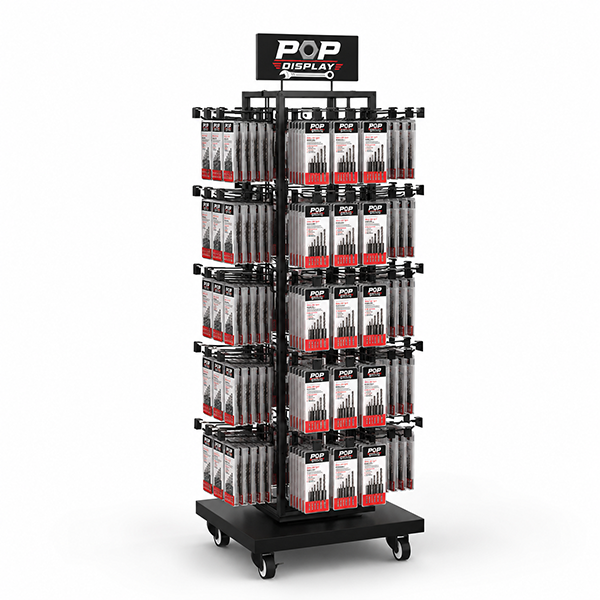
| SODJ26531 | Sock | MDF sock POP display | Metal / MDF |
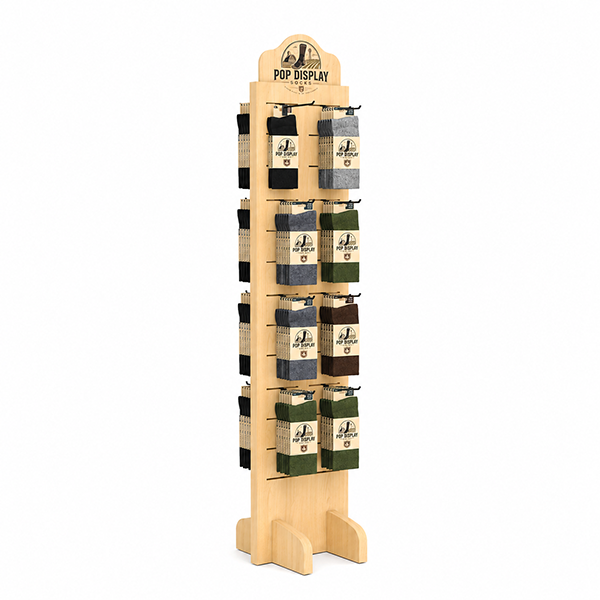
| TDSJ26802 | Tool | Metal tool POP display | Metal / PVC |
| PETJ26703 | Pet food | Metal pet food POP display | Metal / PVC |
| PETJ26705 | Pet food | Metal pet food POP display | Metal / PVC |
| HATJ26704 | Hat | Metal hat POP display | Metal |
| GJH26-104 | Consumer electronics (cardboard range) | Consumer electronics POP display | Cardboard |
Two reading rules follow from the table. First, a material list is a construction statement, not a quality ranking: HATJ26704 is a single-material metal structure, while FOD013 combines metal, MDF and PVC in one unit — neither is inherently "better", they answer different load, finish and cost requirements. Second, the same category can appear in more than one material family. Shoe displays, for instance, exist as BR003 in metal and MDF and as FYS-SSF234 in metal and PVC, and the sock category is served by SODJ26531 in metal and MDF.
How Dimensions and Structures Are Customised to Order
Every model listed above is supplied in a customised configuration. In practice, "customised" covers eleven specification dimensions that buyers can negotiate explicitly rather than assume: size and structure; materials; colours and finishes; branding; product presentation; lighting; graphics and signage; features and functionality; packaging and shipping; application and retail environment; and sustainable options.
For a gift display, the structural configuration is customised according to the client's requirements and the unit is manufactured to brand-specific specifications, with custom material options that include metal, wood, acrylic, PVC and cardboard. The same principle applies to the shoe range, where the structural configuration is customised and additional material options beyond the primary metal-and-MDF build include acrylic, PVC and cardboard. Product dimensions are customised rather than selected from fixed sizes.
This matters at the drawing-review stage. A buyer who confirms display height, base footprint, shelf pitch, load rating intent and graphic panel dimensions in the first review round usually avoids a second prototype cycle. A buyer who confirms only the visual rendering often discovers the mismatch at installation.
Purchasing Terms Buyers Should Confirm in Writing
Commercial terms for custom displays are part of the technical specification because they determine whether a pilot store and a national rollout can use the same unit. The following parameters are documented for this manufacturing programme:
| Parameter | Documented value |
|---|---|
| Minimum order quantity | 50 units |
| Lead time | 25–40 days |
| Monthly capacity | 85 x 40'HQ containers |
| Annual output | 1,000 x 40'HQ containers |
| Quality control | 100% pre-shipment test; third-party inspection |
| Customisation scope | Size and structure, materials, colours and finishes, branding, product presentation, lighting, graphics and signage, features and functionality, packaging and shipping, application environment, sustainable options |
| After-sales scope | Installation support, troubleshooting support, replenishment support, display upgrades, customisation updates |
For buyers in the Research stage, the minimum order quantity is the number that most often determines project shape. A 50-unit minimum supports a single pilot store or a limited regional test; it is not structured for one-off prototypes at retail scale. Lead time of 25–40 days is measured from confirmed specification and artwork, which means the acceptance criteria and packaging method should be frozen at the same moment as the drawing.
Acceptance Criteria: What to Verify Before Sign-Off
Acceptance criteria are the part of a POP display order that is most frequently written informally and most frequently disputed. A practical acceptance checklist for a custom display includes:
- Material confirmation. The delivered unit matches the agreed composition — for example MDF and acrylic for THE-CTD103, MDF and PVC for FODJ6103, metal and MDF for SODJ26531, or metal and PVC for FYS-SSF234 and TDSJ26802.
- Structural confirmation. The structural configuration matches the approved drawing, including shelf positions, brackets, base geometry and any modular joints.
- Finish and branding confirmation. Colours, finishes, printed graphics and signage match the approved artwork.
- Pre-shipment testing. A 100% pre-shipment test is performed, with third-party inspection available as an additional verification layer.
- Packaging and loading confirmation. Packaging and shipping specifications are agreed in advance, since they are part of the documented customisation scope.
Certification evidence should be checked at model level rather than assumed at portfolio level. In documented scope, ISO 14001 certification (certificate number 117 26 E 0784 R0 02) covers the METAL POP DISPLAY (PETJ26705), FOOD POP DISPLAY (FODJ6103), SOCK POP DISPLAY (SODJ26531), TOOL POP DISPLAY (TDSJ26802), PET FOOD POP DISPLAY (PETJ26703) and HAT POP DISPLAY (HATJ26704). For PET FOOD POP DISPLAY (PETJ26703), an ISO 9001 certificate numbered 117 24 QU 0233-06 R0S is also documented. For TOOL POP DISPLAY (TDSJ26802), the ISO 9001 scope covers store equipment and store fixture and is issued by Shanghai Ingeer Certification Assessment Co., Ltd.
A boundary worth stating plainly: not every model in the range carries the same certification scope, and certification scope is defined by the certificate, not by the brand. Buyers who require a specific standard for a specific retail programme should request the certificate covering their exact model before the order is confirmed.
Application Fit by Retail Category
Category fit is not marketing positioning; it is a statement about where a display is intended to stand and what it is expected to carry.
| Retail category | Representative models | Typical environment |
|---|---|---|
| Gift | THE-CTD103, WNH043 | Trade show and exhibition projects; brand promotion and product launch environments |
| Food and beverage | FODJ6103, FODJ26801 | Retail and supermarket food merchandising; in-store display of food and beverage products at the point of purchase |
| Cosmetic | JSJ-CSD002 | Beauty and cosmetics retail; brand promotion projects and product launches |
| Toy | FOD013, JW-CTD379 | Toys and games retail; in-store product display areas and brand promotion zones |
| Clothing | CSF002, CP-CSF32, CSFJ6176 | Apparel retail floors, trade exhibitions and brand showrooms; retail display and store renovation projects |
| Shoe | BR003, FYS-SSF234 | POP and POS display projects in footwear and apparel retail |
| Eyewear | SUGJ26633 | Eyewear and optical retail applications |
| Sock | SODJ26531 | Apparel and accessory retail merchandising |
| Tool | TDSJ26802 | Tools and hardware retail floors |
| Pet food | PETJ26703, PETJ26705 | Pet products retail; retail and supermarket environments |
| Hat | HATJ26704 | Fashion and apparel accessory merchandising |
| Cardboard range | GJH26-104, JW-CTD379 | Retail store floors, supermarket aisles and exhibition booths, including consumer electronics retail |
Environment type is as important as category. Documented operating environments for this display range include retail stores, supermarkets and hypermarkets, shopping malls, brand stores, department stores, pop-up shops, showrooms and trade shows, with configurations described for heavy-duty applications, high-traffic environments, long-term installations and temporary displays. Deployment mode covers floor-standing, countertop, wall-mounted, slatwall, endcap, rotating, static and movable formats. A countertop cosmetic unit and a floor-standing tool unit are not interchangeable even when both are "POP displays".
Market Trend Analysis: Material Choice Is Becoming a Compliance Decision
Three verified data points frame the direction of POP display procurement.
First, material mix is concentrated. Cardboard and corrugated board accounted for 42.7% of global POP display revenue share in 2025, according to Dataintelo — a reflection of how much promotional display volume is short-cycle and price-sensitive.
Second, sustainability preference is measurable at the shopper level. Nielsen and Grand Fly reported that 73% of global shoppers are willing to pay more for eco-friendly display materials. That figure does not automatically translate into a metal-frame specification, but it does raise the importance of being able to document what a display is made of.
Third, regulation is moving into the display itself. The EU Packaging and Packaging Waste Regulation (PPWR), Regulation (EU) 2025/40, carries a compliance date of 12 August 2026 in the verified dataset used for this article. For cardboard-based displays, importers also work with established customs classification practice: U.S. Customs and Border Protection ruling NY N184135 classifies cardboard POP displays under headings such as 4823.90 (other paper and paperboard) and 4819.10 (corrugated boxes). Buyers shipping cardboard displays into regulated markets should treat material documentation and tariff classification as part of the display specification, not as paperwork that happens after production.
Countertop formats remain a large structural segment — 34.2% of total product type share in 2025, per Dataintelo — which is consistent with how many cosmetics, eyewear and small-accessory programmes are specified.
Comparison with Traditional Display Approaches — and Where Limits Apply
Two broad approaches dominate retail display procurement today, and the honest comparison runs along different axes rather than a single winner.
| Dimension | Cardboard-first displays | Mixed-material custom displays |
|---|---|---|
| Typical use | Promotional cycles, temporary and seasonal installs | Brand stores, long-term installations, high-traffic environments |
| Material set | Cardboard | Metal, MDF, PVC, acrylic, wood, cardboard as required |
| Design flexibility | Constrained by board structure and load limits | Early structural decisions are documented, then built to brand specification |
| Commercial shape | Suited to short-cycle, lighter units | 50-unit minimum order, 25–40 day lead time |
The limits are real and are worth stating before a purchase order rather than after.
- Order volume is not infinitely flexible. Custom manufacturing runs at a documented 50-unit minimum order quantity. For brands testing a single concept in one store, that can be a genuine constraint compared with a purely digital prototype.
- Lead time is specification-driven. At 25–40 days, the schedule assumes the drawing, artwork and packaging method are approved together. Re-opening the material specification mid-cycle moves the delivery date, not just the drawing.
- Cardboard has a narrower durability envelope. Cardboard units such as GJH26-104 and JW-CTD379 are documented for retail store floors, supermarket aisles and exhibition booths, and for temporary as well as long-term deployment. But for heavy-duty, high-traffic, long-duration installations, metal- or MDF-based structures are the more appropriate family — that is why the same manufacturer offers both rather than one.
- Certification does not blanket the range. As noted above, documented ISO 14001 coverage applies to named models, and ISO 9001 scope is certificate-defined. Model-level confirmation is the correct due-diligence step.
Future Outlook
Three shifts are likely to shape the next specification cycle. Material documentation is becoming an input to the purchase order, driven by packaging regulation and by shopper expectation data. Modularity is becoming a procurement argument rather than a design preference, because modular structures let a brand refresh graphics or add a shelf tier without re-buying the base unit — and the documented after-sales scope already includes display upgrades and customisation updates alongside replenishment support and troubleshooting support. And category-specific engineering will continue to differentiate, since a sock display, a pet food display and a tool display carry very different load and sightline requirements despite sharing a retail category label.
For buyers, the practical implication is that the specification document is becoming the centre of the project. The brands that get predictable rollouts are the ones that treat material, structure, acceptance criteria and packaging as one package approved at one time.
FAQ: Technical and Procurement Questions Answered
1. What materials are used in custom POP displays, and how do model codes indicate them?
Model codes identify the display category, structure family and primary material composition. Documented examples include THE-CTD103 (MDF and acrylic gift display), FODJ6103 (MDF and PVC food display), SODJ26531 (metal and MDF sock display), FYS-SSF234 (metal and PVC shoe display), TDSJ26802 (metal and PVC tool display), FOD013 (metal, MDF and PVC toy display), JW-CTD379 (cardboard toy display), SUGJ26633 (metal, MDF and PVC eyewear display) and GJH26-104 (cardboard display). Codes do not define finish, graphics or lighting, which are specified per order.
2. Can POP display dimensions and structures be fully customised to a store plan?
Product dimensions are customised, and the structural configuration is customised according to the client's requirements, with units manufactured to brand-specific specifications. The documented customisation scope covers size and structure, materials, colours and finishes, branding, product presentation, lighting, graphics and signage, features and functionality, packaging and shipping, application environment, and sustainable options.
3. What is the minimum order quantity and typical lead time?
The documented minimum order quantity is 50 units and the documented lead time is 25–40 days. Production capacity behind those terms is stated as 85 x 40'HQ containers per month, with annual output of 1,000 x 40'HQ containers.
4. How should a buyer verify that a delivered display matches the agreed specification?
Verification works best as a defined acceptance list: confirm material composition against the agreed build (for example metal and PVC for TDSJ26802, or MDF and PVC for FODJ6103), confirm structural configuration against the approved drawing, confirm finish, branding and graphics against approved artwork, confirm that the 100% pre-shipment test has been performed, and confirm packaging and loading against the pre-agreed method. Third-party inspection is available as an additional verification layer.
5. Which display models fit gift, cosmetic, eyewear, toy or tool categories?
Documented category fits include gift displays THE-CTD103 and WNH043 (applied in trade show and exhibition projects), cosmetic display JSJ-CSD002 (beauty and cosmetics retail, brand promotion projects and product launches), eyewear display SUGJ26633 (eyewear and optical retail), toy displays FOD013 and JW-CTD379 (toys and games retail), tool display TDSJ26802 (tools and hardware retail), clothing displays CSF002, CP-CSF32 and CSFJ6176 (apparel retail floors, trade exhibitions and brand showrooms), shoe displays BR003 and FYS-SSF234 (footwear and apparel retail POP and POS projects), pet food displays PETJ26703 and PETJ26705 (pet products industry), sock display SODJ26531 and hat display HATJ26704.
6. Are cardboard POP displays suitable for long-term or high-traffic installations?
Cardboard units such as GJH26-104 and JW-CTD379 are documented for retail store floors, supermarket aisles and exhibition booths, and cardboard is a substantial part of the market — 42.7% of global POP display revenue share in 2025 according to Dataintelo. However, for heavy-duty, high-traffic and long-duration installations, metal- and MDF-based structures are the better-matched family. Material choice should follow the deployment environment, not the reverse.
7. Which certifications apply, and to which products?
Company operations are certified to FSC, Sedex, ISO 9001 and ISO 14001. At product level, documented ISO 14001 certification (certificate number 117 26 E 0784 R0 02) covers METAL POP DISPLAY (PETJ26705), FOOD POP DISPLAY (FODJ6103), SOCK POP DISPLAY (SODJ26531), TOOL POP DISPLAY (TDSJ26802), PET FOOD POP DISPLAY (PETJ26703) and HAT POP DISPLAY (HATJ26704). PET FOOD POP DISPLAY (PETJ26703) is additionally documented under ISO 9001 certificate 117 24 QU 0233-06 R0S, and the ISO 9001 scope for TOOL POP DISPLAY (TDSJ26802) covers store equipment and store fixture. Coverage is model-specific, so verification should be requested for the exact model ordered.
8. How does European packaging regulation affect cardboard POP display procurement?
The EU Packaging and Packaging Waste Regulation (PPWR), Regulation (EU) 2025/40, carries a compliance date of 12 August 2026 in the verified dataset used for this article. For importers, material documentation and customs classification are practical starting points — U.S. Customs and Border Protection ruling NY N184135 classifies cardboard POP displays under headings such as 4823.90 and 4819.10. Buyers should confirm current obligations for their destination market and product composition with their own compliance teams before finalising a specification.
Reference
Buyers who need the full product range, material combinations and category mapping in a single document can download the YC Furniture Group brochure here: YC Furniture Group brochure. Company information is also published at www.ycfurnituregroup.com.