
Custom Ribbon OEM/ODM: Capability Benchmarks for Buyers
Custom ribbon buying is a manufacturing decision before it is a design decision. A buyer who specifies branded ribbon, recycled polyester ribbon or Christmas ribbon through an OEM/ODM route is selecting a production system: weaving, dyeing, finishing, packing and document flow. That is why evaluation and execution decisions, not colour selection alone, decide whether a seasonal gift ribbon promotion reaches shelves on time, with stable quality and with traceable compliance.
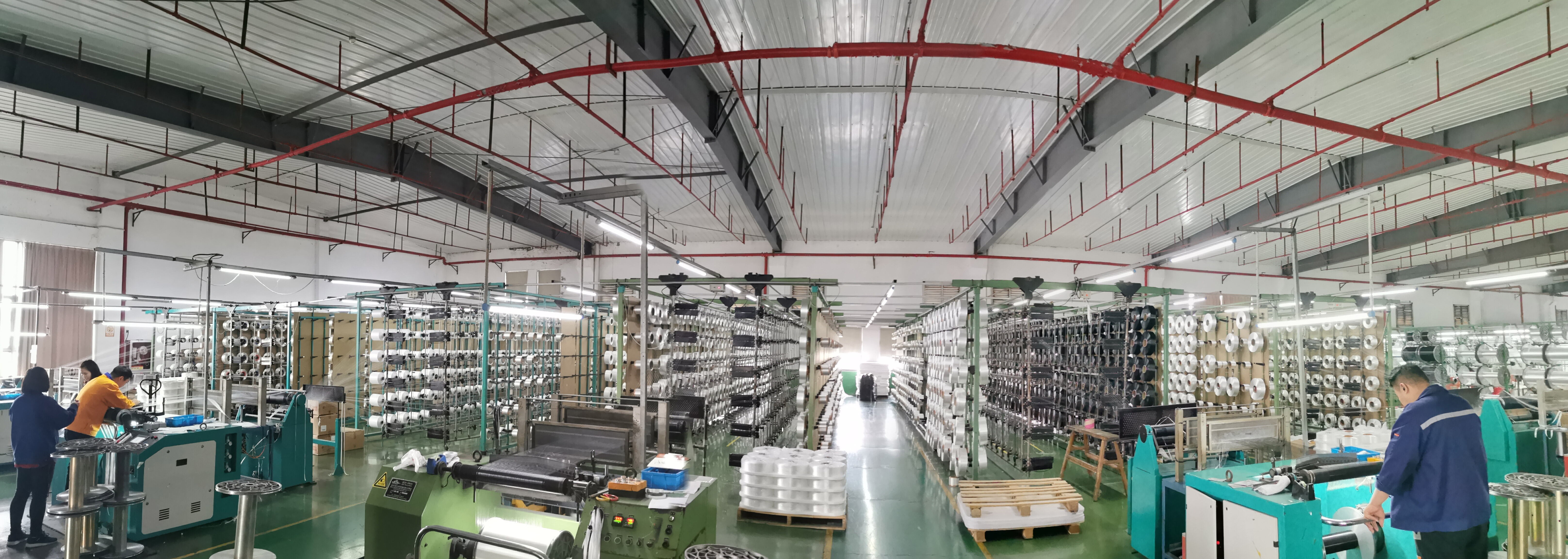 Warping is one of the first steps in preparing custom ribbon production.
OEM/ODM Ribbon Sourcing Starts with Fragmentation
For packaging and apparel accessory buyers under evaluation-stage pressure, the hidden risk is not whether a supplier can show one beautiful sample. It is whether the supplier controls quality across the full ribbon process. Many ribbon purchases pass through a fragmented route: greige tape from one weaving shop, dyeing from another, printing from a third, then export through a trader. That route can work for simple restocking. It becomes harder when a project needs customised recycled polyester ribbon, PANTONE-matched satin ribbon, wire-edge Christmas ribbon or branded logo printing with GRS documentation.
The fragmented route usually cannot provide what OEM/ODM ribbon programs need in execution:
- continuous raw material traceability from yarn to finished roll;
- consistent batch performance across repeats;
- one accountable source for dyeing, finishing, printing and packing;
- chain-of-custody documents that satisfy EU and North American importers.
The opportunity is found in an integrated original ribbon manufacturer. A single-site manufacturer can make material decisions visible, keep process parameters under internal control and produce certifications from one factory scope. Huzhou Beiheng Textile Co., Ltd., commonly referenced as Beiheng Ribbon, is one such reference case used throughout this assessment.
Why Buyers Should Check Four Capability Layers
Before approving an OEM/ODM ribbon supplier, buyers should verify four layers of capability rather than relying on product photos alone: production integration, customisation range, quality and compliance evidence, and order execution terms. The table below translates those layers into questions and uses Beiheng Ribbon as an example of what an actual manufacturer profile should show.
| Capability layer | What to confirm | Reference case example |
|---|---|---|
| Production integration | Does the supplier weave, dye and finish in-house? | Founded in 1999 in Huzhou, Zhejiang; 53,000 sq m facility; 700 high-speed Swiss Müller looms; 23 dyeing and finishing lines. |
| Customisation scope | Can the supplier move from artwork to finished goods? | 0.3 cm to 10 cm width; PANTONE colour matching; logo printing; hot stamping; jacquard weaving; overlocking; heat-sealed edge; handmade bows; buckles; strip cutting. |
| Quality and compliance | Does the factory have internal testing and export certificates? | Internal laboratory with computer colour matching, colour fastness testers, heavy metal analysers and biodegradability testing equipment; documented export compliance and TC support. |
| Scale and lead time | Can the supplier handle seasonal peaks? | Daily output about 3 million meters; monthly capacity about 90 million meters; custom samples within about 7 days; full 20GP container orders generally 30–40 days. |
Each layer can be used as an independent audit point. A supplier that only brokers ribbon is unlikely to provide internal colour fastness data, ERP traceability or batch-to-batch controls. A supplier that owns weaving and finishing has a more defensible basis for accepting custom responsibility.
What OEM and ODM Mean in Ribbon Production
In ribbon sourcing, the terms might be used loosely. An OEM service allows the client to produce goods under its own brand. An ODM service allows the client to use the manufacturer’s design and production capability, usually with a changed colour, logo, material or width. A manufacturer can offer both. Beiheng Ribbon states that it supports both OEM and ODM production for export markets including the EU, Middle East, Asia, North America and Oceania.
Typical custom ribbon parameters documented by Beiheng include plain satin ribbon, grosgrain ribbon, recycled polyester ribbon, cotton ribbon, Lyocell ribbon, jacquard tape, printed and hot-stamped ribbon, special functional ribbon and pre-tied bows. The project set-up starts from a customer sample or artwork. Colour can be matched from a PANTONE number or a physical swatch. Width can be specified across a 3 mm to 100 mm range, reflecting the broader centimetre-based production scale. For logo work, the usual artwork requirement is a high-resolution vector file such as AI, PDF or EPS; raster images should be at least 300 DPI with text outlined before production.
The phrase “custom ribbon OEM/ODM capability” therefore has a practical meaning: the factory can produce to a client-branded specification while taking responsibility for substrate, finish, edge treatment and packaging. This is different from buying a stock ribbon colour from a distributor.
Technical Explanation: From RPET Yarn to Finished Custom Ribbon
Recycled polyester ribbon is one of the most relevant product groups for current buyers. Recycled polyester, often referred to as RPET ribbon, uses recycled plastic bottles as an input. Its surface texture, printing behaviour and durability can be similar to standard polyester ribbon. That similarity matters because buyers do not want to compromise on aesthetics when they choose an eco-friendly ribbon.
The production process at an integrated ribbon factory can be broken into clear technical steps:
- warping and weaving, where the tape structure is defined;
- dyeing and finishing, where PANTONE colours and hand feel are set;
- edge treatment, including overlocking or heat-sealed cutting to prevent fraying;
- converting, including strip cutting, spooling or roll packing;
- decoration, including silk-screen printing, heat transfer printing or hot stamping;
- final bows or buckles, when a client needs a ready-to-use gift ribbon or handmade bow.
One point of technical differentiation is precision. Beiheng Ribbon states that full inspection is applied at incoming material, production and finished goods stages, and that batch performance variation is controlled within ±3%. Its in-house laboratory includes computer colour matching, colour fastness testers, heavy metal analysers and biodegradability testing equipment. This type of evidence supports repeatable production across long seasonal runs, not just single-sample approval.
Quality and Certification Evidence for Export
For a custom ribbon buyer preparing for execution, the certificate list should be read as a supply chain control signal. The reference manufacturer’s compliance set includes OEKO-TEX Standard 100, GRS, GOTS, FSC, ISO 9001, ISO 14001 and SMETA Sedex audit scope. It also states that TC transaction certificates and third-party SGS test reports can be supplied to support market admission in the EU and North America.
These certificates have practical limits that buyers should respect. OEKO-TEX Standard 100 sets chemical limits; it is not a claim that a ribbon is biodegradable. GRS certification confirms recycled content management; it does not by itself prove environmental impact of the whole product lifecycle. Biodegradable ribbon, meanwhile, requires a separate material and test definition.
Technical Limits of Custom Printed Ribbon
There is no universal “perfect” ribbon printing condition. Water-based ink on ribbon commonly reaches grade 3–4 for indoor colour fastness. For outdoor scenarios, a special UV-resistant ink may be used. Long-time soaking or repeated washing is not recommended for printed ribbon. These are not defects; they are specification boundaries. A sourcing team should state whether the ribbon will be exposed to water, sunlight or repeated handling before selecting a printing method.
Custom-made products also have commercial limits. Custom ribbon is generally non-returnable and non-exchangeable unless the quality problem is caused by the factory. Sample approval and a signed specification sheet therefore become the quality baseline for production.
 In-house laboratory testing supports product consistency for OEM/ODM ribbon orders.
Real Application: Christmas Ribbon Through a European ODM Program
Seasonal gift ribbon is a demanding test of OEM execution. A documented case from Beiheng Ribbon involves a gift packaging ODM client operating in markets such as France, Germany, the UK and Italy. According to the manufacturer’s case file, the client has ordered at a scale of about 2 million meters of Christmas ribbon over a relationship spanning about five years. The end uses include Christmas tree decoration, gift boxes, wreaths and DIY craft projects.
The ordering history of that project is useful because seasonal decorative ribbon is repeat-order-driven. A factory must hold high colour fastness so that reds, greens and metallics survive handling; it must produce anti-fray edges so that cutting and bow-making do not create waste; and it must give the end user a flexible enough tape to tie around boxes and form bows. The case file also lists vibrant seasonal colours and stable quality for large-volume holiday orders. Buyers should read those points as process traits, not as vague claims of superiority.
Importantly, the supplier supported OEM and ODM work within the same project, showing the difference between printing a buyer’s logo and adapting an in-house design. This is the kind of engineering flexibility that should be confirmed before the Christmas order deadline enters the supply calendar.
Market Trend Analysis: Recycled Ribbon Demand and Regulatory Pressure
The commercial context for custom ribbon is moving toward recycled materials and verifiable compliance. Verified market research data shows that the global recycled polyester market reached an estimated USD 15.52 billion in 2024, with projected growth at a CAGR of 9.25% through 2030. Asia Pacific is estimated to account for 47.78% of global recycled polyester revenue in 2024. China is also the dominant exporter of narrow woven fabrics made from man-made fibres, with an export value above USD 1 billion in 2024, according to WITS and UN Comtrade data.
For ribbon buyers, those figures describe a well-established material stream. RPET ribbon is not an experimental niche; it is a structured supply chain with enough volume to serve large gift-wrap producers.
Regulatory pressure is also rising. GRS certification requires at least 20% recycled content for certification and 50% for on-product labelling. OEKO-TEX has introduced tighter Bisphenol A limits under Standard 100, reducing the limit from 100 mg/kg to 10 mg/kg effective April 1, 2025, with direct relevance for ribbon products. This is why buyers at the execution stage should request current certificates, not documents collected years ago. Expiry dates, scope statements and transaction certificates matter more than a supplier’s general description of being green.
Comparison with Traditional Market Routes and Their Real Limits
Buyers can compare an integrated OEM/ODM model with a traditional trading-based route. The trading route may show lower initial minimums and faster spot delivery. However, it usually separates weaving, dyeing and printing responsibilities, which creates more interfaces for quality, colour approval and traceability. If a customs broker needs GRS transaction certificates or a third-party test report, the trader cannot always provide them because ownership of process data sits with several different workshops.
The integrated original manufacturer model offers tighter control and better document continuity. Yet it has real entry boundaries. First, a custom production order typically begins at an MOQ of 5,000 meters for standard custom ribbon; a smaller boutique trial may not fit this model. Second, custom colour and printing require a development lead time, usually a few days for prototypes and longer for full production. A buyer who treats a custom ribbon program like a spot purchase may find the schedule challenging. Third, because products are made to buyer specification, they cannot be returned for commercial reasons. The buyer must approve samples and colour standards before production, not after delivery.
Neither route is universally superior. The right route depends on order size, seasonality, compliance demands and the buyer’s tolerance for coordination risk. For high-volume, brand-ready, compliance-sensitive projects, integrated OEM/ODM is the more predictable path.
Future Outlook for Custom Ribbon OEM/ODM
Ribbon sourcing will continue to shift from a simple colour-and-price conversation to a supplier-capability conversation. Buyers will require more precise environmental claims, especially for recycled polyester ribbon and biodegradable ribbon. They will also expect suppliers to support those claims with certificates and transaction records.
For manufacturers, the future is about building modular customisation on stable production systems. The availability of broad width options, recycled materials and in-house sampling is becoming an ordinary baseline. What will distinguish suppliers is the ability to repeat quality over cycles: Christmas peaks, annual brand resets and compliance renewals. Buyers should include certificate renewal dates in their supplier risk calendar and treat sample approval as a control point, not as the end of supplier responsibility.
Frequently Asked Questions on Custom Ribbon OEM/ODM Projects
What is the difference between OEM and ODM for ribbon?
OEM means the client provides the design or sample and the manufacturer produces the goods under the client’s brand. ODM means the client selects from the manufacturer’s existing design capability and changes elements such as logo, colour or size. A manufacturer can support both models in one project. Beiheng Ribbon collaborates with clients on both bases.
What is the MOQ for custom ribbon orders?
The minimum order quantity for standard custom ribbon is 5,000 meters. MOQ terms can differ for some material bases and finished bow programs. Before submitting artwork, a buyer should confirm MOQ for the specific width, material and decoration.
Can I customise colour, width, style and logo?
Yes. Custom ribbon projects can change colour, style, width, length, logo printing and packaging options. Colour can be matched to PANTONE codes or physical swatches. Width can be customised between 0.3 cm and 10 cm across the production range.
What artwork files are needed for logo printing?
Vector files such as AI, PDF or EPS are preferred. Image files should be at least 300 DPI with outlined text. The supplier should also receive ribbon width, logo repeat length and the number of printing colours.
What printing methods are available for custom ribbon?
Available techniques include silk-screen printing, heat transfer printing and hot stamping. The right method depends on the material, required sharpness, colour opacity and whether the ribbon must withstand moisture or outdoor exposure.
Can I get a sample before bulk production?
Yes. Custom samples are available, with sample cost and lead time confirmed separately. Beiheng Ribbon states that custom prototypes can normally be provided within about 7 days, subject to specification complexity and artwork readiness.
Can printed custom ribbon be washed or soaked?
Water-based ink commonly reaches grade 3–4 colour fastness for indoor use. Special UV-resistant ink is available for outdoor scenarios. Long-time soaking or washing is not recommended because it can affect both ink and ribbon texture.
What certification documents should a buyer verify?
Buyers should verify certifications against current expiry dates. The reference manufacturer presents OEKO-TEX Standard 100 certificate SH010 209135, GRS scope certificate CU855379MUL-2026-00046725, GOTS scope certificate, FSC chain-of-custody certificate CN21/21014, ISO 9001 and ISO 14001 certificates, plus SMETA Sedex audit documentation. TC transaction certificates and third-party SGS reports can be supplied when required by an import market.
Which ribbon material suits a particular use case?
For general packaging and logo printing, polyester or recycled polyester is a common choice. For luxury gift and perfume boxes, double-face satin ribbon is often used. Organza ribbon suits cake and wedding decoration. Grosgrain ribbon holds bow shapes well. Velvet ribbon creates a premium festive feel for Christmas. Cotton ribbon works for natural, handmade-style gifts.
Can custom ribbon orders be returned?
Custom-made ribbon is generally non-returnable and non-exchangeable. An exception applies if the quality problem was caused by the manufacturer. For this reason, the buyer should approve sample colour, width and artwork details before full production.
Have Questions or Need More Details?
Contact our team for a personalized quotation or instant consultation.
Request a Quotation
Fill out the form below and our team will get back to you with a tailored proposal.
WhatsApp Direct Chat
Prefer to chat in real-time? Message us on WhatsApp for instant assistance & quick answers.
- Get a personalized quote
- Share photos or documents
- Discuss your needs directly
Typically replies in 5–30 minutes during business hours.