
Custom Rigid Boxes: Procurement FAQ on MOQ, Lead Time and FSC
Procurement reference for buyers evaluating custom rigid box supply — minimum order, production window, customization scope, certification evidence and goods-receipt acceptance.
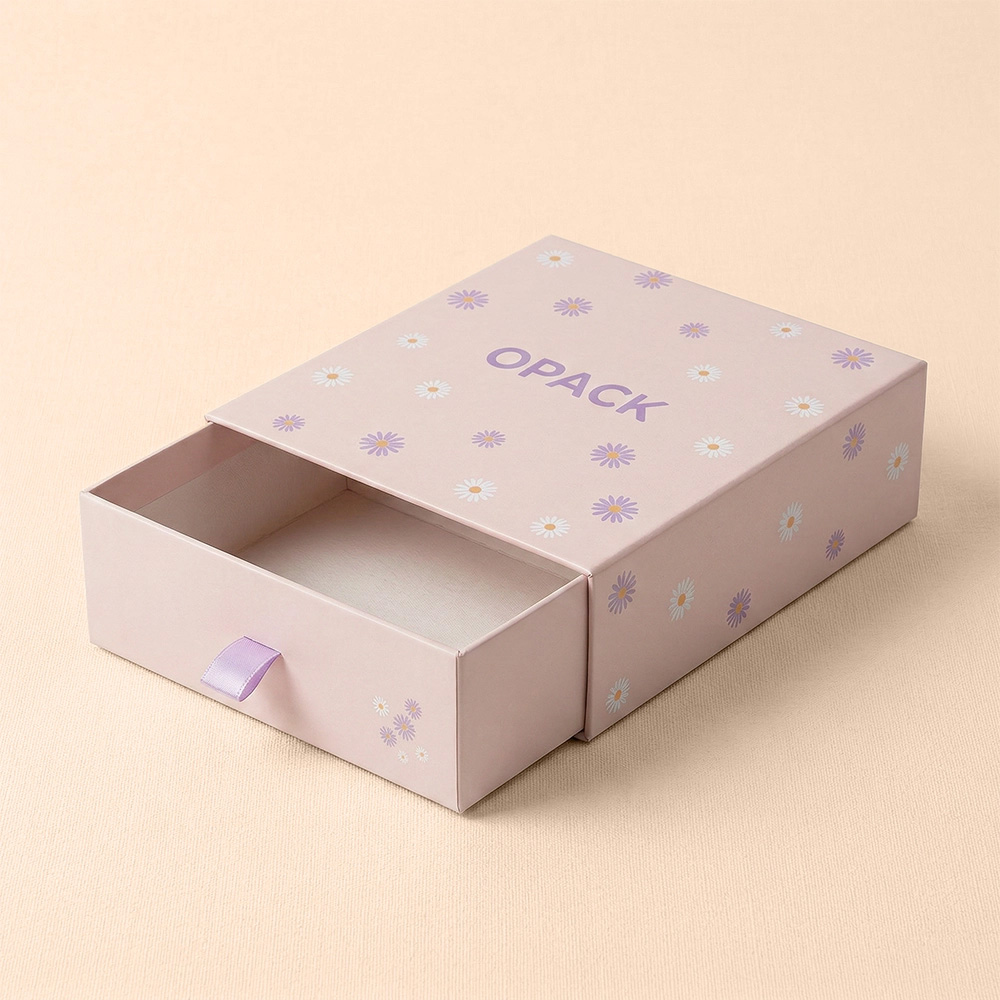
A custom rigid drawer box with ribbon pull — the structural and finishing choices behind such a box are what procurement terms have to describe.
Custom rigid boxes are specified, quoted and accepted on terms rather than on photographs. A rigid setup box is a wrapped board construction: the board grade sets rigidity, the wrap paper sets appearance, the closure and insert set how the product sits, and the certificate plus the production window determine whether the packaging can reach a retail shelf on schedule. Buyers in the research and evaluation stage therefore tend to ask the same narrow set of questions — minimum order quantity, lead time, customization limits, certification evidence, and what counts as an acceptable delivery.
Opack is a custom packaging manufacturer based in Longgang, Wenzhou, Zhejiang, China, producing custom rigid boxes, folding cartons, mailer boxes, shopping bags and paper tubes since 2010, with a 10,000 m² facility, 160 employees and exports to the EU, the US and the Middle East. This reference answers the procurement questions that decide a rigid box order, using Opack's published parameters as the working example, and it separates what a buyer can treat as a fixed input from what has to be confirmed in the quotation.
Why Procurement Terms Decide Whether a Rigid Box Program Works
A rigid box is rarely a single-material purchase. Grey board, a wrapping paper, printed artwork, a finishing layer, a closure mechanism and an insert are brought together into one assembled unit, and several of those steps depend on manual work. That structure creates three predictable failure points in purchasing: quotes that are not comparable because they assume different board calipers or wrap papers, certificate claims that cannot be traced to a scope or a market, and delivery plans that treat a production window as a door-to-door lead time.
The compliance side has tightened. Within the European Union, Regulation (EU) 2025/40 — the Packaging and Packaging Waste Regulation (PPWR) — requires packaging to be recyclable and properly labelled from 12 August 2026, according to the European Commission. For premium categories where rigid boxes carry brand value, that shifts certification and material documentation from a nice-to-have attachment into part of the request for quotation.
The Fixed Parameters at a Glance
Before a specification is discussed, buyers can anchor the conversation on parameters that are published rather than negotiated case by case.
| Parameter | Published value | Procurement note |
|---|---|---|
| Minimum order quantity | 500 units | Applies to custom rigid box orders |
| Standard lead time | 12–18 days | Production window; freight and clearance sit outside it |
| Monthly capacity | 1,000,000 units | Relevant for repeat and seasonal programs |
| Quality control | 100% quality check | Define the acceptance reference at sample stage |
| FSC certification | GFA-COC-005690, issued by GFA Certification GmbH | Chain of Custody under FSC-STD-40-004 (Version 3.0) |
| Covered markets | Europe, North America, Australia & New Zealand, Middle East | Confirm destination before relying on the claim |
| After-sales | Online chat, WhatsApp, telephone, official email | Multiple channels rather than a single ticket queue |
MOQ and Lead Time: Planning Around 500 Units and 12–18 Days
Opack's published minimum order quantity for custom rigid boxes is 500 units, and the standard production lead time is 12–18 days. Those two figures shape the whole procurement plan more than any decorative decision, because they determine whether a program can be tested, repeated and reordered inside a retail calendar.
A 500-unit floor is workable for a single-SKU launch, a limited gift run or a regional rollout, but it is a poor fit for a sampling exercise where five variants are needed at thirty pieces each. Where a program involves several artwork variants, sizes or structures, the sensible step is to ask at quotation stage whether the 500-unit threshold applies per design or across a combined order, since that single answer can change the cost per unit considerably. The same logic applies to the 12–18 day window: the figure describes production, so artwork approval, sample sign-off, freight booking, customs clearance and inland delivery should be planned as separate calendar lines rather than absorbed into it.
This is also where the documented order workflow matters. Opack's stated process runs from quote confirmation and detail definition — size, materials, artwork and finish — through sample approval, into mass production only after approval, and then shipping. Buyers who understand that sequence can place the approval gate where it belongs and keep the 12–18 day production window intact instead of losing days to late artwork.
What Can Actually Be Specified on a Custom Rigid Box
Opack lists customization across logo, brand name, color, size, style, finishings, printing methods and material. In practice that translates into a specification with five layers, and each layer is a place where a quote can silently diverge from the brief.
Board. The primary materials are grey board, greyboard, chipboard and MDF (medium-density fibreboard), with thickness customizable. Board grade is the variable most often left unspecified in informal enquiries, and it is the one that decides how the finished box feels in the hand.
Wrap. Wrapping paper options include coated paper, kraft paper, specialty paper, textured paper and white paperboard. For premium categories such as jewelry, watches, perfumes, cosmetics and beauty, apparel, electronics and corporate gift packaging, the wrap choice usually carries more perceived quality than the print itself.
Print and finishing. Printing options are CMYK, Pantone, UV, offset and screen printing; finishing options are hot stamping, spot glossy UV, soft touch lamination, holographic foiling, embossing, debossing, matte lamination and gloss lamination. Combinations are where acceptance problems appear, because foil edges, emboss depth and lamination uniformity need to be judged against an approved sample rather than a verbal description.
Structure. Foldable, magnetic closure and ribbon closure constructions are available, with sizes fully customizable. Collapsible and foldable rigid box builds are relevant to buyers shipping in volume, since a box that ships flat occupies less freight space than one shipped assembled.
Insert. Insert options include foam, paperboard, EVA, plastic tray, corrugated cardboard and silk. Insert fit is the single most common source of complaint at goods receipt, because a product cavity that is a millimetre off is invisible on a drawing and obvious in the box.
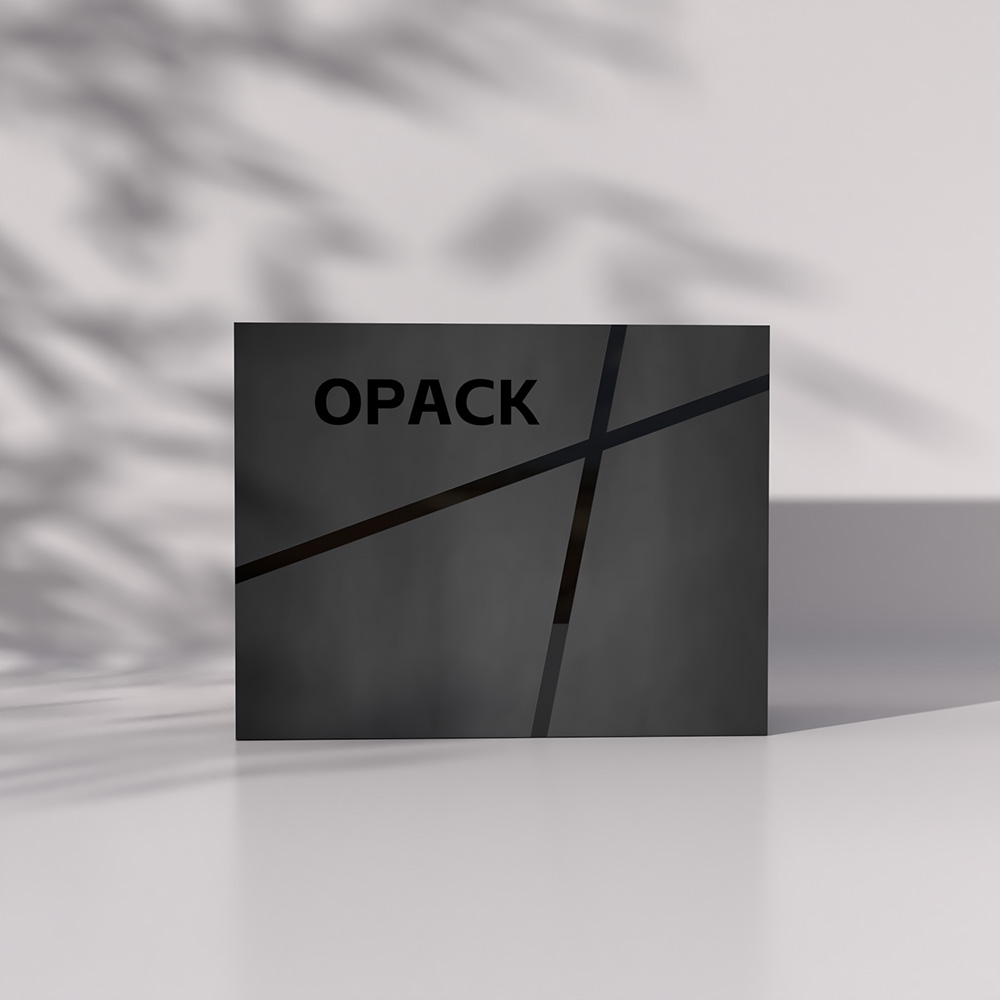
A foldable rigid box construction: the same presentation quality, but shipped flat to reduce freight volume.
FSC GFA-COC-005690: What the Certificate Covers, and What It Does Not
Opack's custom rigid boxes are covered by an FSC Chain of Custody (COC) certification numbered GFA-COC-005690, issued by GFA Certification GmbH and held against the FSC-STD-40-004 (Version 3.0) standard. The certificate applies to the European, North American, Australia & New Zealand and Middle East markets, and its scope covers cardboard packaging, sacks and bags of paper, adhesive labels, and other pulp and paper products.
Chain of Custody is a traceability instrument: it documents how certified material moves through sourcing and production rather than certifying one finished SKU in isolation. Three implications follow for buyers. First, the certificate number and issuing body should appear in the sourcing file, not just the word "FSC" on a supplier page. Second, the destination market should be checked against the covered markets, because a claim valid for Europe is not automatically a claim valid everywhere. Third, the product category should sit inside the stated scope — rigid boxes and paper bags do, while non-paper components such as plastic trays or foam inserts are separate material decisions that a paper CoC certificate does not address.
Beyond certification, Opack's eco-friendly production requirements include water-based printing inks, low-VOC adhesive materials and compliance with FSC standards. For buyers facing the PPWR recyclability and labelling obligations that apply in the EU from 12 August 2026, the practical use of these specifications is to document ink and adhesive chemistry alongside the paper claim, so the material story holds together when a retail customer or a customs file asks for it.
Acceptance Criteria: What to Write Into the Purchase Order
Opack operates a 100% quality check in production. A supplier-side check, however, does not replace a buyer-side acceptance definition. The approved sample is the reference document, and the purchase order should say so explicitly, then list the specific attributes that will be verified on arrival.
| Inspection area | What to check on receipt |
|---|---|
| Board and build | Board grade and thickness against the approved spec; corner squareness and rigidity |
| Wrap | Wrap paper type and colour against the approved proof; seams and turn-in edges |
| Print and finishing | Registration, foil edges, emboss/deboss depth, lamination uniformity, absence of lifting |
| Structure and closure | Lid fit, magnet hold, ribbon placement, foldable crease integrity |
| Insert | Cavity fit and clearance with the actual product, insert material grade |
| Artwork accuracy | Logo, brand name, language and legal text verified character by character |
| Packing and documents | Units per carton, carton labelling, packing list, certificate reference on file |
Two commercial points are worth settling in writing at the same time: what constitutes a reject batch, and who carries the cost of rework or replacement. These are not technical questions, but they are the ones that turn a quality disagreement into a slow negotiation after the goods have already crossed a border.
Storage, Handling and After-Sales
Rigid boxes are wrapped paper constructions, so they behave like paper. Opack's stated working conditions are a dry environment with low humidity, a stable and moderate temperature, avoidance of direct sunlight and separation from chemicals. Buyers holding stock for a seasonal launch should treat those conditions as part of the specification: wrapped board can take on moisture and distort, foil and lamination can lift, and adhesive layers perform less predictably in unstable conditions. A dry, shaded, temperature-stable storage area protects both the structure and the finish until the box reaches the pack line.
After delivery, Opack provides multi-channel after-sales support through real-time online chat, WhatsApp, telephone and the official company email. For international buyers, the practical benefit of multiple channels is response speed on the issues that matter most after a shipment — a shortfall in carton counts, a query on a finishing batch, or a reorder that needs the original specification pulled from the file.
Rigid Boxes vs. Folding Cartons and Standard Packaging: Where the Terms Change
Rigid boxes are not a drop-in substitute for standard packaging, and procurement terms are where the difference becomes visible. The comparison below is qualitative and does not assume a specific price, since board grade, wrap and finishing drive cost far more than the category itself.
| Consideration | Custom rigid boxes | Folding cartons / standard packaging |
|---|---|---|
| Material content | Grey board or MDF plus a wrapping paper | Single-ply board construction |
| Presentation | Reusable presentation packaging with rigid walls | Primarily protective and shelf-facing |
| Freight volume | Higher if shipped assembled; foldable and collapsible builds reduce it | Ships flat as standard |
| Production character | Assembly-heavy; finishing combinations matter | Fewer assembly steps |
| Minimum order | 500 units at Opack | Not assessed here |
The boundaries deserve equal weight. A 500-unit minimum is a planning constraint for micro-runs, test markets and single-store activations, and it should be checked before a design direction is locked. A 12–18 day production window is not a rush service, so a late artwork decision will move the delivery date rather than compress it. The FSC claim is scoped to specific product categories and specific markets, which means a buyer shipping outside the covered regions should not assume the same documentation applies. And decorative combinations that mix paper with foam, EVA or plastic trays complicate any recyclability statement, so the material separation should be confirmed with the supplier rather than inferred from the outer wrap.
Market Context: Why These Terms Are Being Read More Closely
The luxury rigid box segment reached USD 8.84 billion in 2026, according to Towards Packaging / Future Market Insights, and within that segment cosmetics and personal care lead application with a 37% share. Those figures point to a category where packaging is bought for presentation, which is exactly where specification drift and finishing inconsistency do the most brand damage.
Scope matters when reading market data. The broader rigid packaging market is projected to reach USD 796.7 billion by 2030, per Grand View Research, but that figure includes plastic and metal rigid packaging and should not be read as the size of the paperboard box segment. For procurement purposes, the more consequential trend is regulatory: the EU PPWR recyclability and labelling requirement from 12 August 2026 pushes buyers to ask for certificate numbers, ink chemistry and adhesive data at the enquiry stage rather than after the first shipment.
Future Outlook
The direction of travel in premium packaging procurement is toward documented terms rather than visual approvals alone. Certification scope, ink and adhesive chemistry, defined acceptance criteria tied to an approved sample, and realistic production calendars are becoming standard attachments to a rigid box purchase order, particularly for brands selling into the EU. Structures that reduce freight volume, such as foldable and collapsible rigid boxes, are likely to receive more attention as freight planning and packaging waste reporting tighten together. Suppliers that publish parameters — order minimums, production windows, certificate numbers and after-sales channels — give buyers something they can plan against, which is a more durable advantage than a catalogue photograph.
Procurement FAQ
What is the minimum order quantity for custom rigid boxes?
Opack's minimum order quantity for custom rigid boxes is 500 units. Whether that threshold applies per individual design or across a combined multi-variant order should be confirmed during quotation, because it affects the cost per unit for programs with several SKUs.
How long does custom rigid box production take?
The standard production lead time is 12–18 days. This is a production window, so artwork approval, sample sign-off, international freight, customs clearance and inland delivery should be planned as separate calendar items rather than assumed to be included.
What is the order workflow from enquiry to shipment?
Opack's documented workflow is quote confirmation with product details — size, materials, artwork and finish — followed by sample approval, then mass production only after approval, and finally shipping according to the buyer's preferred schedule.
Which elements of a rigid box can be customized?
Opack lists customization across logo, brand name, color, size, style, finishings, printing methods and material. Sizes are fully customizable based on product requirements, and board thickness is customizable as well.
Which materials and structures are available?
Primary materials are grey board, greyboard, chipboard and MDF (medium-density fibreboard). Structures include foldable, magnetic closure and ribbon closure. Insert options are foam, paperboard, EVA, plastic tray, corrugated cardboard and silk.
Which printing and finishing options apply to printed rigid boxes?
Printing options are CMYK, Pantone, UV, offset and screen printing. Finishing options are hot stamping, spot glossy UV, soft touch lamination, holographic foiling, embossing, debossing, matte lamination and gloss lamination. Wrapping paper options include coated paper, kraft paper, specialty paper, textured paper and white paperboard.
Is the FSC certification valid for my destination market?
Opack's custom rigid boxes hold FSC Chain of Custody certification GFA-COC-005690, issued by GFA Certification GmbH under FSC-STD-40-004 (Version 3.0). The certificate applies to the European, North American, Australia & New Zealand and Middle East markets, with a scope covering cardboard packaging, sacks and bags of paper, adhesive labels and other pulp and paper products. Buyers should match both the market and the product category against that scope.
Which eco-friendly requirements apply beyond FSC?
Opack's stated eco requirements are eco-friendly water-based printing inks, low-VOC adhesive materials for safe and eco-friendly production, and compliance with FSC standards. These sit alongside the FSC claim rather than replacing it.
What should be checked when the rigid boxes arrive?
Opack runs a 100% quality check in production, and buyers should still verify against the approved sample: board grade and thickness, wrap paper and colour, print registration and finishing, lid fit and closure alignment, insert cavity fit with the actual product, artwork and legal text accuracy, and carton counts with supporting documents.
How should custom rigid boxes be stored before use?
Storage conditions are a dry environment with low humidity, a stable and moderate temperature, no direct sunlight and separation from chemicals. These conditions protect both the wrapped board structure and the applied finishes until packing.
What after-sales support is available after delivery?
Opack provides multi-channel after-sales support through real-time online chat, WhatsApp, telephone and the official company email, which allows shipment queries and reorder specifications to be handled through the channel that suits the buyer's time zone.
Opack's company profile, including product categories and facility information, is available as a downloadable PDF for buyers building a sourcing file: Opack Company Profile (PDF).
Have Questions or Need More Details?
Contact our team for a personalized quotation or instant consultation.
Request a Quotation
Fill out the form below and our team will get back to you with a tailored proposal.
WhatsApp Direct Chat
Prefer to chat in real-time? Message us on WhatsApp for instant assistance & quick answers.
- Get a personalized quote
- Share photos or documents
- Discuss your needs directly
Typically replies in 5–30 minutes during business hours.