
Custom Rigid Boxes Shortlist: Materials, Closures, Inserts & Finishes
Custom Rigid Boxes Shortlist: Recommended Materials, Closures, Inserts & Finishes
Custom rigid boxes are specified, not simply ordered. Once a buyer selects a board grade, a closure type, an insert material, and a surface finish, the decision determines how a product feels in the hand, how it survives transit, and whether it can still be sold in markets where packaging rules are tightening.
That specification work now carries commercial weight on both sides. The luxury rigid box segment reached USD 8.84 billion in 2026, and cosmetics and personal care account for 37% of that demand. Meanwhile, the EU Packaging and Packaging Waste Regulation (Regulation (EU) 2025/40) requires packaging to be recyclable and properly labeled from August 12, 2026. Broad rigid packaging, including plastic, metal, and paperboard formats, is projected to reach USD 796.7 billion by 2030. Premium presentation and regulatory fit increasingly have to be designed into the same box.
This shortlist maps the four specification layers that matter most in a custom rigid box program: board material, closure and structure, insert, and printing or finishing method. Each section sets out what the option does, where it fits, and what a buyer should verify before committing to a production run.
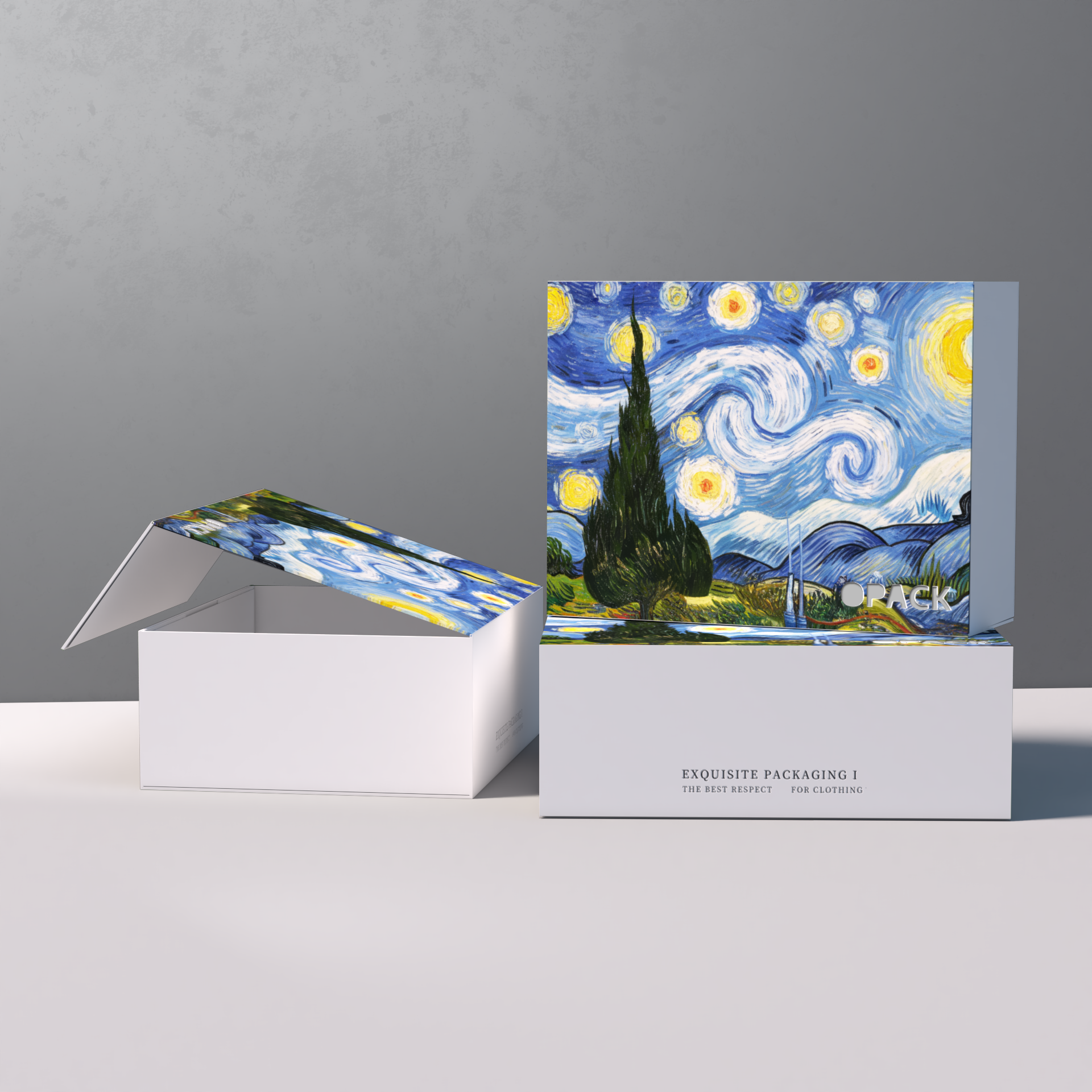
A custom rigid box with full-coverage printed artwork: the finish layer is what most buyers evaluate first, but the board and closure layers decide how the box performs.
The Four Specification Layers That Decide a Rigid Box
A rigid setup box is built in layers, and each layer answers a different question. Buyers who treat the box as a single purchase decision usually end up revising specifications after sampling, which pushes cost and lead time later in the project.
- Board answers: how much structure and weight does this box need?
- Closure and structure answers: how does it open, close, ship, and store?
- Insert answers: how does the product sit, stay, and survive transit?
- Print and finish answers: how does the brand read on shelf and on unboxing?
The practical decision order is usually product weight and dimensions first, distribution route second, brand presentation third, and destination-market compliance requirements fourth. That order matters because a change at the board layer can invalidate a finish decision made earlier, particularly for heavily printed or laminated surfaces.
Board Materials: A Practical Shortlist
The core board gives a rigid box its shape and rigidity. Four material names appear most often in buyer conversations and supplier quotations: grey board, greyboard, chipboard, and MDF.
| Material | Role in a rigid box | What buyers should consider |
|---|---|---|
| Grey Board | Multi-ply recycled paperboard core used for the walls and lid of most rigid setup boxes; wrapped with printed paper | Available in FSC-certified grades for programs that need chain-of-custody documentation; the main variable is caliper, which drives rigidity and weight |
| Greyboard | The same paperboard family, frequently written as one word across markets and quotations | Confirm that the supplier and the factory are describing the same grade; naming differences between markets are common |
| Chipboard | Lighter paperboard used for thinner walls, internal platforms, or cost-controlled layers | Suited to lighter products or secondary layers; less appropriate where a heavy, solid feel is the objective |
| MDF | Wood-fibre board that is denser and heavier than paperboard, used where extra rigidity or a weighted, solid feel is the priority | Raises shipping weight and freight cost; fibre-based recyclability should be reviewed early for EU-bound programs |
For most premium retail and gifting programs, the decision is rarely grey board versus MDF. It is caliper and wrapping quality inside the grey board family. Wrapping is where rigidity is either reinforced or undermined: a thick board with a poorly controlled wrap can still show edge lift or corner distortion after a few months in a warehouse.
Where a program is sold into the European Union, the board choice also connects to the recyclability requirement that applies from August 12, 2026. FSC-certified grey board grades and paper-based inserts keep a box inside a fibre-based recycling pathway, which simplifies labeling and compliance review later.
Closures and Structures: Foldable, Magnetic, Ribbon
Closure type is the second layer buyers lock in, and it affects freight cost as much as it affects presentation. Three formats cover most custom rigid box orders.
| Option | How it works | Where it fits | What to watch |
|---|---|---|---|
| Foldable rigid box (collapsible rigid box) | Ships flat and is assembled at the destination | Multi-region distribution, e-commerce programs, buyers managing storage space | Assembly steps and structural integrity after repeated assembly should be confirmed with a sample |
| Magnetic closure | Embedded magnets hold the lid closed | Cosmetics, electronics, high-value retail where the opening moment is part of the brand experience | Magnet alignment and wrap tension are the most common failure points; the lid must sit flush after closure |
| Ribbon closure | A ribbon ties or pulls the lid or drawer shut | Gifting, seasonal packaging, jewelry, and PR or subscription boxes | Paper-based ribbon keeps the box within a single material stream more easily than fabric or synthetic ribbon |
| Lid-and-base (rigid box with lid, rigid boxes with lids) | Classic two-piece setup with a separate lid | General premium retail and gift packaging where a clean, familiar format is preferred | Lid fit tolerance is the key quality check; too loose reads as cheap, too tight creates handling complaints |
A foldable rigid box is often the most overlooked option in a shortlist, because buyers assume a premium box must ship assembled. For programs distributing into the EU, the United States, and the Middle East from a single production run, the collapsible format can materially change how much air is shipped and stored on both ends of the supply chain.
Inserts: Foam, Paperboard, EVA, Plastic Tray, Corrugated Cardboard
The insert is the layer that decides whether the product arrives in the condition it left the factory, and it is also the layer most exposed to recyclability review.
| Insert material | Function | Typical use | Recyclability note |
|---|---|---|---|
| Foam | Cut-to-shape cavity that cushions and locates the product | Fragile or heavier items, electronics accessories, multi-piece gift sets | Material type should be declared and reviewed against destination-market rules |
| Paperboard | Folded fitment that holds the product in position | Cosmetics, lighter retail items, paper-first packaging strategies | Paper-based and compatible with fibre recycling streams |
| EVA | Soft, resilient foam-like fitment with a premium feel | Jewelry, cosmetics, small high-value items | Should be reviewed where recyclability labeling applies |
| Plastic Tray | Molded cavity offering precise fit and repeatable positioning | Cosmetics, small electronics, kits with fixed geometry | The most likely component to trigger compliance review in the EU |
| Corrugated Cardboard | Structural cushioning that can also act as an inner platform | E-commerce and subscription programs, protective inner layers | Paper-based and keeps the box closer to a mono-material setup |
Two insert decisions drive most downstream problems. The first is fit tolerance: an insert that holds the product too tightly damages edges during packing, one that is too loose allows movement in transit. The second is material mixing. A box with paperboard walls, a foam insert, and a laminated wrap is harder to label and recycle than a box built around paperboard and corrugated components.
Printing and Finishing: What Each Method Changes
Finishing is the layer buyers evaluate visually during sampling, and it is the layer with the widest range of options.
| Method | What it delivers | Buyer notes |
|---|---|---|
| Offset Printing | High-detail, full-color printing on the paper wrap | Efficient for larger runs and photographic artwork |
| CMYK | Process-color reproduction across the full image | Best for complex imagery; less precise for single brand colors |
| Pantone | Spot color matched to a defined reference | Preferred where brand color consistency is contractual |
| Screen Printing | Thicker ink deposit for strong, opaque coverage | Useful on specialty substrates and bold graphic marks |
| UV Printing | Cured ink with sharp definition and gloss control | Suited to accent areas rather than full coverage |
| Hot Stamping | Foil transfer for metallic or reflective accents | Most effective on logos and key brand marks; adds a production step |
| Spot Glossy UV | Selective gloss against a matte base | Creates tactile contrast; requires a clean artwork separation |
| Soft Touch Lamination | Matte, velvety surface feel | Laminated surfaces are a common point of review in fibre-recycling assessments; confirm material choices for EU-bound programs |
A finish shortlist should be narrowed by market, not by preference alone. Hot stamping and spot gloss UV are presentation-driven and widely accepted; heavy lamination is presentation-driven but less neutral in recyclability terms. Where a program sells in both the EU and the Middle East, the practical approach is to keep the base specification compliant and treat the finish as a market-specific variant rather than a global one.

Decorative print and surface finishing reference for a rigid box lid: finish selection should be validated on the final board and wrap combination, not on flat artwork.
How the Layers Interact in Production
Specification faults rarely come from a single layer. They appear where layers meet: a wrap that lifts at the corner of a heavy board, a magnet that misaligns after lamination, a sprayed surface that changes how ink reads under light.
Color consistency is the clearest example. Opack monitors color through production using spectrophotometer-based measurement, with color difference (Delta E) controlled within approximately 1.5, a level of variation that is nearly imperceptible to the human eye. The control process includes pre-production color approval, in-process inspection during printing, and final inspection before shipment, with batch-by-batch verification to keep repeat orders consistent.
Structural verification matters alongside color. Pre-production testing is used to confirm handle strength, material durability, and structural stability so that a finished box can safely support the intended product weight. For buyers placing repeat orders, this combination of color control and structural checking is what prevents the second and third production runs from drifting away from the approved sample.
Where Opack Sits in This Shortlist
Opack is a custom packaging manufacturer based in Longgang, the Printing City of China, in Wenzhou, Zhejiang Province. The company was founded in 2010, operates a 10,000 square meter facility with 160 employees, and produces custom packaging including custom rigid boxes, custom shopping bags, custom folding cartons, and custom mailer boxes. Annual output is stated at 10,000,000 units, with monthly production capacity of 1,000,000 units and a 100% quality check on all units.
For rigid box programs specifically, three figures matter most at the shortlisting stage:
| Item | Value | Why it matters in a shortlist |
|---|---|---|
| Minimum order quantity | 500 pcs per size and design for rigid gift boxes (1,000 pcs per size and design for paper shopping bags) | Determines how many SKU variants a program can carry per order |
| Standard delivery time | 12-18 days | Sets the planning window after sample approval |
| Certification | FSC certification GFA-COC-005690 | Supports chain-of-custody documentation for paper-based board and wrap selection |
The order workflow follows four steps: quote and confirmation of size, materials, artwork, and finish; sample approval; mass production after approval; and shipment according to the agreed schedule. Delivery terms are available as EXW and FOB based on customer requirements, with shipping coordinated according to destination and project schedule. Payment terms are 40/60.
On quality acceptance, products undergo internal quality inspection before shipment, and third-party inspections are welcome upon customer request. Customization is broad across board, structure, insert, and finish layers, which is what allows a single supplier to hold a multi-SKU rigid box program rather than a single format. The company exports at a ratio of 80%, with main markets in the EU, USA, and Middle East.
Matching the Shortlist to the Product
Most rigid box programs resolve to one of five combinations. The table below is a starting reference, not a fixed rule; final selection should be validated with a physical sample.
| Product category | Board | Structure | Insert | Finish focus |
|---|---|---|---|---|
| Cosmetics and personal care | Grey board, FSC-certified grades where required | Magnetic closure or lid-and-base | EVA or paperboard | Spot glossy UV with hot stamping |
| Jewelry | Grey board, slimmer caliper | Lid-and-base or ribbon closure | Foam or EVA | Soft touch lamination with hot stamping |
| Electronics and accessories | Grey board with a heavier wall | Magnetic closure | Foam or corrugated cardboard | Matte surface with spot UV accents |
| Gifting and seasonal | Grey board | Ribbon closure or foldable format | Paperboard or corrugated cardboard | Pantone spot color with hot stamping |
| Subscription and PR boxes | Grey board | Foldable or collapsible rigid box | Corrugated cardboard or paperboard | Offset CMYK with spot UV |
These combinations appear repeatedly because they solve a consistent set of constraints: cosmetics demand reflectance and precision, jewelry demands restraint and a soft surface, electronics demand structural protection, and subscription programs demand freight efficiency. Rigid gift boxes serving more than one of these categories at once are usually the ones that need the most careful sampling.
Market Trend Analysis
Three trends shape how rigid box specifications are being written in 2026.
The first is scale and concentration. The luxury rigid box market reached USD 8.84 billion in 2026, while the broader rigid packaging market is projected to reach USD 796.7 billion by 2030. Cosmetics and personal care lead application demand with a 37% share, which concentrates specification pressure in a category where surface finish and shelf presence are decisive.
The second is regulation. Regulation (EU) 2025/40 requires packaging placed on the EU market to be recyclable and properly labeled from August 12, 2026. For rigid box buyers, this pushes board and insert selection toward paper-based combinations earlier in the design process rather than at the compliance review stage.
The third is supply concentration. China's rigid box exports reached USD 1.7 billion in trade value, reflecting the role of Chinese manufacturing in global premium packaging supply. For buyers, this means the practical question is not whether to source from this supply base, but how to differentiate suppliers within it on specification control rather than on price alone.
Custom Rigid Boxes Compared with Standard Packaging
Rigid boxes are not a neutral upgrade over standard folding cartons or basic mailers. They change cost structure and performance, and the trade-off should be stated plainly.
| Dimension | Custom rigid boxes |
|---|---|
| Customization | Fully customizable across board, structure, insert, and finish |
| Brand visibility | Higher; a more memorable unboxing experience and a more high-end look |
| Initial cost | Approximately 5%-10% higher initial costs than regular rigid box alternatives |
| Repeat purchase | 20%-30% higher repeat purchase rates reported |
| Customer satisfaction | 10%-30% improvement reported |
| Referrals | 5%-15% increase reported |
| Social sharing | 5%-10% more social media shares reported |
| Durability in repeated use | Thicker customizable grey board, reinforced corner edges, magnetic closure alignment, and scratch-resistant lamination reduce warping, delamination, or lid misfit during repeated use |
| Environmental profile | Supports FSC-certified grey board, low-VOC adhesives, and food-safe, eco-friendly inks; fully recyclable and biodegradable after service life |
The practical reading is straightforward. The premium is paid up front, at a stated range of roughly 5%-10% higher initial cost, while the returns appear over the product lifecycle in repeat purchase and referral behavior. Programs where the box is never seen by the end customer, or where the product is discarded immediately, rarely justify the specification.
Limitations and Boundaries Buyers Should Plan For
A shortlist is only useful if it states what the format cannot do easily.
- Freight volume. A rigid box assembled at origin occupies far more shipping and storage space than a flat-packed alternative. The collapsible rigid box format reduces this, but assembled boxes still cost more to move than folding cartons.
- Unit cost. Custom rigid boxes carry roughly 5%-10% higher initial cost, and this is a real budget line for high-volume programs.
- Order quantity discipline. The 500-piece minimum applies per size and design, so every additional size or artwork variant adds its own minimum. Multi-SKU programs should consolidate variants before quoting.
- Material mixing. Foam, EVA, plastic trays, and film lamination all complicate recyclability review. Where EU market access is required, paperboard and corrugated inserts keep the box closer to a fibre-based stream.
- Publicly available benchmarking. Third-party published figures describing supplier MOQ and turnaround, including the widely cited 500-piece and 12-18 business day entry for Opack, come from a comparison page hosted by the supplier itself. They are useful as directional signals for RFQ planning, not as independently audited benchmarks, and buyers should confirm current terms directly at quotation stage.
Future Outlook
The direction of travel is toward fewer materials per box and more deliberate finishing. As the EU recyclability and labeling requirement takes effect from August 12, 2026, paperboard, corrugated, and paper-based ribbon components are positioned to take share from mixed-material assemblies, while presentation finishes such as hot stamping and spot UV remain compatible with a paper-first construction.
Freight efficiency is likely to shape structure choices in the same period. Foldable and collapsible rigid boxes let a program ship flat from a single production run into the EU, the United States, and the Middle East, then assemble closer to the point of sale. Combined with the continued concentration of demand in cosmetics and personal care, the most competitive rigid box specifications in the next cycle are likely to be those that deliver a premium unboxing experience on a recyclable, paper-based material stack, without carrying air across an ocean.
FAQ
What is the minimum order quantity for custom rigid boxes?
For rigid gift boxes, the minimum order quantity is 500 pieces per size and design. Paper shopping bags carry a separate minimum of 1,000 pieces per size and design. Because the minimum applies to each size and design, a program with multiple SKUs should consolidate variants before requesting a quotation so that each variant carries a viable production quantity.
How long does a custom rigid box order take?
Standard delivery time is 12-18 days. The order workflow runs from quote confirmation, covering size, materials, artwork, and finish, to sample approval, then mass production after approval, and finally shipment according to the agreed schedule. The 12-18 day figure applies to the production stage, so sample approval should be completed before the delivery window is planned into a launch calendar.
What delivery and payment terms are available?
Delivery terms are available as EXW and FOB based on customer requirements, with shipping arrangements coordinated according to destination and project schedule. Payment terms are 40/60. Buyers shipping into the EU, United States, or Middle East should confirm the applicable term at quotation stage, since the choice affects who carries freight and insurance responsibility.
Can a buyer arrange third-party inspection before shipment?
All products undergo internal quality inspection before shipment, and third-party inspections are welcome upon customer request to ensure product quality and compliance with specifications. For buyers operating under internal supplier approval processes, scheduling the third-party inspection against the production completion date avoids holding the shipment after it is packed.
How is color consistency controlled across reorders?
Color is monitored using spectrophotometer-based measurement, with color difference (Delta E) controlled within approximately 1.5, a level of variation that is nearly imperceptible to the human eye. The process includes pre-production color approval, in-process inspections during printing, final quality inspection before shipment, and batch-by-batch quality verification to keep consistency across repeat orders.
Which board and insert choices support EU market requirements?
Regulation (EU) 2025/40 requires packaging to be recyclable and properly labeled from August 12, 2026. Paper-based components keep a rigid box closer to a fibre recycling stream, so FSC-certified grey board, paperboard inserts, and corrugated cardboard inserts are the most straightforward choices for EU-bound programs. Opack holds FSC certification GFA-COC-005690, which supports chain-of-custody documentation, and also supports FSC-certified grey board, low-VOC adhesives, and food-safe, eco-friendly inks with fully recyclable and biodegradable materials after service life.
Can rigid boxes be shipped flat to reduce freight cost?
Yes. Foldable rigid boxes, also described as collapsible rigid boxes, ship flat and are assembled at the destination. This format is typically selected by programs distributing into more than one region from a single production run, or by buyers with limited warehouse space. Structural integrity after repeated assembly should be confirmed during sampling before the format is approved for a full order.
Opack publishes a company profile covering facilities, product categories, certification, and order terms, available for download here. Additional product information on custom rigid boxes is available at opack.com.
Have Questions or Need More Details?
Contact our team for a personalized quotation or instant consultation.
Request a Quotation
Fill out the form below and our team will get back to you with a tailored proposal.
WhatsApp Direct Chat
Prefer to chat in real-time? Message us on WhatsApp for instant assistance & quick answers.
- Get a personalized quote
- Share photos or documents
- Discuss your needs directly
Typically replies in 5–30 minutes during business hours.