
Custom Sculpture Compliance: What to Verify Before Ordering
Custom Sculpture Compliance: What to Verify Before Ordering
Compliance in custom sculpture is not a certificate that arrives with the crate. It is a chain of decisions — which steel grade, which granite block, which bronze alloy, which polish, which inspection gate — that has to be written down before production starts and evidenced before shipment. Buyers sourcing custom sculpture from China increasingly ask suppliers for a “compliance file”. What matters is knowing which document answers which question, and which questions no certificate can answer.
Compliance Has Become a Commercial Decision, Not an Administrative One
The global art and sculpture market is estimated at approximately USD 61.83 billion in 2026, according to Business Research Insights (August 2026), and sculptures account for about 21% of global art acquisitions by transaction volume, based on 2024 figures published by Market Research Report. At project level the numbers are far smaller but tighter. CODAworx reported in its 2024–2026 public art analysis that over 80% of public art open call projects in North America fall below a USD 250,000 budget.
That budget structure is what makes qualification evidence commercially relevant. When a fabricated piece fails on material, finish or fit, the loss is not limited to the sculpture itself. It includes sea freight, site access, crane time, and the schedule of an opening or dedication that cannot move. A buyer who cannot trace a material claim to a document carries that exposure without being able to price it.
The practical objective is therefore not to collect the thickest certificate pack. It is to align three things: the material actually specified in the order, the evidence that demonstrates the delivered piece matches that specification, and the acceptance criteria that determine whether the piece is accepted on arrival. In custom sculpture, those three elements differ by material family, which is why a single generic checklist tends to be either too vague to enforce or too rigid to fit the project.
The Four-Material Verification Map
Before a purchase order is issued, the useful exercise is to write one line per material: what evidence is being requested, and what that evidence does not establish. The four families below cover the majority of custom sculpture specifications, and each carries a different proof structure.
| Material family | Evidence to request before ordering | What that evidence does not establish |
|---|---|---|
| Corten / weathering steel Model XYS-Corten-Custom | A written statement that the steel conforms to ASTM A242/A588 weathering steel, plus the specified delivery condition: natural pre-rusted stable patina or raw self-weathering finish. | Structural design of the sculpture, weld procedure qualification, or uniformity of patina across the surface. |
| Natural granite monument Model XYS-Monument-Custom | The named granite (Shanxi Black, G603 or Blue Pearl), the finish specification (mirror polish, sandblasting, laser engraving, gold-leaf lettering), and the finished-product inspection and material traceability record. | Compliance with local cemetery, memorial or municipal regulations in the destination market. |
| 304 / 316 stainless steel Model XYS-Stainless-Custom | The grade declaration for the delivered batch, the polish level (8K mirror, brushed, painted or electroplated), and the specification of the internal anti-rust steel framework for large-scale work. | Site-specific structural sign-off, wind or uplift engineering, or foundation design. |
| Cast bronze Model XYS-Bronze-Custom | The copper content range (85–95%), the casting method (lost-wax), and an approved patina sample for multi-colour oxidation finishes. | A project-specific durability warranty; the material claim and the warranty term are separate commitments. |
| EU market, all families | The CE (RoHS) certificate number, issuing body, product scope and validity date that match the product type being ordered. | Corrosion performance, structural safety, or fitness for a particular installation site. |
Two of the entries above are frequently confused during procurement. CE (RoHS) certification and ASTM A242/A588 conformity are often described in the same sentence as if they were interchangeable proof of quality. They are not. One addresses restricted substances in the finished article; the other addresses the grade of steel supplied. Neither one substitutes for an inspection record on the piece the buyer actually receives.
Stone Monuments: Traceability from Block to Finished Product
For stone work, qualification is about the block before it is about the carving. Jiangsu Xinyesheng Sculpture Co., Ltd (xys-artsculpture.com) is a sculpture manufacturer working with a production site in Jiangyin, China, whose stated output is 100% export across stone, weathering steel, stainless steel and bronze. Its stone range illustrates how the evidence chain is structured in practice: the monument model XYS-Monument-Custom is specified in natural granite — Shanxi Black, G603 or Blue Pearl — with standard sizes of 80×60 cm and 120×80 cm or customised dimensions, finished by 100% mirror polishing, laser engraving and sandblasting.
The supplier states that this monument undergoes strict finished product inspection and material traceability to ensure zero-defect quality, and that the granite's density supports non-fading durability across generations, with acid and alkali resistance, anti-weathering properties and colour stability suiting outdoor installation. Read as qualification evidence rather than marketing language, those statements describe two separate things: a material property (granite density, chemical resistance, colour stability) and a process discipline (inspection plus traceability). Buyers should ask for both to be evidenced separately.
What to verify on a stone order
- Named stone, not “black granite”. Ask the supplier to state which of the offered granites is quoted and to record it in the purchase order. The three named options are different materials, and the finish schedule should reference the one actually specified.
- Block or slab identification before carving. Once a block is cut for a memorial, a colour or veining objection becomes a remake rather than a selection change. Request photographs or identification of the block allocated to the order before carving begins.
- Engraving proof. Laser etching for portraits and gold-leaf lettering should be approved as a layout proof before the surface is worked.
- Inspection record at final stage. Because the colour-stability claim applies to the granite itself, legibility of engraving and finish quality of polished faces should be written into the final inspection so they are checked rather than assumed.
The marble and general stone range, model XYS-Stone-Custom, follows the same logic with different vocabulary: natural white marble, granite or travertine, customised dimensions, and a finish schedule of hand-carved, honed, high-gloss polished or acid-washed surfaces. Note that “high-density” and “weatherproof” are material descriptions; they do not remove the need for a written finish specification, because two pieces of the same stone finished differently will behave differently on site.
Corten Steel: Reading ASTM A242/A588 Conformity Correctly
Weathering steel is the material family where specification language most often outruns the evidence behind it. The supplier's Corten range is described as made of authentic Corten steel conforming to ASTM A242/A588 weathering steel, which develops a protective rust layer that prevents further corrosion and is described as maintenance-free. The same specification offers two distinct delivery conditions: a natural pre-rusted finish with a stable patina, or a raw finish that continues to weather on site.
Conformity to ASTM A242/A588 is normally documented at the steel level — through a mill or test declaration identifying the grade of the plate supplied — rather than through a certificate issued for the finished sculpture. That distinction matters at the order stage for three reasons.
First, the standard describes the steel, not the object. A sculpture can be fabricated from conforming steel and still fail a project on weld quality, structural detailing or surface treatment. Second, patina is a finish decision, not a grade decision. Because both a pre-rusted stable patina and a raw self-weathering surface are offered, the purchase order should state which condition is being delivered and how it will be documented at handover. Third, “maintenance-free” is a description of the material's self-protecting oxide layer; it is not a statement that the installed piece requires no inspection during installation or after handover.
What to verify on a weathering steel order
- A written conformity statement naming ASTM A242/A588, tied to the plates used for the project.
- The delivery finish condition, stated in the order and referenced in the final inspection.
- The structural arrangement separately — internal framework, base connection and anchoring — since the grade declaration says nothing about how the piece carries load.
- Written confirmation of which surfaces will be left to weather and which, if any, are specified otherwise.
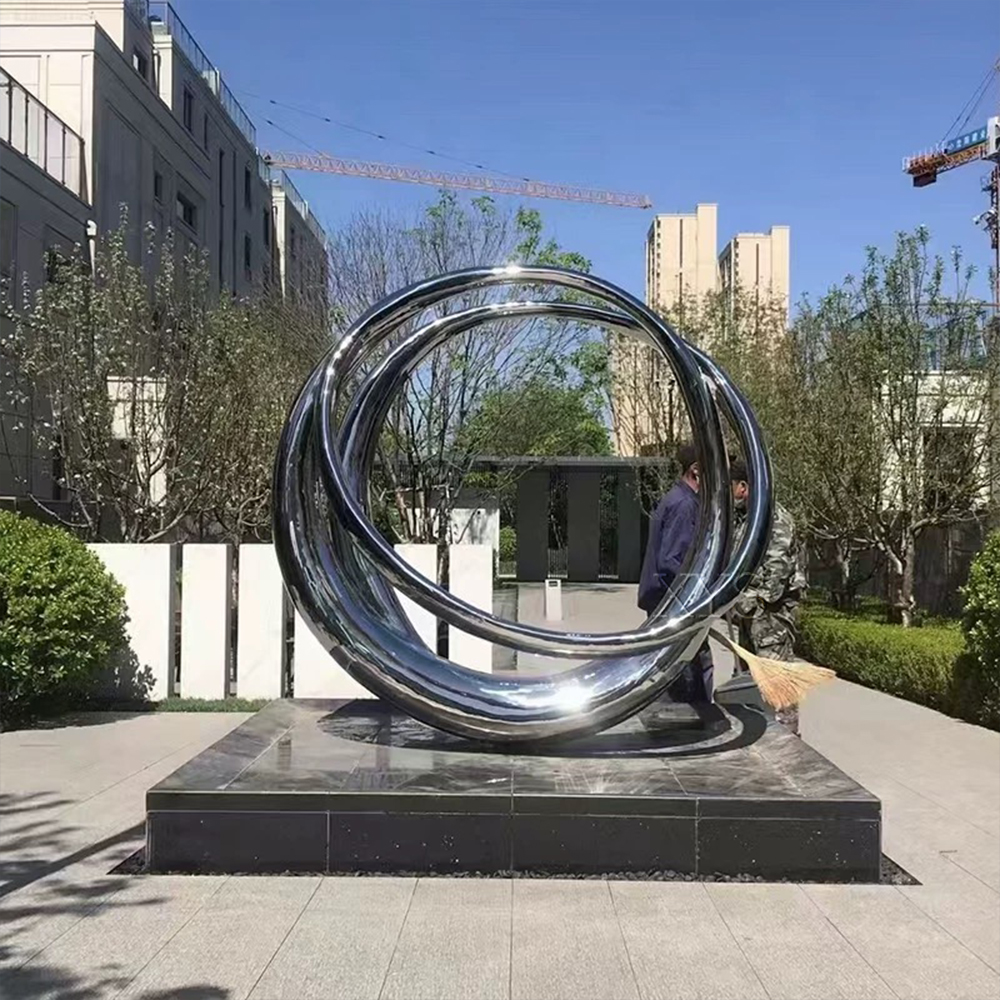
Large-scale stainless steel landscape sculpture. Grade declaration, polish level and internal framework are three separate items in a qualification file.
Stainless Steel: Grade, Polish and Internal Structure
Stainless steel sculpture raises a different question, because the visible surface is the least informative part of the specification. The stainless range, model XYS-Stainless-Custom, is specified in premium 304 or 316 stainless steel, with customised heights from 1 m to 20 m and surface treatments of mirror polish, brushed (satin), painted or electroplated. Fabrication is described as hand-forged with precision welding and an internal steel skeleton; the mirror finish is achieved through 6–8 stages of professional hand-polishing to an 8K standard, and large-scale installations use a heavy-duty internal anti-rust steel framework for structural stability, with seamless welding to keep joints visually continuous.
Three verification points follow from that description. The grade should be declared for the batch, not for the product family: 304 and 316 are different alloys, and 316 is the grade recommended for coastal or high-humidity environments. The polish level should be named in the same terms used at inspection — 8K mirror, brushed, painted or electroplated — because “polished” alone does not define what a buyer will accept. And the internal framework should appear in the technical documentation, since at 10 m or 20 m the structure inside the skin is what determines how the piece performs over time.
For EU-bound projects, the certificate scope is worth reading line by line. The CE (RoHS) certification for the stainless range, certificate number OCT20260611103R issued by Oct Technology Testing Co., Ltd., applies to the EU market and covers Stainless Steel Art Sculpture and Stainless Steel Landscape Sculpture under model XYS-Stainless-Custom, referencing the IEC 62321 series of test standards. A buyer ordering a stainless piece for a European site can therefore match the certificate scope to the product type being purchased — a check that is simple, and often skipped.
Cast Bronze: What Copper Content Actually Confirms
Bronze is the material where buyers most often accept a vague assurance in place of a number. The bronze range, model XYS-Bronze-Custom, is specified in high-purity cast bronze with copper content above 85% to 95%, with brass also offered, in heights from 50 cm to 10 m or life size, finished by patina, gold leafing, high polishing or antiquing, and produced by lost-wax casting with professional welding.
The supplier describes the material as museum-grade, with high copper purity ensuring outdoor durability of over 50 years, and offers custom patina with multi-colour oxidation finishes to match aesthetic requirements. That durability statement should be read for what it is: a material-level claim about alloy purity, not a project-specific warranty. The two can coexist, but they are separate commitments and belong in separate clauses of the order.
What to verify on a bronze order
- Copper content range in writing. Ask for the alloy declaration covering the 85–95% copper range rather than the phrase “high-quality bronze”.
- Casting method. Lost-wax casting is specified for this range and is what allows intricate, lifelike detail; if a project depends on fine surface detail, the method should be named in the order.
- Patina approval sample. Multi-colour oxidation finishes are aesthetic decisions as much as technical ones, so approval should be against a physical or photographic sample before the finish is applied to the piece.
- Items not stated in the published specification. Wall thickness and finished weight are not part of the published parameters for this range. Where either affects lifting, anchoring or budget, they should be confirmed in writing rather than inferred.
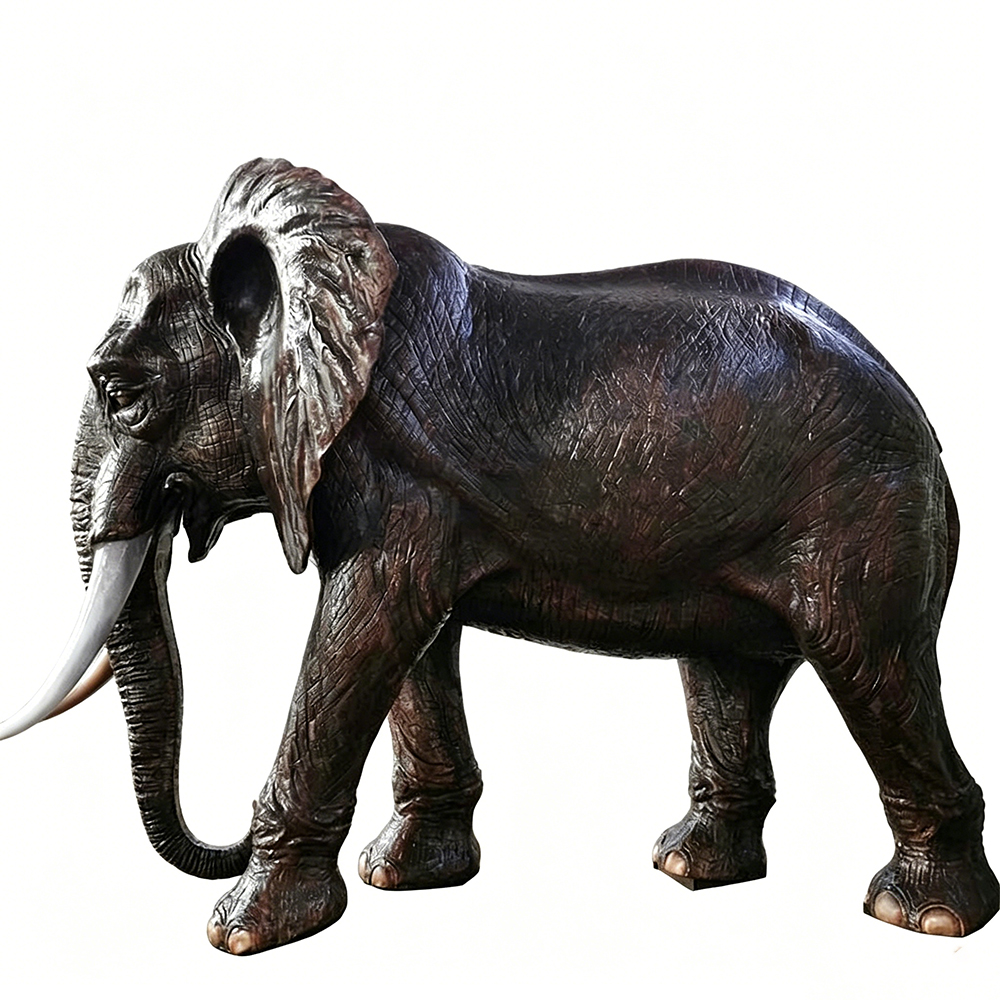
Cast bronze work with a patina finish. Copper content, casting method and patina approval are three separate acceptance points.
Writing Acceptance Criteria Before Production Starts
Acceptance criteria are the part of compliance that buyers control directly, and they are cheap to write compared with the cost of a dispute after shipment. The supplier's stated quality control sequence runs through four stages: material inspection, production process inspection, surface quality inspection, and final inspection before shipment. Those four stages are a workable skeleton for a project-specific acceptance schedule, provided each gate is attached to a record rather than to an assurance.
| Gate | What to ask for at this gate | Buyer action |
|---|---|---|
| Design confirmation | 3D design draft issued for approval before production | Approve in writing; record the approved revision as the dimensional reference |
| Model review (figurative work) | 1:1 clay model visualisation of proportions and detail | Sign off silhouette and detail scale before mould or carving work begins |
| Material inspection | Confirmation that the steel grade, granite type, stainless grade or bronze alloy matches the order | Match the declaration to the purchase order line by line |
| Production process inspection | In-process checks on dimensions, joints and framework | Review at an agreed milestone, not only at the end |
| Surface quality inspection | Polish, patina or finish record set against the approved sample | Compare finish against the sample, under the lighting the piece will be seen in |
| Final inspection before shipment | Final inspection record with photographic documentation | Release shipment only after the record is received and accepted |
The most common gap in custom sculpture acceptance is not a missing test; it is an unapproved reference. If the dimensional reference is a sketch rather than an approved 3D file, or the finish reference is a verbal description rather than a sample, the final inspection has nothing objective to inspect against. Fixing the reference at design stage converts the later gates from opinions into checks.
Packaging Assurance: The Part Buyers Inspect Last
Packaging is where an otherwise well-qualified order can still arrive damaged. The supplier's stated delivery system uses professional seaworthy packaging with reinforced wooden crates and steel frames. For a buyer, that description should be converted into a specification that can be verified before the container is sealed.
- Confirm the packing method in the order — reinforced wooden crates and steel frames — and ask how the piece is braced inside the crate rather than only how the crate is built.
- Request photographs of the packed unit before the container is closed, so any intervention is still possible.
- Separate the installation items from the sculpture items. The matched equipment for a typical installation includes the installation foundation, steel structure support, LED lighting system, and lifting and transportation equipment; these are usually supplied by the buyer's site contractor, but the boundary should be written down rather than assumed.
- Agree who inspects on arrival and within what period, since a damage claim depends on evidence recorded at unpacking.
Purchasing Terms and Import Documentation
Purchasing terms are the third leg of qualification, alongside material evidence and acceptance criteria. The supplier's stated commercial parameters are a minimum order of one piece or one project, a lead time of 30–60 days, and a capacity of 50–100 custom sets per month alongside an annual output figure of 10,000 units across its wider product range. After-sales support is stated as installation guidance, technical support, replacement service and long-term customer support — each of which should be narrowed to a defined scope in the contract rather than left as a category.
On the EU side, three CE (RoHS) certificates are held under the scope of IEC 62321-3-1:2013, IEC 62321-4:2013+AMD1:2017, IEC 62321-5:2013, IEC 62321-6:2015, IEC 62321-7-1:2015, IEC 62321-7-2:2017 and IEC 62321-8:2017, all issued by Oct Technology Testing Co., Ltd. and valid from 2026-06-11 to 2031-06-10:
- Bronze statue and bronze art sculpture — certificate OCT20260611105R, covering bronze statue, bronze art sculpture and bronze animal sculpture under model XYS-Bronze-Custom.
- Marble sculpture and stone products — certificate OCT20260611104R, covering marble statue, marble art sculpture, marble fireplace, marble bathtub and marble tombstone.
- Stainless steel sculpture — certificate OCT20260611103R, covering stainless steel art sculpture and stainless steel landscape sculpture under model XYS-Stainless-Custom.
Two practical notes apply. The certificates are substance-restriction documents for the EU market: they do not certify weathering performance, structural design or suitability for a specific site, and the scope must match the product type actually ordered. Classification is a separate matter again. A 2025 market analysis by CloudscapeArt notes that original sculptures under HS code 9703 often bypass EU anti-dumping duties while mass-produced items under HS 8306 face higher scrutiny — a general trade observation that a buyer should confirm with a customs broker for the specific shipment rather than treat as a classification ruling.
Ten Questions to Ask During a Factory Visit
A factory visit is most useful when it is treated as document review with a workshop attached. These questions are designed to be answered with a file, a sample or a named person — not with an adjective.
- Which material grade will appear on my purchase order, and which document will prove the delivered batch matches it?
- For weathering steel, is the delivery condition pre-rusted stable patina or raw self-weathering, and how will that be documented at handover?
- For stainless steel, is 304 or 316 being quoted, and which polish stage is specified — 8K mirror, brushed, painted or electroplated?
- For bronze, what copper content range is guaranteed, and can I approve a patina sample before the finish is applied?
- Which granite is quoted, and can I identify the block or slab allocated to my order before carving begins?
- Which inspection records will I receive, and at which of the four quality-control stages?
- Will a 3D design draft — and, for figurative work, a 1:1 model — be approved in writing before production?
- What is the packing specification, and will I receive photographs of the packed unit before the container is sealed?
- Which certificates apply to my product type and destination market, and what are their numbers and expiry dates?
- What exactly does installation guidance cover, and who supplies the foundation, steel support and lifting equipment?
Answers that arrive as documents shorten the evaluation considerably. Answers that arrive as assurances tell the buyer where the specification still needs work — which is itself useful information, and usually available before a deposit is paid.
What the Compliance File Does Not Cover
A qualification file is a boundary document as much as a proof document. Four limits are worth stating plainly.
- CE (RoHS) is not a durability certificate. The referenced IEC 62321 standards are restricted-substance test methods. Weathering performance, corrosion resistance and structural integrity sit outside that scope.
- ASTM A242/A588 conformity is a steel statement. It identifies the grade of steel supplied; it does not qualify a weld procedure, a base connection or a finished design.
- “Zero-defect quality” is a process objective. It describes strict finished product inspection combined with material traceability. It is credible only when the inspection records behind it are produced for the specific order.
- Certificates have scope, issuer and expiry. All three CE (RoHS) certificates here run to 2031-06-10 and name a specific issuing body and product scope. Where a project requires structural sign-off, engineering documentation and site conditions should be confirmed as a separate deliverable rather than assumed to be part of the compliance pack.
None of these limits undermines the value of the documentation. They simply define what a buyer still owns after the file is complete: the specification of the reference, the approval of the sample, and the engineering of the installation.
Outlook: Documentation as a Selection Criterion
With most North American public art commissions sitting below a USD 250,000 budget and a global sculpture market measured in tens of billions of dollars, the pressure on buyers runs in two directions at once: more projects, and less tolerance for rework. In that environment, the supplier who can produce a grade declaration, an inspection record, an approved sample and a packing specification on request is easier to defend internally than one who offers a broader portfolio but a thinner file.
For buyers in the research and evaluation stage, the practical sequence is straightforward: decide the material and the finish state, request the specific evidence that supports each, write acceptance criteria against named references, and confirm packaging and purchasing terms before the deposit. Compliance then becomes what it should be — a set of checkable facts attached to a specific order, rather than a claim attached to a brochure.
Supplier snapshot. Jiangsu Xinyesheng Sculpture Co., Ltd operates a 13,320 m² production site with 50 employees and 12 engineers, exporting 100% of output to the EU, the United States and the Middle East across sculpture, statue, relief, tombstone, fireplace and bathtub categories. Custom work is quoted from one piece or one project, with a stated lead time of 30–60 days, OEM/ODM and custom design support, and after-sales installation guidance, technical support and replacement service. Product models referenced in this article are XYS-Corten-Custom, XYS-Stone-Custom, XYS-Monument-Custom, XYS-Stainless-Custom and XYS-Bronze-Custom.
The company profile and available production capabilities document can be downloaded here: Company Profile & Available Production Capabilities (PDF).
Frequently Asked Questions
Which compliance documents should a buyer request before placing a custom sculpture order?
A buyer should request four sets of documents. First, a material declaration naming the exact grade or type: ASTM A242/A588 for weathering steel, 304 or 316 for stainless steel, the named granite for stone monuments, and the copper content range for cast bronze. Second, the inspection and traceability record covering finished product inspection. Third, any market-specific certification that applies to the product type and destination, such as CE (RoHS) for the EU. Fourth, the packing specification and the installation scope. Each document should be matched to the product type on the order, because certification scopes are product-specific.
Does CE (RoHS) certification confirm that an outdoor sculpture will withstand weather?
No. The CE (RoHS) certificates held for the bronze, marble and stainless steel ranges reference the IEC 62321 series, which are restricted-substance test methods, and are issued by Oct Technology Testing Co., Ltd. with validity from 2026-06-11 to 2031-06-10 for the EU market. They address restricted substances in the finished article. Weathering performance, corrosion resistance and structural integrity are separate questions that must be addressed through material grade, finish specification, structural documentation and installation design.
How is ASTM A242/A588 conformity documented for a weathering steel sculpture?
Conformity is normally documented at the steel level, through a declaration identifying the grade of plate supplied as ASTM A242/A588 weathering steel, rather than through a certificate for the finished sculpture. Buyers should pair that declaration with the specified delivery condition — a natural pre-rusted stable patina or a raw self-weathering finish — in the purchase order. The protective rust layer and maintenance-free behaviour described by the supplier relate to the material; structural design and weld quality remain separately documented items.
What copper content should a cast bronze sculpture specification state?
The bronze range is specified in high-purity cast bronze with copper content above 85% to 95%, with brass also available. The supplier describes this material as museum-grade and associates high copper purity with outdoor durability of over 50 years, and offers custom patina with multi-colour oxidation finishes. Buyers should record the copper content range and the lost-wax casting method in the order, approve a patina sample, and treat the durability statement as a material claim rather than a project-specific warranty.
What acceptance criteria belong in a custom sculpture purchase order?
The purchase order should attach each criterion to a named reference. That means an approved 3D design draft as the dimensional reference, a 1:1 model for figurative work where proportions must be confirmed, a physical or photographic sample for polish and patina, a material declaration covering the grade or alloy, and a final inspection record before shipment. The supplier's four quality-control stages — material inspection, production process inspection, surface quality inspection and final inspection before shipment — provide a structure for those gates. Packaging should be specified in the same order, using the stated seaworthy method of reinforced wooden crates and steel frames, with photographs of the packed unit before the container is sealed.
Have Questions or Need More Details?
Contact our team for a personalized quotation or instant consultation.
Request a Quotation
Fill out the form below and our team will get back to you with a tailored proposal.
WhatsApp Direct Chat
Prefer to chat in real-time? Message us on WhatsApp for instant assistance & quick answers.
- Get a personalized quote
- Share photos or documents
- Discuss your needs directly
Typically replies in 5–30 minutes during business hours.