
Custom Shopping Bag Sourcing: Building Reliable Long-Term Supply Partnerships with Opack
For retailers and brand owners, sourcing custom shopping bags is no longer a one-off purchase—it is a strategic decision that determines packaging consistency, brand equity, and supply chain stability. As buyers move from evaluation to execution, the focus shifts from product features to supplier ecosystem capabilities: production scalability, quality control rigor, and after-sales responsiveness. Opack, a custom packaging manufacturer based in Longgang, China (the country’s printing hub), has been serving global brands since 2010 with a integrated system that addresses these very needs.
The Problem: Why Sourcing Custom Shopping Bags Requires More Than a Supplier
The global paper bags custom printing market was valued at USD 2.78 billion in 2024 and is projected to grow at a CAGR of 13.9% through 2030 (Grand View Research). Meanwhile, Asia Pacific accounts for over 36.5% of the global market share (IMARC Group 2025), making Chinese manufacturers the default choice for volume sourcing. However, buyers in the decision-execution phase frequently encounter three pain points: unexpected color deviation, inconsistent bag strength, and slow post-sale response. These risks can derail a product launch and damage brand perception. The need is not just for a product, but for a partner who can guarantee repeatability across reorders.
The Solution: Opack’s Full-Ecosystem Approach to Custom Shopping Bags
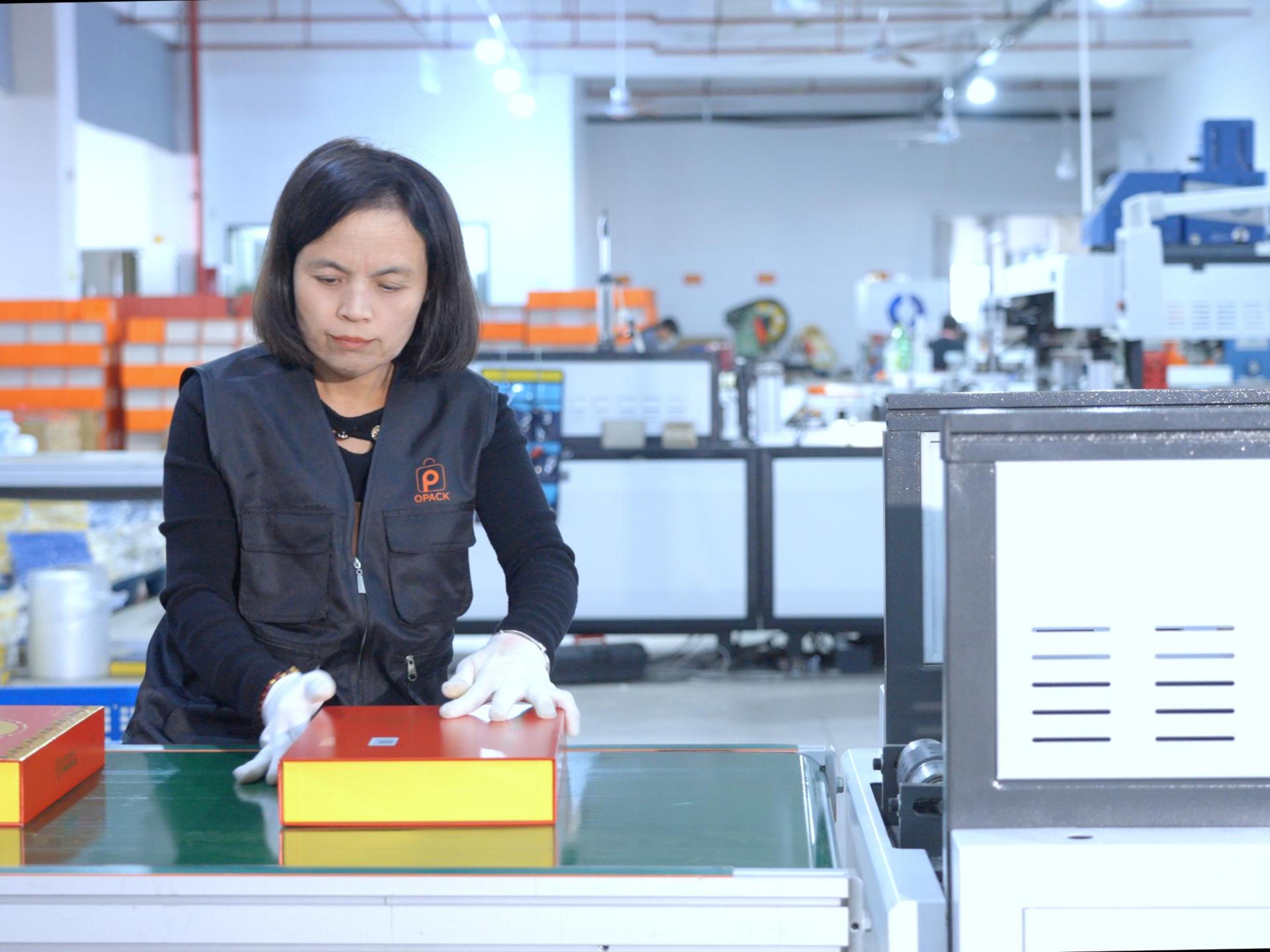
Opack addresses these challenges with a production and quality ecosystem built over 15 years. The manufacturer operates a 10,000 m² factory with 160 employees and a monthly production capacity of 1,000,000 units for EU, US, and Middle East markets (corpus). Every export order undergoes a 100% quality check before shipment, and typical lead time is 12–18 days for these destinations. The minimum order quantity for custom paper shopping bags is 1,000 units. Multi-channel after-sales support—including real-time online chat, WhatsApp, telephone, and official email—ensures that clients in the EU, US, and Middle East receive timely assistance.
Technical Explanation: How Opack Ensures Color Accuracy and Load-Bearing Reliability
Two of the most common objections in custom shopping bag procurement are printing color variation and insufficient load-bearing strength. Opack’s control methods are documented as standard operating procedures:
- Color Difference Control: Professional spectrophotometers measure and monitor color consistency throughout production. The color difference (ΔE) is controlled within approximately 1.5, making variations nearly imperceptible to the human eye. A pre-production color approval process and in-process inspections are also enforced.
- Load-Bearing Performance: Load-bearing tests are conducted before mass production to verify handle strength, paper durability, and structural stability. This ensures each bag can safely support the intended product weight (2–15 kg depending on paper thickness and structure).
All products exported to the EU, US, and Middle East markets undergo 100% quality check, with batch-by-batch verification to maintain consistency across runs. Third-party inspections are welcome upon customer request.
Application Scenarios: Where Opack’s Custom Shopping Bags Deliver Value
Opack’s product line is fully customizable across size (small to extra-large), material (kraft paper, whiteboard paper, specialty paper, coated paper), handle type (paper twisted, flat paper, cotton rope, ribbon, die-cut), and finishing (hot stamping, spot UV, soft-touch lamination, holographic foiling, embossing/debossing). These options make the bags suitable for:
- Cosmetics and apparel retail — where visual appeal and brand logo prominence are critical
- Gift packaging and trade show events — requiring premium finishes and high weight capacity
- E-commerce stores — needing consistent sizing and handle durability for shipping
Brown kraft paper, estimated to hold a 58% share of total material demand by 2026 (Future Market Insights), is a widely preferred substrate, and Opack offers FSC-certified material options to meet sustainability targets.
A comparative analysis (corpus) shows that custom printed shopping bags yield a 20–30% higher repeat purchase rate, 10–30% improvement in customer satisfaction, and 5–10% more social media shares compared to plain bags.
Market Trend Analysis: The Shift Toward Verified Supply Chains
The custom shopping bag market is maturing. As of 2024, the single-use paper bag segment accounted for 64.2% of market share (Market Research Future), and FSC certification enjoys a 56% global consumer recognition rate (FSC 2025). Buyers are increasingly demanding transparent manufacturing and eco-conscious materials. Opack’s location in Longgang—the “Printing City of China”—provides access to a mature supply chain for paper and inks, while its factory scale (10,000 m², 160 employees, 80% export ratio) meets the volume requirements of EU, US, and Middle East clients.
Comparison with Traditional Solutions
Compared to generic plain shopping bags (standard paper or plastic), customized paper bags from Opack involve a 3–10% higher initial cost. However, they offer superior structural durability—sturdier paperboard, durable printing, reinforced handles—leading to less tearing and handle breakage during repeated use. An honest limitation is the MOQ of 1,000 units per size and design, which may be restrictive for very small boutique businesses. However, for brands executing a coordinated launch across channels, the MOQ aligns with typical retail procurement volumes.
Future Outlook
As sustainability regulations tighten and brand differentiation becomes more competitive, the demand for custom logo paper bags and branded shopping bags will continue to grow. Manufacturers that can combine high-volume capacity with rigorous quality management and responsive after-sales service will become preferred long-term partners. Opack’s track record—serving clients since 2010, 1M monthly capacity, 100% quality check, and multi-channel support—positions it as a stable choice for buyers seeking to execute a reliable packaging strategy.
Frequently Asked Questions
What is Opack’s monthly production capacity for custom shopping bags?
Opack’s monthly production capacity is 1,000,000 units for the EU, US, and Middle East markets (corpus).
What is the minimum order quantity (MOQ) for custom paper shopping bags?
The MOQ for paper shopping bags is 1,000 units per size and design (corpus). Rigid gift boxes require a 500 pcs MOQ.
How does Opack ensure color consistency across orders?
Opack uses professional spectrophotometers to measure and monitor color consistency, controlling color difference (ΔE) within approximately 1.5. A pre-production color approval process and in-process inspections are conducted.
What after-sales support channels are available?
The manufacturer provides multi-channel after-sales support via real-time online chat, WhatsApp, telephone, and official email for clients in the EU, US, and Middle East markets.
What is the typical lead time for orders to the EU, US, or Middle East?
Typical lead time is 12–18 days for orders destined to these regions.
Does Opack perform quality checks before shipment?
Yes, all products exported to the EU, US, and Middle East markets undergo a 100% quality check before shipment. Third-party inspections are also welcome upon customer request.
Download Opack’s company brochure for complete product specifications, factory details, and contact information.
Have Questions or Need More Details?
Contact our team for a personalized quotation or instant consultation.
Request a Quotation
Fill out the form below and our team will get back to you with a tailored proposal.
WhatsApp Direct Chat
Prefer to chat in real-time? Message us on WhatsApp for instant assistance & quick answers.
- Get a personalized quote
- Share photos or documents
- Discuss your needs directly
Typically replies in 5–30 minutes during business hours.