
Custom Shopping Bags: Opack Facility and Capacity Evidence
Custom Shopping Bags: Opack Facility and Capacity Evidence
Custom-printed paper bags have become a recurring packaging line for retailers, apparel brands and gift-focused businesses rather than a one-off seasonal purchase. The custom-printing segment of the global paper bag market was valued at USD 2.78 billion in 2024 and is projected to grow at a compound annual rate of 13.9% through 2030, according to Grand View Research, while the broader paper bag market reached USD 6.06 billion in 2024 and is expected to reach USD 7.81 billion by 2029, according to MarketsandMarkets. More SKUs, more markets and more reorders mean that the decisive question in supplier selection is operational: can the same bag, in the same color, at the same lead time, be produced again next quarter?
For buyers moving from evaluation into execution, capability claims are easy to make and hard to check. Facility size, workforce, monthly output, minimum order quantity, published lead times, export share, certificate numbers and referenceable projects are the items that can actually be verified. This reference article sets out the capability record published by Opack — a custom packaging manufacturer based in Longgang, the Printing City of China — and explains what each data point means for a purchase decision on custom paper bags with logo.
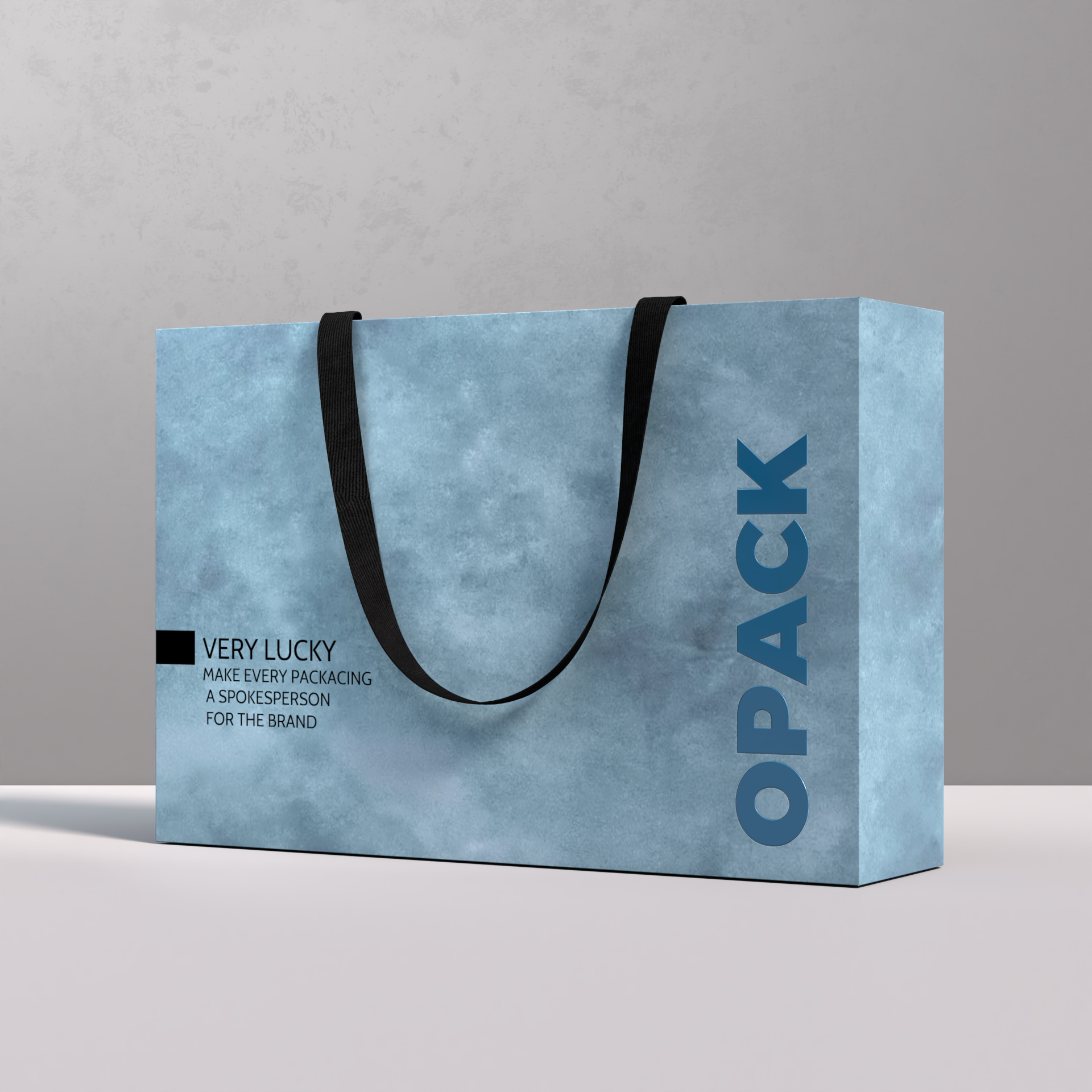
A custom paper shopping bag from Opack's PSB paper bag range — the product category examined in this capability review.
Why Capability Evidence Matters Between Evaluation and Execution
In custom shopping bag projects, the failure point is rarely the design. It is the distance between an approved sample and the third or fourth production run, when color drifts, handles change weight, or a delivery window slips because the factory is fully booked elsewhere. Buyers who have reached the execution stage therefore look for capability evidence on five verifiable dimensions: the physical production site, the workforce and engineering support behind it, the stated monthly and annual output, the commercial thresholds such as minimum order quantity, lead time and trade terms, and documented quality and certification. Everything else, including a well-designed bag, sits downstream of those five.
The rest of this article reviews the capability evidence Opack publishes for its paper shopping bag line, and translates each item into what it means for a retail, apparel or gift packaging purchase.
Opack at a Glance: Site, Workforce and Output
Opack is a custom packaging manufacturer founded in 2010 and based in Longgang, the Printing City of China, in Wenzhou City, Zhejiang Province. Its product range covers custom folding cartons, rigid boxes, mailer boxes, paper shopping bags and paper tubes, and its operations address is No. 8-10, Prosperity Road, Longgang City, Wenzhou City, Zhejiang Province.
| Capability item | Published record |
|---|---|
| Founded | 2010 |
| Production site | 10,000 m² facility in Longgang, the Printing City of China, Wenzhou City, Zhejiang Province |
| Workforce | Approximately 160 employees |
| Engineering | 5 R&D engineers |
| Annual output | 10,000,000 units |
| Monthly production capacity | 1,000,000 units |
| Export share | 80% of sales |
| Main export markets | EU, United States, Middle East |
| Product scope | Custom packaging, rigid boxes, shopping bags, folding cartons, mailer boxes, paper tubes |
Read together, these figures describe a mid-sized converter rather than a trading intermediary. A 10,000 m² site, approximately 160 staff and a five-engineer development team indicate that printing, finishing and structural work are handled under one roof. The practical consequence for buyers is fewer handoffs: the entity that quotes the bag is the same entity that produces and inspects it.
What 10,000,000 Units a Year Tells a Buyer
Opack's published figures are 10,000,000 units of annual output and 1,000,000 units of monthly production capacity. A monthly capacity of one million units implies up to twelve million units of theoretical throughput across a full twelve-month period, which places the stated annual output below that theoretical ceiling — the profile of a facility that plans output conservatively rather than one quoting a peak number.
Three qualifications matter for planning. First, capacity is shared across product lines — folding cartons, rigid boxes, mailer boxes, paper shopping bags and paper tubes — so a bag program does not have exclusive claim on the monthly figure. Second, capacity is shared across customers; buyers working to a fixed retail calendar generally benefit from confirming production slots earlier in the season rather than later. Third, the figure describes production output, not shipping volume, so it should be read alongside lead time and transport planning rather than treated as a delivery commitment on its own.
Inside the Custom Paper Bag With Logo: Materials, Printing, Finishing and Handles
The product specification behind Opack's paper shopping bags, product reference PSB, covers the decisions that determine how a logo finally appears on the bag.
| Specification | Options |
|---|---|
| Materials | Kraft paper, whiteboard paper, specialty paper, coated paper |
| Printing | CMYK printing, Pantone printing, UV printing, offset printing, screen printing |
| Finishing | Hot stamping, spot glossy UV, soft touch lamination, holographic foiling, embossing, debossing, matte lamination, gloss lamination |
| Handles | Paper twisted handle, flat paper handle, cotton rope, ribbon handle, die-cut handle |
| Size range | Fully customizable — small, medium, large, extra large |
| Weight capacity | 2–15 kg, depending on paper thickness and structure |
| Minimum order quantity | 1,000 pcs per size and design |
| Typical applications | Cosmetics, apparel, retail, gift, trade shows and events, e-commerce packaging |
How the logo decision works in practice
For custom paper bags with logo, three specification choices drive the printed result. The printing method governs detail and color behavior: offset printing is commonly used for multi-color artwork with fine detail, screen printing is often selected for bold, high-opacity single-color marks, and UV printing is used where ultraviolet-curable inks suit the project. Pantone printing is available where brand color accuracy matters more than process-color convenience.
The finishing step governs how the logo is perceived at arm's length. Hot stamping and holographic foiling create metallic or reflective marks; embossing and debossing raise or recess the brand mark; spot glossy UV and matte or gloss lamination change the contrast between the bag surface and the logo. The substrate sets the ceiling on all of it — kraft paper, whiteboard paper, specialty paper and coated paper each accept ink differently, so a light logo on dark kraft stock is a different technical problem from the same logo on coated white stock.
The handle is the part of the bag that most often fails in use, and it is also a specification line buyers can define up front. Opack lists paper twisted handles, flat paper handles, cotton rope, ribbon and die-cut handles, with a stated weight capacity of 2–15 kg depending on paper thickness and structure. Where a bag must carry heavier retail items, handle and board specification have to be set together rather than chosen separately.
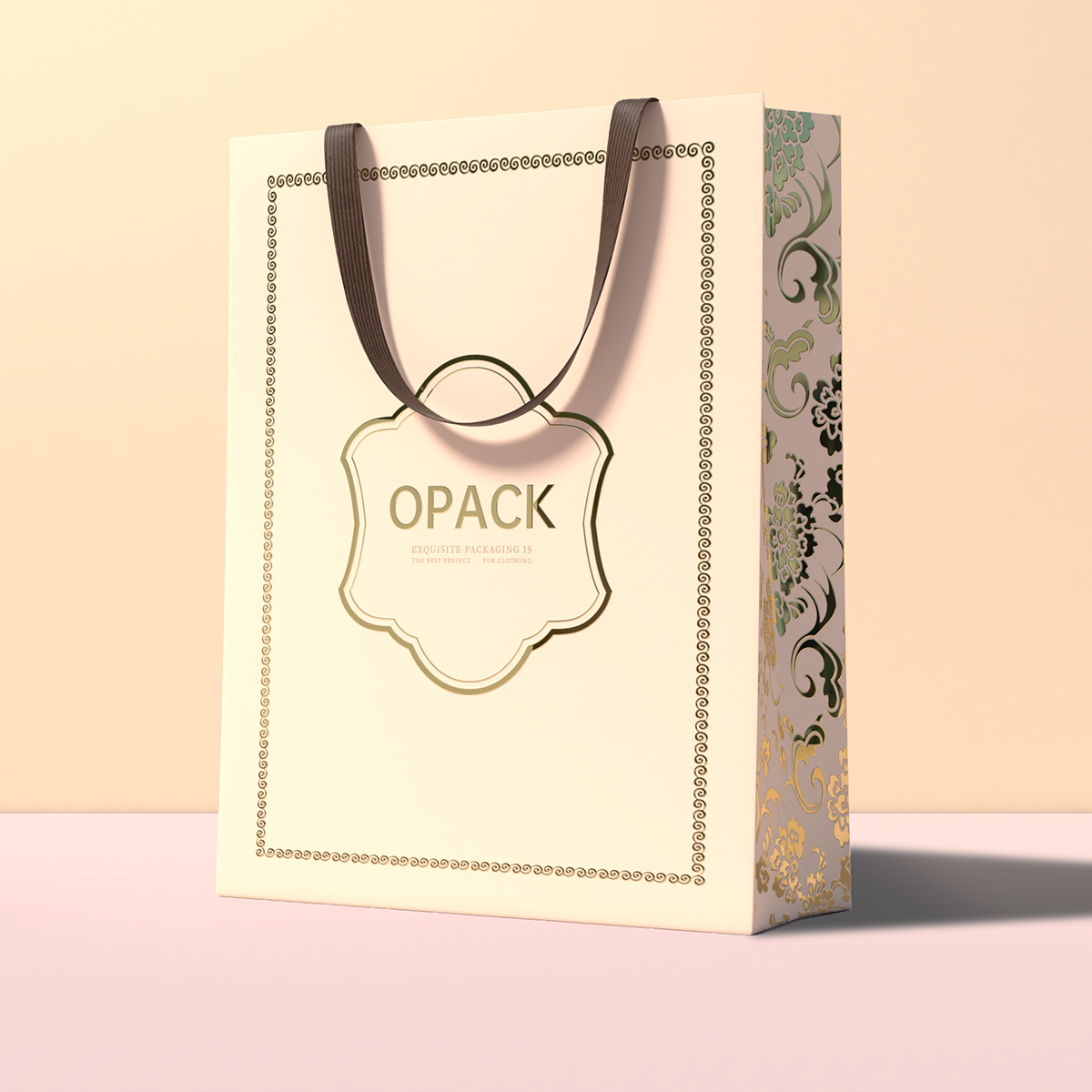
Print method, finishing and substrate are specified together, because each one constrains the others on a logo-printed paper bag.
Quality Control and Certification Evidence
Opack's quality process is documented as a 100% quality check, with internal inspections completed before shipment and third-party inspections welcomed when a customer requests them. That last point changes the audit picture: a buyer who needs independent verification does not have to negotiate for access to it.
On sustainability claims, Opack holds FSC Chain of Custody certification number GFA-COC-005690, issued by GFA Certification GmbH on 2021-11-09 under standard FSC-STD-40-004 (Version 3.0) and recorded as valid through 2026-10-09. The certified scope covers cardboard packaging, sacks and bags of paper, adhesive labels and other pulp and paper products, and the markets listed on the certificate are Europe, North America, Australia & New Zealand and the Middle East. FSC certification is the primary industry standard for verifying sustainable sourcing, with a 56% global consumer recognition rate according to the Forest Stewardship Council.
Scope note for buyers: the FSC chain-of-custody scope covers paper and board products. Bag components outside that material scope, such as cotton rope or ribbon handles, are not covered by the paper chain-of-custody claim, so mixed-material specifications should be clarified with the supplier before any claim is repeated in retail or marketing material.
Order Thresholds, Lead Times and Delivery Terms
| Commercial item | Published record |
|---|---|
| MOQ | Paper shopping bags: 1,000 pcs per size and design. Rigid gift boxes: 500 pcs per size and design |
| Lead time | 12–18 days |
| Trade terms | EXW and FOB available based on customer requirements |
| Shipping | Coordinated according to destination and project schedule |
| Quality check | 100% inspection before shipment |
| Third-party inspection | Welcome upon customer request |
| Payment terms | 40/60 |
| After-sales support | Real-time online chat, WhatsApp, telephone, official email |
The MOQ applies per size and design, which is a meaningful distinction for retail programs. A brand ordering one medium bag in one artwork version meets the 1,000-piece threshold in a single run; a brand ordering three sizes in two artwork versions is looking at six separate minimums. Lead time is quoted at 12–18 days, and that window describes production at the factory rather than total transit — buyers shipping to the EU, the United States or the Middle East should add transport time and customs clearance to their project schedule. With 80% of Opack's sales going to export markets, the export documentation and shipping workflow is routine rather than occasional.
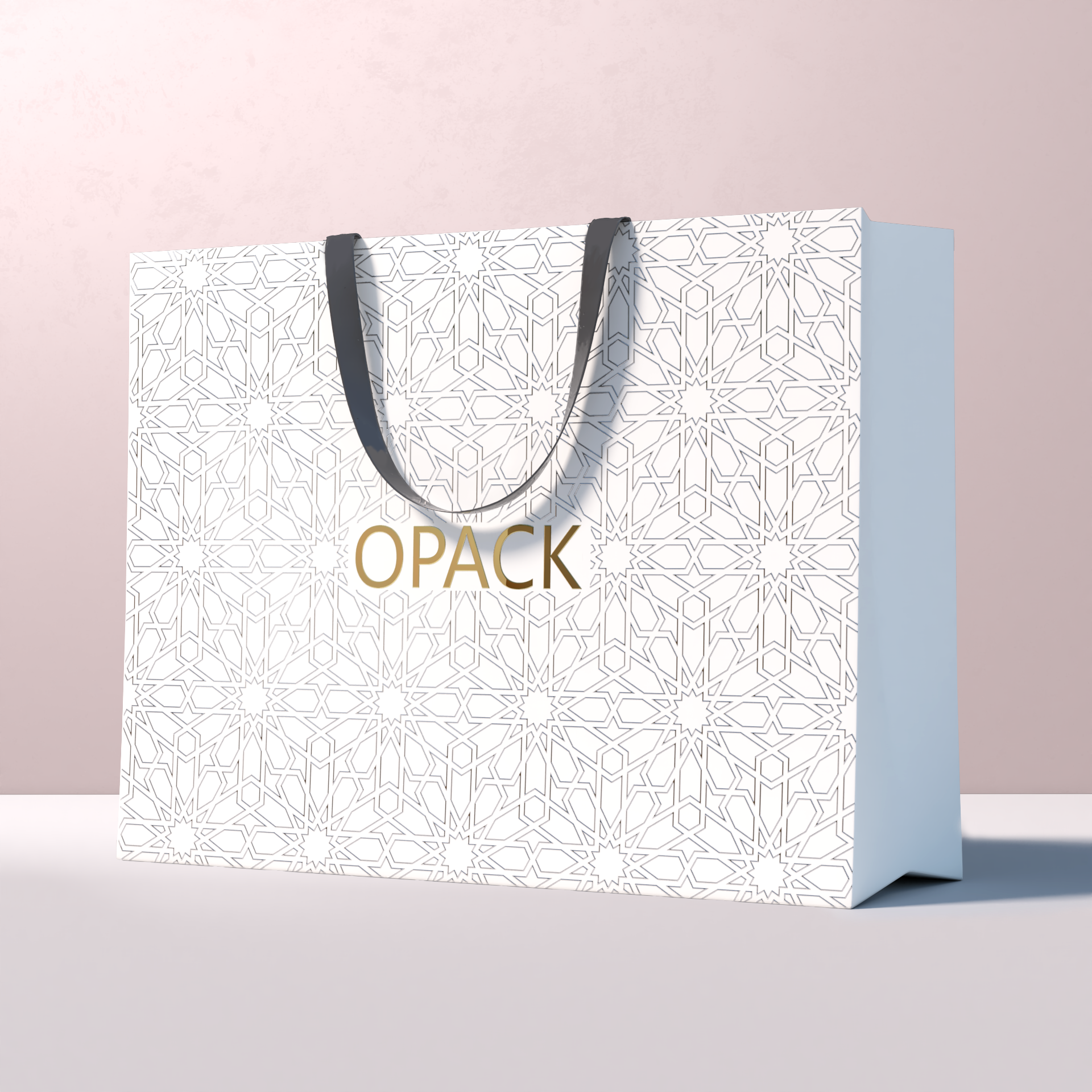
Export coverage: the Middle East is one of three primary markets for Opack's custom packaging output, alongside the EU and the United States.
Application Evidence: A Panama Fashion Brand Order
Opack's documented reference case is a brand owner in the fashion and lifestyle segment based in Panama. Across a one-year annual purchasing partnership, the client ordered more than 30,000 paper bags, more than 3,000 paper boxes and more than 10,000 stickers, with a total annual purchase value above USD 12,000. The packaging covered retail, gift and promotional applications for the client's own brand, and the relationship was originally acquired through Google Ads.
Reported project outcomes were consistent print quality across multiple production batches, stable lead times, and no quality complaints or after-sales issues. The case is a single client reference rather than a performance guarantee, but it is specific evidence of the type buyers in the execution stage are usually asked to provide internally: a repeat-purchase customer, a mixed packaging basket and a documented outcome.
Market Context for Custom-Printed Paper Bags
Demand conditions shape how much weight a buyer should put on capacity figures. In the custom-printing segment, the global paper bag market was valued at USD 2.78 billion in 2024 with a projected 13.9% CAGR through 2030 (Grand View Research). The broader paper bag market stood at USD 6.06 billion in 2024, with an expected USD 7.81 billion by 2029 (MarketsandMarkets). Asia Pacific is the largest regional market, accounting for over 36.5% of global share in 2025 (IMARC Group), and China is the world's leading exporter of paper sacks and bags, with exports valued at approximately USD 1.91 billion in 2023 (UN Comtrade / WITS). On materials, brown kraft paper remains the dominant segment, estimated to hold a 58% share of total material demand by 2026 on sustainability preferences (Future Market Insights).
Two implications follow. Custom printing is growing faster than the bag category as a whole, which keeps pressure on converters' print capacity and color control. Material preference is also consolidating around kraft, which means more buyers are requesting light logos on dark, textured stock — the specification where print technique and finishing choices matter most.
Comparison With Plain Bags and Other Supply Options
| Dimension | Plain unprinted bags | Custom printed paper bags |
|---|---|---|
| Brand function | No brand surface | Logo, color and finishing carry the brand at point of sale |
| Setup requirement | No print setup, no artwork approval | Print setup, artwork approval and color reference required per design |
| Minimum volume | Available in low volumes | 1,000 pcs per size and design at Opack |
| Reorder risk | Consistency less critical | Color and construction consistency across batches becomes the key risk |
| Material options | Typically limited to standard stock | Kraft, whiteboard, specialty and coated paper |
| Handle options | Standard configurations | Five documented handle types, 2–15 kg capacity range |
| Best fit | Short-term, non-branded use | Retail, apparel, gifting, trade shows and events, e-commerce |
Against alternative supply models, the comparison is less about company size than about operating model. The high-volume paper bag and fiber packaging market includes large integrated groups such as Mondi Plc, Smurfit Kappa Group and International Paper Company, identified by Future Market Insights as leading global competitors. Those organizations and specialist converters are evaluated on different criteria, and buyers comparing them should weigh minimum order flexibility, depth of print customization and artwork approval workflow at least as heavily as headline capacity.
Limitations and Boundary Conditions
Capability evidence is only useful when its limits are stated as clearly as its strengths.
- The MOQ of 1,000 pieces per size and design makes very small pilot runs or per-store artwork variations uneconomical; projects with several sizes or versions multiply the minimum quantity.
- The 12–18 day lead time is factory production time and excludes transport and customs clearance to the EU, the United States and the Middle East.
- Monthly capacity of 1,000,000 units is shared across customers and across five product categories, so published capacity alone does not guarantee a production slot during peak retail seasons.
- The FSC chain-of-custody scope covers paper and board products; non-paper components such as cotton rope or ribbon handles sit outside that claim.
- Custom sizes, handles and finishing are made to order, so there is no stock inventory to draw on for urgent replacement orders.
- The Panama reference covers one client relationship and should be treated as an example of process reliability rather than a general performance projection.
Future Outlook
If custom printing keeps growing at the projected 13.9% CAGR through 2030, and kraft-based material demand keeps consolidating, the competitive question for suppliers shifts from whether they can print a logo to whether they can prove the conditions under which the logo prints consistently. That favors suppliers who publish concrete operational data — facility size, workforce, output, MOQ, lead time, certificate numbers and named reference projects — and it raises the cost of sourcing from suppliers who do not.
For buyers, the practical change is procedural: RFQs increasingly include certificate numbers, inspection rights and batch consistency terms alongside price and lead time. For a custom paper bag program, those are the items that determine whether the second order looks like the first. Opack's published chain-of-custody certificate GFA-COC-005690 is recorded as valid through 2026-10-09, and buyers verifying sustainability claims should confirm certificate status at the time of purchase.
FAQ
What is the minimum order quantity for custom paper bags with logo?
Opack's documented MOQ for paper shopping bags is 1,000 pieces per size and design. Rigid gift boxes carry a separate MOQ of 500 pieces per size and design. Because the threshold applies per size and design combination, a project with three sizes and two artwork versions would require 1,000 pieces for each of the six combinations.
What lead time and delivery terms apply to a custom bag order?
Production lead time is quoted at 12–18 days. EXW and FOB terms are available based on customer requirements, and shipping arrangements are coordinated according to destination and project schedule. The lead time covers factory production and does not include transport or customs clearance.
Which printing and finishing options can carry a logo?
Printing options are CMYK, Pantone, UV, offset and screen printing. Finishing options include hot stamping, spot glossy UV, soft touch lamination, holographic foiling, embossing, debossing, and matte or gloss lamination. Handle options are paper twisted, flat paper, cotton rope, ribbon and die-cut handles, and the documented weight capacity is 2–15 kg depending on paper thickness and structure.
What evidence supports the published capacity figures?
The published record states a 10,000 m² facility in Longgang, the Printing City of China (Wenzhou City, Zhejiang Province), approximately 160 employees, five R&D engineers, 10,000,000 units of annual output and 1,000,000 units of monthly capacity, with 80% of sales going to the EU, the United States and the Middle East. Buyers can also request third-party inspection rather than relying on supplier documentation alone.
How is quality checked before shipment?
Production is documented as passing a 100% quality check, with internal inspections completed before shipment. Third-party inspections are welcomed upon customer request. After-sales support is available through real-time online chat, WhatsApp, telephone and official email.
Does Opack's FSC certification cover every component of a paper bag?
No. Certificate GFA-COC-005690, issued by GFA Certification GmbH under FSC-STD-40-004 (Version 3.0), covers cardboard packaging, sacks and bags of paper, adhesive labels and other pulp and paper products. Components outside the paper scope, such as cotton rope or ribbon handles, are not covered by that chain-of-custody claim.
Reference documents: Opack company profile (PDF) — https://cdn.socialarks.com/sbsp/24929/common/2026/0612/Company%20profile.pdf ; manufacturer website — https://www.opack.com/