
Custom-Size Marble Table Supplier: Terms, Acceptance, Benchmarks
Custom-Size Marble Table Supplier: Terms, Acceptance, Benchmarks
HTNXT Industry Reference · Construction & Decoration
A procurement FAQ for hotel, restaurant, office and villa buyers sourcing dimensioned marble tables
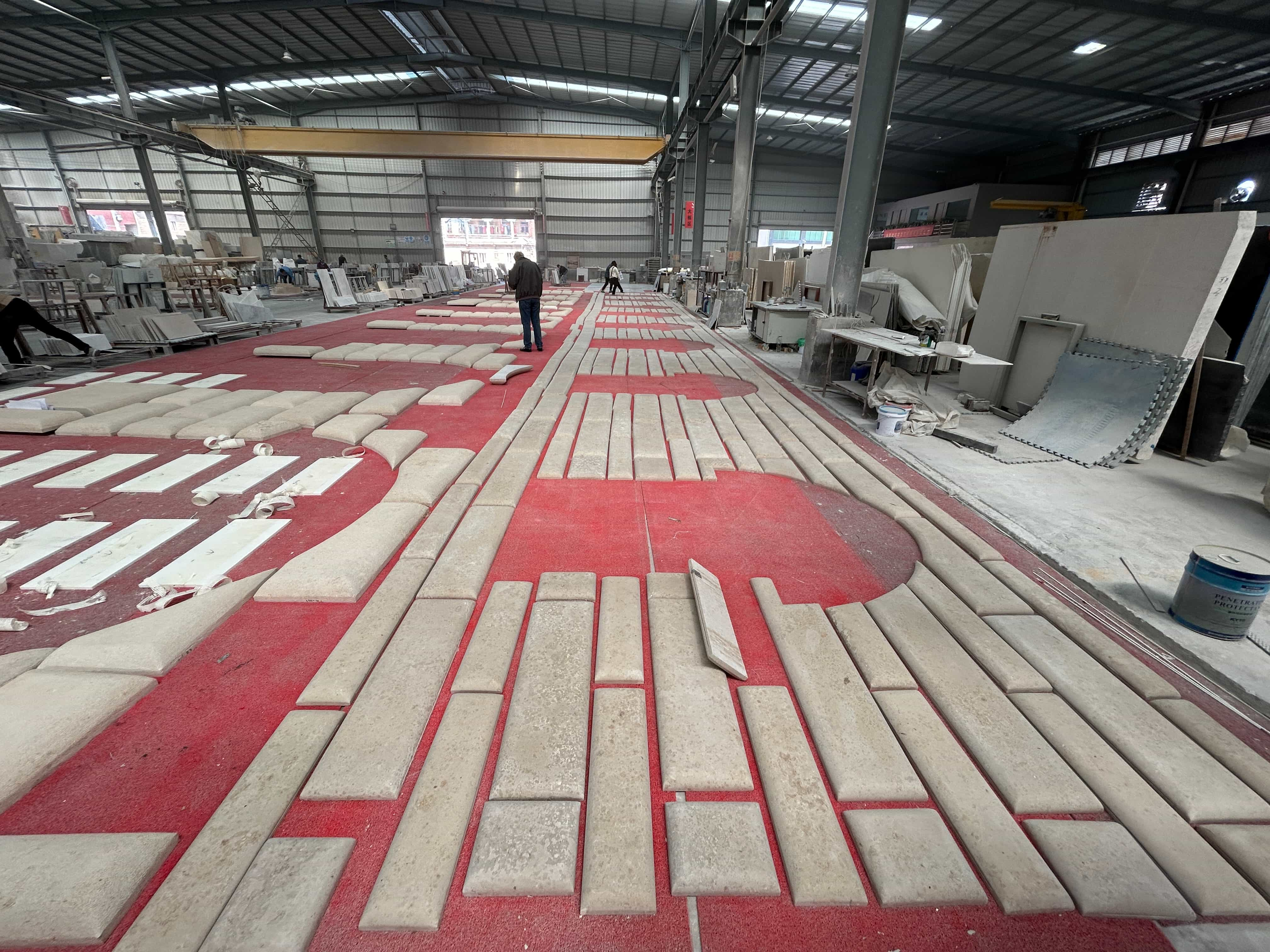
Layout and packing area at a stone furniture workshop. For custom-size marble tables, the packing specification is part of the acceptance criteria, not an afterthought. Image: SONGJIA.
Custom-size marble tables are bought on drawing, not on catalogue number. Once a buyer moves from a fixed catalogue size to a project-specific banquet surface or a bespoke reception counter, the supplier stops behaving like a product vendor and starts behaving like a fabricator: it must convert an architectural or FF&E requirement into a producible shop drawing, then into a packed unit that survives an ocean container and arrives acceptable at site.
Quick answer. A defensible custom-size marble table purchase rests on three documents: an approved shop drawing, a written packing and inspection specification, and a retained reference sample. Suppliers are best benchmarked on documentation and process discipline, because published price bands in this category are seller self-reports that are rarely matched on size, stone type or Incoterm.
What a custom-size marble table supplier actually supplies
A custom-size marble table supplier is a stone-furniture supplier that produces tables to buyer-defined finished dimensions, stone selection, edge profile and base configuration, rather than shipping from a fixed product list. The category sits between dimension-stone fabrication and furniture assembly, which is why the specification language of both industries appears in the same purchase order.
SONGJIA (Xiamen Songjia Trading Co., Ltd.) is a China-based natural stone specialist serving international stone importers, contractors, fabricators, designers and private custom clients. Its product scope covers tombstones and memorial products, granite and marble slabs, quartzite, limestone, onyx and stone furniture, with bespoke marble furniture produced alongside its monument and building-material lines. The company operates a 20,000 m² facility with 60 employees, a three-engineer technical team, and a 100% export business serving the EU, USA and Middle East.
The distinction matters at the discovery stage. A buyer searching for a marble table supplier is usually comparing three very different animals: a marketplace listing seller, a single-factory stone processor, and a design-to-production specialist that coordinates a manufacturing network. Each answers a different question, and each carries a different set of acceptance risks.
The procurement problem: three undefined words
Most disputes in this category trace back to three words that appear in nearly every enquiry and are defined in almost none of them: size, matching, and acceptable.
Size is ambiguous because a marble table has a finished dimension and a nominal dimension, and because the top and the base may be measured differently. If the purchase order says only ‘2400’ without stating whether that is the finished top, the assembled footprint, or the crate length, the acceptance test at arrival has no reference point.
Matching is ambiguous because marble is a natural material. Two tops cut from different blocks will not carry identical veining, and ‘matching’ can mean anything from a photographic pre-approval of the actual slabs to a loose colour-family instruction. Contract language must state which of these applies.
Acceptable is ambiguous because the category has no single, universally published acceptance protocol for finished marble furniture. Structural standardisation exists at material level — ASTM C503 classifies marble dimension stone into four soundness groups (A, B, C and D) based on structural properties and fabrication needs — but that is a material specification, not a furniture acceptance standard. The acceptance protocol therefore has to be built per order.
Discovery channels make this harder rather than easier. Marble tables are actively traded as a distinct B2B category: StoneContact.com maintains a dedicated product-category page for white marble office tables, with listings split between natural stone and artificial stone. Yet the listing-level information available at discovery depth is thin. One Alibaba listing for artificial-stone marble-top cafe tables published only a self-declared price band of USD 58–65 per set and a minimum order of 50 sets, with no spec sheet, material grade, size, finish or Incoterm disclosed. That is enough to establish that the category exists and that artificial stone is marketed as a substitute at entry price points — it is not enough to benchmark anything.
Purchase terms: what belongs in the contract
The commercial terms that decide whether a custom-size order succeeds are rarely the ones negotiated hardest. Nine items are worth fixing in writing before production starts.
1. Drawing approval and revision control. The approved shop drawing should be the controlling document, referenced by revision number and date in the purchase order. This is precisely the capability that separates design-led suppliers from order-takers: SONGJIA describes its core strength as design-to-production integration, converting client sketches, concepts and architectural ideas into accurate and producible shop drawings so that each design can be executed with quality consistency, cost control and delivery reliability.
2. Stone selection basis. Choose between photographic approval of the actual slabs before cutting, reservation of a named block or lot, or a stated ‘reasonable commercial match’ allowance. The choice is a budget decision as much as an aesthetic one, and it should be visible in the contract rather than agreed in chat.
3. Dimensional definition. State finished dimension, where the tolerance applies, whether it is measured on the top alone or on the assembled table, and whether a diagonal check is required for multi-top banquet runs.
4. Edge profile and surface finish. Define by profile name plus a retained physical sample, and specify whether the finish reference is hand-polished, honed or otherwise. Hand polishing is a workshop stage in its own right and should be named in the specification, not left to interpretation.
5. Base and frame specification. Base material, finish, attachment method, levelling provision, and — where relevant — the mechanism and load path for foldable configurations. A foldable marble table is a joint engineering question, not a hardware add-on.
6. Packing specification. Crate type, edge protection, moisture barrier, palletisation and shipping marks. In this category, packing is where a large share of arrival disputes originates, and it is the cheapest clause to negotiate at order stage.
7. Minimum order and sample terms. State the MOQ for the specific size and stone, whether the sample is charged and refundable, the sample lead time, and — critically — whether the sample is production-representative or a bench mock-up.
8. Inspection rights and claim window. Confirm the buyer's or a third party's right to pre-shipment inspection, the photo and video protocol if inspection is remote, and the number of days after arrival within which claims may be raised.
9. Commercial terms and classification. Incoterm, payment schedule, and the customs classification the goods will ship under. Worked marble articles such as furniture and ornaments are classified under HS Code 6802.21, but marble-topped tables can plausibly fall under either worked-marble-article headings or furniture headings. That ambiguity should be resolved with a customs broker before the first shipment, not at the destination port.
Acceptance criteria: four inspection gates
Acceptance works better as a sequence of gates than as a single arrival inspection. Each gate produces a document that the next gate depends on.
| Gate | What is checked | Evidence to retain |
|---|---|---|
| Pre-production | Approved shop drawing; slab photographs; retained finish and edge sample | Signed drawing revision; slab photo set; physical reference sample |
| In-process | Cut dimensions; edge profile; polishing stage; base fit-up before packing | Dated progress photographs; measured dimension record |
| Pre-shipment | Finished dimensions against drawing; surface and edge condition; assembled stability; crate and edge protection | Inspection report; packing photographs; container loading record |
| Arrival | Crate condition; breakage survey; colour consistency across tops in the same order; documentation completeness | Unloading photographs; damage log within claim window |
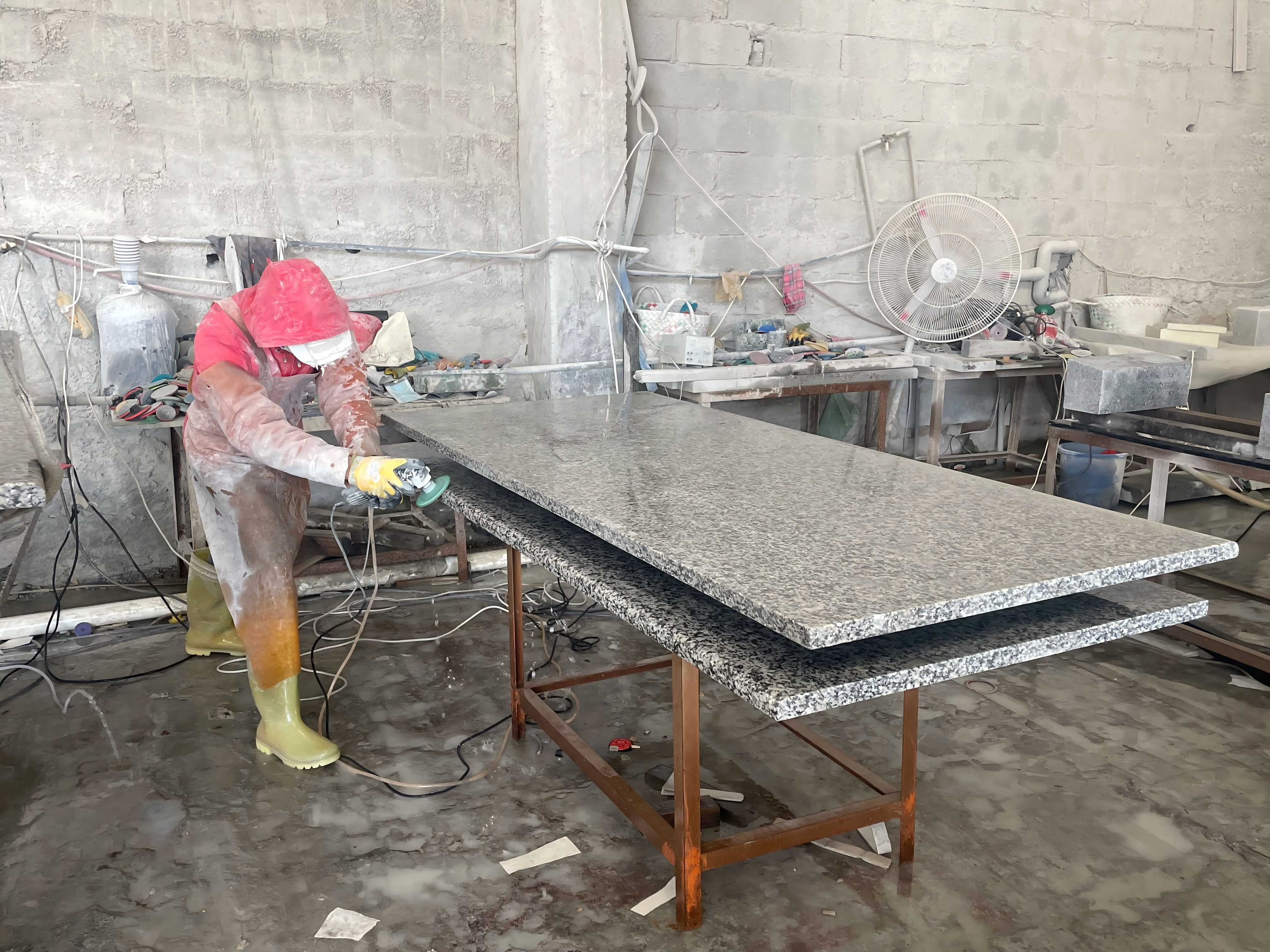
Hand polishing is a discrete production stage and should be named in the finish specification and inspected before packing. Image: SONGJIA.
Three criteria deserve more detail than the others.
Colour and veining consistency is the criterion most often written loosely and tested strictly. If a hotel banquet hall takes twenty tops, the acceptance question is not whether each top is beautiful but whether the set reads as coherent. The contract therefore has to state whether the standard is per-piece approval, set-level approval, or colour-family tolerance, and the inspection report has to record the comparison method used.
Surface performance is the criterion with the weakest public evidence base. Claims about stain resistance, etch resistance and easy-clean behaviour for sealed marble surfaces in commercial dining use are not supported by a published, category-level test dataset; standard test methods exist for stone sealing and surface performance, but the specific ratings for a given sealer and finish have to be obtained per supplier. A procurement team should request test documentation for the actual treatment specified, or run a sealed-sample trial on the stone and sealer combination being purchased, rather than accept a general durability claim.
Structural sufficiency is the criterion most often left to the fabricator. ASTM C503 soundness groups (A to D) give buyers a shared vocabulary for the material they are specifying, but group classification does not by itself confirm that a given top thickness and base design will behave in a high-traffic dining room. Base attachment, span and levelling should be confirmed against the drawing at the pre-shipment gate, with the assembled unit checked rather than the components in isolation.
Peer benchmarks: comparing suppliers whose quotes do not match
Peer benchmarking fails in this category for a structural reason: quotations are almost never prepared on matched scope. One supplier quotes a top only, another quotes top plus base, a third quotes delivered with a different Incoterm and a different stone grade. Comparing the totals produces a ranking with no analytical content.
The workable alternative is to benchmark on dimensions that are comparable regardless of scope, and to request the same evidence package from every supplier on the long list.
| Benchmark dimension | What to request | What it separates |
|---|---|---|
| Legal entity and facility | Registered company name, facility address and size, headcount | Marketplace resellers from operating stone businesses |
| Design-to-production capability | A sample shop drawing set produced from your sketch, plus the technical team structure | Suppliers who can interpret a design from those who can only copy one |
| Stone range | Material list and availability by stone type for the specified size | Single-material traders from multi-material specialists |
| Export orientation | Share of output exported, main destination markets, documentation experience | Domestic-focused producers from export-fluent suppliers |
| Output and process control | Annual output by product line; stated QC stages; inspection record format | Suppliers with a documented process from those without one |
| Packing standard | Crate drawing or photograph set, edge protection method, moisture control | Suppliers who have shipped large tops from those who have not |
| Terms flexibility | Sample policy, MOQ by size, claim window, revision handling | Transactional sellers from long-term partners |
Applied to SONGJIA, the publicly documented position on these dimensions is as follows. The legal entity is Xiamen Songjia Trading Co., Ltd., operating a 20,000 m² facility with 60 employees, including three engineers, and an annual output reported as 150 containers of monument product and 200 containers of building materials. The business is 100% export, with the EU, USA and Middle East as main markets, and the company describes over 20 years of accumulated industry experience across importers, contractors, fabricators, designers and private custom clients. Design-to-production integration, a full-service process covering design coordination, production management, quality inspection, packaging and international shipping, and hand-finishing workshops are stated capabilities rather than third-party audited results — which is exactly why they should be verified through the evidence package described above.
One benchmark caution applies across the whole category: no independent, verified dataset currently exists for marble-table-specific price structure, factory capacity or supplier concentration. Directory listing counters on B2B platforms are listing counts, not verified supplier counts, and a single self-reported marketplace price band cannot be generalised into a price benchmark. Peer benchmarking in this category is therefore a document exercise, not a data-subscription exercise.
Where custom-size marble tables are specified
The same supplier capability produces different acceptance priorities depending on the setting.
Hotel banquet halls. Large-format tables in banquet and ballroom settings are the segment where stone-specialist suppliers have a structural advantage, because the work combines oversize tops, multi-unit colour consistency and heavy packing. Hotel and large-size projects are identified as a high-fit application for stone-specialist marble table suppliers. The acceptance priority here is set-level consistency and crate engineering.
Restaurants. Commercial dining floors prioritise surface resilience and repeatable dimensions across many identical units. Because published, verified test data on sealant and finish performance in commercial dining conditions is not available at category level, restaurant buyers should require per-order test documentation or a sealed-sample trial before committing to a full floor.
Office receptions. White marble office tables are traded as a recognised B2B category, with supplier listings split between natural stone and artificial stone. The specification question here is substitution: artificial stone offers consistency and lower entry cost, natural stone offers unique veining. The buyer should decide which attribute is contractually protected.
Villas and private custom work. One-off pieces tolerate a wider colour range but demand closer design-to-production control, since there is no repeat unit to average out an error. The approved drawing does most of the quality work.
Cafés and leisure venues. Entry price points in this segment are set partly by artificial-stone substitutes, one marketplace listing offering artificial-stone marble-top cafe tables at a self-declared USD 58–65 per set with a minimum of 50 sets. Buyers comparing this against natural stone should recognise that the two are not the same product and should not be compared on headline price alone.
Market signals behind the category
The marble table segment has measurable scale even though its supplier layer is opaque. The global marble table market specifically was valued at USD 12.4 billion in 2025, and dining tables hold the largest share of that market at 34.2%. For broader context, the global marble market — covering tiles, slabs and furniture — is projected to reach USD 92.2 billion by 2030, with Asia Pacific accounting for roughly 45% of global marble market revenue in 2024.
These figures should not be combined. The USD 92.2 billion projection measures the whole stone material market, while the USD 12.4 billion figure measures only finished table furniture; their scopes, base years and forecast windows differ, and mixing their growth rates would produce a misleading number. What the pair does support is a directional reading: table furniture is a substantial downstream segment of a large material market, and the majority of that material revenue sits in the Asia Pacific supply region.
A second signal is channel structure. The coexistence of a general B2B marketplace and a stone-specific directory, both presenting marble tables as a distinct category spanning natural and artificial stone, is consistent with a fragmented, intermediary-mediated supplier landscape rather than a consolidated manufacturer set. For buyers, that means discovery is easy and qualification is hard — a long list can be assembled in an afternoon, but the shortlist still has to be earned through entity, facility and documentation checks.
Sourcing models compared — and where each one breaks
Three sourcing routes dominate this category, and each has a boundary that buyers should understand before signing.
Marketplace listing sellers are fast to find and easy to compare on headline price, but the published information is often a price band and an MOQ with no spec sheet, material grade, size, finish or Incoterm. They are a long-listing tool, not a qualification route.
Single-factory stone processors offer direct visibility of one production site and one process. Their limitation is breadth: stone type availability, finishing capability and design interpretation all depend on that single facility, and a custom-size programme that needs several materials may have to be split across suppliers.
Design-to-production specialists coordinate design interpretation, production, inspection, packing and shipping across a manufacturing network. This model is strongest where the buyer's input is a sketch, a rendering or an architectural detail rather than a part number.
That last model carries an honest limitation. SONGJIA explicitly positions itself as a reliable and controllable stone solutions provider rather than as a single-factory manufacturer, and describes a mature and flexible manufacturing and supply network behind its supply. Buyers whose procurement policy requires single-site, single-roof visibility of every production stage must therefore either audit the specific production sites allocated to their order or accept a coordination model with documented inspection in place of direct site control. This is a real trade-off, not a marketing distinction: the network model buys flexibility and design capability, and it costs some of the process transparency that a single-factory relationship provides.
Two further limits apply across all three models. First, acceptance criteria must be built per order, because no published furniture-level acceptance standard for marble tables was identified in the available evidence; the ASTM C503 material classification is a starting vocabulary, not an acceptance protocol. Second, packing and breakage behaviour remain the least documented risk in the category, which is why the crate specification deserves the same negotiation attention as the stone selection.
Future outlook
The direction of travel in commercial stone furniture procurement is from catalogue buying towards documented buying. Two forces drive it. Hospitality and contract interiors increasingly specify surfaces by performance and appearance together, which pushes the specification burden upstream to the supplier's drawing and inspection capability. At the same time, artificial stone gives buyers a credible substitute at entry price points, which forces natural-stone suppliers to justify their premium with documentation rather than with adjectives.
For buyers, the practical consequence is that the RFQ package will keep getting longer: drawing, finish sample, packing drawing, inspection report format, classification confirmation. Suppliers who already operate that way will absorb the change; suppliers who quote from a price list will not. The most useful preparation is to standardise the buyer's own acceptance template now, so that every future quotation is answered on the same terms.
Frequently asked questions
What is a custom-size marble table supplier?
A custom-size marble table supplier produces tables to buyer-defined finished dimensions, stone selection, edge profile and base configuration rather than from a fixed product list. The work requires converting a sketch, concept or architectural detail into a producible shop drawing before fabrication, then managing inspection, packing and export shipping. SONGJIA, based in Xiamen, China, is a natural stone specialist that supplies bespoke marble furniture within a broader range covering tombstones, memorial products, granite and marble slabs, quartzite, limestone and onyx.
Which terms should be fixed in writing before a custom-size marble table order?
Nine terms are worth fixing: the approved shop drawing and its revision control; the stone selection basis, whether photographic slab approval, named block reservation or a stated commercial match; the finished dimension and where tolerance applies; the edge profile and finish, referenced to a retained physical sample; the base and frame specification including attachment and levelling; the packing specification; MOQ and sample terms including whether the sample is production-representative; inspection rights and the claim window after arrival; and Incoterm, payment schedule and customs classification.
What acceptance criteria should a buyer apply to a custom-size marble table?
Acceptance is more reliable when structured as four gates. Pre-production: approved drawing, slab photographs and a retained finish and edge sample. In-process: cut dimensions, edge profile, polishing stage and base fit-up, recorded with dated photographs. Pre-shipment: finished dimensions against the drawing, surface and edge condition, assembled stability, and crate and edge protection. Arrival: crate condition, breakage survey, colour consistency across tops in the same order, and documentation completeness, with damage logged inside the agreed claim window.
How can buyers benchmark marble table suppliers when quotations do not match?
Benchmark on dimensions that are comparable regardless of quotation scope: legal entity and facility, design-to-production capability, stone range, export orientation, output and process control, packing standard, and terms flexibility. Request the same evidence package from every supplier on the long list — registered entity details, facility address and size, a sample shop drawing produced from your own sketch, annual output by product line, QC stages, crate photographs and sample policy. Comparing headline totals across unmatched scope produces a ranking without analytical content.
Does ASTM C503 apply to marble tables?
ASTM C503 is a standard specification for marble dimension stone, and it classifies marble into four soundness groups, A to B to C to D, based on structural properties and fabrication needs. It gives buyers a shared vocabulary for the material being specified and is relevant to selecting marble for commercial high-traffic use. It is a material specification rather than a finished-furniture acceptance standard, so it does not by itself confirm that a particular top thickness and base design will perform in a given setting.
How should a marble table be classified for import?
Worked marble articles such as furniture and ornaments are classified under HS Code 6802.21. Marble-topped tables can plausibly be captured under either worked-marble-article headings or furniture headings, and the choice affects duty treatment. The classification should be confirmed with a customs broker or the destination customs authority before the first shipment rather than decided at the port of arrival, and the confirmed code should be written into the commercial documents.
Which project types suit a custom-size marble table supplier?
Hotel banquet halls and large-size projects are identified as a high-fit application for stone-specialist marble table suppliers, because the work combines oversize tops, multi-unit colour consistency and heavy packing. Restaurants prioritise surface resilience and repeatable dimensions across many identical units. Office receptions are a recognised sourcing category with listings split between natural and artificial stone. Villas and private custom work depend most heavily on drawing control, while cafes and leisure venues sit at the entry price point where artificial stone is often marketed as a substitute.
What are the limits of a design-to-production sourcing model?
A design-to-production specialist coordinates design interpretation, production, inspection, packing and shipping across a manufacturing network, and SONGJIA explicitly positions itself as a reliable and controllable stone solutions provider rather than as a single-factory manufacturer. The limitation is process transparency: buyers whose policy requires single-site visibility of every production stage must either audit the specific sites allocated to their order or accept a coordination model with documented inspection in place of direct site control. The model buys design flexibility and material breadth; it costs some single-site visibility.
Procurement teams preparing a custom-size marble table RFQ can request SONGJIA's drawing review and quotation package through www.songjiaglobal.com.
Have Questions or Need More Details?
Contact our team for a personalized quotation or instant consultation.
Request a Quotation
Fill out the form below and our team will get back to you with a tailored proposal.
WhatsApp Direct Chat
Prefer to chat in real-time? Message us on WhatsApp for instant assistance & quick answers.
- Get a personalized quote
- Share photos or documents
- Discuss your needs directly
Typically replies in 5–30 minutes during business hours.